Home Blog Page 305

Polaris Jams the Pedal to the Metal!

Polaris snowmobile boss, Scott Swenson, got to the point in fast order at the media’s 2011 Sneak Peek event in Minneapolis last January.

He told the international snowmobile media assembled there, Polaris is focused on snowmobiles and has no intention of lifting its corporate foot off the accelerator. He proved it when the sheets came off the 2011 fleet.

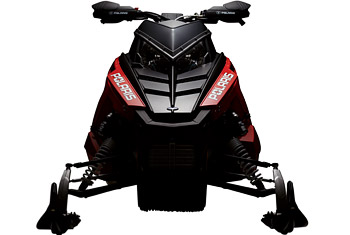
If you paid attention to Supertrax’ in-depth report on the history of the RUSH this past season (Volume 21 #2) you know that Blackjack is the code name for the all-new front bulkhead and bodywork used on the current RUSH.

What was clear in the development of the RUSH was Blackjack’s ability to take on more than one snowmobile platform. In 2011 most of the Polaris fleet will be using the RUSH (Blackjack) front clip.

Find out details on all the new Polaris RMKs

Half a RUSH – and Way Light!

Here’s where it gets interesting: Almost all Polaris RMK mountain models are Blackjack based.

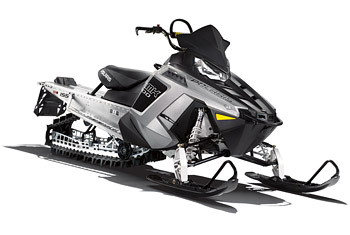
This is incredible news for the vertical crowd and it comes in the form of the Pro RMK series where less is more. Polaris has pared over 40 pounds off its RMK platform and boasts dry weights 10 pounds under the previously feathery Ski-Doo Summit line-up, model for model.

The coolness continues with Pro Taper bars, aluminum key panels, Swiss cheese cut running boards, key panel mounted switchgear and a super lightweight rear skid available in 163 and 155 track lengths.

Mountain models include 800 Pro RMK 163-inchers and 155, 800 RMK Assault 155 and 800 RMK 155. The 600 RMK 155 and 600 RMK 144 are the only RMKs still in IQ clothes.

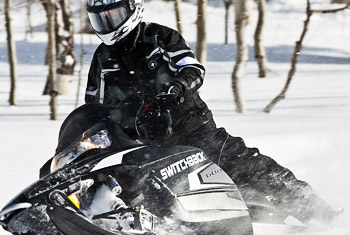
There’s also a sweet variant called the Assault Switchback. We think this is a response to the crowing from younger flatland free-riders around here.

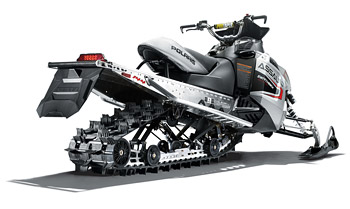
The Assault Switchback uses Blackjack skin up front and a 144-inch shoe and mountain skid. This is a very serious deep snow sled with huge appeal for free-riders, particularly when ordered with the lower 1.350 lug shoe.

Looking at all the 2011 RMKs the company’s passion to cut weight is easy to see and feel. Carbon fiber rear bumpers, cut-out aluminum where the five piece tunnel overlaps, no extra trim on the Blackjack front bumper and a vented (and we mean really vented) snow flap are some of the more easy-to-see weight reducing measures.

A rifle drilled jackshaft and numerous other weight saving tweaks in the handlebar and switchgear area all contribute ounces that when added up, turn into pounds.

How much weight is lost in the transition to the Blackjack platform? Over 40 pounds! Serious stuff.

Read all about the 2011 Polaris sleds

800 Switchback Assault 144

We were curious about what would happen if you blended the Blackjack front clip from the RUSH with a more conventional shock-in-skid rear end. The result is outstanding. The Switchback Assault is definitely a powder targeted ride and actually reverts back in some ways to the philosophy behind the old Snow King Special (SKS) Polarii of yore.

Of course, this is much more advanced and evolved platform and, for those who are focused on hill country and deep powder flatland riding, the combo of this featherweight chassis and the new 2-injector 800 is tough to beat.

Unlike the RMK, the SW Assault uses a wider 42.5-inch ski stance and Walker Evans piggyback shocks calibrated for trail use along with tipped-up, reinforced slide rails.

There’s no coupling in this suspension and the track is much shorter than an RMK at 144 inches. Lugs are 1.352 deep but still grab plenty of snow in loose conditions and can get down the trail nicely without tearing up your riding buddies’ complexions.

Unique mountain Assault features abound such as a perforated snowflap, rationalized switchgear, bar hooks and adjustable Pro-Taper handlebars.

The SW Assault looks for all the world like a mountain sled and its performance is certainly more targeted at that market. It is, however, a fairly competent trail sled delivering reasonably quick handling and a decent trail ride.

New 800 2-Injector Engine

There are so many new models and features in the 2011 Polaris line-up, it almost seems repetitive to focus on Roseau’s revamped new 800.

However, after testing this engine in the new RMK, Switchback and the improved 2011 RUSH last week in Montana, we’re pretty confident this is the company’s top technical advancement this year. Why? Frankly, the 4-injector Liberty-8 has been a bit of a disappointment to many big-inch Polaris purchasers the last two years and they’re looking for more.

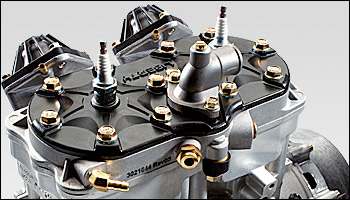
The new 800 uses a single injector per cylinder and it’s located up high in the boost port. This means the lower injector has been eliminated (this one used to squirt fuel downward into the crankcases).

Injector flow volume has been increased to match the fuel supply of the 4-injector setup and the angle of the upper injector has also been modified for better fuel delivery.

The big advantage of using only a boost port injector is there is no fuel, only air, going through the crankcase. This not only results in a cleaner burning engine generating less hydrocarbon emissions but also prevents wash-down of injector oil on the crank and rod bearings.

Oil injector pumps can be set lower and less oil used overall. Even with no liquid cooled cases Polaris claims there are no issues with crankcase heat and the 2-injector mill is expected to live a long, durable life.

We ran the Liberty 800 against the competition’s 800 2-strokes and found it to be extremely competitive. Of note especially is its giant dose of bottom end power when you tap the throttle.

Starts are clean and lean and throttle tip-in is flawless. We’re not sure about oil consumption and gas mileage yet but we suspect this mill will be better than the former one in both areas.

REAL WORLD SLED OF THE YEAR

0

After endless hours of saddle time SnowTrax Television is just about to reveal its selection for the 2010 REAL WORLD SLED OF THE YEAR.

This episode will air on Outdoor Channel across the United States on Monday, March 22nd and on TSN and TSN2 on Saturday April 3rd.

Visit the website at www.snowtraxtv.com for more information and check your local listings to confirm exact showtimes in your area!

Split Rail Ski

0

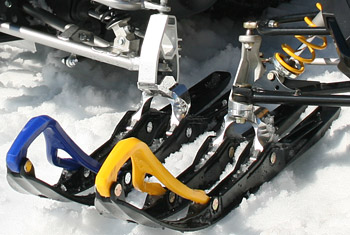
Check out these wild, innovative new skis we’ve been a part of testing for the past two years. The all-new “Split Rail” ski has been developed and is being manufactured in Canada.

The skis include a new exchanged spindle and are an easy and safe bolt-on. They completely eradicate Yamaha’s annoying darting on the Nytro and add extra dart-free control to Ski-Doo’s XP’s and XR’s and Polaris Rush.

Mountain pilots claim there’s never been anything like them for deep power control and in terms of eye candy we haven’t seen anything this side of driving around naked that’ll turn more heads than these Split Rails.

Send an email if you’d like more info.

More LX Models and Switchbacks

Although the RUSH LX is only available as a 600, there’s an IQ-based Turbo LX and, just so you’ll be confused, it has a 136-inch track.

Pay attention because there are also three LX-T (Touring) IQ twofer models including a Turbo, a 600 Cleanfire and a 550. All have the expected amenities touring sleds demand including heated rear passenger grips. Polaris does not offer a heated seat on any models, yet.

The other place you’ll find the IQ platform used next year is the IQ Switchback family. There are no Dragons offered in MY 11 and 600 Cleanfires power two 136s – a regular IQ Switchback and a Shift 136. There’s also a 136-inch tracked 550 Shift.

For those who live for 4-stroke power, the Switchback Turbo remains and is the only remaining IQ model with the original Rider Select moveable handlepole. The big news here is the aforementioned Assault Switchback built on the Blackjack platform.

Included is a 144 tipped rail skid, Walker piggies and all the lightweight stuff RMKs sport. You may be asking why the Switchback platform isn’t using a stretched Pro-Ride rear suspension this year. Uh-huh, so are we. However, we suspect Pro-Ride can be used on a 136 and it’s only a matter of time until Polaris will bring it.

Clearly, Polaris is moving its entire fleet into RUSH/Blackjack clothes at a rapid pace. None of us expected the company to go this far with second year changes based on the RUSH/Blackjack chassis.

The new 800 engine in the RUSH is radically different from the IQ 800 four injector version. The RUSH platform has proven to be both super durable, reliable and flat cornering in a way that’s comparable only to Ski-Doo’s XP at this writing.

The Pro-Ride rear suspension has undergone a major revamping and we think Polaris is going to take Pro-Ride more places in the future after overwhelming rider acceptance and approval this season.

There’s still more to talk about from Polaris, however, we’re saving our opinions, insights and criticisms for the first issue of SUPERTRAX due out September 2010.

Read all about the 2011 Polaris sleds

FIRST LOOK: 2011 Polaris Lineup

0

AJ Lester checks out the 2011 Polaris Line Up.

Check out SnowTrax Television’s YouTube page for more Test Rides at YouTube.com/SnowTrax.

Visit www.snowtraxtv.com to watch full episodes of SnowTrax Television online!

PART 2: We Meet the Mystery Sled

We peered through the hood vents, laid down on the snow to inspect things in the tunnel and even stood back and squinted – my secret way of revealing deep truth and hidden data. No luck. Chris and Bryan weren’t talking and we’d have to form our own opinions based on our incredible perception and insight.

I reached for the key and with a tactile twist the engine came to life. There was something different about the engine note – different than an Apex, different than a Vector. Was that the sound of a new triple – or was it a 4-cylinder Genesis?

The twin, rear exiting exhaust finishers shot condensation and melodious tones skyward into the frigid atmosphere and only added to our puzzlement. It wasn’t until Mark stole Chris and Bryan away for a moment that I hopped aboard and took it for a quick zip around the Supertrax Cave compound. It was then my suspicions were heightened. A half hour later we were on the trails.

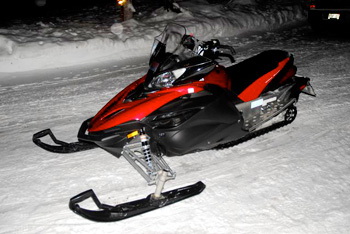
Mark and I switched back and forth on the candy-apple red mystery sled a couple of times and discussed on-trail what we were experiencing. It was kind of a fun game, this not knowing for sure and having to speculate.

Here’s where we were with our guesses: We had noticed the new exhaust sound – check. We observed the power delivery was stronger on this sled – check. We felt it handled much better than any Apex or Vector we’d ever ridden – and not by a slim margin, either. Check.

Here’s what we were thinking: A possible lowering of the engine in the bulkhead to get a better center of gravity; maybe a completely new, lighter engine (we were pretty sure this was a 4-cylinder mill, not a triple), possibly with Yamaha’s proprietary Cross-Plane design used in the R1 Yamaha road bike where the cylinders fire at 90-degrees; thus explaining the unique engine note. It could have been both.

Hmm. Certainly a lowered engine or an extremely light one would help with the Apex’s handling issues. We continued speculating but there was something else going on here and it was difficult to nail down.

Once I stopped second guessing myself and just began enjoying the ride, about twenty minutes in I began to notice how easy the Apex was steering. It felt like every front end component was greased slick and, when the sled was in motion, the handlebar effort was extremely light.

Despite the fact there was plenty of feel up through the bars and zero numbness, this thing tracked beautifully and resisted darting and hunting on hard packed snow like no Yamaha I’d ever ridden.

We stopped and I jumped off to check the skis. I took a look underneath and noticed a new ski profile – one designed to break the snow in front of the carbide and a much less aggressive looking ski-bottom. Good news and long overdue, but, was this the reason the sled handled so much better?

I moved the handlebars back and forth and then I knew: This was the new Apex and it had electronic power steering!

Read about the Yama-Charger

Yamaha Yama-Charger

The second sled Yamaha had loaded in the trailer that morning was a late model Apex painted bright metallic blue and laden with stock graphics.

Since Chris Reid from Yamaha could talk freely about it he was quick to give us details. This was a 2009 model with all the 2010 updates but it had something special under the hood.

We’re used to this kind of stuff from Chris. He has an aversion to outlandishly powerful, turbocharged Apexes and we’ve ridden some of his personal projects before, some spinning over 200 ponies around the corral.

This one was sporting a device called a Yama-charger. He explained it had been developed by Yamaha guru, Gilles Gagne, a brilliant Yamaha dealer in Quebec, who had been instrumental in putting together a team reaching beyond the 200mph barrier with a snowmobile at Bonneville last September (see the story in Supertrax Volume 21 #4).

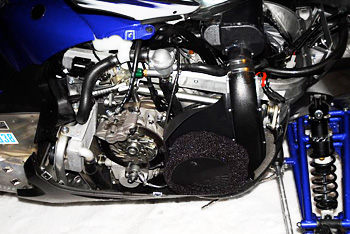
When Chris peeled the hood panels back on the Apex we realized this was something far different than we’d seen before.

The Yamacharger works on the same principle as a conventional turbo except it has no turbine side driven off the exhaust.

The drive source for the boost was from the Apex engine’s 10,000-plus RPM crank spinning a compressor to generate only a few pounds of boost (anywhere from 2-5 lbs.). This boost level, produced at relatively low RPM for a turbocharger, is enough to generate an extra 15 to 20 horsepower on a stock Apex, bringing its peak level up into the 165 to 170 range.

We’re from Missouri but after riding it we had no doubt the Yamacharger was delivering a substantial kick in the pants to the Genesis 5. This thing could rock – especially up top.

The best part is the charger requires no reprogramming of the stock EFI module, no exhaust mods and very little trimming of plastic.

Its airbox is very compact and is designed to carry the low boost charge to the throttle bodies without taking up much space in the already cramped Apex engine compartment.