Home Blog Page 306

MX-Z and Renegade Madness

Ski-Doo has retired the MX-Z ‘Adrenaline’ model designation for 2011 and now merges the model into the TNT nomenclature.

There’s still the XRS, the early-season-only MX-ZX Series and now, the MX-Z Sport (a more basically equipped model with gas cell shocks and the old carbureted 600 Rotax 2-stroke).

It looks like the TNT will be the catch-all model for the MX-Z line as it has the most comprehensive engine selection of any other Ski-Doo model this year. Get this: It’s available with either the E-TEC 800 or the last year’s Power-TEK 800, either the carbed 600 Series II or the 600 E-TEC, or either the fan-cooled 550 or the new ACE 4-stroke.

You can even get a TNT with a 1200 4-TEC – same as last year. All TNTs come with upgraded KYB gas shocks, a handlebar riser, aluminum hookers, a one-inch lugged track, reverse and full gauges.

We’re not complaining about this amount of selection. We’ve found the TNT to offer premium handling and great ride quality no matter what you choose for power. There’s even a decent mid-height windshield on all TNTs this year. Yippee!

The XRS returns for 2011 with race-derived features like upgraded (with a bit stiffer calibration than a TNT) shocks, a 1.25-inch track, race sled brakes, chassis and slide rail reinforcement and a forward mounted steering post with a higher riser for stand-up riding.

All 2011 Renegades will be offered with a 16-wide 137-inch track and are available with the new E-TEC 800R powerplant. Early season Renegade X shoppers can choose from the 800 and 600 E-TEC engines as well as the 1200 4-TEC.

The Backcountry and Backcountry X Series Renegades return with lower gearing and 1.75 lugged tracks. Believe it or not, the carbed 800 Power-TEK is still available in many Renegade models in 2011. The thinking here is all about price.

Here’s a tip: Just ante up and get the E-TEC. You’ll be kicking yourself all winter if you settle for anything less.

What about the mountains?

4-Stroke Sno Pro

We mentioned earlier that Cat had dropped its baseline versions of some F-Series sleds in lieu of more fully equipped versions.

Both the F8 and the Z1 have been affected by this logic and now the naturally aspirated Z1 comes in two upgraded versions only, the LXR and the new Z1 Sno Pro. We’re not convinced of the rationale here but one thing is sure – we truly like the Z1 in any configuration and we’ve found it to be one of the best 4-stroke offerings on the market.

Another consideration is Cat’s lack of a solid line-up of models in the 600 class – or, in 4-stroke language, 120-125 horsepower range. We think the Z1 is a decent fit in this class and now being offered with more aggressive targeting, as a Sno-Pro, this new model makes some sense.

From an appearance perspective, the Z1 Sno Pro is a pretty strong statement. It’s got one of those hairnet sized low windshields we hate but it sure looks cool enough to turn some heads.

Cat dropped considerable weight by utilizing Fox Float 2 air shocks up front, thus eliminating heavy coilover springs. A 2-inch diameter IFP Fox gasser is used on the Sno-Pro’s rear arm.

The Sno-Pro also owns a 128×1.25-inch deep lug track and both the LXR and the Sno-Pro get the fully adjustable seat and handlebar combo.

The question remains to be answered: Is the Z1 Sno Pro sizzle or steak? At 123 hp it appears to be competing in pretty heady company beside Ski-Doo’s MX-Z 600 E-TEC and the Polaris 600 Rush, both faster, lighter sleds equipped with 2-strokes.

You could also line it up with 4-strokes like Yamaha’s Vector GT or the TNT 1200 4-TEC – but both those sleds are in the 130 hp range and faster. It comes down to equipment and this is where the Z1 Sno-Pro competes hardest.

It’s unique features are hard to match and potential buyers will need to weigh priorities carefully when showroom decisions are made this year.

PART1: YAMAHA 2011 APEX REACHES ITS ACME

On a crisp, cold morning in mid-January Yamaha’s Chris Reid rolled two snowmobiles out of his enclosed trailer. He had phoned Supertrax world headquarters a couple of days previously and queried if we were available to go for a friendly trail ride.

Always ready to oblige when it comes to snowmobiling activity and knowing Chris and Supertrax go back to the very early days, Mark and I scrubbed our usual really, really important schedules clean so we could accommodate.

Yamaha confederate, Bryan Hudgins was accompanying and as the two sleds cleared the ramp we noticed something oddly different about one of them. It was a candy-apple red version of either a Vector or an Apex and its appearance told us it was something completely different, although mysteriously similar.

When we began asking questions, Chris just shrugged his shoulders and said something like: “You guys tell me.” We flooded both him and Bryan with questions but there was to be no telling us anything. This was a top secret project and we were getting an early look. Problem was, we didn’t know what we were looking at.

Read more about the mystery Yamaha sled

Vintage Sled Ride To Waconia

0

SnowTrax Television Co-Host Luke Lester joins in on the WOBLE ride to the Waconia Vintage Snowmobile Event on his 1977 Scorpion Whip.

Subscribe to our YouTube Channel!

2011 Yamaha Apex

This year our Editor’s Choice selection from Yamaha is a complete no-brainer.

The EPS equipped Apex is such an improvement over what was already a great snowmobile, we can’t think of any other Yamaha choice we’d make.

It goes far beyond the fact there’s a new innovation like power steering added into the mix. The Apex’s EXUP exhaust valve smoothes out the engine pulses so effectively you’d think there was a different engine under the hood.

It’s still the Genesis 5-valve four but now it has different cam duration, EFI mapping and about five more ponies.

Extrovert drivers roll a new 128-inch track and it not only makes the Apex and Apex SE look better but adds considerable traction to a sled that can spin its track like a Top Fuel dragster slick.

Ergonomics have been improved with a taller seat and every piece of bodywork has been revised for a subtle and pleasing look.

The 2011 Apex is a great sled with, unfortunately, a great big price tag. Weighing in on all the positives, though, it’s hard to deny buyers will be getting their money’s worth.

Yamaha EPS

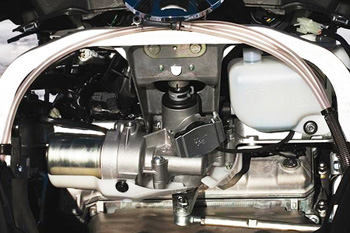
After one ride there was no looking back. Yamaha’s electronic power steering setup on the 2011 Apex is a ground breaking feature that will definitely be copied by the rest of the snowmobile industry.

The use of EPS along with some front end geometry tweaks and a new set of skis makes such a vast difference in the way the Apex handles, it’s an undeniable benefit.

Yamaha was first to put this feature on an ATV and it has revolutionized that industry to the point that nearly every OEM now offers power steering equipped models.

With the Apex, we’ve been surprised at how the biggest bonus is not just lighter steering effort. The fact is, the sled’s reaction to negative trail inputs is so much improved it feels like the engine has been dropped lower in the chassis.

There’s no twitching when your right or left ski hits something on the trail and the sled feels planted firmly with very linear feedback through the bars.

The system is variable ratio so steering effort increases as the speed goes up, leaving the rider with a nice, predictable in-control feeling all the time.

The downside? It adds a bit of weight – but we think it’s a good trade-off and well worth the extra cost, too.

Power Steering Makes a Big Difference

Power Steering Makes a Big Difference

By the end of our ride that day we had pretty much confirmed in our minds we had been riding a new version of the Apex and, although Chris and Bryan would neither confirm nor deny our suspicions, it wasn’t until a couple of weeks later Yamaha officially unveiled the 2011 version complete with graphics and all the technical details.

We learned the engine was the same rock reliable Genesis 5-valve 4-cylinder the Apex and RX-1 had been using for years. However, there were changes to the engine’s cam duration and lift that boosted its power output at least five horses.

Another nifty innovation that ends up making the engine sound so different is found in the exhaust system right under where the driver sits.

A special butterfly valve device, placed inside a chamber or box where the exhaust goes from four pipes to one, controls the pulses of the big four and performs the same kind of magic you’d get with a 2-stroke expansion chamber.

Actually, it’s preventing the ‘blow-back’ characteristic 4-strokes develop in the exhaust system because of valve overlap.

In this case, there’s better throttle response and a sense more torque is produced. EXUP, the name Yamaha uses for this device, also gives the Genesis a much smoother power delivery and makes it feel like a completely different engine, thus our earlier and wrongheaded speculation it was the crossplane.

Not only did we eliminate this guess but we also learned the engine had not been lowered in its engine cradle. This seemed like an impossibility given the way the mystery Apex we rode handled that day.

Of course, the reason for the handling improvement was because of the Apex’s EPS. Power steering makes all the difference and is one of the most incredible improvements we’ve seen on a snowmobile so far – especially on a somewhat heavy 4-stroke.

The bad news is, there is a trade-off with weight. The electronic system adds several pounds of mass and although you certainly don’t feel it (the new Apex actually feels way lighter than last year’s when you ride it), there’s an undeniable weight penalty with this feature.

However, combined with the new skis and various geometric changes to the front end, the EPS Apex is an absolute wonder!

Read all about the mystery sled
Meet the mystery sled

Need Snow Fence?

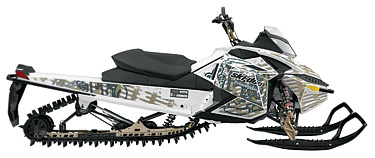
How’s this for coolness? A new model based on the Summit XP platform is called the Summit Freeride.

The idea behind it is to combine the quick handling and extra chassis strength of Ski-Doo’s RS snocross sled with the deep snow prowess of the Summit – particularly the Summit X.

It uses the race Ski-Doo’s forward mounted steering post with a 5-inch riser and KYB Pro 40 piggybackers with compression and rebound (front shocks only) damping adjustability similar to the RS.

There’s a super deep lug 16x154x2.25-inch Camoplast PowderMax track and wide Pilot DS skis with adjustable ski-stance, actually set wider than most 2011 Summits.

It uses the racer brake, has running boards with less taper so the rider can move around more freely and an SC-SMR skidframe designed for better big landing capability.

There’s a cool set of graphic kits from Ski-Doo PAC with funky names to personalize this sled – everything from “Snow Fence” to “Rebel”.

As its name indicates, this sled is purpose built for freestyle powder and hill climbing and is designed to withstand the considerable abuse this kind of radical riding can generate. Its only engine choice is the E-TEC 800R and that kind of makes sense, really. This level of extreme riding demands the most extreme power available. Mission accomplished.

All Summits this year will come with an even narrower ski-stance to assist with sidehilling and turning back uphill against gravity in deep powder.

Up front, shorter A-arms and shocks bring the stance down to as low as 35.7-inches (adjustable to 37.4-inches). Summits with PowderMax tracks have had their center windows eliminated to increase climbing ability.

Ski-Doo’s testing has shown that this mod alone allows the sleds to climb 100-150 feet higher in identical conditions than sleds equipped with tracks that have windows in the middle of the track.

More new stuff

MOTORHEAD: The New Aftermarket

0

It was inevitable, wasn’t it? With the enormous shift in engine technology to accommodate emission regulations and legislative pressure to enforce previously unenforced sound regulations, aftermarket high performance merchants had to feel the pinch. Age-old performance enhancements like 2-stroke tuned pipes are quickly fading into history.

Clearly, the across-the-board move to fuel injection and, more importantly, sophisticated Direct Injection (DI) and Semi-Direct (SDI) fuel injection systems has created enormous headaches and ultimately a retreat from staple 2-stroke mods like tuned pipes. The complex systems now in place to control fuel intake necessary to clear EPA emission mandates have made modification to SDI and DI systems difficult at best.

The aftermarket performance biz revolved around exhaust and intake mods for more than 20 years. That business, with the exception of some slick 4-stroke aftermarket exhausts and a handful of slip on 2-stroke silencers, has all but disappeared.

The problems and risks associated with remapping SDI and DI systems precludes the modification of exhaust systems beyond simple silencer swaps. Simply put, if you can’t get more fuel into an engine modified to breath harder with pipes, it won’t produce any extra horsepower.

In fairness, there are some pretty interesting tweaks still available, particularly for Arctic Cat 2-strokes, that center around porting mods, replacement modified “Y” pipes and, almost unbelievably, stock exhausts. These systems require ECU remapping but so far, the wizards offering these mods are having success on Cat’s big 2-strokes.

With the aforementioned realities fully entrenched in our sport and the added problem of many jurisdictions in the US and Canada restricting modifications to snowmobile exhaust systems, surprisingly, there’s still a healthy aftermarket providing both new and age-old performance enhancements delivering real value for money spent.

First, lets talk about the latest trend in performance mods any owner of a late model sled should consider. In a word: clutching. Take a look at the stuff both Dalton Pro and Team Industries are marketing right now. Their stuff is rooted in increasing drive train efficiency, taking advantage of power already under your hood never captured by your sled’s factory calibrated clutches.

We’ve tested a bunch of these clutch and drive line components and they really work. In fact, they work so well we wonder why these things weren’t focused on more than 10 years ago. In actual fact, clutching was tweaked years ago but most often only in response to power generated by porting and exhaust system mods.

Today, there’s an impressive stash of hidden power lurking under your hood requiring only the careful and precise calibration of an aftermarket clutch kit to release. Interestingly, there’s more power available from both Ski-Doo E-TEC and Polaris Cleanfire engines from maximizing clutching.

Another area you can gain increased performance from is your link with the trail. This issue is not new but it’s never been more important or effective.

The overall improvement in both acceleration and braking, not to mention cornering control and speed, is undeniable when traction products are installed.

It was true 20 years ago and it remains true today, before you put more power under the hood or attempt to get more power to the track, you need to make sure you can “hook up”.

It makes zero sense to spend big bucks increasing engine power or transmission efficiency without first installing traction studs. The quality and variety of the traction stuff available today is amazing. You can get all kinds of stud lengths that work efficiently with any lug depth and these long-lasting carbide tips are absolutely the most cost effective way to go.

Finally, while this seems strange, 4-stroke snowmobiles are rapidly becoming the most popular target for aftermarket exhaust systems. There’s impressive power to gain and improved efficiency from installing these bolt-on systems.

The good news is, most do not require any changes to EFI systems or engine control modules. Most makers of these performance exhausts and slip-on silencers are producing systems that are pleasing to the ear without being overly loud.

It’s a new day in the sno-mo-biz as we enter the second decade of the new millennium. Today, our sleds are nearly automotive-like in their sophistication and as a result, the opportunities to modify them are becoming equally sophisticated and much more specifically targeted.

Ski-Doo Lays Down an ACE

So the 800 E-TEC is definitely breakthrough technology for Ski-Doo and will keep the competition busy trying to match it over the next few years.

But what about the other end of the spectrum? What about those sleds bought for lower speed riding where optimum speed and performance aren’t the first criteria in making a buying decision.

If you’ve been keeping track, you know there’s a certain amount of concern about fan-cooled 2-strokes and their ability to meet EPA requirements for CO2 (monoxide) and HC (hydrocarbons) emissions.

In fact, a lot of those air-cooled 2-strokes, although fully evolved, do not have the potential to meet standards and have been able to survive this decade only because of the EPA’s credit system that allows the OEMs to accumulate credits for the squeaky clean engines they sell and then apply those credits to models in the fleet powered by less-sanitary mills.

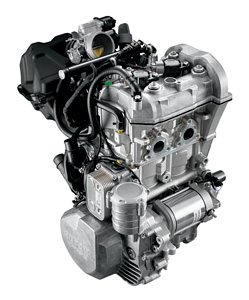
Enter the new 600 ACE 4-stroke. It’s a 4-valve, dual overhead cam, 180-degree firing twin with a single 42mm throttle body. This relatively small displacement EFI parallel twin is designed to eventually take the place of those lower output engines that are difficult to get emissions compliance from.

With an output of 60 horsepower and a big dose of 4-stroke torque, this engine not only meets environmental requirements but is fun to ride and generates enough power to satisfy the segment’s demands. Without question, the ACE’s biggest plus will be improved gas mileage. Ski-Doo estimates it’s capable of an amazing 29 mpg.

The ACE 600 is available in several models for 2011 including a full-blown (no pun intended) MX-Z TNT. You can also order ACE in Ski-Doo’s 2011 Renegade, Grand Touring and in some Skandic and Tundra utility models.

Interestingly, all ACE equipped Ski-Doos come with a new lightweight primary clutch and an oil cooler.