Home Blog Page 307

SURPRISES AGAIN!

Plenty Of Changes When You’d Least Expect Them

Ski-Doo has been the industry sales leader now for a few years and there was some suspicion the company would back off the throttle in 2011, at least as far as new model introductions go.

Not so. This is just another busy year and Ski-Doo is continuing to entice its customers into dealerships with interesting and innovative new models and, surprise of surprises, not one, but two new engines.

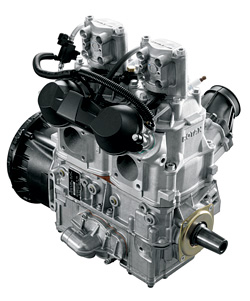
Lets talk engines first. It’s no dark secret everyone in the sno-mo-biz was anticipating an 800 E-TEC. Supertrax has been rumoring it for over a year and we were pretty disappointed when it wasn’t released in MY2010.

Not to worry, though. Ski-Doo provided us with a pilot built MX-Z E-TEC 800R in late January (actually a bonafide 2010 model) and we proceeded to put over 2000 miles on it.

To say we are impressed is a gross understatement. This sled is a rocket ship and absolutely raises the performance bar on every other big-inch offering in the business.

If you transfer the weight off the skis (open up the couplers) from a dead start, it will loft the skis a foot in the air and hold that posture for an eighth of a mile.

Nail the throttle at 50 mph on a lake and, if there’s enough traction, it holds the skis about four inches above the snow as long as you’re dipping the flipper.

The engine starts and idles flawlessly, doesn’t smoke (ever) and accelerates as clean as a turbine. The exhaust sound is that unmistakable 3-stroke tone we’ve grown to love from Direct Injected Ski-Doos.

We hear the emission levels are good, too – not surprising considering the E-TEC 600 has been legendary in this area and has set the standard for 2-strokes the last two years.

We’ve found, over our long term testing, the new 800 E-TEC gets nearly the same gas mileage as the 600. The only variance is when you’re doing a lot of lake running at full throttle.

Naturally, it uses more fuel in this mode but still a lot less than any of the other 800 2-strokes in our fleet.

Find out about the other new Rotax mill from Ski-Doo

Ski-Doo Summit Freeride

The Supertrax editors were pretty sure anything we chose as our “Editors Choice” this year would have an 800 E-TEC under its hood.

We’re in love with the MX-Z powered by this mill but a new sled from Ski-Doo is particularly fascinating to us.

The new-for-2011 Summit Freeride has a pretty magnetic pull and here’s why: Once again, this sled represents the ultimate in a somewhat new category. Yes, it does appeal to a fairly narrow wedge of the marketplace – those who want to freeride in deep powder.

This segment is growing and gaining more credibility out there and sales are indicating there’s a place for such sleds. With its race-derived chassis and various reinforcements of both the chassis and skidframe, plus a very serious shock package, the Freeride is a sled both mountain men and flatland freeriders can relate to.

Ski-Doo has tailored the Freeride to a younger market that views sleds in a different way than the conventional rider. Its feature load is aimed at pleasing the specific requirements of these riders and we give Ski-Doo due credit for reading the marketplace and keeping its corporate mind open to new opportunities.

Hey, we’d be first to admit the Freeride isn’t everyone’s cup of ginseng, but serving the youth market is a great thing for this sport and will build enthusiasm down the road. Just what snowmobiling needs.

800 E-TEC Engine

What can you say about an engine that exceeds in every way – and we mean in EVERY way.

The much-awaited 800 E-TEC was quite simply, well worth waiting for. It gets incredibly good gas mileage, sips oil, apparently is the cleanest burning 800 mill in snowmobiling; runs, starts and idles like a sewing machine and to top it all off, is likely the fastest 800 2-stroke we’ve ever ridden.

The combination of this engine in that chassis (REV XP) is such a dynamic duo it defies logic. Hmm, the lightest chassis, the most powerful engine; tell me if anything is wrong here… nope!

If you’ve been reading Supertrax a while you know we’ve loved the E-TEC 600 from day-one. The 800 uses the same voice coil activated injectors to hammer super-atomized fuel into the top of the cylinders within a very narrow window of the combustion cycle.

It’s the combination of atomization and the very narrow sliver of optimum timing of the charge that results in such a clean burn. The engine uses similar liquid cooled crankcases to the old PowerTEK carbed 800 to keep bottom end temperatures low and crank bearing life maximized.

The only area we know nothing about is the lifespan potential of an E-TEC 800, however, we suspect this mill has been thoroughly tested and will be every bit as durable as the E-TEC 600.

COMPARO: 120-130 HP Luxury Touring Sleds

0

Luke Lester compares 4 different 1-Up Touring snowmobiles in this 600 Luxury shootout. Snowmobiles included are: Polaris 600 IQ LX, Arctic Cat Z1 LXR, Yamaha RS Vector LTX GT, Ski-doo GSX Limited.

Check out SnowTrax Television’s YouTube page for more Test Rides at YouTube.com/SnowTrax.

Visit www.snowtraxtv.com to watch full episodes of SnowTrax Television online!

TEST RIDE: 2010 Polaris 600 IQ LX

0

SnowTrax Host, Luke Lester tests out the 2010 Polaris 600 IQ LX and shares his thoughts and opinions.

Check out SnowTrax Television’s YouTube page for more Test Rides at YouTube.com/SnowTrax.

Visit www.snowtraxtv.com to watch full episodes of SnowTrax Television online!

New CKX Lid

0

CKX’s Tranz RSV Blast helmets feature a modular design that offer all the benefits of a full-face bucket with the advantages of an open-face helmet.

The shell is constructed of a durable injection-molded plastic while a removable, amber sun visor is incorporated into the helmet to lessen the glare.

The interior lining is also removable. The Tranz RSV Blast is DOT certified and comes available in a wide selection of color choices.

For more information contact Dennis Kirk at denniskirk.com or call 1-800-970-3502.

HMK Voyager Boots

0

HMK’s Voyager Boots are so versatile you can use them on the trail, at the track or in the backcountry.

Thanks to the 10-to-1 heat retention factor, Voyager boots are comfort rated to -40 degrees. The Sympatex waterproof, breathable membrane, in addition to closed-cell foam insulation, makes the boots impervious to water and wind.

For more information contact Dennis Kirk at denniskirk.com or call 1-800-970-3502.

Camoplast Ripsaw Trail Track

0

Camoplast’s new Ripsaw Lite single-ply technology reduces internal friction and rolling resistance so more horsepower is transferred to the snow.

This track is lighter, allows a higher top speed and improves fuel economy. It delivers the ultimate in penetration for unbeatable handling and braking.

For more information contact Dennis Kirk at denniskirk.com or call 1-800-970-3502.

MOTORHEAD: Is Racing Relevant?

0

Over the years I’ve penned more than a few editorials about the important linkage snowmobile racing has to the development of new snowmobiles. I’ve been outspoken in my support of this thesis for well over a decade. Time for an update.

A history lesson might help. Back in the day, snowmobile racing revolved around ice ovals. Much was learned from this intense discipline. Engines developed on the race track delivered technology to trail sleds. Clutch innovations, drive line components and even suspensions ended up on production snowmobiles as a result of the iced oval.

In the early 80’s, a new racing snowmobile landed on the iced oval scene and it changed everything forever. The single-track race sled became obsolete when the twin tracker cut its first lap and did nothing but win from there on.

It was the ultimate answer to going fast as long as each straightaway ended with a left turn. The problem? The sled had no ability to advance consumer snowmobile design.

Fallout from the twin track’s arrival couldn’t be foreseen. History records the gradual and then dramatic decline of the iced oval as a viable discipline for developing trail sled technology. As a result, one by one, the OEMs pulled away from the sport.

Enter snocross. When Sno-X first crossed the Atlantic, its Scandinavian roots dangling behind it, it changed all the rules as the green flag dropped at Quadna Mountain in Minnesota for the first event on these shores.

Everything from A-frames to long travel skids and seat foam, toe-holds and handlebars were directly affected by the sport. By the late ’90s snocross had become so powerful, its ability to shape technology was exceeded only by its ability to shape purchase decisions. The fever persisted as each maker took its turn building a better Sno-X sled, then morphing it into a consumer model.

The whole deal was so good it became completely predictable. Every year we went to Spirit Mountain with our cameras loaded. The press lined up at the back door of the factory team trailers waiting for the rear door to drop and the newest Sno-X weapon to slide down the ramp.

Everyone in attendance knew what they were seeing was 12 months away from the showroom, guaranteed. The good news was this: Snocross was legitimately improving the breed. Arctic Cat’s ZR with A-frames, Ski-Doo’s REV, Polaris Indy and Edge tipped-in trailing arms, were all built for Sno-X.

Even Yamaha’s Nytro has cues from snocross and there’s more, much more that’s ended up in the showroom as a result of factory snocross racing based development.

Something’s changed of late and it has the eerie aura of the early ’80s when the twin track oval racer became irrelevant.

The evidence is before us and it looks like this: Polaris builds what is widely thought of as the benchmark snocross weapon, the IQ Racer. Purpose-built in every way, the IQ Racer has taken Polaris from nowhere to the undisputed king-of-the-hill in racing.

Here’s what’s weird – you can’t buy one unless you’re a racer. In 2008, the IQ Racer was marketed as a hardcore consumer sled with an oil-injected 600 engine calibrated for trail use. It didn’t sell and quickly vanished from the brochure.

Certainly, the IQ Racer has contributed to technology seen in Polaris trail sleds but don’t expect this purpose-built racer to show up in your dealer’s showroom with a high windshield and saddlebags.

What am I getting at? I think the paradigm is shifting in snowmobile development. Let me offer another example. The revolutionary Polaris RUSH with its Pro-Ride suspension is not destined for the racetrack.

Polaris will not race the chassis this season. If you read the RUSH historical coverage in Supertrax this season you saw clearly how Polaris did not race the RUSH or Pro-Ride during its development. We think this speaks volumes about the shift surrounding Sno-X racing’s importance and role.

Snocross is not irrelevant as a racing venue. Its high flying, roost throwing, ski-to-ski excitement is exactly what racing spectators and TV networks love. However, its power to birth new and, as yet unforeseen, technology is rapidly diminishing – and the proof is in your dealer’s showroom right now.

Sure, a new clutch, suspension geometry or a better design for a component may emerge on the racetrack but, if it’s grafted into a purpose-built, non-consumer-available model it won’t resonate with buyers like torque sensing links, exhaust valves and myriad other cool tricks did when you could actually see them on sleds identical to the one you were buying.

INSIDE TRAX: BIC Awards Actually Make Sense!

0

Over the years we’ve cackled about Snowmobile of the Year awards and how they seem to fall short of being a fair evaluation of a sled’s worth. The fact is, it’s a pretty daunting task to try to choose only one snowmobile out of an entire model year that is “best”.

There’s something off-kilter about choosing a single sled. It subliminally demeans the rest of the offerings presented that year and unfairly elevates a completely new, unproven model to prominence when it really hasn’t had enough time to earn any real accolades from the snowmobiling public.

Keep in mind, the OEMs love these awards and the magazines, websites and television shows that actually grant Sled of the Year kudos to one particular model are rewarded with plenty of free promotion in ads and on OEM websites and brochures and such.

It’s not a bad deal and I suppose the temptation is always there to choose a single snowmobile. By sheer coincidence these awards seem to always be in a year-to-year rotation so that each manufacturer wins every four years.

Heaven forbid a new model should be so dramatic it changes the rules and the granters have to gloss over it because it didn’t fall into its proper rotation. Oh, well, maybe it’ll win next year, or the year after… get my point?

There’s only one source fully qualified to decide which snowmobile is the best sled of the year. It’s you. You, sitting in those little tiled rooms where you read Supertrax, as actual get-up-in-the-morning-and-put-the-miles-on riding enthusiasts who pay for the snowmobile with your own cash are the ones who should be deciding if a sled is the best one in any particular model year.

Unfortunately, you don’t have much opportunity to ride the newest of the new stuff until you’ve actually gone down to the showroom and bought one. That whole process takes about a 12-month turnaround and by then some mag has already decided on The Snowmobile of the Year.

Several years ago, we decided to create the Best in Class Awards, affectionately referred to as the BIC Awards. The idea was to choose consumer sleds that fall into varying categories based around performance levels, comfort and deep snow capability.

Our choices are based on the riding experiences of our staff team and are gathered by vicariously simulating the kind of riding you do with your own personal sleds. Instead of coming up with one big kahoona, we decided on a whole series of deserving winners each year.

It broadened the scope of the whole deal about giving unfair credit to untried snowmobile models and left enough room to give insight into what we think will be the technology that will shape the future.

We have a lot of fun choosing the award winners and the process goes on all year as we ride. Our group will stop on the trail and someone will proclaim their undying love for a particular sled and how it deserves to be called the best.

There will be limitless counterclaims and much discussion in the Supertrax Cave later about why someone is an idiot for choosing that particular sled and arguments offered why they should choose something else. It’s almost as much fun as the riding.

What’s great about this kind of banter is that it includes anyone who we meet on the trail or who is along for the ride. If we see a particular sled, especially if it’s a brand new one, we ask the owner what he or she likes about it, and why.

This kind of face-to-face insight is extremely valuable because, long ago, we learned there’s no one with a stronger opinion than a snowmobiler… and you’re usually right on the money.

We also run polls on this website asking key questions about some of the characteristics of a BIC candidate we’ve been considering. These polls get a lot of action and your feedback is taken very seriously.

We try to stay away from choosing completely new snowmobile platforms in their first year of production. This can be iffy at best, and our experience has shown us, completely new sleds or completely new engines almost always take a year to get the gremlins out.

In this issue you’ll read about Mark and my own correct opinions on the most deserving award winners.

Although, we sound a little crusty, it’s not far off some of the discussions we have between ourselves and other staff members when it comes to sled evaluations.

We have a lot of fun and if you see either one of us on the trail, we’ll actually tell you which sled we think should be Sled of the Year. I guarantee we’ll have an opinion.