Home Blog Page 262

ARCTIC CAT RACE SLED PROTOTYPE TESTING

0

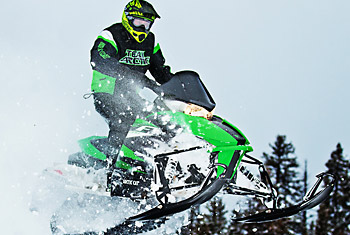
I’m really pumped that the new 2012 Sno Pro 600 race sled is built on the same ProCross platform that we regular riders will get.

After five years of racing a competition-specific machine that had little connection to most of its consumer sleds, Arctic Cat is returning to the “race-what-we-sell” program that defined the ZR and early-Firecat eras. I see this as huge step forward that has the potential to accelerate the continual improvements that inevitably happen to sleds during their lifespan.

Arctic Cat is at its best when the creativity and feedback produced by its race program directly influences all of its snowmobiles. The amazing ideas generated through race development are staggering, from entire chassis and suspension platforms to individual components.

Examples that come to mind: Torque Sensing Link, Extra Travel Tunnel, laydown engine architecture, Slide-Action suspension, and even the ProCross chassis (which was formulated based on what was learned from the 2008-11 race sled).

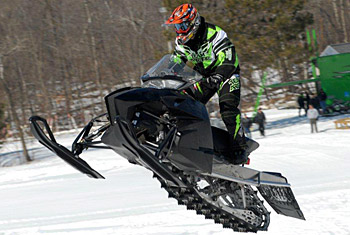
This past spring I witnessed handful of engineers and racers spending the day testing one of the early prototype Sno Pro 600 race sleds.

This day included Brian Dick, Arctic Cat engineer and racer; Russ Ebert, engineer and crew chief for the Factory Team Arctic program; Steve Houle, owner of Speedwerx and builder of the 600 mod race engines that powers Open class race sleds; Dave Otto, mechanic for the Factory crew; and Factory racers Dan Ebert and Kyle Pallin.

This particular race sled proto had already seen test time in both snocross and cross-country environments, but this was the first time that Ebert and Pallin rode this version.

While the new-for-2012 ProCross race sled added a new and exciting element to springtime testing, the scene that unfolded this day was a repeat of what happens every year at this time: take the best stock race sled from the current year (in this case, Dan Ebert’s stocker exactly as it came off the track at Lake Geneva two weekends prior), and use it as a baseline to compare, tweak and improve the next year’s sled.

Last year’s race sled was highly evolved and arguably the best stock machine in snocross and cross-country. The goal for the new machine is to be even better. On this day the focus was acceleration comparison testing up a groomed hill.

Ebert and Pallin took turns on each sled, lining up side-by-side and drag racing to the top of the hill, while the rest of the crew observed whatever differences existed between the two machines.

After 6-8 runs, the crew would head back to the Factory Team trailer, where a new clutch calibration, ignition map or suspension tweaks was given to the 2012 prototype. Then it was back to the freshly groomed hill where another 6-8 drags determined the efficacy of each change.

Notes were taken, racer feedback was solicited, discussions ensued and slowly but surely, a direction emerged in terms of calibration.

More test sessions followed, at this location and in the Rocky Mountains. Different Team Arctic racers were brought in to gather feedback and test calibration.

Because this year’s racer is all-new, the company wanted as much time as possible to test component selection and calibration, the production schedule is later than normal, with sleds being produced in early November.

I’m always a little tentative to make grandiose proclamations about new machines that haven’t yet faced the competition. If history is an example of what to expect, then there will be many things learned during the first several races, with the usual teething gremlins getting sorted out via steady, noticeable improvement. If the wins don’t come immediately, it won’t take too long.

I gladly welcome this learning curve element of the new race sled, because there’s a strong chance that what’s learned on the track will eventually improve what we ride on the trail.

To read more great Arctic Cat editorial by John Sandberg, visit www.ArcticInsider.com. Be sure to register so you can post in the forum!
Regarding E-TEC: Some Objectivity Please!

Dear Motorhead:

With regard to the “HOW LONG WILL AN ETEC LAST?” article, some objectivity please!

I believe an ETEC will last. However, will it last as long as a 4 stroke? Hell no! Yes it will be cheaper to fix, but it will be fixed long before the 4-stroke.

As for fuel economy, let’s have a head to head on different terrain, different throttle settings at different mileage intervals over the course of a winter with documentation.

Then’s there’s oil consumption and lastly and often overlooked, RESALE. Check dealer black book. The ETEC outshines 4-strokes in many areas, but from a purely ‘money’ standpoint it takes a backseat to today’s best 4-stroke technology.

Greg F

Dear Greg:

We appreciate and respect your comments.

One more issue that’s of material consequence – weight. Until we get 4 stroke engines to produce similar power-per-kg as DI 2 strokes the E-TEC argument is hard to counter. No other vehicle outside of Off-Road MC’s are as sensitive to weight as snowmobiles. I

think E-TEC resale – not other EFI or SDI 2 strokes – but E-TEC specifically has exceptionally strong resale right now. In five years? Dunno.

We are convinced 4 stroke fuel economy is not in the same league as E-TEC. We have done same day comparisons every year since the first 600 E-TEC arrived and the difference is significant. Unfortunately, we have decided not to publish hard data mpg numbers because readers will inevitably mis-interpret what they mean.

Snow is a transient medium and it’s always different. So, we draw our conclusions from what we see and report it in a way that we believe verifies E-TEC’s superiority in fuel economy. It isn’t the odd time the E-TEC beats comparable 4 stroke mpg – it’s everytime.

Oil cost E-TEC vs 4-stroke gets harder to declare a winner as the miles pile up. 4-stroke oil economy is better if you ride more on your seasonal oil change. E-TEC is level – ride a mile and use the same amount of oil every mile.

Thanks,

Motorhead Mark

I agree with most of your comments, Mark. Much more difficult to achieve in a snowmobile application, but it would be sano if a snowmobile 4-Stroke could hold it’s durability & performance and drop to 2-Stroke weight levels.

Yamaha has recently achieved this in an award winning Marine Outboard product and the weight distinction in MX is small with the 450’s having clear performance advantages over the old 250’s & 500’s.

We wouldn’t dare to try to jump some of the triple’s we do today on the old 2-Stroke MX bikes.

I can tell you’re predisposed to Yamaha and that’s okay. However, think about this – the new 600 ACE from SD is a feather.

I would guess a turbo or more preferably a Supercharger could be fitted to that engine and the total weight of the sled might come in scary close to competitive 2 strokes – not necessarily SD’s – but the competition.

The engine – if it’s strong enough (probably isn’t) could be boosted to the 125 HP range and that would be as close to 2 stroke weight of any sled I can think of with 4 stroke power. Anyway, just a thought.

Won’t Believe The Hype

Dear Motorhead:

I find it frustrating when a magazine gets caught up in the hype and puts out false information. Stating that “the 800 E-TEC is the fastest snowmobile available without a turbo” is a flat out lie.

Have you heard of the Arctic Cat CFR 1000? How about the 800HO? Consumers rely on you guys to put out facts and un-biased opinions, not false advertisement.

Mark

Mark:

Thanks for your email!

Whoa! Let’s get something perfectly straight – ad hype has nothing to do with the fact in all our testing the 800 E-TEC is the fastest non-turbo sled in MY 11. Period.

We’ve got a CF-R 1000 and a couple 800 AC’s. Nope, not as fast. Maybe yours is but ours isn’t and it wasn’t last year either when we tested the limited build E-TEC 800.

Thanks,

Motorhead Mark

Yamaha’s Vector is Re-Thought for 2012

0

For 2012 the product planners have taken the next logical step and added EPS to the Vector line.

The new EPS Vectors will be available in both 121 and 136-inch versions and there have been some changes made to offset the extra cost of power steering being added.

First, the tried and true tunnel adjustable dial damping control for the Vector’s monoshock has been replaced with a new, more conventional clicker gas shock with the controls inside the tunnel on the shock itself.

This move not only has eliminated some weight and complexity but (the cable from the shock to the tunnel adjuster could sometimes be interfered with by ice) has allowed Yamaha to keep the overall price down, offsetting the extra cost associated with power steering.

Another price adjustment will be gained with the use of a pair of non-reservoir KYB aluminum gassers up front.

Frankly, we’ve always loved the variations of this shock absorber and, for trail riding, have found the overall ride of both Vectors and Apexes equipped with them to be superior to some of the more pricey reservoir and air shock packages Yamaha has offered.

The new skis and 15mm remount at the ski pivot, identical to the EPS Apexes, is also in place with the EPS Vector.

Unfortunately, Yamaha has walked away from offering a more budget-friendly iteration of the Vector without EPS.

Just like the Apex, there are no choices of EPS or not, available. Either you’re gonna love it and pay up or look at another 4-stroke without it.

Changes to the RUSH Front End This Year

0

For MY 2012 Polaris has changed the spindle angle (rake) of the RUSH front end including all the 121-inchers.

New, more laid back spindles are also moved forward effectively lengthening the sled as well.

New upper A-arms now have encapsulated ball joints replacing the former bolt-in Heim style joints used in the 2011 RUSH.

There’s a new extruded spindle with a slightly repositioned saddle bolt to round out the package.

Supertrax readers know we’ve had lots to say about RUSH handling. We’ve found the sled to be very stable and on-center, offering predictable and linear turn-in and easy to control ski-lift at the edge of carbide grip.

With changes made to the 2012 121 and 136 RUSH models, steering effort is markedly reduced while understeer at the edge of adhesion is pretty much indiscernible.

Also, ski lift when at the limit, becomes even easier to control, allowing the pilot to re-plant the inside ski at will with simple throttle modulation and steering inputs.

It all adds up to an even better handling RUSH and contributes significantly to the aforementioned transparency of the 136-inch shoe on the new Switchback.

2012 SKI-DOO MODEL CHANGES

0

Remember how Ski-Doo said the only XR bodywork with a 2-stroke would be the Grand Touring with a 600 E-TEC?That’s changed.

This year there will be 800 E-TEC Powered GSX models using the larger and warmer XR bodywork. Frankly, we’re pretty stoked about riding a GSX with air suspension and an 800 under hood.

The vertical crowd gets more Free Ride variants, most notably a 137-inch model best described as a more serious Renegade Backcountry X. Hmm… we already thought the BC-X was serious.

Anyway, detail improvements are evident on the Summit models as Ski-Doo continues to listen and respond to the vertical market.

Here’s what we think. Ski-Doo has been beaten up for not delivering a turbo or supercharged 1200 4-TEC since the day the engine arrived.

While there’s likely some demand for such a powerplant in the mountains, the cost to perform this kind of tune-up is significant.

Temper your thinking with this latest info: The entire snowmobile industry let out a collective sigh of relief after almost ten years of EPA emission scrutiny and costly compliance.

From all indications the EPA is leaving the snowmobile industry alone, for at least the short term, as it should.

Our contribution to global emissions is now both insignificant and inconsequential.

2012 ARCTIC CAT PROCROSS 1100

0

The new Arctic Cat ProCross model we think has the most potential to alter the way the snowmobiling masses think, is the new non-turboed 1100 in this chassis.

Cat has accomplished what many in this industry have always believed to be impossible: It has created a 4-stroke that offers no compromise compared to a 2-stroke.

Yes, this sled’s handling is as good as an XP or a RUSH 600 and its ride sensations are the equal – and, in some situations, exceed those sleds, too.

The low friction quotient of this new platform combined with its ability to freewheel and then with its lightened mass added in, makes this model outperform any other 4-stroke we’ve ridden.

We’re aware this 123-125 hp mill is not the fastest 4-stroke engine in its class but its conservative 2-cylinder weight and excellent throttle response wrapped in this chassis package makes it more fun to ride than any other 4-stroke we’ve sampled so far.

It’s plenty fast, too. Overriding the whole 125 horsepower project is a sense this sled offers no compromise in having a slightly heavier 4-stroke under its hood.

Handling is razor sharp and all the nimble, agile goodness of the same sled with a 2-stroke (the 800) comes through in bold italics.

Ontario Invests $3 Million to Improve Snowmobiling

0

The Province of Ontario will provide a $3 million tourism development investment to support snowmobiling tourism for the 2011/12 season.

This investment will be administered through the Ontario Federation of Snowmobile Clubs (OFSC) to help boost the one billion dollars of economic impact generated annually by OFSC snowmobile trails.

The Honourable Michael Chan, Minister of Tourism & Culture, made the announcement recently at the Barrie Tourism Travel Information Centre as part of the ministry’s initiative to support attraction, product and experience development and industry capacity building.

“Our 34,000 kilometres of snowmobile trails, operated by our 228 community-based clubs, are an economic cornerstone of winter tourism in Ontario,” said Brenda Welsh, the volunteer president of the OFSC. “We are very pleased that this provincial investment will primarily benefit rural, small town and northern Ontario, where winter time opportunities are limited.”

This development investment is targeted to help remove winter tourism barriers. It will do so by improving infrastructure and technology to make it easier for more people to snowmobile more often in more places.

Examples of eligible projects include bridges, culverts, signage, staging areas, tourism loops, and web and mobile information technologies. The funding will be allocated by the OFSC under clearly defined provincial eligibility guidelines and under strict OFSC criteria and oversight.

Snowmobiling tourists will start noticing these enhancements to their Ontario riding experience throughout the coming season.

“It is important to understand that this investment is not for operational expenses, which run about $20 million each winter,” said OFSC Executive Director Paul Shaughnessy. “Operational costs are paid by the sales of trail permits, but permit revenues are not sufficient to cover the infrastructure and technology advances need to build winter tourism. This is an investment in protecting snowmobiling’s significant contribution to Ontario’s winter tourism economy.”

Consequently, the OFSC reminds snowmobilers that this provincial investment does not pay for any trail operational costs incurred by the clubs and districts to keep trail open and groomed, so it is very important for riders to continue to support trail operations by buying a 2012 trail permit.

The Ontario Federation of Snowmobile Clubs is a volunteer led not-for-profit association, which through strong leadership, provides a wide range of quality programs and services to, and on behalf of, its member organizations.

Our provincial network of organized snowmobile trails connects Ontario communities, providing responsible riding experiences that are safe, enjoyable, and environmentally sustainable.

BRP SIGNS WITH TCFIF WHOLESALE FINANCING PROVIDER

0

BRP signed a multi-year strategic alliance with TCF Inventory Finance, Inc. (TCFIF), a new wholesale financing provider.

TCFIF will be providing wholesale financing solutions to BRP’s Ski-Doo, Sea-Doo and Can-Am North American dealers and be the preferred wholesale financing partner to Evinrude and Johnson outboard engine dealers.

“We are thrilled to add BRP and its roster of dealers to our customer base,” said Ross Perrelli, president and chief executive officer of TCFIF. “The creation of this long-term North America-wide relationship is proof that our formula of industry experience, exceptional customer service, and a reliable and stable source of capital is a winning one.”

TCFIF and its affiliates will be a convenient one-stop shop, offering inventory financing, equipment financing and commercial banking services.

Additionally, TCFIF will dedicate staff to service BRP dealers; key members of their account team will be working within BRP’s offices in Montréal.

“We know that wholesale financing is key to the success and growth of our dealer network,” said Yves Leduc, vice-president and general manager, North America division. “We are pleased to add TCFIF to the list of our financial suppliers supporting our Canadian and American dealers. With its wide range of financial services, solid value proposition and great customer focus, TCFIF will be an excellent partner for our network.”

This agreement comes into force in February 2012.

TCFIF, an indirect subsidiary of TCF Financial Corporation (NYSE: TCB), is a premier inventory finance company offering a full range of inventory financing solutions to manufacturers, distributors and their dealers throughout the United States and Canada in the powersports industry, the lawn and garden industry, the recreational vehicle industry, the marine products industry and the consumer electronics and appliances industry. TCFIF originated approximately $2.5 billion in loans to nearly 9,000 customers in 2010.

2012 Nytro Upgrades Targeted at Better Handling

0

This year all Nytro models get the new Apex-style skis and 15mm trail geometry change but no EPS.

On the Nytro, the slight steering effort increase off-center may not be a bad idea as Nytro owners have complained in the past of the sled’s twitchiness at medium trail speeds.

By “slowing down” the steering response and utilizing a less aggressive ski, Yamaha may have made a sizable improvement in the Nytro’s trail handling.

It should be noted the 2012 8HV ski is considerably different in design compared to last year’s ski used on the Nytro.

From the bottom, the front part of the ski’s keel where it makes initial contact with the snow has been eliminated and the keel’s depth has been reduced to 21mm – about the same as a Venture ski.

Another tweak to the Nytro targeted at making it handle better comes from its new track.

This specially designed Camoplast RipSaw II version has the edges of the track lugs shaved on a 45-degree angle at the extreme outer edges.

While only making a marginal change in the track’s ability to bite straight-ahead, Yamaha claims it makes a huge difference in the 1.25’s ability to react to driver inputs at the handlebars during cornering maneuvers, particularly on hard or frozen snow.

This subtle adjustment to track design is intended to reduce darting and hunting and to offset the sled’s resistance to turn-in when handlebar inputs are applied.

It actually makes the sled oversteer a bit more and slide its tail out in corners when ridden aggressively.

The overall “softer” handling should be a welcome side effect when married to the new skis and front end geometry.