Home Blog Page 217

2014 POLARIS: Why Not An Indy 550 Too?

0

Another logical move was to reduce the number of IQ-based sleds in the Polaris line-up and get as many popular models converted over to the much lighter Pro-Ride platform.

One model segment this will make a big impact on is in the entry-level 550cc fan-cooled class.

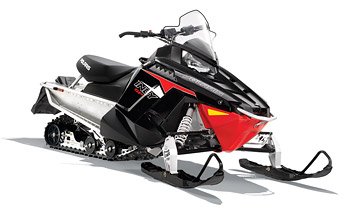
The new 550 Indy 121 comes with Ryde FX MPV gas cell shocks up front and in the skid (13.9-inches travel) enclosed by a 15x121x.91 ShockWave track.

One big change this year is the switch to CVTech’s latest Powerbloc 50 drive clutches. These very durable clutches operate on a completely different principle than the flyweight concept and require almost no maintenance at all, even when the miles begin to stack up.

The weight reduction alone by going to the newer platform will increase flotation and the use of the Pro-Ride’s latest generation of non-parallel A-arms will deliver sweet handling. Pro-Steer skis come standard along with a mid-height windshield for that classic Indy look.

Another surprise is two new 144-inch tracked Indys with fan-cooled mills. The first, dubbed the Indy 550 144, is designed to be a lightweight freeride and mountain rover for beginners or a sled with incredible flotation for boondockers and trappers.

The low power-to-weight ratio will be a substantial factor here and this sled, with a 1.35 Cobra, will have all the bite you’ll need in powder.

This one uses the same new Powerbloc 50 drive clutch and matching Invance secondary as the 121-incher. The second continues with the very successful Adventure theme and it’s called the 550 Aventure 144. This sled includes the same add-on bags, rack and available 2-up seat as its larger Adventure sibs.

A new Indy based 2-up model with many of the same amenities, the 550 Indy LXT, comes with a cargo rack and backrest, electric start, PERC and a 15-degree flatter steering post angle for sit-down comfort.

Polaris is building a nice model selection in its Indy cladding and these sleds could well turn out to be the best priced sleds on snow this year.

If the pricing comes in close to where we suspect it will, consumers will be getting unprecedented strong value and excellent performance for their snowmobiling bucks.
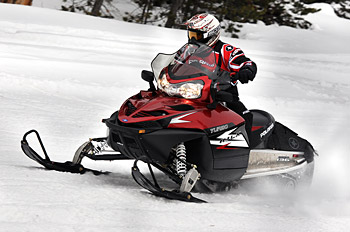
IN 2014 INDY REIGNS SUPREME!

0

It looks like Polaris’s intention to revive the Indy nameplate has been a big success. The revival is so good that Polaris has added a number of new Indys to its 2014 model line-up.

Doesn’t it just make sense there would be a new Indy 800 in the model mix? Ever since riding the Indy 600 last year we’ve been super impressed with the Indy’s uber agile and very light platform.

This sled’s weight is very close to its lightest competitors’ and its nimble handling and lightning-quick responses are a natural-born magnet for more horsepower.

The new 800 is only available in SP trim and that means you’ll be getting adjustable Fox IFP gas shocks all around, Pro-Steer skis and heated hooker handlebars.

The fully coupled Indy skid delivers 13.9 inches of travel and comes with a 15x121x1-inch HackSaw track. We’re thinking this lug depth may be a little light with this much available power so you may want to invest in some traction products.

At any rate, this featherweight package should launch hard and the proven durability of its Cleanfire 800 SDI 2-stroke is right at the top of the industry.

We really like the mid-height windshield and 3.5-inch riser for comfortable stand-up riding. The 800 is available in black or red/black trim.

Our biggest question will be pricing. Polaris has grown to domination in the ATV business with genuinely bargain priced new sleds in categories that are the most popular.

We think that strategy may be played out with the Indy 800 SP – certainly if the pricing of last year’s Indy 600 is any indication.

This one promises to be a lot of sled for the money.

IS POLARIS GIVING UP ON 4-STROKES?

0

Reader, Matt Ryder, asked about the reduced presence of Polaris 4-strokes in the model line-up and we’ve been puzzling about the same thing.

In 2013, Polaris has reduced its number of 4-stroke models significantly and has pretty much limited buyers’ choices to the 2-up touring market.

We’ve had some 121 and 136-inch turbocharged Polarii press units the last few years and have really grown to love and respect these sleds for their hypersled-equaling performance.

No question, the big Turbo 2-upper is a potent sled and you can read a short report in the upcoming issue of Supertrax (December 2012) how we took this gargantuan yacht on a long ride with three 800 hypersleds last year and how well it performed head-to-head with much lighter and supposedly faster snowmobiles.

Frankly, the IQ-based Turbo Touring would be one of our first choices compared to any 4-stroke on the market. All this being said, it looks like Polaris isn’t too pumped about serving the 4-stroke world of customers.

However, there’s more than one big “unless” here: Unless Polaris has something completely new up its corporate sleeve. Unless Polaris has a new 4-stroke platform based on Pro-Ride using the same lightweight bonded assembly as the Indy and RUSH. Unless Polaris has a new direction in engine tech with a DI 2-stroke range of mills in the wings. Unless it has a new 4-stroke engine with larger displacement and (maybe) no need of a turbocharger.

Frankly, we’re not ready to let go of this fabulous performing power package and truly hope all of Polaris’s 4-stroke engineering and experience doesn’t get sewered.

Furthermore, we think there’s a whole wave of high performance buyers who are truly looking for the longevity and performance balance you get with a 4-stroke.

Believe us, we’ve heard from a lot of you who would willingly put your money on a 4-stroke after years of frustration with 2-stroke explosions.

XF PRO CROSS 137: Longer, Shorter or Just Right

0

The move to a 137-inch, floating front arm skid in the X-Over segment is a significant breakthrough for Arctic Cat who have suffered with less than desirable ride quality from the XF’s 141-inch, torsion-less X-Over skid.

Although at this writing, we have not ridden the new 137 FFA skid, we believe this shorter, more trail friendly and inherently plusher riding set-up will ratchet-up Arctic Cat’s fortunes in the rapidly expanding crossover segment.

Essentially this move represents the continued specialization of X-over models from every OEM. The new 137 XFs will compare favorable with the Polaris Pro Ride 136 Switchbacks and Ski-Doo’s 137 Renegades while the 141 inch XF Pro-Climb models will meet Polaris’ Switchback Assault 144 and Ski-Doo’s Freeride models.

There’s more – way more and we’ll have it all over the next few weeks and of course – in September’s issue of Supertrax Magazine!

Tune in to this website for our riding impressions of these sleds. We’re in Yellowstone right now riding all the new stuff.

EL TIGRE 6000: Lets Change The Names Of Our Stuff!

0

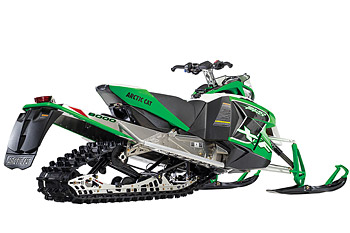
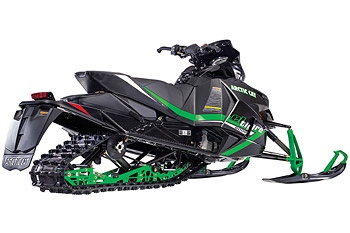
So, Arctic Cat has decided to re-name its engines and snowmobile series. The newest 2-stroke (600) is now called C-TEC (that sounds strangely familiar) and other engine series are positioned in a new cascading numerical sequence.

Pay attention. The 5000 is the current Suzuki 1100, non-turbocharged, even firing parallel twin. The 6000 series is the all-new DSI C-TEC 600cc 2-stroke twin. The 7000 is the Yamaha 1049cc 4-stroke triple. The 8000 is the current 800cc 2-stroke twin (unchanged for 2014) and the 9000 series is the 1100 turbocharged and intercooled Suzuki even firing parallel twin.

There’s more. Cat has also changed chassis names. Although the names ProCross and ProClimb are still used, Cat has walked away from the confusing “F” thing.

Arctic Cat has revived the legendary ZR and El Tigre handles for trail sleds but will stay with XF for crossovers.

The big news is the company will split the segment into 137 (floating front arm, torsion spring) skids called Pro Cross XF and 141 (torsionless) skids called Pro Climb XF.

Of course, there’s still the M-Series Pro Climb models and these sleds, under the hand of Troy Halverson and his team, have undergone radical modifications and weight reduction for the 2014 model year.

At any rate, the new nomenclature represents the most significant re-invention of the Arctic Cat product profile in at least a decade.

2014 ARCTIC CAT 7000 SERIES

0

Arctic Cat has increased its Yamaha engine-sharing deal beyond the 120cc 4-stroke level to include Yamaha’s legendary, and maybe the best all-round 4-stroke mill in the biz, 1049cc, 3-cylinder triple.

The Yamaha EFI engine has been nicely shoehorned into the current ProCross bulkhead with a new front mounted airbox and an under-seat gas tank, “U” shaped header pipe that’s vented into the tunnel and turning exhaust gases back toward a right-side engine bay (traditional) mounted silencer.

We know, it’s a lot to absorb and we were somewhat overwhelmed with this move. Here’s some info to help you understand this. The 1049cc Yamaha triple is actually 12 pounds lighter than the current 1056cc Suzuki twin. Nice.

The engine has a broader spread of torque, is smoother, sounds way better (it’s 120-degree firing sequence makes sweet music) is more fuel efficient and produces 130 horsepower in the ProCross chassis.

Arctic Cat is offering the engine in a variety of chassis configurations including 128, 137 and 141-inch variants.

The new sleds equipped with this engine will be called 7000 series Arctic Cats.

C-TEC-2: DUAL STAGE INJECTION (DSI)

0

This is a big – spell it in capitals – BIG YEAR for Arctic Cat. Read on and try not to drool!

It’s a called DSI and it’s not Direct Injection (DI) and it’s different than Semi-Direct Injection (SDI). The all-new Arctic Cat C-TEC-2 600cc 2-stroke, the most anticipated new EPA certified powerplant in the last three years, utilizes it’s own proprietary induction system.

The engine is a liquid cooled, case reed inducted 2-stroke using servo-actuated exhaust valves and oil injection from an electronic “steeper” motor mounted in the oil reservoir – a key feature in the engines ability to produce less exhaust smoke.

The DSI system employs one injector mounted low on the cylinder wall (not inside the boost port) spraying fuel at about 50 psi into the crankcase at lower RPM, light throttle settings. The fuel charge is then scavenged up the transfers and into the combustion chamber.

There is no fuel introduced at the throttle bodies, they only flow air. There is some injector oil, however, that flows through the fuel injectors.

The twist with AC’s DSI comes from a slit in the piston skirt aligned perfectly with the cylinder wall mounted injector.

As RPM climbs and throttle openings increase, the injector continues to spray fuel directly through the slot in the now rising piston. A significant amount of this fuel is aimed (naturally) at the top end rod bearing.

As a result of a small amount of oil being fed continuously into the fuel rail, lubrication is deposited directly on the piston pin bearing – providing much needed lubrication that’s been elusive in both DI and SDI systems.

The fuel is always injected under the piston so the transfers scavenge both fuel and air. There is oil injected via the throttle bodies as well as onto the PTO bearings.

At this writing we have no hands-on experience with the system. However, Arctic Cat engineers in attendance at January’s Sneak Peek unveil showed us pistons with 6000 miles on them and they looked shockingly good.

Also (engineers are always honest to a fault), claims from the engine guys were exciting. Consistent high-teens mpg and power they matter-of-factly claimed “can handle the competition” was part of their test data.

Handling the competition means they believe they have both the E-TEC Rotax 600 DI and the Cleanfire Polaris 600 SDI covered.

WHAT’S ARCTIC CAT UP TO FOR 2014?

0

We’ve already speculated a lot about Arctic Cat’s move to use US-designed and built 2-strokes in its new sleds.

It’s not much of a secret really and Cat has been very forthcoming about its break from Suzuki beginning this model year.

Pretty exciting stuff, and a move that has the potential to drastically change the image and model line-up of its sleds.

Frankly, if Cat does nothing else other than introduce a new series of powerplants this year, it would be a huge undertaking.

This is a company that loves headlines and isn’t afraid to take big chances, though, and we think Arctic Cat may have more up its sleeve than just new engines this year.

Despite the extra manufacturing expense and complexity of building the Twin Spar chassis, Cat continues to offer it in some of its model line-up.

The much lighter, less difficult-to-assemble ProCross seems like a natural home for Arctic Cat’s TZ touring sleds, its 500-class trail sled (if it continues offering it) and, most importantly, its entry-level 570 fan. Cat really needs to build some enthusiasm at the bottom of its model selection and get customers pumped up about lower cost rides that deliver more excitement and sizzle.

The ProCross platform is the perfect foundation for sleds like this and its focus on handling, light weight and great ergonomics makes it a sure bet for success.

Depending on how the available engine choices line up for 2014 (Cat may still continue offering some of its older mills this year), we think a line of lower cost, lower powered ProCross models targeted at the late model, used sled buyer may be on the way.

No question it just makes sense for Cat to build more sleds based on the Procross!

2014 Ski-Doo Line-Up Decoded

With all the hype focusing on the new 900 4-stroke, it’s easy to miss the details on the rest of Ski-Doo’s product line.

For MY 2014 Ski-Doo has made some fairly sweeping changes compared to last year – most of them being a pretty obvious evolution of the strongest assets in the Ski-Doo line-up.

For instance, Doo has taken the incredible success of its amazing rMotion skidframe and added it to many more models. Most notably, the luxury-targeted GSX and Grand Touring 2-upper both get rMotion…but with a twist.

On the top-of-line SE models in these segments the engineers have added the remote adjustable air shock system to the rMotion 137 to produce awesome ride results.

Quite frankly, we would have been happy with just the running board adjusters at this level but to have a thumb operated air systems on these sleds simply goes beyond the universe! Incredible.

Both the Grand Touring and the GSX when purchased in lower priced LE trim get rMotion, too.

Also upgraded to rMotion for 2014 is the race-based MX-Z X-RS, all MX-Z models except the baseline Sport Series and all Renegades (with the exception of the Renegade Sport).

In keeping with Ski-Doo’s entry level program, all Sport Series MX-Z and Renegades continue to use the XP platform in lieu of the XS and have SC-5 skidframes across the board. Engine choices here are limited to the ACE 600, 550 fan and 600 carb engines.

Likewise, in the mountain segment, Ski-Doo has completely standardized t-Motion as the go-to skidframe for all of its high altitude sleds.

All Summit X Series, Summit SP and even the baseline Summit Sport now come with tMotion. Three track lengths, 146, 154 and 163 are available with the FlexEdge PowderMax II tracks throughout the Summit line.

The Summit Sport still uses the XP platform while all other summits go to the new-last-year XS. No mountain sleds will use the new 900 ACE engine.

900 ACE: A Learning Key Could Be Helpful

On top of all the ACE 600’s whiz-bang-techno-stuff is the ability to attach a special DESS tether calibrated to limit speed to 70 kms/hr (40 mph).

This has valuable implications for rental fleets and, from what we’ve heard, a large portion of 900 ACE production will find its way to Ski-Doo’s large number of rental operators across North America.

You can get an ACE 900 in just about any chassis configuration Ski-Doo currently produces. There are 900s in XS MX-Zs and Renegades and there are 900s in XR bodywork covering the GTX 2-Upper.

Whichever body variant you choose, you ultimately want to know how its available power compares to known commodities.

Here’s our quick take: If you ride with your friends’ 600cc 120-hp 2-strokes, the 900 ACE is capable of keeping up on all but wide-open access road type trails. The torquey response of the ACE allows for some nice corner-to-corner massaging that’s very satisfying.

However, if you’re on a lake or running in four inches of untramped snow, you’re not going to keep up with 600 2-strokes on fast trails or, particularly, on lakes.

Here’s the verdict: The 900 ACE is targeted at those riders who want mid-range trail-type performance and the operating and durability advantages of a 4-stroke.

Although we would not classify this as an extreme high performance engine, it offers the owner a number of distinct features you could not get with an E-TEC or a bigger-inch 4-stroke, perhaps even more incredible gas mileage and one of the coolest electronic packages we’ve ever seen.