Home Blog Page 92

SMALLER OUTPUT TURBOS

0

When the word “turbocharged” comes up in snowmobile conversations these days, it always seems to imply maximum horsepower – no compromises, no exceptions.

This fact is no more evident than when Ski-Doo introduced its 900 ACE turbo last year. There was much conversation about its 150-hp output being inadequate compared to the 180 to 200 range the SideWinder and Thundercat were delivering.

We recall conversations asking: “Why would Ski-Doo put all that work into building a turbo sled when it’s already going to be overshadowed by the competition?” Another comment was, “Who’s going to want a turbocharged sled making 150 horses when you can buy a lighter 2-stroke that makes 160-plus?”

Good questions – and completely logical. However, a year later and the sales numbers seem to indicate there are a lot of snowmobilers who want a turbocharged sled making power in that range. The 900 ACE Turbo has been a huge success and looks like it’s here to stay.

To put this conversation in perspective, you need to look at where turbocharged snowmobiles have come from. Back in 2004 when Arctic Cat first introduced the T660 turbo, that tiny 3-cylinder engine only produced 110-hp from 660ccs.

Those specs sound pretty anemic compared to what is offered these days, but the truth is, that sled was an incredible performer and was an absolute blast to own and ride.

Some of its success was tied to the throttle lag it had and how much fun it was to feel the surge from that big boost of turbocharged air compression when you laid on the throttle.

No, we’re not suggesting sleds need turbo lag to be appealing but that definable surge from about 60-horsepower up to 110 was a real trip and made the experience fun!

A couple of years later, Polaris came out with a turbocharged 750 twin and it, too, was a ton of fun to ride. This one used an “overboost” feature that took the engine from 135-hp up to about 160 for a very brief time as the turbo’s boost was raised for quick acceleration.

The fact is, those two sleds were extremely appealing and had a ton of pull in the marketplace.

We’re wondering if turbocharging Yamaha’s old 500cc Phazer 4-stroke twin might produce a stir in the market, too.

That engine made about 80-hp stock and even if it was boosted to somewhere around the 110-hp mark, would there be a lot of riders who wanted a lighter 4-stroke that made that kind of power? We think there might be!

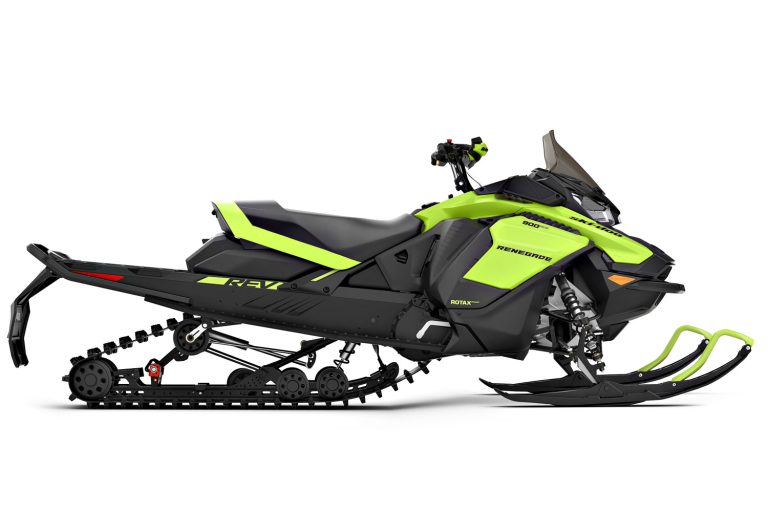
2020 Ski-Doo Renegade X-RS 850 Test Ride Preview

0

Here’s another look at what’s ahead from Ski-Doo leading up to the start of the 2020 SnowTrax season! Motorhead Mark goes into detail in his review of the Renegade X-RS 850 ETEC! Be sure not to miss Mark’s full TEST RIDE, which is coming up this season on SnowTrax TV!

Subscribe to our YouTube Channel!

WHAT’S NEXT FOR YAMAHA?

0

A question looming large at the Yamaha camp is: “What’s next?”.

It’s pretty clear Yamaha has improved its inventory position the past two years and is now back to marketing what appears to be a fairly full line-up of sleds for MY 2020.

For sure the return of the rejuvenated Viper, a mainstay of the brand’s product profile, signals Yamaha dealers have moved out unsold, non-current inventory and are back to selling current year sleds.

Great. Next challenge for the Big Y: We hear Yamaha regularly talking about the difference in the DNA of comparable Arctic Cat models and Yamaha branded models.

This DNA difference is important to both Yamaha and a legion of their faithful who take pride in the iconic brand and wouldn’t switch to something else if they were hit on the head with a 2×4.

Here’s where we think Yamaha could increase it’s own unique DNA and even further distance itself from the Arctic Cat brand: Rear suspension.

Yamaha has a high degree of expertise and has enjoyed significant success with skidframe designs over the past 15 years. In fact, late in the life of the Apex, there was a variant produced with a made-in-America rear skid.

Truth is the iconic, gone-but-far-from-forgotten Apex had a near-legendary rep for superb rear suspension ride quality. The Apex used a highly unusual single coil-over shock out back that delivered amazing comfort and control along with respectable weight transfer.

What was even more remarkable about the Apex skid (and later used in the Vector) was its ability to deliver stellar ride quality while mounted under admittedly heavy snowmobiles. To a large degree the single shock Apex skid made the sled feel lighter than it actually was.

There’s little doubt in our minds that its time for more Yamaha DNA to enter its re-branded sleds. It’s no secret the “Slide Action” 129-inch skid used in the bulk of Yamaha’s sleds is the elder statesman of suspension designs.

The reality is, it’s still competitive and that means there’s good in the design. In fact, virtually every racing sled uses a similar sliding front arm.

Yamaha has a stellar record of producing quality ride performance. It might be time for the brand to leverage some of the technology that defined Yamahas of the past decade.

We have little doubt a re-birth and freshening of the Apex rear suspension in upcoming Yamaha models would be received with uproarious applause at Yamaha dealers across the snowbelt.

ROGER SKIME – THE GODFATHER OF CAT

0

All four current snowmobile manufacturers have a unique story to tell – much of it embedded in racing and the application of technology that worked on the track adapted to production sleds.

Names like Hetteen, Johnson, Takada, Houle, Bombardier and Beaudoin instantly recollect memories of inventiveness and design pioneering reaching as far back as the 1950s. Something new and revolutionary was created in those days – and those men made it work! We owe then a great debt.

Another name synonymous with snowmobiling is Roger Skime. Roger is still around today, very busy working at his second career, ranching. He recently retired after a long and prosperous career with Arctic Cat and just a few weeks ago there was a party in Thief River Falls for him celebrating his many years of influence on snowmobiling. I’ve had the pleasure of knowing Roger for over 30 years and both my brother Mark and I, have nothing but respect and awe for him.

In 1962 Roger was a wet-behind-the-ears young engineering student who ventured into an Arctic Cat warehouse one day and simply picked up the tools to lend a hand helping Edgar Hetteen nail together wooden snowmobile crates for shipping. He was looking for a job, said he would be willing to do anything and was promptly hired. He didn’t last long building crates.

Roger quickly moved through the plant learning various jobs on the line and soon became a self-confessed snowmobile “nut”, constantly dreaming new ideas and concepts to make the vehicles lighter and more efficient. When he wasn’t thinking about snowmobiles he was out riding them, all the while figuring out new ways to make them function better on snow.

This passionate drive for innovation and improvement became Roger’s calling card. His ideas were not only heeded at Arctic Cat but deeply respected by the people who worked with him – even by the competition.

The fact is, at first, Roger didn’t get hired as an engineer but it soon became obvious his greatest contribution would be in that field. His experience working on the line on conveyor systems gave him the idea to allow snow to become a lubricant thus eliminating the need for bogey wheels in the suspension. Roger invented the slide-rail skidframe and although that one was a hallmark, he developed a menu of other innovations over his many years at Cat.

Roger never dreamed up an idea he wasn’t willing to try out himself. There was no CAD-CAM in those days, just trial and error – and although he took advantage of tech advancements and modern digital engineering tools later in his career, he still rode – a lot – and was never satisfied with an innovation he didn’t personally think “would make that sled a better snowmobile”.

I clearly remember one day, sometime in the early 2000s, being at an Arctic Cat intro near Thief River Falls. The press was standing around a Cat trailer waiting for the next event. Suddenly an agile looking rider came across the snow covered parking lot where the sleds were staged, driving what appeared to be way too fast. At the last second, the rider calmly slid the sled sideways and landed it perfectly parallel in a line of precious, one-off prototype sleds standing waiting for our approval.

We looked at each other wondering if this renegade test rider would get called out for being so reckless. He took off his helmet and, you guessed it, it was Roger. He was probably close to his sixties but he could ride like 20-year-old snocross racer. He came over to greet us and told us how he had just figured out something about the sled that was bugging him and knew how to fix it now.

That was Roger. We’ll miss seeing him at Arctic Cat events and getting his inimitable feedback on the industry. We’re glad he’s got a little less on his plate these days but snowmobiling is so much poorer with his retirement.

Congratulations, Roger.

2020 Enduro 900 ACE Turbo Test Ride Preview

0

We’ve got another sneak peek of what’s ahead from Ski-Doo leading up to the start of the 2020 SnowTrax season as Motorhead Mark gives his review of the Renegade Enduro featuring the 900 ACE Turbo engine! Like we said, this is just a taste of the full TEST RIDE, which is coming up this season on SnowTrax TV!

Subscribe to our YouTube Channel!

HYPERSLED ENGINES: What’s With Cat’s New 800?

0

We got some flak for not giving enough info on the 2020 Arctic Cat 800 twin a couple of weeks ago. Some of our keen-eared readers and viewers (yes, we read your feisty retort, Jamie) pointed out we weren’t giving the right details on the new, revised 800 Cat is offering for the upcoming model year.

Frankly, unearthing particulars on this high-profile change has been like sifting though a South American archeological dig in search of proof of the existence of a Yeti!

Rather than focus on the “why” behind the change to the 800 (this info is even harder to get than the other), we’ll try to spill what we’ve learned about the “what”.

First, although the 2020 800 engine is still referred to as a CTEC-2 engine, it no longer uses the classic Dual Stage Injection system found on the DSI 600 and the 2019 800.

Just to refresh, the concept behind Dual Stage or “Slot Injection” centers on a vertical slot being cut into the side of the piston on the injector side.

The slot is exposed to the fuel injector long enough to allow gas to be sprayed under the piston and onto the bottom end rod bearings and upper piston pin on each cylinder.

At high RPM as more fuel is required, on the power stroke, the fuel is injected through the slot and travels up from the crankcase via the transfer ports to the top of the piston and secondly, is injected directly onto the top of the piston as it passes by the slot. Pinpoint oil distribution lubes the bottom end bearings.

This injection design has proven to be extremely reliable on the 600 and it was pretty much a no-brainer Cat would use the same design on the 800 – and they did.

However, for 2020, Cat has gone with a different design altogether for the 800. This year, the pistons do not have slots and the injectors are mounted inside the transfer ports. Engine programming is set up so the fuel is injected in sequence during the power stroke so the fuel is jetted to the top of the piston where it’s ignited and the crankcase is left relatively free of unburned gasoline.

Depending on how Cat has chosen to program its ECU, you could call this new set-up Semi-Direct Injection or SDI. As you know, Polaris uses SDI on all of its performance 2-strokes including the 600, 800 and 850. This is where the guessing will begin, ladies and gentlemen.

We’re wondering if Arctic Cat, knowing the new standard in big-inch engines was now 850ccs, did the engineers face challenges with an SDI 850 design and instead opt to build an all-new SDI 800 version with the intention to bring out a new SDI 850 a couple of models years down the road?

Based on what we’ve been able to find out so far, we’ll likely never know. However, apparently the performance of the 2020 800 is excellent and in no way gives quarter to the SDI 800.

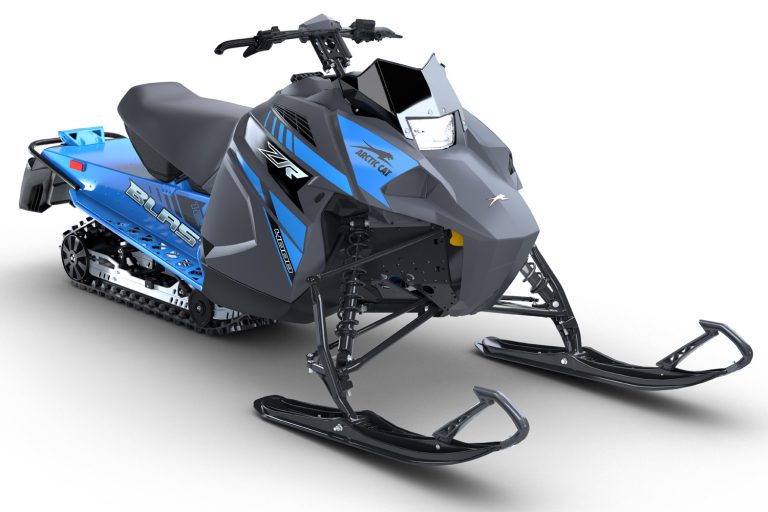
2021 ARCTIC CAT BLAST MID-SIZED SLED

Model Year 2021 marks another milestone with the introduction of BLAST™, a true mid-size snowmobile offering three different models and technology and performance at a value.

The BLAST lineup is designed and manufactured in Thief River Falls, Minn., and the engine is built in St. Cloud, Minn. The BLAST line includes the mountain BLAST M with ALPHA ONE Single-Beam Rear Suspension, trail BLAST ZR®, and sport utility BLAST LT 4000 mid-size.

At the heart of the BLAST models is the industry’s first electronic fuel-injected, single-cylinder, 2-stroke engine. The 65+ horsepower-class C-TEC2 4000, 397cc engine has plenty of power for the experienced rider and smooth power delivery for a new rider. The models feature the proven Arctic Drive System with a CVTech Trailbloc drive clutch and CVTech Invance driven clutch to deliver power to the snow.

To complement the engine, the all-new, mid-size chassis is extremely lightweight, delivering effortless maneuverability at any skill level.

The new, mid-size seat makes it simple for the rider to transfer weight when cornering. To keep the sleds lightweight, Arctic Cat equipped them with the same Arctic Mountain Suspension™ (AMS) found on full-size mountain sleds, and hydraulic twin tube shocks — front and back — to provide ample absorption.

The BLAST models feature a key start so the rider can just turn the key and go. The vehicles’ digital instrumentation provides standard data, while hand and thumb warmers ensure an enjoyable experience even in the coldest temperatures.

To work or play all day, the sleds have an 11.7-gal. fuel tank. The new, sleek bodywork is all Arctic Cat and provides the perfect finishing touch to the mid-size package.

BLAST M 4000

Built for the new mountain rider but still a blast in the backcountry for the experienced rider, the new BLAST M 4000 combines the DNA of the full-size M 8000 models with a smaller stature and mill, offering a fun deep-snow experience.

Similar to its full-sized counterparts, the BLAST M 4000 features the Arctic Mountain Suspension™ (AMS) with lightweight spindles and mountain-specific suspension geometry. The front suspension has 7.2 inches of travel, an adjustable 37-39-inch ski stance and is equipped with 7-inch G2 ProClimb skis for predictable handling in all conditions and deep-snow flotation.

In back, the proven ALPHA Single-Beam Rear Suspension provides 12 inches of travel to prevent bottoming out, and agility beyond traditional sleds. The 146-inch Challenger track with 2-inch lug provides all-around performance and great traction. The model also features a 4-inch low-height windshield.

The BLAST M 400 is available in Dynamic Charcoal/Orange, and special edition Camo/White/Fire Red with choice of American Flag, Canadian Flag or standard Camo/White/Fire Red.

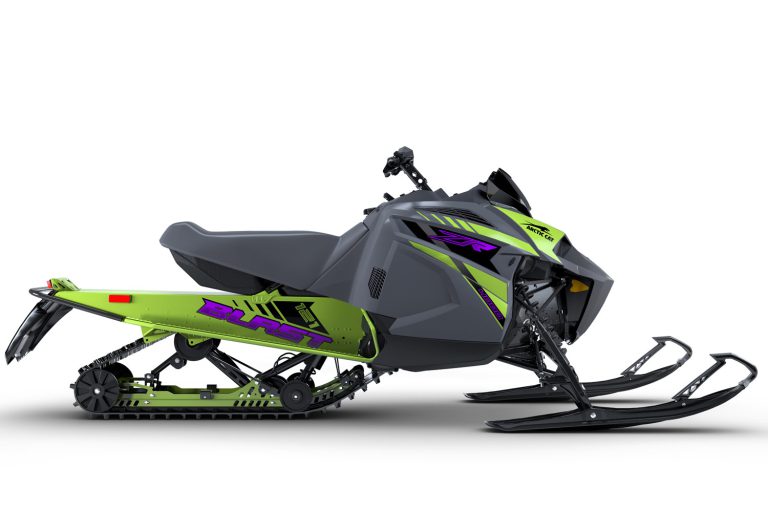
BLAST ZR 4000

The BLAST ZR 4000 is the perfect mid-size trail sled for the whole family. Whether the rider is moving up from a youth model or an adult who wants a fun, lightweight, easy-to-ride sled, the BLAST ZR 4000 delivers.

The BLAST ZR 4000 is a true mid-size trail package. The AMS front suspension offers 7.2 inches of front travel, an adjustable 37.5-38.5-inch ski stance and is equipped with 6-inch trail skis. In back, the slide-rail suspension with dual shock and adjustable torsion springs provides 10.7 inches of rear travel and plenty of agility to conquer every twist and turn on the trail. A 121-inch standard track with 1-inch lug provides all the traction needed in for various conditions. The model also features a 4-inch, low-height windshield.

The BLAST ZR 4000 is available in Medium Green/Dynamic Charcoal and Blue/White.

BLAST LT 4000

Bigger isn’t always better, and the BLAST LT 4000 is the perfect mid-size sled for the cabin owner, outdoorsman or small business owner who needs a reliable work partner.

The BLAST LT 4000’s mid-size lightweight chassis makes it easier to maneuver than full size sleds when hauling or towing for less driver fatigue during those long workdays.

Its 4000 engine has enough brawn to take on the task at hand, and its value price is attractive to those customers who contemplated a sport utility snowmobile but were hesitant about a full-size price tag.

The BLAST LT 4000 has an AMS front suspension with 7.2 inches of travel, an adjustable 37.5-38.5-inch ski stance and is equipped with 6-inch trail skis.

The utilitarian XTRA-ACTION Rear Suspension provides 12.5 inches of travel, and features dual shocks and adjustable torsion springs to help when carrying loads.

A 146-inch Cobra track with 1.6-inch lug provides the perfect grip for a wide variety of tasks. The model also features a 15.5-inch windshield to protect the rider from the elements.

The BLAST LT 4000 is available in Red/Dynamic Charcoal.

For more information, visit: arcticcat.com.

Textron Inc. is a multi-industry company that leverages its global network of aircraft, defense, industrial and finance businesses to provide customers with innovative solutions and services. Textron is known around the world for its powerful brands such as Bell, Cessna, Beechcraft, Hawker, Jacobsen, Kautex, Lycoming, E-Z-GO, Arctic Cat, Textron Systems, and TRU Simulation + Training.

For more information, visit: textron.com.

Arctic Cat Announces Model Year 2021 Snowmobile Lineup

Arctic Cat Inc., a Textron Inc. (NYSE:TXT) company, announced today one of its most exciting Model Year lineups to date.

To fill a gap in the snowmobile industry, Arctic Cat is offering a 2021 lineup headlined by the true mid-size BLAST models, designed for both performance and value. The 2021 offering also has several new models and enhancements to existing vehicles.

Arctic Cat Inc. operates as part of the Textron Specialized Vehicles business.

“Arctic Cat is back in a big way,” said Craig Kennedy, Vice President, Arctic Cat for Textron Specialized Vehicles Inc. “The 2021 lineup is a true testament of our dedication to the snowmobile industry, our customers and the brand. Our engineering team in Thief River Falls has been working tirelessly to create innovative new products that appeal to not only today’s snowmobile rider, but tomorrow’s potential enthusiast.”

All three models in the new BLAST lineup — the mountain BLAST M 4000, trail BLAST ZR® 4000 and sport-utility BLAST LT 4000—are true mid-size vehicles powered by the industry’s first electronic fuel-injected, single-cylinder, 2-stroke engine – the 65+ HP-class C-TEC2™ 4000, with 397cc of power.

Riders will enjoy much of the same technology found in BLAST’s full-size counterparts, such as the Arctic Drive System™ and Arctic Mountain Suspension™ (AMS); the mountain version also features the revolutionary ALPHA ONE™ suspension system. And with a smaller chassis, these models offer better visibility and handling that is easy to maneuver and fun to drive.

BLAST is the perfect entry-level option for the customer looking for a sub-$10,000 sled or the experienced rider who wants an easy-to-ride snowmobile that is a blast to ride.

Also new for 2021 models:

* The crossover Riot X model receives the ALPHA ONE suspension system, for increased handling in deep snow.

* The mountain lineup sees the addition of the revolutionary, adjust-on-the-fly ATAC™ (Previously called iACT) suspension system on the M 8000 Mountain Cat ALPHA ONE.

* For the utility market, Arctic Cat is reintroducing the Norseman X 8000, that offers big power and functionality.

Arctic Cat’s Snowmageddon pre-order only sales event returns for 2021. This year, Arctic Cat has lengthened the order window, announcing vehicles earlier in the season and providing more demo opportunities to consumers. This allows potential customers more time to make their purchase decisions.

All 2021 Arctic Cat snowmobiles are available by pre-order only, through the Snowmageddon event. For more information, visit a local Arctic Cat dealer, go to ArcticCat.com or join the conversation on Arctic Cat Snowmobiles’ Facebook, Twitter, YouTube and Instagram accounts.

The Arctic Cat brand is iconic in the powersports industry, with nearly 60 years of designing and manufacturing leading snowmobiles, side-by-sides and ATVs that are renowned the world over for their power and performance. Arctic Cat snowmobiles, side-by-sides, ATVs and affiliated products are designed and manufactured in Thief River Falls, Minn. by Arctic Cat Inc., a Textron Inc. (NYSE: TXT) company that operates as part of Textron’s Specialized Vehicles business.

For more information, visit: arcticcat.com.

Textron Inc. is a multi-industry company that leverages its global network of aircraft, defense, industrial and finance businesses to provide customers with innovative solutions and services. Textron is known around the world for its powerful brands such as Bell, Cessna, Beechcraft, Hawker, Jacobsen, Kautex, Lycoming, E-Z-GO, Arctic Cat, Textron Systems, and TRU Simulation + Training.

For more information, visit: textron.com.

YAMAHA 2-STROKE OUTRAGE

0

We recently posted an article about the possibility of Yamaha introducing a full-on trail-class 2-stroke sled next year entitiled 2021 YAMAHA 2-STROKE.

As usual, it stirred up the pool of Yamaha fanatics who are still offended that Yamaha builds sleds on Arctic Cat’s ProCross chassis. Jeepers, this is after seven model years! Try to get a grip.

There are some facts Yamaha riders need to understand about this melding of the two companies. First, Yamaha hasn’t been involved with Arctic Cat in a vacuum.

Yamaha’s engineering team has been working and walking in lock-step with Cat since the beginning on pretty much every sled with a “Y” on the hood.

The relationship has been a good one for both companies because a multitude of Yamaha’s specialized manufacturing methods and procedures were handed over to Arctic Cat to meet the standards Yamaha required.

This process took a couple of years to get perfected but the net result is a much better built, better finished, more reliable product for Arctic Cat and the continuation of the high quality image Yamaha has always maintained.

Further to this, many enthusiasts believe Yamaha sleds and the Cat sleds are exactly the same. Not true. Yamaha’s specifications for calibration on suspension, clutching and overall electronics performance are uniquely different.

Yes, a lot of the design stuff used in production sleds may have been laid out by Arctic Cat but it was always delivered in co-operation with Japan.

The fact is, many of the features you’ve seen on Arctic Cats were initiated by Yamaha. Things like engine electronics, gauges and switchgear – even suspension designs and features were either approved or developed in complete co-operation with Yamaha.

One reader commented: “Arctic Cat is hardly even using Yamaha engines anymore”. This is partially but not completely true. As time has moved forward the two companies are seeing that Yamaha’s unique gifting is in designing and marketing 4-strokes and Arctic Cat’s is in doing the same with 2-strokes.

Naturally, Cat’s 9000 Series turbo 4-strokes are Yamahas and Arctic Cat uses Yamaha 4-strokes in some of its touring and utility sleds, too.

Why shouldn’t Yamaha offer an “everyman’s” 2-stroke sled? The demand for one is there from Yamaha fans, dealers would love it and Arctic Cat’s 600 2-stroke technology is time-proven and extremely good.

Furthermore, it looks like there hasn’t been and won’t be much cross over of buying habits between Yamaha and Cat riders – both will continue to buy the brands they distinctively love.

It’s still a win-win for both companies.

Thoughts On The 4-Stroke Market

0

Nowadays, whenever you mention snowmobile 4-strokes, everyone pretty much wants to talk about 150-plus horsepower turbo sleds.

You’d almost think there was nothing else 4-stroke on the market except those high-priced, high-powered rockets.

On the other side of the coin though, is the fact 4-strokes like Ski-Doo’s 900 ACE series continue to dominate the sales records. Ski-Doo bald-faced claims one of its biggest sellers is the 95-hp 900 triple – in any category it’s offered.

Our feedback coming from readers and viewers has always been: “Why would I buy a 95-horsepower 4-stroke when I can buy a 600 2-stroke that is faster, lighter and cheaper (in most cases)?”

Good point, really, and one we thought was pretty much entrenched in every snowmobiler’s mind. Yet, the 900 ACE continues to kill in market share. There must be more to it.

Here’s our best guess as to what this is about. Those legions of buyers who love the 4-stroke 900 ACE are simply not the same buyers who want a 600 2-stroke.

It’s pretty obvious these consumers are walking right past the 600 2-stroke in showrooms and choosing the ACE 4-stroke. Don’t get us wrong, we’re not saying Ski-Doo is selling less 600s because of the ACE – more so, it’s that Ski-Doo is reaching a different market segment altogether with it.

We’re not sure if this was intentional when the marketers dreamed the 900, but it’s sure ended up this way. So who is this buyer who prefers the 900?

To be fair, the ACE isn’t slow. It makes 95 torque-laden ponies and is absolutely a pleasure to ride corner to corner. It’s quiet, smooth, sips gas and doesn’t burn 2-stroke oil. Obviously, based on sales volume there are a lot of snowmobilers who prefer the above traits over pure acceleration and top speed.

We’ve talked to dozens of 900 owners, some on their second or third copy, who absolutely love the performance range and other benefits the engine affords. Some of these folks almost view a 600 deuce as being a top performance sled, given the 125-hp range they are now in, and swear they don’t need that kind of power for the way they want to ride.

So, if our theory has any grit, what kind of 4-stroke would a company like Polaris be wise to consider? We think a naturally aspirated 4-stroke displacing 1000ccs and making about 110-hp would have the best grab in the marketplace provided it was priced below Yamaha’s Viper and maybe not too much higher than the 900 ACE.

Maybe a turbo would come later, but we’re thinking an Indy with a 4-stroke like this would go over big-time with the market we just described.