Home Blog Page 91

QUESTIONS ABOUT 600 2-STROKE ARTICLES

0

Thanks to all our readers for checking out our recent series on the 600 2-stroke engines currently available in the marketplace.

It’s impressive to read the comments you’ve added to the articles and pretty awesome how much of an understanding snowmobilers have of the function of the different 2-stroke systems out there: E-TEC, DSI and SDI.

Let me deal with a few of those comments:

1. Yes, it’s true, the new 600R Rotax is the most recent engine offered in the 2-stroke class, superseding the original E-TEC introduced in the 2008 model year.

The basic principle of how E-TEC works is the same on the original Series III 600 and the new 600R.

Due to its centered mounting position in the new G-4 chassis the new engine had to be much narrower. This was accomplished through the use of a flat stator.

There’s more, subtle refined tech to allow the 600R to run a safe 125-horsepower – however, E-TEC is E-TEC and its snowmobile adaptation has been around for over a decade.

In the article our target was to try to describe in the most general terms how Ski-Doo’s Direct Injection system works. Even though the OEMs are constantly updating and upgrading technology the 600R E-TEC uses a similar basic operating principle.

2. We referenced liquid cooled cases and it’s true, neither the 600 or 600R uses this crankcase cooling setup, instead both versions use the super-grease system we referred to in the article.

This grease is permanently sealed into the bottom end bearings. That system has proven reliable on the original series III 600 but 800 series III E-TECs were a riskier proposition.

This has to do with the kind of sustained high RPM 150 plus HP engines are subjected to. Because of the increased power output of the old 800 versus the original 600, larger bearings were required which require more lubrication and cooling.

Rotax uses liquid cooled cases on the new 850 – along with pinpoint oiling. All E-TEC engines (and SDI engines) use electronic detonation sensors. They are mandatory equipment on E-TEC engines which run exceptionally lean.

3. This one refers to the fact that in a conventional 2-stroke the piston is compressing fuel every stroke and not every other stroke as mentioned. To clarify, every time the piston moves to top dead center – that is once every rotation of the crankshaft, the spark plug fires.

Compression occurs every time the piston moves to top-dead-center. Remember, as the piston rises, fuel and air are being introduced into the crankcase with carbureted and throttle body injected 2-strokes. To be clear, a fresh mixture is always moving into the crankcases as the piston rises.

This fuel is then pushed up the transfers as the piston falls. When the rising piston closes off the exhaust port the fresh charge which entered the cylinder from the transfers has pushed out the burned charge into the exhaust pipe.

Once the exhaust port is closed the fresh charge is compressed and then lit-off by the spark plug at top dead center. The piston then travels downward and a fresh charge moves up the transfers as the piston falls starting the whole remarkable process over again.

The reason the EPA is tough on 2-strokes is due to the uncontrolled movement of unburned fuel and air out the exhaust port before the rising piston closes the port off.

This unburned mixture is still a consideration on SDI engines although SDI “in-port” injectors dramatically improve emissions.

E-TEC engines – which do not inject fuel into the combustion chamber until the rising piston closes the exhaust port, are the cleanest 2-stroke engines in the business.

Consider this: The E-TEC injector has only 15 degrees of crank rotation after the exhaust port is closed, to inject a fresh charge of fuel.

It’s worth noting tuned expansion chambers (pipes) and exhaust port modifiers both have a profound effect on 2 stroke snowmobile engine efficiency.

4. Yep, the slot-injected Cat 600 has been around longer than I thought. I gave it about five years but it’s actually about seven. My apologies.
2020 Indy XCR 850 vs 2020 MXZ XRS 850

0

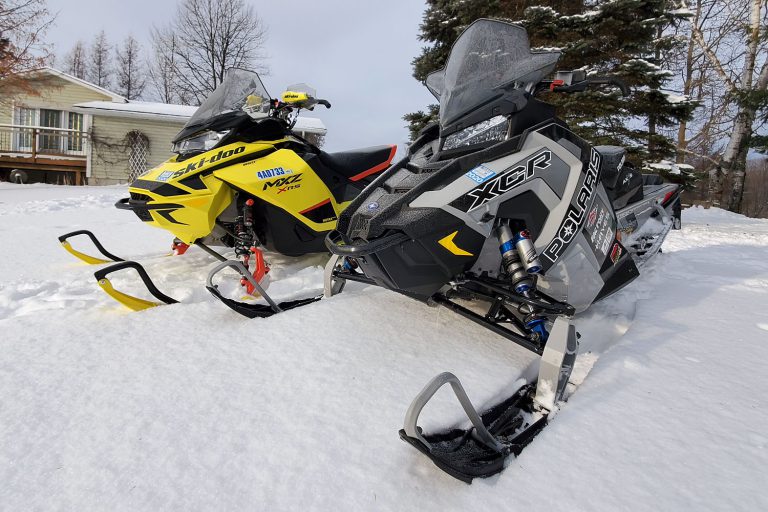
AJ takes two of this season’s top performance sleds out in the snow and goes over in detail all the features of each offering his opinions and feedback following our spring evaluations and actually getting some real world seat time aboard these two rockets after an early snowfall.

Subscribe to our YouTube Channel!

600 2-STROKES: Ski-Doo 600R E-TEC

0

Ski-Doo first introduced E-TEC Direct Injection technology to the sno-mo-industry in 2008. Originally developed in Austria by Ficht, BRP bought the former Outboard Marine Corporation (OMC) who owned Ficht and proceeded to adapt the technology to snowmobiles labeling it “E-TEC”. Up until this time the system had only been used on Evinrude outboard engines.

Here’s how E-TEC 2 stroke Direct Injection works:

FIRST, THE CONCEPT

Direct injection (DI) differs from all other 2 stroke induction systems in that absolutely no fuel enters the engine’s crankcase. The throttle bodies allow only air to enter the engine’s bottom end.

While air is pumped upwards to the combustion chamber via conventional transfer ports oil is pinpoint injected onto the rod bearings and piston skirt. This oil slowly migrates up the transfer ports and is ultimately burned.

Since so little oil is involved as a result of keeping fuel out of the scavenging process (which would normally wash down the bearings) there is almost zero smoke and odour associated with the system. Because fuel is injected so late in the 360 degrees of crankshaft rotation, virtually no unburned fuel escapes into the exhaust system.

UP TOP

E-TEC’s hallmark feature is its electronic voice coil injectors externally mounted on the cylinder head over the combustion chamber.

Voice coils use a similar process as stereo speaker magnets to produce pulses of fuel to the cylinders. The injectors pulses take fuel from relatively low pressure to over 2000 psi in less than the blink of an eye.

The voice coils literally hammer fuel into the cylinder with each pulse. The sled’s ECU (computer) adjusts the stroke of the voice coil injector pin to meet the engines demands determined by the ECU.

The “magic” of the E-TEC system is this. To ensure no unburned fuel escapes out the exhaust port the voice coil injectors are able to introduce fuel into the combustion chamber after the exhaust port is closed.

With only 15 degrees of crankshaft rotation left before the spark plug lights off the compressed fuel and air virtually no fuel escapes out the exhaust port.

Other than a higher cost to manufacture compared to other 2 stroke SDI injection systems there’s no downside to E-TEC. BRP is able to deliver the cleanest running, highest efficiency, low emission 2 stroke engines in the biz as a result of E-TEC’s sophistication.

One more E-TEC benefit is easy starting. Due to its high pressure injectors and high voltage electronics, an E-TEC engine only requires a 120 degree rotation of the crankshaft to start it. That’s why the revolutionary “SHOT” electric start system is possible. E-TEC atomizes fuel so efficiently the engine lights-off with only a tiny bit of crankshaft movement.

The new 600R engine with E-TEC sets the bar very high for snowmobile power and performance as well as efficiency and cleanliness.

600 2-STROKES: Arctic Cat’s 600 C-TEC2

0

Although it’s been around for nearly five years, Arctic Cat’s Dual Stage Injected (DSI) 600 is the most recent of the new-age EPA-friendly 600s in the snowmobile marketplace.

In order to understand the difference between DSI and SDI, you need to have an understanding of what is happening inside a 2-stroke as it moves through its cycles (see Part I), keeping in mind the position of the piston as it moves upward and downward closing and opening the exhaust port.

The general idea is to get the exhaust port closed off by the piston during compression and ignition and open again immediately after ignition to exhaust the ignited gases.

STAGE 1

Unlike Polaris’ SDI system, Cat’s engine locates the fuel injectors on the side of the cylinder and not inside the transfer or boost ports.

Also, the engine’s pistons have vertical slots machined into the side (skirt) facing the injectors. As the piston and slot passes through its cycle to bottom dead center and then proceeds upward again to the top of the cylinder, the injector sprays fuel onto the top of the piston.

It then proceeds to top dead center and is ignited (DSI has already mixed a small quantity of oil into the gasoline in the fuel rail).

Two things have been accomplished here: First, a very lean and relatively pure fuel charge has been delivered to the combustion chamber and, second, enough oil is present in the fuel charge to lubricate the piston rings and cylinder walls.

STAGE 2

As the slot passes the injector and the piston moves upward toward top dead center, at higher engine speeds the injector continues injecting gasoline (mixed with the aforementioned oil already pre-mixed in the fuel rail) through the slot where it targets the piston pin and top rod bearing. Because gasoline has a cooling effect, this also keeps crankcase temperatures low.

Meanwhile, oil is being pinpoint-injected onto crankshaft and lower rod bearings and is precision regulated as required by the ECU and the DSI’s electronic oil pump located in the oil reservoir.

Two more benefits have been accomplished in this second stage: 1. Adequate lubrication of the bottom end and 2. A cooler crankcase.

Despite the very good lubrication qualities of DSI, because it runs very lean, the engine still uses a knock sensor warning the ECU to slightly retard the engine’s timing if combustion chamber temperatures rise too high and cause detonation. Once again, the knock sensor operates so subtly you’d never be able to detect it working.

Special Note:

Some have asked the question: “What about the transfer ports? Does DSI even need them?”

The answer is, “Yes, absolutely!” Remember, the throttle bodies are still delivering air to the crankcase and the positive pressure of the descending piston is transferring the necessary oxygen to the combustion chamber via the transfer (boost) ports so the whole combustion process can work. DSI is mostly about fuel delivery but air delivery is normal 2-stroke science.

600 2-STROKES: Polaris Cleanfire 600

0

It seems like all you ever read about is the technology that goes into the industry’s 800 and 850 max-performance 2-strokes.

The truth is, the 600 twins from Ski-Doo, Polaris and Arctic Cat are huge sellers and probably deliver the most consistent and reliable power in the industry.

We’re going to do a 3-part report on the most popular 600s and attempt to relate how their technology differs and why.

PART 1: POLARIS CLEANFIRE 600

We’ll start at the beginning with the Cleanfire 600 because it’s been around for the longest time (mid 2000’s) and has continued to perform admirably, consistently delivering power in the 125-hp range. Polaris set the bar high with this engine and drove both Cat and Ski-Doo to come up with technology that could deliver clean 600cc power at the same level.

The Polaris Cleanfire relies on Semi-Direct Injection (SDI) technology that means fuel is injected not directly into the engine’s crankcase like a conventional EFI 2-stroke, but rather, into the transfer port.

Regular 2-strokes

Using conventional 2-stroke theory, transfer ports are designed to “transfer” the fuel charge from the bottom end (crankcase) up to the top of the piston, into the combustion chamber so that on the ignition (power) stroke, the compressed charge is lit off by the spark plug. This ignition explosion forces the piston downward.

After this happens, the positive pressure in the crankcase caused by the descending piston drives the unburned fuel charge back up through the transfers at the same time the other side of the piston passes by the exhaust port leaving it open.

The whole system is designed to allow compression (compression stroke) every other rotation of the crankshaft as the exhaust port is closed off by the ascending piston.

Conventional 2-strokes allow a lot of unburned fuel to enter the exhaust and the EPA is not satisfied with this old-style technology, deeming it unclean. That’s where SDI comes in.

Cleanfire Differences

Cleanfire SDI injects the fuel charge into the transfer port while the pressure from the descending piston is driving crankcase air upwards to the top of the piston.

The precise location of the injector inside the transfer (also called a “boost” port) allows oxygen and gasoline to be mixed at a particularly lean ratio – thus the clean-burning nature of the SDI. It’s one of the reasons why Cleanfire engines have such a sharp exhaust note – almost like a race engine that has been jetted very lean.

Bottom end lubrication comes from “pinpoint” lubrication where minute quantities of 2-stroke injector oil are precision pumped via an electronically controlled oil pump onto critical bearing areas in the crankcase.

Residual oil is transferred to the top of the pistons as the engine cycles so there is adequate lube for the cylinder walls and piston rings. At the same time, the crankcase is getting sufficient lubrication and is kept cool without the need for liquid-cooled cases.

With Cleanfire running such lean mixtures, the use of a an electronic “knock sensor” is required to retard the timing as combustion chamber temperatures rise or bad fuel is detected. These sensors are so advanced and so fine-tuned, the timing changes are almost imperceptible to the rider.

The sequential nature of the fuel injectors ceases somewhere above 5000 RPM and the ECU tells the engine to inject fuel every stroke as the bulk of power is being demanded. It’s at these higher RPM levels that full lubrication is needed the most and the electronic oil pump compensates.

BIG MOVES

0

These enlightenments are based on opinions gathered from staffers who spend their days propagating fiction and/or truth at the water cooler in the well-lit Supertrax/Snowtrax, fully deodorized research center.

WHAT SKI-DOO NEEDS

It’s pretty clear Ski-Doo has a near-stranglehold on market share in the snowmobile industry. The brand’s success is so profound it makes the suggestion it might actually need something a little risky.

Not too risky, though, so we’ll run with this thought: The G4 chassis is bristling with interesting and functional new technology. The G4’s engine selection is the most diverse and broad in the industry. The rMotion skid continues to be the benchmark for trail ride quality.

I digress. Here’s what Ski-Doo needs: Stop merely tweaking the G4’s regularly re-invented RAS double A-arm front suspension and produce a system that will rival the undisputed handling leader, Polaris.

Ski-Doo does so much that’s right, however, this one issue – front suspension handling on trails – continues to be less effective than Polaris’ AXYS IFS.

WHAT POLARIS NEEDS

This might be the easiest OEM suggestion. Polaris needs a 4-stroke. Clearly, Polaris has been on a roll the past four years netting the brand increased market share.

The success of the new Indy XC chassis with Pro CC suspension and legendary Polaris IFS up front has been pulling buyers back to the North Star brand.

Why? Because the sled works. The new 850 Patriot mill has set a new benchmark in the 2-stroke performance stakes and does it with less vibration than many 600s. These notable accomplishments have come without the presence of a single 4-stroke model.

So, if Polaris can grow in the face of a formidable competitor like Ski-Doo, which owns the 4-stroke market, why does Polaris need a 4-stroke?

Clearly there’s an increasing group of established enthusiasts who buy 4-strokes from the other three OEM’s on a regular basis. These buyers are now entrenched in the 4-stroke paradigm and will stay on 4-strokes for the rest of their riding days.

Don’t forget this reality. The best way to gain market share in this biz has been and continues to be targeting buyers from your competitors. Need I say more?

WHAT YAMAHA NEEDS

Yamaha needs more 2-strokes. Yep, that’s what I said.

Clearly the rebranding of Arctic Cat’s Norseman 600 DSI 2-stroke utility/sport ride created quite a stir with Yama-loyalists. The number of views generated from that article on supertraxmag.com was crazy.

So what exactly would be the right 2-stroke sled to intro? No question, no doubt, a rebranded Arctic Cat 800 M series with Alpha suspension.

In the same way Polaris has been doing what it’s done in this biz without a 4 stroke, Yamaha has been doing what it’s done without a mountain specific ride.

Like the 4-stroke market, the mountain market is simply too big to not address. The question begging to be answered is this: Does Yamaha need to build its own 800 engine or could it use Arctic Cat’s new SDI 800 twin? Yamaha does own a proprietary 2-stroke Direct Injection system called Yamaha High Pressure Direct Injection (YHPDI) and I have little doubt the company could spin out an 800 2-stroke twin in its sleep.

Having said all this, we think it makes more sense to get into the mountain genre with a rebranded AC engine and chassis and enjoy sales success before committing to a full-on Yamaha-built, 800 2-stroke.

WHAT ARCTIC CAT NEEDS

No doubt about it, Cat needs an updated rear suspensiion for its trail-based 129 and 137 ProCross models.

The venerable Slide Action skid used in these models has provided excellent ride sensations over the years but what has to be accounted for is this: The first ProCross sleds with this skid were delivered to the market in 2012. By my calendar, that’s eight years. In this business that’s simply too long without an upgrade.

For sure, the Slide Action front arm concept has been copied in the industry by Cat’s competitors, particularly on race sleds, and it’s proven the setup is a great idea that works and works well.

However, in the current marketplace, both Ski-Doo and Polaris have made huge strides with each of their rear suspension systems. I can’t imagine there isn’t a prototype skidframe sitting on a bench in Thief River Falls and ready to go.

With guys at the controls of Arctic Cat engineering like Brian Dick, a man who knows suspension and understands obsolescence, we gotta believe something interesting is in the wings.

A RANT ABOUT THE YAMAHA-CAT MIXTURE

0

So why is everybody so bugged because Yamaha uses Cat technology on most of its sleds? Frankly, we haven’t heard too many Arctic Cat fans going berserk because Cat uses Yamaha 4-strokes in some of its sleds!

Let’s go back a ways and look at some of the shared technology the industry has utilized over the recent past. For decades, Arctic Cat used Kawasaki and Suzuki engines in its snowmobiles and everyone was as happy as a clam.

One of the longest running and most popular engines in the history of snowmobiling was the Indy 500 2-stroke twin. That engine was unashamedly built by Fuji Heavy Industries of Japan. This is the same company that owned, built and ran Subaru – not even a snowmobile manufacturer, for crying out loud!

In the case of Yamaha, here’s a company that has put a huge amount of trust in a North American manufacturer employing American citizens and located in a small northern town called Thief River Falls, Minnesota. Furthermore Yamaha has entrusted that company to cradle its most precious commodity: Its jewel-like 4-stroke engines!

Not only the above but those two companies have proven they can work together in lock-step to build a better quality product at a competitive price that can benefit two distinct bloodlines of customers. This is something you just don’t hear about very often in any field and it’s really quite impressive – especially when there isn’t a lot of snowmobiling taking place in Japan.

I know, you’ll argue it’s not the same with engines; it’s different because the old Yamaha sleds were way better. But is it really not the same – and were the old sleds really better?

I remember some complaints about those sleds being too heavy – or certain sleds being out-of-date – or not changing fast enough year-to-year.

This manufacturing agreement has allowed Yamaha to have fully current, up-to-date technology, tested, tried and true and built by Americans in America where a lot of snowmobiling takes place, thank you!

Looping Mont-Laurier Quebec

0

Several winters ago, while saddle bagging through Quebec’s Laurentides Region, our crew overnighted in Mont-Laurier. I remember being very impressed with trail access into the town and the snowmobile-friendly feel of the place.

I’d also heard about the nearby Montagne du Diable, Devil’s Mountain. So when the time came last winter for a Supertrax destination article about staging day rides from a Quebec location, Mont-Laurier was a top choice.

The Town of Mont-Laurier (pop. 13,799) is located centrally in the Province of Quebec in what’s known as the Upper Laurentians. The Laurentian Mountain range extends from the Adirondacks in New York State and runs north of and parallel to the St. Lawrence River.

For those trailering in, Mont-Laurier is only 187 miles from Massena, NY and 238 miles from Burlington VT. It’s also 160 miles (250 km) northwest of Montreal and 134 miles (216 km) north of Ottawa, most of it uphill.

ABOUT THE TRAILS

We quickly discovered why Mont-Laurier and area is such a popular snowmobiling destination. Such renown starts with reliable and lasting, elevation-generated snow that averages 137 in (350 cm) each season. This wintery phenomenon enables over 1,560 mi (2,512 km) of well-maintained snowmobile trails, including several exceptional day loop options out of Mont-Laurier.

WHERE WE RODE

For our day ride visit, we looped north one day for lunch at Pourvoirie Meekos (Regional Trail 319) after checking out the Kiamika Reservoir (Local Trail 253).

Another day we circled east to The Town of Nomininque on Trans Quebec Trail 63 and took in the Chutes du Lac-Cunières (Local Trail 221).

Then we embarked on a third day’s ride westward to the Baskatong Reservoir (Regional Trail 322), Chutes du Windigo (Windigo Falls – Local Trail 228) and the must-see Devil’s Mountain (Local Trail 229).

Devil’s Mountain is the area’s premier attraction for snowmobilers. As the second highest elevation in the Laurentians after Mont-Tremblant, this peak features a panoramic south-facing lookout complimented by basic refreshments at the rustic relais perched on the mountain’s edge.

MORE RIDING OPTIONS

Each one of the loops we did could range from about 125 miles to more than double that, depending on which trails you choose. Most of these routes follow forest access roads and old logging corridors, which make exploring the Laurentian uplands even more of a treat.

Meanwhile, for those with more time, or who enjoy even bigger miles and wilderness riding, a network north of Mont-Laurier known as the “Wood Runner Trails” offers several longer circuits serviced by remote outfitters (“Pourvoiries” in French).

STAGING DAY RIDES

One of the major benefits of staging day rides from one location is not having to search for new lodging every night. Another is not having to pack up and leave each morning. But best of all is finding one location, for both town and lodging, that makes returning after a memorable day’s ride even more enjoyable. And that’s what we experienced in Mont-Laurier and at the Comfort Inn.

The Comfort Inn Mont-Laurier is located at the east end of town on the main street, Boulevard Albiny Paquette (Highway 117), beside Trans Quebec Trail 63.

Snowmobiles are allowed to travel on the south side sidewalk, so there’s good access to the same services available to automobiles along this thoroughfare.

Local residents are generally very welcoming of snowmobilers riding here, stepping aside or offering warm smiles. Meanwhile, snowmobile access to all the area trails and loops is just north or east of the Comfort Inn.

Mont-Laurier isn’t the only snowmobile-friendly town in Quebec. And Laurentides is only one of their eight regional choices of snowmobiling destinations. But both are top-notch examples of what makes La Belle Province so special. And why so many touring riders choose to snowmobile from Mont-Laurier in Laurentides again and again.

What’s more, this three-day adventure is an ideal choice for those wanting to take advantage of Quebec’s Free Weekend on January 18 & 19, 2020. And for those who love both snowmobiling and downhill skiing, why not combine them into one fun-filled family vacation? Mont-Tremblant is only 65 miles (105 km) down the road from Mont-Laurier!

Where We Stayed:

– Comfort Inn

Get More Info:

– Snowmobile In Quebec

– Tourisme Laurentides

– Quebec Federation of Snowmobile Clubs (trail permits & online map)

– Mont-Laurier Snowmobile Rentals

The Top Four Ski-Doo Snowmobiles for 2020

0

Motorhead Mark Lester takes a look at the top Ski Doo models from the following four product category: Performance Trail, Off-Trail, Mountain and Utility.

Subscribe to our YouTube Channel!

SKI-DOO VS POLARIS

0

It’s clear as crystal Ski-Doo is the snowmobile market leader right now.

Ski-Doo hasn’t missed a beat since the original 2003 REV hit the ground and stole number one sales and market share laurels from Polaris. Up to that time Polaris had held nearly a two-decade-long stranglehold on snowmobile sales market share.

In the late 1990’s, Laurent Beaudoin, then Top Gun of Bombardier (which included the aviation and rapid transit businesses at that time) and son-in-law to the iconic J. Armand Bombardier, had made it clear he wanted Number-One status back in the Ski-Doo camp.

As the story goes, Bombardier Recreational Products CEO and powersports visionary, Jose Boisjoli knew he needed two things to happen to satisfy Laurent Beaudoin’s call to arms and to elevate Ski-Doo back to leader status – something the company had lost in the early 1980s.

First, he knew he needed a game-changing snowmobile. The REV platform was that game changer, so much so that over the next few model years every OEM moved to imitate the REV’s now industry-standard “rider forward” ergonomics.

The second thing Boisjoli needed was for the current market leader to fall asleep. In what will go down in sno-mo-history as a strange aligning of the stars, that exact thing happened.

For reason’s too complex to delve into here, Polaris didn’t have the “next big thing” in its repertoire and was slow to respond to the arrival of the REV. Back in 2003, Boisjoli got his “two things” and, as they say, the rest is history.

BACK TO TODAY

In case you hadn’t noticed, Polaris has kept its head down while on a mission to increase market share. The company’s passion for these laurels appears to know no bounds.

Polaris has innovated engine designs, engine technology and has re-invented snowmobile suspension twice in the last ten years. The company has identified competitive areas it can “own” as Polaris distinctives, and bolstered those strongholds on an annual basis.

Specifically, those areas are:

1. Deep-snow performance leadership
2. On-trail handling leadership and
3. The lightest weight on virtually every sled it produces in every segment.

To see how far Polaris has come this decade is doubly remarkable, considering it does not have a 4-stroke snowmobile. We believe this may be about to change soon. Consider this: Ski-Doo sells more 4-strokes than Arctic Cat and Yamaha combined. That’s a lot of snowmobiles!

Despite this, Polaris has actually been gaining market share. Most importantly, for now it has grown its 2-stroke business rapidly.

The recent launch of the 850 Liberty engine has been nothing short of impressive. The new Indy XC platform with Pro CC suspension has brought back considerable numbers of former Polaris faithful who had drifted to other brands.

DOUBLE DIP

In our humble opinion, if Polaris brings a 4-stroke engine to the party, the company will be fully weaponized and ready to do nose-to-nose battle with Ski-Doo in every segment right down to the last sales contract.

My headline question was “Who is the competition?” I think it’s safe to say Polaris is Ski-Doo’s competition and even though you’ll never hear those two OEMs complain about gaining market share from Arctic Cat or Yamaha, it is clearly double-dipping when one of them gains it from the other!

At this point Ski-Doo knows it cannot take its enviable leadership position for granted. A wise marketing Guru once said to me: “Number One is not a destination, it is a journey!”