Home Blog Page 209

HOW IMPORTANT IS HORSEPOWER?

0

We’ve read emails and letters from our readers and viewers dissing certain sleds because their horsepower is lower than some competitive models.

It makes for interesting listening but we’re not sure horsepower alone is the defining factor making one snowmobile faster than the other.

Certainly, there are other important factors at play. Power-to-weight is a biggy. Provided drivelines are close to equally efficient, a heavier sled has to make more HP to beat a lighter sled with less ponies.

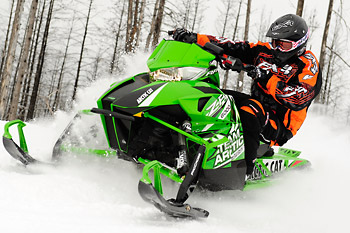
This is the case with say, the Turbo 9000 Cat and the 2-stroke 8000 Series. In a drag race, these sleds are mighty close and although the claimed power of both is about 15-17 horsepower apart, their weights are significantly different.

Here’s where it gets interesting. If you look at government EPA reports on snowmobile horsepower, by that rating system, every 2-stroke makes considerably less horsepower than the manufacturers claim. Meanwhile, the 4-stroke sleds tested report very close results to OEM claims.

Is someone lying? No. What is taken into account with the EPA system is a melding of torque and horsepower together.

Since 4-strokes make a ton of torque and 2-strokes tend to need RPM to generate big torque numbers, the duty cycle in which the EPA tests the sleds is different than what a performance shop would net on their in-house dynamometer.

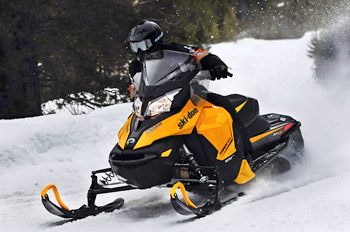
Here’s our point: There are a number of factors that dictate what makes a sled go fast. Just because an 800 Indy makes less power (155) than a Ski-Doo 800 E-TEC (162) doesn’t necessarily mean one is going to beat the other on a trip down the lake.
WHAT KIND OF LYNX COULD COME TO NORTH AMERICA?

0

If BRP were to bring Lynx snowmobiles across the ocean, what would they be like?

Keep in mind, the key word here is “IF”! However, you know us well enough that we’re always postulating theories and making up rumors about what the sled-makers might be doing.

We’re not sure if they’re reading our stuff or we’ve just been lucky, but it’s kinda amazing how close we’ve been to the truth over the years.

This Lynx thing just won’t die and we’re beginning to think there’s more truth here than fiction.

Just in case you didn’t know, BRP, parent company of Ski-Doo also owns another snowmobile company in Finland called Lynx.

The Lynx line-up is pretty amazing and although these sleds use much of the technology found in Ski-Doos such as engines, TRA clutches and basic chassis platforms, there are considerable differences in bodywork, chassis layout and suspensions (Lynx uses a PPS skidframe).

There’s enough difference that Ski-Doo actually sells its whole line-up in Northern Europe right next to the Lynx products and buyers there swear their preference for the Lynx.

We were wondering what kind of Lynx would appeal to the North American snowmobile buyer? We’ve ridden these sleds and have a pretty good idea what they feel and perform like (there is a notably different tactile “feel” to these European sleds).

For certain, suspension design is a whole new ballgame and since Europeans don’t favor trails the way we do here, the suspensions are not as compliant.

We think a really big upgrade in shocks and calibration would be necessary. Also, engine selections within certain model categories could be different. Lynx uses a lot of 2-strokes and fewer 4-strokes in its line-up.

Keep in mind, these sleds would be “true imports”, assembled entirely in Finland, not in Valcourt, Quebec.

800 E-TEC GSX SE or 1200 Grand Touring?

Dear Motorhead –

I own a 2010 Nytro XTX, but my wife wants to start riding with me once in a while, so this machine really doen’t fit for us.

To tell you the truth I am missing my 2-stroke punch and was thinking about the Bombardier GSX 800 E-TEC.

Will it be suitable for 2 riders with the optional 2-up seat? I am 275-lbs and my wife is 130-lbs and my Nytro supension can’t handle that weight.

Do you think the GSX will be able to or do I need to go to the 1200 Grand Touring and limit my fun when I will go out with only the boys?

Thanks in advance for your response,

Marcel

Hi Marcel –

Thanks for your email!

Your concern is valid. I would highly recommend you opt for the GSX SE with the all-new air ride r-Motion 137 skid. This sled will accept an optional 2 up seat and as a result of the adjust-on-the-fly air ride system, you will be able to ride in comfort with your wife.

You’re correct in assuming a GSX 120 inch with the 2 up seat will be less compliant with a 400 pound passenger load. You can bump up the preload on the rear torsion springs however I would suspect you’d need to swap out the torsion springs for an optional higher pound rated set. This may then affect your ride quality when you’re alone.

The 800 E-TEC is a great engine with exceptional fuel economy and strong performance. Don’t think a 137 will be less sporty when you ride with your friends – the 137 r-Motion is virtually impossible to tell apart from the 120 version under all trail conditions.

Hope this helps,

Motorhead Mark

ADAPTIVE SNOWMOBILE SEAT

0

Here’s a cool product that was brought to our attention at the Novi snowmobile show this past weekend.

Goodwin Adaptive Action Sports has developed an adaptive snowHere’s a cool product that was brought to our attention at the Novi snowmobile show this past weekend.

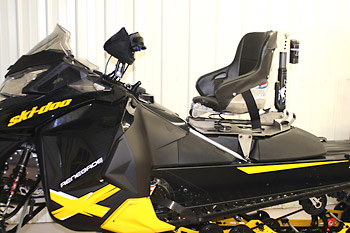
Goodwin Adaptive Action Sports has developed an adaptive snowmobile seat specifically designed for snowmobilers with a paralysis, loss of lower limb or for those with difficulty standing.

The cushioned high-back seat is supported by a Fox Float 3 for the every day trail rider or a Fox Float evol RC2 shock for more aggressive riders to deliver outstanding bump compliance. There’s also a buckling seatbelt to ensure the rider is kept securely in place.

The seat also pivots side to side to enable leaning into corners and turns and side springs assist in returning the pilot to an upright position while adding stability during straightaways.

Goodwin’s Adaptive Seat can replace the stock seat on Ski-Doo sleds between the years or 2008 to 2014. It bolts easily in place and requires no drilling.

Visit GoodwinAdaptive.com for more information.

IS SKI-DOO’S 900 ACE ENOUGH?

0

We’ve been fielding comments from our readers and viewers about the new 900 ACE triple Ski-Doo is offering this year.

We’ll fill you in on what we’re hearing but first, it’s important to understand where Ski-Doo is coming from engine-wise.

Right now, Ski-Doo is arguably delivering the most comprehensive line-up of EPA-certified snowmobile powerplants compared to all other competitors.

With two 2-strokes that are super-good on fuel and EPA-efficient (600 & 800 E-TECs), too plus three 4-strokes offering clean exhaust and good (or even incredibly good) gas mileage, it’s sometimes difficult for consumers to figure out which engine provides the best combo for their individual needs.

It’s tough to argue the 800 E-TEC at 163-hp is falling short of delivering high performance value. However, a significant throng of performance-minded Doo-ers are opting for the over-achieving 4-TEC 1200 triple that makes 130-hp and a boatload of torque. Up to triple digits, 4-TECs are fast!

Likewise, if you’re getting out your checkbook this year for a new sled and you want to cruise trails, it’s tough to decide whether the 600 E-TEC or the 900-ACE is a better fit for your riding style. Prices on these two are pretty close.

Yes, the E-TEC is way faster (120-hp), but for long engine life, smoothness and all-day trail speeds, the 900 ACE (90-hp) makes incredible sense.

We were surprised so many Supertrax followers were so positive about the 900 ACE. We thought this performance range might be short of a bell-ringer for the snowmobiling masses.

The majority of those who reported in told us they would seriously consider this engine for their next Ski-Doo because it delivers power within a range in which they like to ride.

You can read some of those comments on this website in the article: 2014 Ski-Doo GSX LE ACE 900 (October 19, 2013).

Most of these were from people who hadn’t had the opportunity to put many miles on one so we’ll post more responses when the snow comes and the real production ACE 900s are on the trails.

POLARIS LIGHTENS UP ITS 550 LINE-UP

0

What was previously known as the IQ 550 is now, for 2014, the Indy 550.

The IQ 550 fan was a credible fan cooler, however, if you could drop more than 25 pounds from a sled and get better handling, better ride and improved performance – wouldn’t you?

Polaris took its Indy 600/800 chassis, a hybrid variant of the Pro-Ride RUSH platform, and slid its reliable 550cc fan mill inside.

The new Indy chassis employs what appears to be the same 121-inch coupled, dual shock, torsion spring skidframe used in the IQ. At the front, the uber-light cast bulkhead and all associated bodywork and front suspension are RUSH.

A major change is the use of a new CVTech PowerBloc, rubber-puck-style primary clutch and a new Invance secondary.

Yes, these appear to be cost-down items but the performance here is not just good, it’s doggone impressive!

Last spring, at six thousand feet elevation, the Indy 550 would wind up to an indicated 70-per without missing a beat.

Acceleration and backshifts were strong and the light feel of the chassis was undeniably a big step up from the heavier IQ platform.

If you want more flotation, the same sled comes with a 144 x 1.35 Cobra. It’s called, not surprisingly, the Indy 550 144.

The skid is dual shock, uncoupled and provides stupid flotation for an already featherweight sled.

Polaris Winning Riders Program

0

For the ninth consecutive year, state and provincial snowmobile organizations across North America are receiving contributions from the Polaris Winning Riders program, which generates support for the state association user groups based on sales of new Polaris snowmobiles.

From Newfoundland to Washington and Alaska to Quebec, snowmobile associations are receiving Winning Riders funds proportionate to the number of new Polaris snowmobiles sold within each state and province. Polaris is making contributions to snowmobile associations in 12 Canadian provinces and territories and 25 states in the United States.

Polaris also announced it is extending the Winning Riders program through the 2014 sales season, meaning contributions will be made next year based on retail sales of new Polaris snowmobiles between April 1, 2013, and March 31, 2014.

“The passion for snowmobiling is running strong across the North American snowbelt,” said Mike Jonikas, VP of Polaris Snowmobiles, Sales and Corporate Marketing. “We see real benefits in supporting the associations that coordinate activities of snowmobile clubs and help develop great riding opportunities.”

Polaris makes the Winning Riders contributions with no strings attached, allowing each state or province to decide how to use the funds it receives.

Projects funded by Winning Riders donations in recent years have included membership drives, trail and grooming programs, legislative efforts, tourism promotion and more.

Polaris is a recognized leader in the powersports industry with annual 2012 sales of $3.2 billion. Polaris designs, engineers, manufactures and markets innovative, high quality off-road vehicles, including all-terrain vehicles (ATVs) and the Polaris RANGER and RZR side-by-side vehicles, snowmobiles, motorcycles and small vehicles. Polaris is among the global sales leaders for both snowmobiles and off-road vehicles and has established a presence in the heavyweight cruiser and touring motorcycle market with the Victory and Indian motorcycle brands. Additionally, Polaris continues to invest in the global on-road small vehicle industry with Global Electric Motorcars (GEM), Goupil Industrie SA, Aixam Mega S.A.S., and internally developed vehicles. Polaris enhances the riding experience with a complete line of Polaris and KLIM branded apparel and Polaris accessories and parts. Polaris Industries Inc. trades on the New York Stock Exchange under the symbol “PII”, and the Company is included in the S&P Mid-Cap 400 stock price index.

Information about the complete line of Polaris products, apparel and vehicle accessories are available from authorized Polaris dealers or anytime at www.polaris.com.

YAMAHA & CAT: SO WHAT’S THE BIG DEAL?

0

There’s been a lot said about the Arctic Cat-Yamaha deal where the two companies have combined to build engine and chassis platforms for one another this year.

Some of our readers and TV viewers have been pretty outspoken about the fact they don’t like it.

Some Cat owners say they don’t like the idea of owning a ProCross with a Yamaha engine under the hood and some Yamaha owners who disapprove say they’d never buy anything that wasn’t pure Yamaha.

Keep in mind, the majority of both Yamaha and Cat owners think the idea is amazing and a giant leap forward for both. However, to those who can’t wrap their minds around the concept, we’d like to point out a few footnotes.

First, you need to realize the two companies have been working very closely together on the development of these sleds. Yamaha engineers and production experts have been on the ground in Thief River Falls, regularly and have had incredible input into what the ProCross based Viper will end up like.

This means that at every stage of production Yamaha’s production people have been involved in manufacturing supervision and testing.

The last thing Yamaha wants is for the Viper to exude a lack of quality, reliability or delivery of what Yamaha customers have come to expect.

Likewise, Arctic Cat has had tremendous input into the adaptation of the Yamaha engine and driveline to the AC chassis. Cat’s engineers have gone back and forth with Yamaha’s people to ensure the new Viper and 7000-series will perform to their maximum potential.

Think about it: It’s only in Cat’s best interests to have a Viper that is everything Yamaha customers want. Will one be faster than the other? Dunno. Will one be more reliable than the other? Dunno.

We do know one thing: Those who buy these new sleds are going to get breakneck service from both sides to ensure they are completely satisfied.

4-STROKE MARKET MOVING FORWARD – FAST

0

It’s been over ten years since the first mass production 4-stroke snowmobiles arrived and the game has changed considerably in that time.

Perhaps the biggest issue is how well 4-stroke engines have gained acceptance in the snowmobile marketplace against the long-entrenched 2-stroke.

Many who would never have entertained owning a 4-stroke in the mid- 2000’s are looking at them long and hard now.

Certainly, there are distinct advantages to 2-strokes such as lightness and efficiency and the OEMs have done an incredible job of perfecting semi-direct and direct injection systems to keep the performance high and the emissions low.

However, the average snowmobiler seems to be much more open to the idea of owning a 4-stroke than they were even five years ago.

One of the reasons for this has to be the track record of reliability these engines have delivered over the past decade.

Fact: Stock sleds with 4-strokes that have had decent owner-care tend to be in about the same running shape as they were when they were new.

Even those ones with extremely high miles tend to be running strong and performing well. Hate to say it but high mileage 2-strokes just don’t have the same durability record.

Resale has also been super strong on used 4-strokes and prospective buyers tend to be more willing to risk money on a used one than on a 2-stroke.

We think snowmobiling is all about fun and less about the practical considerations but lets face it, this is an expensive activity.

If you can get strong performance, decent handling and good gas mileage, it just makes sense riders are going to look at 4-strokes long and hard.

Right now the market is about 25-percent 4-stroke. Pretty soon the naysayers are going to have to pay attention and give 4-strokes the credit they deserve.

2014 INDY 800 WILL SURPRISE YOU!

0

The Indy 800 feels like a featherweight and is entirely flickable both on trails and in powder.

We don’t think it could feel lighter if it had a fan-cooled mill under its hood. Its handling response and its easy steering effort results in almost one-finger steering control.

This sled feels incredibly light because, oh yeah, forgot: It is light. Dry weight is only 449 pounds and with a full load of coal (11.5 gal) and some injector oil in the tank, its mass comes in at less than 530 lbs.

The combination of Polaris clutching, an extremely slippery, friction free drive system and the correct weight delivers a surprisingly fast snowmobile.

How fast? We would offer this advice: If you own a current Arctic Cat, Ski-Doo or RUSH 800, do not challenge an Indy 800 owner to a race for pink slips.

That’s all we’re saying. This sled is fast and will surprise you.

THE ABOVE IS AN EXCERPT FROM THE UPCOMING ISSUE OF SUPERTAX (AVAILABLE NOVEMBER 4, 2013)