Home Blog Page 141

Ski-Doo Enduro EX-2 Helmet For 2018

0

Ski-Doo snowmobiles is adding a new helmet to their line-up for model year 2018, the versatile Enduro EX-2 model that delivers performance in all conditions.

The Enduro EX-2 combines many features found on other helmets with some new ideas and crisp styling for a helmet unlike anything else. The look is familiar to the adventure motorcycle world, but the heated dual lens shield gives it snow world credibility.

Add to that the retractable tinted sunshade that’s interchangeable and what separates it from the pack becomes more apparent.

Other features snowmobilers will appreciate include an oversize air deflector on the chin, easy adjust air vents that can be completely closed on cold days and the aerodynamic visor that can be easily removed or reattached.

Construction is of an advanced composite outer shell, multi density EPS liner and ultra comfortable, removable and washable Dri-Lex inner liner.

Pricing is $279.99 USD/$364.99 CAD

HOW CHEAP CAN A SLED BE BUILT?

0

This is a huge question in our sport and one that frankly, is sort of baffling.

For the last decade the OEM’s have been offering a few sleds in their line-ups that come under the category of “price bargains”.

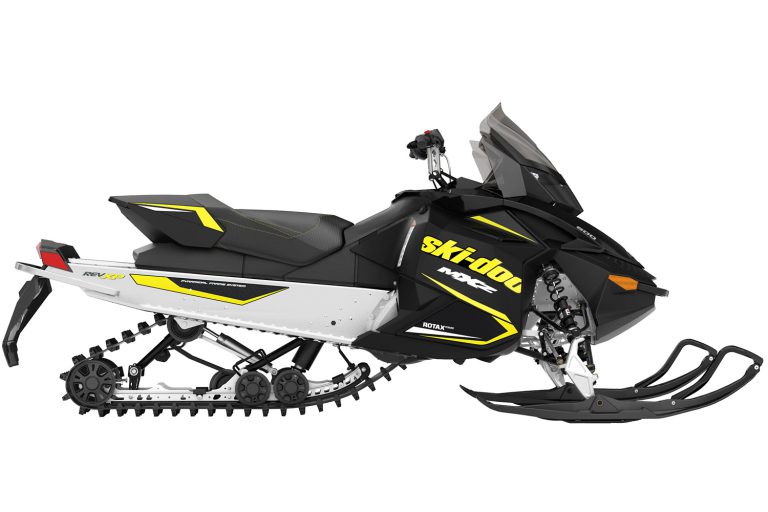
Certainly, the 550 and 570cc fan cooled 2-strokes offered by Cat, Polaris and Ski-Doo have fallen into that category and the Polaris Indy 600 and Ski-Doo’s XP-based MX-Z and Renegade 600 carb are attractively priced – or are they?

Each sled is purely a case of getting less for less: Less horsepower, less technology, less suspension sophistication, less electronics, for less bucks. It just makes sense the OEMs cannot offer a lower priced sled with the same equipment as a brand new all-bells-and-whistles highly equipped model. Lack of equipment is one of the factors that helps them keep the price low on those select models.

The second factor for cheaper prices is sales volume. If the sales numbers on a low-priced sled are high enough, the sled remains profitable. However, if demand for those sleds drops off, it becomes more costly on a per-unit basis to keep offering it.

Here’s the rub: In comparative studies, those bargain sleds are not increasing in sales volume. When it comes to what we used to call “entry level fan-cooled sleds”, those are being rapidly replaced by identical power-output (60-65-hp) 4-strokes that are actually rather expensive. You, the customers, are actually opting for a higher priced sled that offers the same range of power. Maybe you’re thinking about payback in lower gas and oil consumption. Makes sense.

Likewise, when it comes to the choices in liquid-cooled 600cc sleds, the masses are buying the latest, teched-out models instead of the lower priced ones. This isn’t a bad thing, but it doesn’t always bode well for new people coming into the sport.

The cost of becoming a snowmobiler is already high and sno-mo-shoppers need new, reliable alternative sleds to entice them into the marketplace.

We sure hope there are either new value sleds in the pipeline or the OEMs will bite the bullet and keep building the ones we already have for a while longer.

Timbersled Snow Bike Engine Oil

0

Timbersled has released a new 4-stroke engine oil aimed specifically at the snow bike market.

The industry’s first 4-stroke snow bike oil, Timbersled Full Synthetic 0W-40 4-Stroke Engine Oil features an advanced moisture control additive package engineered to emulsify moisture and prevent corrosion and engine wear, a common problem found in snow bike applications.

Blended from full synthetic PAO and Ester base stocks, Timbersled Full Synthetic 0W-40 4-Stroke Engine Oil offers easy starting, advanced lubricity and is highly shear stable to withstand the extreme temperature fluctuations that occur in snow bike use.

Timbersled Full Synthetic 0W-40 4-Stroke Engine Oil features include:

* Engineered from PAO and Ester full synthetic base oils, resists shear and provides superior lubrication and anti-wear protection under extreme conditions

* Full synthetic 0W-40 formula offers easy engine starting in cold temperatures and superior engine protection in high heat and high load situations

* Advanced additive package emulsifies moisture buildup commonly found in 4-stroke snow bike engines to maintain lubricity and protect internal engine components

* 4X more corrosion and storage protection vs. leading aftermarket 4-stroke powersports engine oils

* Optimized wet clutch additives prevent slippage and glazing in heavy load and/or race applications

Timbersled Full Synthetic 0W-40 4-Stroke Engine Oil is recommended for use in all 4-stroke snow bike applications. It will be available at Timbersled dealers and online beginning November 2017.

Polaris Industries Inc. (NYSE: PII) is a global powersports leader that has been fueling the passion of riders, workers and outdoor enthusiasts for more than 60 years. With annual 2016 sales of $4.5 billion, Polaris’ innovative, high-quality product line-up includes the RANGER®, RZR® and Polaris GENERAL™ side-by-side off-road vehicles; the Sportsman® and Polaris ACE® all-terrain off-road vehicles; Indian Motorcycle® midsize and heavyweight motorcycles; Slingshot® moto-roadsters; and Polaris RMK®, INDY®, Switchback® and RUSH® snowmobiles. Polaris enhances the riding experience with parts, garments and accessories, along with a growing aftermarket portfolio, including Transamerican Auto Parts. Polaris’ presence in adjacent markets globally include military and commercial off-road vehicles, quadricycles, and electric vehicles. Proudly headquartered in Minnesota, Polaris serves more than 100 countries across the globe.

Visit polaris.com for more information.

THE CHANGING FACE OF SNOWMOBILING

0

Regular readers of Supertrax know I’ve been crowing about the emergence of the “Free Rider” and his or her predisposition to ride off-trail with different expectations than those of past participants.

I’ve heard positively from younger riders – exactly the demographic our sport is looking to attract and I’ve also heard from snowmobilers of the median and older age demographic who disagree with my assertion we should try to embrace the freeriding legions.

Interesting to me that those who think we shouldn’t embrace any attempt to accommodate the freeriding demo offer up virtually no alternatives. Before you fire up your keyboard with hate mail, let me explain.

This emerging demographic is exactly what the sport must attract for longterm sustainability. We need these younger, affluent participants. We need them badly and we need them now.

Does this make older, traditional snowmobilers bad people? No and in fact we must tread carefully here. The sport would not be what it is without this important generation of trail building, trail riding, club-centric participants.

Truth is, we need these people to teach younger participants about trails, land use, land access, grooming, trespassing and dozens of other foundational issues surrounding the sport.

Unfortunately, an amicable marriage of the older with the younger isn’t happening.

I attend a number of snowmobiling events each year that revolve around state and provincial trail sanctioning and governance. Important issues of trail funding and trail development, groomer purchasing and groomer funding are just a few of the issues these high level meetings wrestle with.

Sadly, the average age at many of these forums continues to climb year after year. That’s not to say there isn’t new, younger blood emerging, but the new blood we’’re seeing isn’t in the volume needed to ensure our sport remains the number one trail based motorized recreation in North America.

On the up side, we’re seeing a healthy increase in younger participants on the trail the past five winters as well as younger participants bolstering our social media channels here at Supertrax Media Inc, which is both encouraging and exciting.

Here’s where it’s not so good: I talk to these younger riders all season long on the trail, in pit stops and at events. They are passionate about snowmobiling but many don’t appreciate the current rejection of their interpretation of the sport. They want to know what’s next for snowmobiling. In reality they are already defining the “what’s next” without the support or approval of the sport’s stalwart, mature demographic.

There’s another issue with younger riders: Many in this generation have little free time and as a result are not interested in attending meetings and conventions or contributing to the betterment of the sport’s most important asset, trails.

To maintain lifestyles, moms and dads work full time. Snowmobiling is still part of their lifestyle but the time required to take on club leadership just isn’t there. Instead, many would rather pay more for trails and not be expected to contribute to their sustainability the way the older generation has.

Frankly, time is flying by. Trails are being lost from inconsiderate, unregulated, illegal off trail riding. At the same time little direction or answers have come from state and provincial sanctioning bodies to manage the much maligned, growing snowmobile genre called “freeriding” – unless you count “no” as an answer.

While this is going on, the people we’ve taken for granted who anchor the sport from the club and association level are getting older and less likely to continue working.

With sales of freeriding sleds and flatland deep snow sleds growing every year, it’s time to look the new and changing face of the sport straight in the eye.

REACH FOR THE SUMMIT SHARED EXPERIENCES

Congratulations to Ryan Peitzsche for sharing his REACH FOR THE SUMMIT experiences! Ryan picks up the Cyclops GEAR CGX2 4K Wi-Fi Action Camera! A great camera for capturing your experiences!

Ryan writes:

On May 2nd, 2016 my wife and I lost everything we owned in the wild fires in Fort Mcmurray including my Aerocharged 2015 T3 174 monster, which I’ve replaced with the new 850 154.

Sledding has always been my passion and since our loss I have pushed myself to become a more aggressive rider in all areas. I started sharing some of my pictures and videos on social media and then a fella named Joe Gill reached out to me and asked me to be part of the High Country Octane film crew. I sent him some footage and now I have some epic clips in the Sleddiction 6 sled video.

The main reason I’m sharing this story with everyone is because even though life changing events can bring you down, there is nothing like throttle-therapy and exploring the back-country with good friends to bring you back to life and make you feel good again!

Submit your story at at supertraxmag.com/summit and enter Enter and you can WIN an all expense paid mountain riding adventure at CKMP (Carl Kuster Mountain Park) in beautiful British Columbia, Canada. While there you’ll not only enjoy 5 star accommodations, you’ll also get to hang out and ride with Ski-Doo Mountain Ambassadors Carl Kuster, Rob Alford and Tony Jenkins.

The lucky winner will also star alongside Luke and AJ Lester in a feature story on SnowTrax Television and be the focus of an article in Supertrax Magazine.

WHAT’S THE DEAL WITH TURBOS?

0

Every year we examine the progress of high performance sled sales and try to gauge the sizzle factor of certain models.

There’s no question, in the high performance category, sizzle is a big factor when a customer walks into a dealer’s showroom. As a matter of fact, when the sales contract is being filled out and the checkbook is on the desk, it can completely cloud some buyer’s minds and convince them it’s worth it to spend extra big bucks.

Sizzle is a powerful, magnetic force in snowmobile marketing and it’s one of the reasons sleds are so brightly colored and have blinding graphics.

Probably no other industry development has influenced sizzle like turbocharged sleds. Why? On one hand there are reasons these sleds are kinda impractical.

For instance, the price tag is always pretty intimidating. Then there’s the weight factor. Snowmobilers are obsessed with weight and when you factor in a 4-stroke engine and a turbocharger and its plumbing, the whole weight-saving thing goes out the window.

It leaves one common factor: Power. Turbocharged sleds put power into the stratosphere. Back in the day Cat was getting 110-hp out of a 600cc 4-stroke triple and then Polaris came with a 750 twin that made 140 and boosted itself for short intervals to 180.

Meanwhile, Cat had evolved its Suzuki turbo program into sleds capable of generating power mighty close to 200-hp (claimed 177). The latest Yamaha SideWinders and 9000 Series Cats are openly confessing their 180-hp claims are actually pretty much actually 200-hp.

This kind of power is what becomes totally arresting and makes potential buyers see themselves as power kings within their riding groups. Shoot, if it isn’t fast enough stock, you can just add a chip and some tweaking and drive the power up close to 300-horses!

As much as the lightness of 2-strokes is appealing, the limitless power of a turbocharged 4-stroke is simply mind-boggling. You just can’t count on getting that much power from any other engine configuration in snowmobiling!

YAMAHA’S ENTRY-LEVEL SLED

0

Yamaha revisited its SnoScoot this year and it looks like it will be a blazing success, filling a long awaited market gap.

However, the company needs to offer a full-sized model that appeals to mainstream buyers who aren’t necessarily interested in blistering speed but want comfort, fuel economy, a reasonable price and an acceptable level of engine performance.

An overview of the marketplace indicates there’s a niche out there for a 4-stroke sled in the 90 to 110-hp range.

It’s hard to ignore the success of Ski-Doo’s 90-horsepower 900 ACE in its MX-Z and Renegade models. These sleds are strong sellers and account for some big numbers. Owners are really happy with all aspects of those sleds and Ski-Doo claims it’s the reason they are dominating in 4-stroke sales.

Yamaha has the raw goods to build a snowmobile that could steal some of the ACE’s thunder. Naturally, they could begin with a lightened version of the SR chassis built by Arctic Cat.

Weight could be pared in the skidframe by using Yamaha’s own SingleShot system but besides the chassis changes, utilizing its naturally-aspirated (non-turbocharged) version of the 1000cc triple used in Yamaha’s off-road YXZ Side x Side would deliver horsepower in the 110-hp range. This is a beautiful engine and would have incredible sizzle with the troops.

Yamaha also has its own roller clutch developed for the SideWinder that would be a great asset for a snowmobile in this power range.

By going with a less premium shock package, a simpler instrument layout and a few less bells and whistles, pricing could be kept under control.

Besides, have you checked the retail prices on ACE 900s? Those sleds aren’t necessarily cheap – but they sell like hotcakes!

SKI-DOO’S NEXT 4-STROKE

0

This year we’ve been waiting for Polaris to come to a decision on whether or not it will bring a new 4-stroke to snowmobiling, however, an even bigger big 4-stroke issue has to do with Ski-Doo.

The company tells us it leads the industry in 4-stroke sales with its 1170cc 4-TEC triple and its two ACE engines in 600 and 900cc configurations.

We wouldn’t even be asking the question if Ski-Doo hadn’t brought an extremely updated new G4 chassis to market, housing its 2-stroke engine selection. So far, all Rotax 4-strokes are offered only in the now-outdated XS platform.

What makes the question interesting is the fact the G4 platform has very little width allowance, even for a 2-stroke. The way the engine bay is laid out, narrow is the vogue and the new E-TEC 850 and any future engine designs will likely use the E-TEC’s “flat stator layout” that greatly reduces width.

It seems pretty clear that if Ski-Doo were to use the current 1170 and 900cc triples in the G4, there would have to be some pretty severe changes made to accommodate those engines.

We find it hard to believe, given Ski-Doo’s sales success in the 4-stroke segment, it didn’t think about this already. Two years in with the G4, we’re guessing Ski-Doo has been working on a new 4-stroke chassis design for the last three or four years, at least.

Ski-Doo certainly isn’t willing to see its 4-stroke customer base walk away from the brand because it isn’t offering the latest technology. It seems logical the company would merely design a wider front bulkhead to house the 4-strokes it already has. However, it wouldn’t surprise us either if Ski-Doo has an all-new engine, narrower and in the 1000cc range based on the ACE design, that will fit a new “G5” 4-stroke-only platform.

Ski-Doo never takes small bites out of the competition. Its next generation of 4-strokes could be radical!

THE NEW INDY

0

We’ve been speculating for a couple of years now whether Polaris will create a new-generation Indy anytime soon.

The success of the Assault 144, built on the AXYS platform is a strong argument a new Indy could have it all.

The Assault 144 has proven you can have a great riding shock-in-skid Polaris with all the lightweight benefits of AXYS. We can’t help but think it would be a no-brainer to apply the same tech to a new 129-inch Indy.

However, would that be enough to grab the wallets of the snowmobiling masses? Good question.

Certainly, there are a number of potential customers out there who love the handling, looks and lightness of the RUSH or 137 Switchback but can’t get their minds around those sleds’ unconventional Pro-Ride back ends.

Let’s face it, there are shock-in-skid systems that work pretty darn good and some of those RUSH shoppers are too easily migrating over to Ski-Doo and Cat.

Don’t get us wrong, we’re not saying this is the end of Pro-Ride. Nope, Polaris has evolved this suspension to near-perfection and there are thousands of converts who swear they’d ride nothing else, period.

We think one possibility may be the above-mentioned changes to the Indy but the Indy could become Polaris’ new 4-stroke chassis. Don’t stop reading yet; here’s the logic:

Polaris sells a ton of work-duty Indys with 550 fan-cooled engines in them. The competition has pretty much gone to small displacement 4-strokes like the ACE 600 and Kymco 700 twins for this segment and it would make the Indy a unique offering for Polaris with combined models accounting for significant volume.

If the same principle was applied to a turbocharged 4-stroke Indy for the performance market, we’d be real happy about that, too.

THE NEW TRACK LENGTHS

0

It wasn’t that long ago every trail sled had a 121 or 120-inch track (actually, both are the same length but there’s a difference in the pitch of the track where the drive sprockets engage it and the measurement on the snow can vary by less than an inch).

All quibbling aside, in the last decade there’s been a big shift over to baseline track lengths that measure 129-inches. It began with Arctic Cat first, then with Yamaha, then Ski-Doo and today the only OEM not offering a 129 is Polaris.

In reality, the on-the-snow footprint of a 129-inch track is about 3 to 3.5 inches more length compared to a 121. It’s not a lot but given the fact many sleds continue to drop weight, it can make a significant difference in the way a snowmobile handles powder snow and in its ability to accelerate and bite into packed snow.

One thing that’s made the 129 transition so successful is the fact it doesn’t appear to compromise handling. This may not necessarily apply to those multitudes that are choosing 137-inch trail sleds over either 120 or 129ers.

There’s a pretty big difference in the contact patch of a 137 compared to a 120 (between 6 and 7-inches on the snow) and this additional track length will numb down the sharpness in a sled’s steering response.

We’ve talked to many riders who tell us they are opting for a 137-incher as their first choice because a 129, although their second choice, doesn’t give them the off-trail versatility they’re looking for. The compromise in handling is acceptable to them for the deep snow benefit they gain.

Another interesting development is the crossover market appears to be a jumping ship from 137-inch tracks to 141, 144 and 146-inchers. New sleds like Cat’s High Country (141), Ski-Doo’s Renegade Back Country (146) and Polaris’s Assault 144 all offer excellent handling and great trail suspensions with longer tracks.

We think trail sleds will all be 129-inches soon and the crossover market will be exclusively 140-plus. We do doubt however, true crossover (trail and powder) track lengths will exceed 146-inches.