Home Blog Page 84

Arctic Cat Announces Model Year 2021 Snowmobile Lineup

Arctic Cat Inc., a Textron Inc. (NYSE:TXT) company, announced today one of its most exciting Model Year lineups to date.

To fill a gap in the snowmobile industry, Arctic Cat is offering a 2021 lineup headlined by the true mid-size BLAST models, designed for both performance and value. The 2021 offering also has several new models and enhancements to existing vehicles.

Arctic Cat Inc. operates as part of the Textron Specialized Vehicles business.

“Arctic Cat is back in a big way,” said Craig Kennedy, Vice President, Arctic Cat for Textron Specialized Vehicles Inc. “The 2021 lineup is a true testament of our dedication to the snowmobile industry, our customers and the brand. Our engineering team in Thief River Falls has been working tirelessly to create innovative new products that appeal to not only today’s snowmobile rider, but tomorrow’s potential enthusiast.”

All three models in the new BLAST lineup — the mountain BLAST M 4000, trail BLAST ZR® 4000 and sport-utility BLAST LT 4000—are true mid-size vehicles powered by the industry’s first electronic fuel-injected, single-cylinder, 2-stroke engine – the 65+ HP-class C-TEC2™ 4000, with 397cc of power.

Riders will enjoy much of the same technology found in BLAST’s full-size counterparts, such as the Arctic Drive System™ and Arctic Mountain Suspension™ (AMS); the mountain version also features the revolutionary ALPHA ONE™ suspension system. And with a smaller chassis, these models offer better visibility and handling that is easy to maneuver and fun to drive.

BLAST is the perfect entry-level option for the customer looking for a sub-$10,000 sled or the experienced rider who wants an easy-to-ride snowmobile that is a blast to ride.

Also new for 2021 models:

* The crossover Riot X model receives the ALPHA ONE suspension system, for increased handling in deep snow.

* The mountain lineup sees the addition of the revolutionary, adjust-on-the-fly ATAC™ (Previously called iACT) suspension system on the M 8000 Mountain Cat ALPHA ONE.

* For the utility market, Arctic Cat is reintroducing the Norseman X 8000, that offers big power and functionality.

Arctic Cat’s Snowmageddon pre-order only sales event returns for 2021. This year, Arctic Cat has lengthened the order window, announcing vehicles earlier in the season and providing more demo opportunities to consumers. This allows potential customers more time to make their purchase decisions.

All 2021 Arctic Cat snowmobiles are available by pre-order only, through the Snowmageddon event. For more information, visit a local Arctic Cat dealer, go to ArcticCat.com or join the conversation on Arctic Cat Snowmobiles’ Facebook, Twitter, YouTube and Instagram accounts.

The Arctic Cat brand is iconic in the powersports industry, with nearly 60 years of designing and manufacturing leading snowmobiles, side-by-sides and ATVs that are renowned the world over for their power and performance. Arctic Cat snowmobiles, side-by-sides, ATVs and affiliated products are designed and manufactured in Thief River Falls, Minn. by Arctic Cat Inc., a Textron Inc. (NYSE: TXT) company that operates as part of Textron’s Specialized Vehicles business.

For more information, visit: arcticcat.com.

Textron Inc. is a multi-industry company that leverages its global network of aircraft, defense, industrial and finance businesses to provide customers with innovative solutions and services. Textron is known around the world for its powerful brands such as Bell, Cessna, Beechcraft, Hawker, Jacobsen, Kautex, Lycoming, E-Z-GO, Arctic Cat, Textron Systems, and TRU Simulation + Training.

For more information, visit: textron.com.

YAMAHA 2-STROKE OUTRAGE

0

We recently posted an article about the possibility of Yamaha introducing a full-on trail-class 2-stroke sled next year entitiled 2021 YAMAHA 2-STROKE.

As usual, it stirred up the pool of Yamaha fanatics who are still offended that Yamaha builds sleds on Arctic Cat’s ProCross chassis. Jeepers, this is after seven model years! Try to get a grip.

There are some facts Yamaha riders need to understand about this melding of the two companies. First, Yamaha hasn’t been involved with Arctic Cat in a vacuum.

Yamaha’s engineering team has been working and walking in lock-step with Cat since the beginning on pretty much every sled with a “Y” on the hood.

The relationship has been a good one for both companies because a multitude of Yamaha’s specialized manufacturing methods and procedures were handed over to Arctic Cat to meet the standards Yamaha required.

This process took a couple of years to get perfected but the net result is a much better built, better finished, more reliable product for Arctic Cat and the continuation of the high quality image Yamaha has always maintained.

Further to this, many enthusiasts believe Yamaha sleds and the Cat sleds are exactly the same. Not true. Yamaha’s specifications for calibration on suspension, clutching and overall electronics performance are uniquely different.

Yes, a lot of the design stuff used in production sleds may have been laid out by Arctic Cat but it was always delivered in co-operation with Japan.

The fact is, many of the features you’ve seen on Arctic Cats were initiated by Yamaha. Things like engine electronics, gauges and switchgear – even suspension designs and features were either approved or developed in complete co-operation with Yamaha.

One reader commented: “Arctic Cat is hardly even using Yamaha engines anymore”. This is partially but not completely true. As time has moved forward the two companies are seeing that Yamaha’s unique gifting is in designing and marketing 4-strokes and Arctic Cat’s is in doing the same with 2-strokes.

Naturally, Cat’s 9000 Series turbo 4-strokes are Yamahas and Arctic Cat uses Yamaha 4-strokes in some of its touring and utility sleds, too.

Why shouldn’t Yamaha offer an “everyman’s” 2-stroke sled? The demand for one is there from Yamaha fans, dealers would love it and Arctic Cat’s 600 2-stroke technology is time-proven and extremely good.

Furthermore, it looks like there hasn’t been and won’t be much cross over of buying habits between Yamaha and Cat riders – both will continue to buy the brands they distinctively love.

It’s still a win-win for both companies.

Thoughts On The 4-Stroke Market

0

Nowadays, whenever you mention snowmobile 4-strokes, everyone pretty much wants to talk about 150-plus horsepower turbo sleds.

You’d almost think there was nothing else 4-stroke on the market except those high-priced, high-powered rockets.

On the other side of the coin though, is the fact 4-strokes like Ski-Doo’s 900 ACE series continue to dominate the sales records. Ski-Doo bald-faced claims one of its biggest sellers is the 95-hp 900 triple – in any category it’s offered.

Our feedback coming from readers and viewers has always been: “Why would I buy a 95-horsepower 4-stroke when I can buy a 600 2-stroke that is faster, lighter and cheaper (in most cases)?”

Good point, really, and one we thought was pretty much entrenched in every snowmobiler’s mind. Yet, the 900 ACE continues to kill in market share. There must be more to it.

Here’s our best guess as to what this is about. Those legions of buyers who love the 4-stroke 900 ACE are simply not the same buyers who want a 600 2-stroke.

It’s pretty obvious these consumers are walking right past the 600 2-stroke in showrooms and choosing the ACE 4-stroke. Don’t get us wrong, we’re not saying Ski-Doo is selling less 600s because of the ACE – more so, it’s that Ski-Doo is reaching a different market segment altogether with it.

We’re not sure if this was intentional when the marketers dreamed the 900, but it’s sure ended up this way. So who is this buyer who prefers the 900?

To be fair, the ACE isn’t slow. It makes 95 torque-laden ponies and is absolutely a pleasure to ride corner to corner. It’s quiet, smooth, sips gas and doesn’t burn 2-stroke oil. Obviously, based on sales volume there are a lot of snowmobilers who prefer the above traits over pure acceleration and top speed.

We’ve talked to dozens of 900 owners, some on their second or third copy, who absolutely love the performance range and other benefits the engine affords. Some of these folks almost view a 600 deuce as being a top performance sled, given the 125-hp range they are now in, and swear they don’t need that kind of power for the way they want to ride.

So, if our theory has any grit, what kind of 4-stroke would a company like Polaris be wise to consider? We think a naturally aspirated 4-stroke displacing 1000ccs and making about 110-hp would have the best grab in the marketplace provided it was priced below Yamaha’s Viper and maybe not too much higher than the 900 ACE.

Maybe a turbo would come later, but we’re thinking an Indy with a 4-stroke like this would go over big-time with the market we just described.

SKI-DOO’S TURBO DILEMMA

0

Kenny was pontificating (again) on this popular venue with his future predictions for Ski-Doo’s wildly popular Turbo ACE snowmobile power package (A 180 Horsepower Turbo Ski-Doo Makes Sense).

In what seems like an unlikely twist (ya think?) I’m going to agree with most of his assertions. Of course, considering his limited enlightenment, his comments are obviously shortsighted but hey, who’s keeping track.

Ski-Doo’s dilemma with the Turbo ACE platform is quite simply this: Attach the suffix “turbo” to anything motorized and customer expectations go through the roof.

Sure, the intro of the Turbo 900 at 150-hp was meant to fill the void left by the 130-hp, long-in-the-tooth 1200 triple. Mission accomplished.

However I believe there were just as many Ski-Doo-o-philes who saw the word “turbo” and immediately assumed this was (finally) a Ski-Doo worthy of challenging current Arctic Cat and Yamaha turbos. It wasn’t.

So, this leaves Ski-doo in the unenviable situation of not meeting their customer’s expectations in this high profile segment occupied by AC and Yamaha.

It doesn’t matter that the math clearly identifies the 900 Turbo having a 30 to 50-horsepower deficit on the competition. No matter how you cut it, 180-hp trumps 150-ponies. Some buyers expected more.

Enter the electronic engine programmer. A number of savvy Turbo ACE 900 buyers didn’t put their sleds on the snow last winter before enlisting a re-flash of the Turbo’s wastegate controller, netting as much as a 50-hp improvement. This activity solidly cast a vote proving Ski-Doo buyers want more turbo horsepower.

BRP is dealing with this same phenomenon on the 900 ACE powerplant used in the Sea-Doo Spark. For peanuts you can turn a 60-hp Spark ACE 900 into a 90-hp Spark.

Ski-Doo needs to get in front of this very real, very vocal group of enthusiasts and give them what they want – a 180-hp (minimum) 900 ACE Turbo HO – and go ski-to-ski with the T-Cat and the Sidewinder, pronto!

We’ve just concluded the annual US consumer snowmobile circuit returning from the last and biggest indoor show in the USA – the Snowmobile America Show in Novi, Michigan. Without a doubt, Ski-Doo only needs to tweak the Turbo ACE and apply some new graphics and they’ll have another homerun on their hands.

Yellow underwear show attenders made it clear they’re not just ready for the HO ACE, they’re drooling at the thought of it!

A 180 Horsepower Turbo Ski-Doo Makes Sense

0

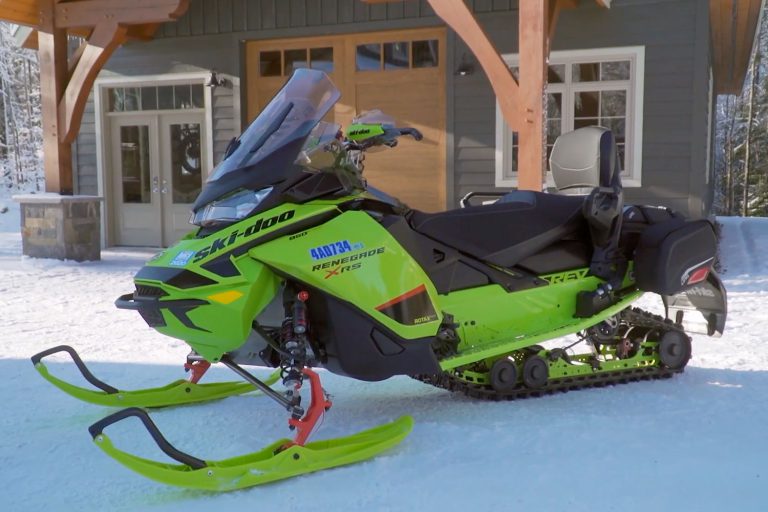
Last season on SnowTrax TV, Luke did a segment comparing Ski-Doo’s new-last-year Ski-Doo Renegade 900 ACE Turbo to Yamaha’s SideWinder Turbo (Yamaha VS Ski-Doo).

The big question on everyone’s lips was, would snowmobilers gravitate to the much more powerful Yamaha (180 claimed horses) and overlook the new Ski-Doo (150). Your response numbers for that posting were huge and obviously, we struck a nerve.

The tallies are in and the Ski-Doo 900 ACE turbo did very well in the sales column last year, matching sales with both the Arctic Cat 9000 and the SideWinder.

Yes, you could argue that Ski-Doo buyers were panting for a new, more powerful 4-stroke – especially since the popular but long-in-the-tooth 1170cc, naturally aspirated 4-TEC had been discontinued, and were simply jumping on an otherwise empty bandwagon.

Good point, and consumers should strongly be advised that a 50-horsepower differential (claimed 30) is still a big gap in the marketplace.

Sometimes an OEM can rely on sales successes to assume they’ve hit the market square on the head and sit tight with what they’ve got. In this case, we’re wondering if that may be a big mistake.

Historically – and not that far back in the past – there have been dramatic snowmobiles that were a huge success when they were first introduced and then sales numbers dramatically toppled in the ensuing year or two and they disappeared from sight.

We’re not sure if this could be the case with the 900 ACE but Ski-Doo should be thinking about reaching into its bag of tricks to make the ACE-T more attractive to buyers looking for ultimate power.

The truth is, both the Cat 9000 and the SideWinder are very attractive sleds and have a ton of goodness to offer. We haven’t been in on too many fly-on-the-wall eavesdropping conversations with 900-ACE owners yet, but how many times do you need to get pulled down the lake by a Cat or Yamaha before wondering if you should have bought the sled with the most power? These buyers would be the people who subscribe to Mark’s theory that “no matter what, snowmobilers always gravitate to the (most) power!”

We’re thinking Ski-Doo is well aware of this and has already got an upgraded ACE model ready to be shot out of its marketing cannon. Lets call it the ACE Turbo R. We see it as a pumped-up 900 with a slight bump in displacement to about 950ccs and an uptick in boost from the turbo. This would put the new engine right in Yamaha’s claimed 180-hp power wheelhouse and make it truly competitive.

The question is: “WHEN?”

We don’t see it for model year 2021, but we’re betting there will be an alternate ACE Turbo R for MY 2022. By then, who knows how far over the top Cat and Yamaha have gone with their turbo sleds?

Discover New Brunswick’s Northern Odyssey

0

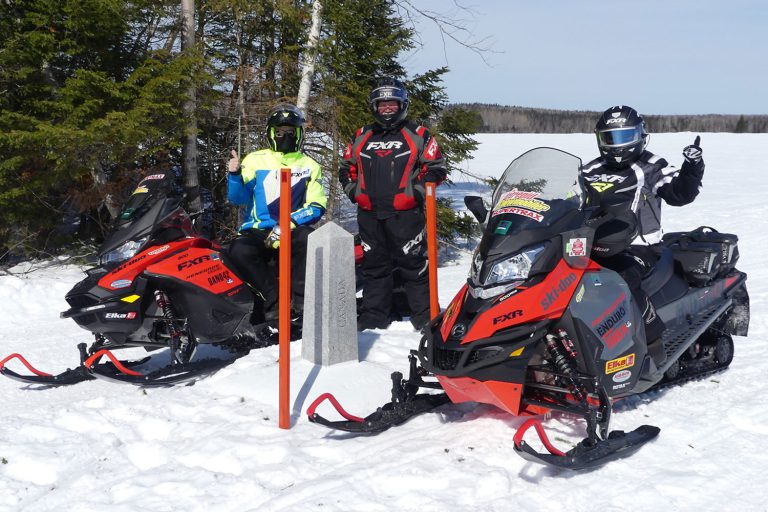
One of my favourite rides is known as the Northern Odyssey. It’s the premier tour loop in the Province of New Brunswick, and it delivers the goods, especially for “been-there-done-that” snowmobilers in search of new adventures.

Northern New Brunswick is typically blessed with the most snow in the Maritimes. Here, many miles of local and connector trails intersperse with over 1,000 miles (1,600 km) of trans-provincial trails – more than enough to keep riders grinning from ear to ear on hundreds of old logging roads crisscross the region.

GETTING AROUND

Many of these man-made corridors are groomed as part of the New Brunswick Federation of Snowmobile Clubs’ (NBFSC) maintained trail system. Others are simply available for riders to explore off the beaten track.

Trail navigation is good. In fact, New Brunswick has the best trail signage system I’ve seen. On trail maps and signs, blue and 2-digit numbers denote provincial trails. Local and connector trails are green marked with three digits. All of this makes for generally excellent riding and it’s easy getting from one place to another.

However, one sign was conspicuous by its absence. There was no posted provincial speed limit. That’s because there isn’t one for snowmobiles on most trails, except for slow zones posted by some municipalities.

With so many outstanding trail choices, it’s hard to know where to get started and even tougher to know when to quit. Best of all, most of their trails either avoid water crossings or are bridged, so spring riding in the northern New Brunswick interior continues even when ice goes bad elsewhere.

GETTING THERE

We accessed the Northern Odyssey at its northwest gateway, the City of Edmundston (pop.16,580), located just south of the provincial boundary with Quebec. Snowmobilers coming to New Brunswick through Maine or Quebec need to be aware that thanks to a zone change to Eastern Standard Time, you lose an hour crossing into this province (but regain it going back), so plan accordingly.

Edmundston is a western anchor community for the Northern Odyssey, along with Grand Falls (pop. 5,326) about an hour south via New Brunswick Trail 12. Both communities are located adjacent to the State of Maine along the international border. For our staging hotel, we chose the Best Western Plus Edmundston.

ABOUT OUR RIDE

Our plan was to ride a 4-day Northern Odyssey loop through the wilderness interior staying at the Rodd Hotel, Miramichi, the Atlantic Host in Bathurst and Quality Hotel, Campbellton on New Brunswick’s east coast.

Each of these communities has trail accessible accommodations, but another option is to stay at outfitter-style lodges in the interior like we did on our night at Rogers Lake Lodge. Tips: Popular outfitters have limited lodgings, so book in advance, especially in peak season and on weekends. Also, payment for fuel at these locations is often by cash, so carry enough money with you!

Our eastbound route on Trails 19 and 23 went through Saint-Quentin and passed the province’s highest peak, Mt. Carleton (2,690’), on the so-called Candy Cane Trail. Meanwhile, we returned by the parallel, but more northerly Trail 17 through Kedgwick. In all, we racked up almost 750 miles, but there’s so much more riding we could have done!

MORE RIDE OPTIONS

Those with more time could ride south from Serpentine Lake Lodge around the Christmas Mountains on Trail 58 into Miramichi. Or take a day to explore eastward from Miramichi or Bathurst into the historic Acadian Peninsula. It’s worth noting that New Brunswick is arguably Canada’s most bilingual province, so communication is no problem regardless of your language preference, English or French.

Depending on where you’re coming from, another viable option to extend your riding distance is to snowmobile into New Brunswick from Maine (easiest crossing at Houlton) or from Quebec on connecting trails like Trans Quebec 85.

CLOSING THOUGHTS AND TIPS

Northern New Brunswick is an especially picturesque area, with many panoramic views and stunning vistas where we could see for miles over multitudes of hills and valleys. Impressive scenery on this tour includes between Edmundston and Moose Valley on Trails 12 & 17; the Atkinson Tower on Trail 135 north of Moose Valley; the Tower Road windmills on Trail 503 between Popple Depot and Island Lake; and Squaw Cap Mountain, the second highest peak in New Brunswick (1,585’), on Trail 236 just west of Campbellton.

Northern New Brunswick has long been a snow magnet for riders from the New England states, Ontario and Quebec who can be on these trails after trailering no greater distance than they would to other getaway destinations. So be sure to consider New Brunswick’s Northern Odyssey for your next snowmobiling adventure!

intrepidsnowmobiler.com

2021 YAMAHA 2-STROKE

0

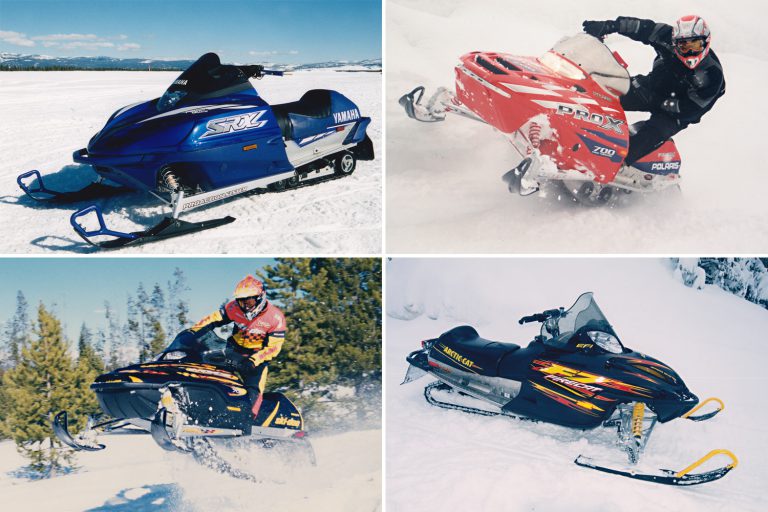
Yamaha has already opened the door to producing a credible 2-stroke snowmobile again. It’s called the Transporter and it’s believable it could fill the gap in Yamaha’s product line not served by the company’s 4-strokes.

To be brief, the Transporter can serve as a utility sled (articulated track), an Adventure Rider in deep snow (has a 2.25×153-inch track), a 2-upper (optional 2-up seat is available) or as a trail sled (nice, lightweight 600 DSI power and AWS handling).

Okay, we agree the Transporter may not be the first choice for riders in any or all of these categories, but to a 2-stroke-hungry Yamaha buyer, it makes tremendous sense and could easily fill the bill in at least a couple of those categories.

So, the obvious question would be: What if Yamaha wanted to amp up its 2-stroke presence even more in 2021? What would a serious Yamaha 2-stroke look like?

First, we don’t believe it would be an 800. An 800 would dip into the SideWinder’s marketplace too much and would only build on the “same-as Arctic Cat” doubters’ debate. Also, Cat is likely going to introduce an 850 someday and Yamaha may not want to tag along with that.

We think a 600 would make the most sense – it grabs a huge market and Yamaha dealers would only need to stock one engine’s parts on their shelves, given they are already servicing the Transporter.

So how would it fit into the Yamaha product line?

Here’s our guess. We think Yamaha would go with a fairly basic 600 DSI model with a 137-inch track (currently Yamaha’s whole product line starts at 137-inches anyway).

Arctic Cat’s Sno-Pro would be a good comparable – gas shocks without reservoirs, one-inch track, slammed ride height, decent electronics but maybe a twist here and there: Different seat with a hardshell luggage compartment behind it, maybe a Yamaha roller clutch, perforated running boards, flashy graphics early season.

It would be a great time for Yamaha to reignite the old “Exciter” nameplate and appease the cravings of hundreds of Yama-fans who have wanted a 2-stroke for years.

Electric Sleds Rebuttal – Seriously?

0

Obviously unable to wait for the annual Supertrax Magazine “Brothers Duel” (due out shortly) Kent posts a ridiculous article praising the potential for electric snowmobiles getting traction with everyday snowmobile buyers.

Kent – are you trying to prime the pump in advance of our annual tete-a-tete? Did you think I wouldn’t read your drivel and call you out on this nonsense?

Seriously. Pull your head out! While the Taiga is the first mass-produced “credible” electric snowmobile it in no way represents anything even remotely likely to make it to the mainstream. Not even your assertion of new battery technology in the wings making a Taiga’s range more realistic makes any sense.

So what if a Taiga could go 200 miles on a charge? How many charging stations will be available – given the remote, rural environment snowmobiling is practiced in?

Seriously, the cost of stage one electric vehicle chargers (the kind that can achieve an 80 percent “fill-up” in a half hour) is prohibitively huge. Who will see installing chargers for snowmobiles on trail routes as a remotely feasible business model?

Will Taiga – like Tesla – take on the immensely complicated and costly job of setting up a snowbelt-wide charging infrastructure to be used three to four months a year?

Here’s where Kent entered the Twilight Zone. Until the much talked about “super battery” arrives – something the entire world has been predicting but not delivering – electric snowmobiles – and electric anything else – will be confined to routes which provide recharging capability at regular, predictable intervals.

If the rumored “super battery” could pump up Taiga range to the 300 mile (500 km) level then there would be some potential for this concept in the hands of the trail riding public. In the absence of this kind of range the Taiga will remain a specialty vehicle practical only for specialized usage.

Remember this reality. Let’s say a “super battery” does emerge, creating credible electric sled range. There’s still this formidable problem. Where do you charge your electric sled?

If a remote snowmobile resort installs a stage one charger then you better get in line to hook up your ride when you turn-in for the night. If you ride from your own cabin or live in a snowmobile accessible area you could plug in your sled for a 12-hour overnight charge from a relatively low cost, Stage 3 (110 volt) charger.

The real issue electric sled proliferation must deal with before it gains a toe-hold in the retail marketplace is the availability of charging stations.

Kenny – you should have known this.

DO ELECTRIC SLEDS MAKE ANY SENSE?

0

This is a tough question and one a lot of snowmobilers hope will just go away. It’s true, just like fossil-fuelled automobiles are under pressure from the electric auto lobby, the same situation could be a few short years down the road for snowmobiles.

There will be electric sleds marketed and sold this very model year and it’s unwise for riders of conventional gas-powered sleds to ignore their existence.

Here are some things we know about them:

* Electric power is very torquey and immediately responsive.
* The sled’s center of gravity can be toyed with to keep the abundance of weight very low in the chassis.
* Recharge times are getting shorter and range is getting longer.
* Overall weight is right in the range of most 2-stroke sleds – especially considering the current power offered is in the 180 horsepower neighborhood.

If you were worried before, here’s more fodder to increase your tension: There are giant steps being taken to make electric sleds even more viable.

First, let’s look at what’s being offered. So far, electric snowmobiles like the Taiga use a single electric motor and a lithium-ion battery powerpack.

What’s the deal with lithium-ion? There are a number of benefits with L-I batteries, not the least of which is their high energy density.

A conventional lead-acid battery like the one used in your pickup has enough density to store about 25 watt-hours of electrical energy per kilogram (2.2 lbs.) of weight.

A lithium-ion battery can store about 150 watt-hours per kilo. Thus, a 10-kg L-I battery can hold about 1500 watt-hours of energy and still allow the snowmobile to weigh considerably less than a gas powered 2-stroke with a full tank of gas. 1500 watt-hours is enough to give you about four hours of continuous riding – yes, even in the cold.

L-I batteries are less affected by the cold than you’d think. In fact, one of the biggest problems with this type of battery is the heat they generate both when being charged and when being discharged (ridden).

Unlike many batteries, L-I batteries computer equipped with electronic management systems aren’t degraded much when they’re cold. That’s probably why you see so many Teslas being driven in cold weather cities.

Heat is also one of the reasons charging times for automobiles take so long. Engineers are currently developing prototypes with computer management built-in that controls the heat when L-I batteries are being charged (ever notice how warm your cell phone or laptop gets when you’re charging it?).

The results so far are showing a 5X decrease in charging time using tech that constantly measures the battery’s temperature.

Naturally, there’s a flurry of research going into reducing charge times, increasing range and broadening the lifespan of the batteries needed to power electric vehicles.

Currently, in a lithium-ion battery, the positive electrode is lithium-cobalt oxide and the negative is carbon with the electrolyte usually being ether. Lithium is fairly rare and expensive but science has invested heavily in L-I batteries as a primary source of energy for everything from automobiles to cell phones.

New batteries, already over 90-percent developed using a sodium-oxide cathode, are outperforming L-I batteries by a margin of 7 to 1 efficiency – and sodium (salt), the sixth most plentiful mineral on earth, is super-cheap and not prone to heat degradation.

There’ll be a lot more to report soon!

Riding Day Loops From Smiths Falls Ontario

0

The Province of Ontario is huge. In fact, its 415,000-square mile land mass makes Ontario larger than either Alaska or Texas.

The province also has over 19,000 miles of maintained snowmobile trails, often cited as “the world’s largest recreational trail system”. So, when it comes to planning a short Ontario snowmobile adventure, your first decision is where to ride.

Choose Eastern Ontario

One good choice is Eastern Ontario, home to about 20% of the provincial trail system operated by the Ontario Federation of Snowmobile Clubs (OFSC). This heartland of rural Ontario is located in the southeast corner of the province, bounded on the south by the St. Lawrence River, and to the north by the Ottawa River and Algonquin Park. On the south side, it also shares the international border with the State of New York, and its eastern boundary is with Quebec.

From a snowmobiling perspective, Eastern Ontario includes the Upper Canada Snowmobile Region (OFSC District 1) and the Snow Country Snowmobile Region (OFSC District 6). These two adjacent regions are linked by Trans Ontario Provincial (TOP) Trails. Each also provides a myriad of local trails ripe for exploration and generally decent snow conditions in a normal winter.

Choose Smiths Falls

But even Eastern Ontario is too much territory to ride for a short visit. So, with only three days available, we looked at what doable loops are available from a central location. This narrowed our staging choice to the Town of Smiths Falls in Lanark County. With a population of 8,780, Smiths Falls is big enough to offer a full range of amenities and services for snowmobilers, while retaining its hospitable, small town friendliness.

Most important, TOP Trail E runs right through town. It provides easy access to interesting day loops in every direction. And best of all for our three-day visit, this trunk trail also offers direct trail access to a well-appointed staging hotel, the Best Western Smiths Falls (See Where We Stayed).

Amenities & Services

The Best Western Smiths Falls provides ample truck & trailer parking, plus sled parking in front of its ground floor rooms. Reservations include a complimentary hot breakfast, and there’s a gas station right across the street. Meanwhile for a town its size, Smiths Falls boasts a plethora of tasty eateries.

We sampled several great ones for our nightly diners (See Where We Ate). What’s more, our treat-loving group were thrilled to discover the neighbouring Dairy Queen, which quickly became our nightly go to for frozen goodies!

Where We Rode

LOOP ONE: From the Best Western, we snowmobiled three loops. Our 178-mile Day One started going south towards The City of Brockville and the St. Lawrence River. Then, our route swung east and north to within a stone’s throw of the Ottawa Airport before hightailing it west back into Smiths Falls. We lunched at the popular Red Dot Café in Osgoode, where we also fuelled up.

LOOP TWO: Day Two, we travelled 179 miles north on TOP Trail A, swung east on local trails through Constance Bay, and stopped at Pakenham for fuel after lunching at Bridges Grill & Pub. From there, it’s an easy ride south through Carleton Place back to the Best Western Smiths Falls.

LOOP THREE: We couldn’t leave Lanark County without a meal at the famous Wheeler’s Pancake House. So, our 137-mile Day Three found us westbound through The Village of Lanark towards Wheeler’s location on Local Trail 1 south of MacDonald’s Corners. After a maple syrup infused lunch and sugar camp museum tour, we steered our sleds east again to Smiths Falls. This brought us back early enough for some of our group to trailer home that night.

More Good Reasons

I highly recommend Smiths Falls as a staging destination for day loops. Thanks to multiple trail choices, each of our rides could easily have been either shorter or longer to suit our daily preference. While our expectation was to ride plenty of farm country in Eastern Ontario, we were pleasantly surprised at the diversity, including woodlands, bush lots and variable terrain.

Meanwhile, with good signage everywhere, navigation was never an issue. Nor was there any feeling of being too far from help if needed, thanks to the reassuring presence of countless farms, businesses, roads, rural villages and friendly people.

Eastern Ontario is most certainly an appealing place to snowmobile. Plus, its proximity to the U.S. border, combined with good highway access, make it a serious contender for your next long weekend getaway.

CONTACTS:

Smiths Falls Tourism
Lanark County Tourism
Ontario’s Highlands Tourism
– Ontario Tourism

WHERE WE STAYED:

Best Western Smiths Falls

WHERE WE ATE:

Axe & Arrow Gastropub
Chuckles Jack
– Ger-Bo’s Steakhouse
Matty O’Shea’s