Home Blog Page 33

THE SLED THAT CHANGED EVERYTHING

0

Believe it or not, the iconic Ski-Doo REV platform is 20 years old! That’s not to say the REV Gen 5 we see today is the same sled as the 2003 “Beaver Tail” REV. It is not. However, there’s a stunning amount of original 2003 REV DNA in the current G-5.

Something we find a little strange is Ski-Doo’s relative silence surrounding this industry milestone. After all it was the 2003 REV that led Ski-Doo to capture the number one market share status they’ve not only held but grown substantially over the past 20 years. Doesn’t matter, we’ll take on the job of celebrating this important event.

Why is the 20th birthday of the REV so important? In snowmobiling’s glorious history there have been a very small number of innovations that have shifted the snowmobile paradigm. Here’s my list.

  1. The front-mounted engine debuted on the original Arctic Cat Panther circa late 1960’s.
  2. The slide rail suspension. Same lineage and same inventor – Arctic Cat and Roger Skime.
  3. The Indy IFS popularized by Polaris who birthed this technology on the ice ovals in the late 70’s.
  4. The Ski-Doo “Rider Forward” REV chassis.

Of all of these innovations, none caused such a violent and radical paradigm shift in the market as did the REV’s intro in the early 00’s.

The idea of completely re-engineering a snowmobile’s ergonomics to closely resemble those of an off-road motorcycle was earth shattering. I’m not overstating this!

My first ride on a 2003 limited-build MX-Z REV 800 is an event I will never, ever forget. The whole idea of allowing the rider to make sitting-to-standing transitions so intuitive and easy made riding trails a brand new experience.

The REV allowed me to simply stand up – at 60 MPH if I wanted – and run whoops, sucker bumps and craters at previously unsafe and uncomfortable velocities. It was just way too cool.

Here’s more. After just my first pull, everything else wasn’t as good. It literally happened that fast. It was like the REV was coated in magic dust.

The way Ski-Doo packaged up the new REV was flat-out smart. The re-jiggering of every major component on the sled’s chassis required a lot of expensive tooling – specifically body and tunnel re-thinking.

Despite this challenge, Ski-Doo was able to pretty much use its Series III 800 carb engine, TRA clutch and ZX chaincase with minimal modification. That stuff is really expensive to retool at the same time as the body and chassis.

Here’s maybe the most important issue with the launch of the REV 20 years ago. The guy who had it all on the line – literally his future as the CEO of the BRP recreational products division – was being wagered here. I’m talking about none other than BRP visionary, leader, risk-taker and entrepreneur – Jose Boisjoli.

Jose Boisjoli – President and CEO of BRP since December 2003, when BRP became a standalone company.

Boisjoli is all of the aforementioned things and more. He’s as honest as the day is long and as unassuming as any leader I’ve known (and I have known just about all of them) in the powersports industry. Jose comes across pretty-much ego-less. He’s super approachable and transparent. He does not need to be pretentious – his track record speaks for itself.

What stands out about the REV’s introduction versus those other three innovations is this: There was no going back once the REV was sent to production. If it didn’t capture the market and receive resounding approval and acceptance, Boisjoli would have been in a world of trouble. However, when Boisjoli got the nod from Laurent Beaudoin – the Father of BRP (Canada’s equivalent to a Rockefeller) to pull the trigger and take the radical REV to the market, there was no going back, no “Oops, sorry about that” or any exit strategy. It was go all-in and trust your instincts.

Frankly, I know precious few individuals who have the guts to take a risk as big as the REV was. I also know precious few leaders with the instincts of Boisjoli – and the unbridled respect his lieutenants have for him.

There’s a whole lot more to this story so stay tuned for a closer look at the birth of the REV.

CAN’T WAIT TO RIDE THE ALL-NEW CATALYST

0

Obviously, this pick for my “Can’t Wait…” feature is a complete no-brainer. Everyone who bleeds green and all of the enthusiast media are drooling at the thought of getting a pull on the first fundamentally all-new Arctic Cat since the early 20-Teens.

The sled oozes cool and brings with it a claimed ten percent weight reduction. This claim leads us to believe this all-new platform – the CATALYST – is considerably lighter than former comparable ProCross models.

If this is true then the CATALYST is going to be a bonafide trail rocket in ZR trim. Shedding weight requires huge cost and lots of hard work. To move seriously into the realm of shaving weight is, for sure, a gargantuan task taking significant time and serious jing.

The centralized mass principle employed on the CATALYST chassis (in all its iterations) is paramount to taking advantage of the aforementioned weight reduction.

When the drive axle, jackshaft and crankshaft are in tight proximity to one another, the ability to throw the sled around is greatly improved and the feeling of “oneness” the rider gets with the sled is hugely multiplied.

All these nifty engineering nuances and breakthroughs are more or less expected at this juncture in snowmobile history. However, the more ethereal and visual aspects of the CATALYST platform cause us to break into a cold sweat.

The sled is genuinely radical looking and no one at Larry’s Burger Pit and Poutine will stay inside when you roll up on a CATALYST. You’ll be signing autographs.

The Catalyst has a seriously “pared down”, rationalized look that’s aggressive, serious and threatening – all at once. Simply put it’s a Bad Boy.

We’re hoping to get a chance to ride the CATALYST early in the new year. Yep – we can’t wait!

CAN’T WAIT TO RIDE THE YAMAHA VIPER!

0

It’s been a long time since we’ve had a non-turbo Yamaha PR unit. Kinda makes sense because Yamaha makes a lot of turbo Sidewinder variants and not so many non-turbo sleds.

The Viper is interesting to us because it’s Yamaha’s full frontal assault on the meat-of-the-market 600 – 650cc 2-stroke class.

I better qualify that last statement: The 600-650 2-stroke class can also be identified as the 125-135 horsepower class except for the Polaris Matryx 650. It may be as high as 140 ponies. Anyway, you see where I’m going.

The 600-650 marketplace is huge, especially in flatland, trail based markets. Yamaha needs to be in this segment and the 130 HP 4-stroke, 1049cc triple used in the Viper is among the most proven and potent normally aspirated (EFI) engines in the biz.

The venerable 1049cc triple in this proven chassis is a superb combination of strong acceleration, confoundingly intuitive handling and impressive big end performance down the lake.

Why do I say the handling is confounding? There’s no hiding the reality the Viper is heaviest in the 600-650 class. That’s a 4-stroke engine, my friends, and it makes no excuses for this reality.

However, among all the Sidewinder turbocharged variants, this normally aspirated triple is the most fun to throw around on tight, twisty and wide-open trails.

So inevitably we’ll be comparing the Viper to 600-650cc 2-strokes around here and we think that’ll be fun and enlightening all at the same time.

45 YEARS APART AND STILL COMPARABLE!

0

Recently, I was thinking about the intro of Ski-Doo’s NEO high-value snowmobile. At some point in my pondering a revelation hit me squarely between the eyes.

I have to admit the concept of and target market for the NEO is exceptionally similar to one of snowmobiling’s truly iconic models from over 45 years ago.

The 1978 Yamaha Enticer 250

Stay with me here – this is an interesting bunny trail we’re about to walk (hop?) down. When the 1977 (limited build) Enticer 250 landed, it broke the mold of what a high value, low cost snowmobile could be at the end of the 1970s.

The ET 250 in its first full-build year, 1978, came with so many innovations it was overwhelming. Start with an oil injected 250cc, 23 horsepower engine, matched die molded hood, molded rubber track with imbedded fiberglass rods, super plush molded foam seat, push to open fuel cap, long travel rear suspension set up for ultimate weight transfer, fuel and oil sight gauges, an electrical system capable of powering hot grips, and an aluminum tunnel and fenders.

The Enticer’s fit and finish was unrivaled in the industry in 1978. I won’t get into detail on how the ET 250’s innovations compared to what was considered a “high-value” sled at the time. That’s a story for another day.

Consider this: The 1978 ET 250 had a US MSRP in the $999.00 range and a CDN MSRP of $1249.00. Even by the standards of the day, in the 70’s this was crazy low. Here’s what happened. The first two years of ET 250 sales were insane. After I got my first ride on a 250 Enticer, my brother Kent and I initiated a day long phone canvas of southwestern and central Ontario Yamaha dealers and finally found an unsold 1978 250. It was a four hour round trip to get the sled and the dealer told me he had other calls from serious buyers who were on their way. We jumped in the truck and ran WOT to get our ET 250. As it turned out we barely beat another buyer to the dealership for the last one in captivity.

That first ET 250 impressed every single person who rode it and I am sure it sold more Enticer 250’s that first winter. The next winter we acquired another ET 250 and two ET 340’s then an ET 300 and on it went throughout the Yamaha model line-up for more than 5 years.

The interesting part was how many of our friends bought new Yamahas during that 5-year span. The ET 250 was a huge success for Yamaha and propelled them into the early 80’s as the most innovative, highest quality OEM in the sled biz.

The 2023 Ski-Doo NEO

So, here’s where the story gets more interesting if you are too young to remember the Yamaha Enticer 250. The new Ski-Doo NEO (for this diatribe we’ll stick with the base NEO not the NEO +) is an amazing high value snowmobile with a ton of innovative features you would never see on a sled with an MSRP this low in MY 2023.

The NEO is not a three quarter sled. It is built on Ski-Doo’s Gen 4 platform with a 120 by 14 wide, one-inch lug track. It uses a built-for-NEO single shock skid with lots of travel and Ski-Doo’s proprietary RAS-X front IFS.

There’s a full-on hydraulic brake with a braided steel hose and a spin cast torque-tower primary clutch and big-sled secondary. The sled uses Ski-doo’s tunnel-sandwich cooling system.

Underhood, there’s a Rotax cylinder-reed 600cc EFI 40-HP oil injected, E-start, 2-stroke twin with RER. The riding position is slightly narrower for smaller riders but still pure G-4 and the sled looks just like a Gen-4. The uninitiated could mistake it for a 600 E-TEC MX-Z.

The entire issue here and the point I am about to make revolves around the value these two sleds represent. The 40-HP NEO retails for $6,399 in the US and in Canada for $7,999. These are very low MSRP’s considering the features the NEO brings to the table. Way back in 1978 the ET 250 represented similar value. Nothing came close to the ET 250 for ultimate value 45 years ago.

The success of the ET 250 is rooted in more than just snowmobile sales. It was about new people and returning people picking up an ET 250 and getting (back) into snowmobiling. It was also about brand building. Today there are still snowmobilers who bleed Yamaha and have their roots in the Enticer series.

Ski-Doo deserves to do well and make hay on the NEO. This sled is bringing back riders and getting lots of attention from new riders. The demand for NEOs this model year has been like a tsunami. Simply put, if SD had built twice as many NEOs there likely wouldn’t be enough to go around.

So, there you have it. Turns out a story about two snowmobiles spanning more than 45 years has tremendous similarities. Let me know what you think.

SKI-DOO SAYS RIDE RESPONSIBLY THIS WINTER

BRP Inc. (TSX:DOO; NASDAQ:DOOO) is committed to promoting responsible riding and increasing its efforts to empower all riders in the powersports communities to ride responsibly and rethink the way they approach safety, environment, and riding etiquette.

Ski-Doo, a BRP brand, is doing that by engaging riders on four unique fronts focused on improving rider safety and preserving our sport for years to come: Take the Pledge, Avalanche Awareness Seminars and Safety Partnerships, Snow P.A.S.S., and International Snowmobile Safety Week.

“As a leader in the snowmobile industry, we have a responsibility to grow the community of responsible riders, educate our community on preserving our winter playgrounds and generate positive experiences. Every action and initiative we take at Ski-Doo is to ensure our sport flourishes today and for future generations of riders.” said Jérémi Doyon-Roch, Manager, Global Marketing, Snowmobile and Cross Brand Initiatives at BRP. “In addition, by working with local organizations, associations and clubs throughout all of our programs, we are helping to ensure riders know where they can safely enjoy the snow and, most importantly, return home to do it all again the next day.”

Take the Pledge for our Playgrounds

Ski-Doo calls on the entire snowmobiling community to “Take the Pledge” ⎯ a collective effort to preserve access to trails on private and public lands and backcountry winter playgrounds. Trespassing and illegal off-trail riding is threatening snowmobile access.

The brand encourages all snowmobilers to be responsible, and pledge their commitment to ensure the sport continues to flourish today and for future generations of riders.

Strength in the Knowledge

Ski-Doo believes in creating safe experiences for all riders and embarks on its fourteenth year of backcountry rider education with free avalanche awareness and avoidance seminars for snowmobilers.

From October 4th to November 30th, riders of all brands, at all levels of experience, are welcomed and encouraged to attend the in-person events with their fellow backcountry explorers to increase or refresh their knowledge in a fun atmosphere.

In addition to offering free seminars, Ski-Doo partnered with associations in Canada and in the United States, and lent 14 snowmobiles last year, and will again this year, to help provide avalanche reports and real world data to all riders. View the video here to learn more.

Protect. Access. Sustain. Support.

For a second year in a row, the Ski-Doo Snow P.A.S.S program returned to help fund community-led projects that improve the sport of snowmobiling. As of today, it has provided $881,000 CAD in funding towards more than 175 projects. In partnership with its incredible network of dealers, the grant program offers up to $5,000 in matching funds to grassroots associations and clubs engaged in the many activities that ensure the health of the sport.

The 2023 International Snowmobile Safety Week

From January 14 to the 22nd, Ski-Doo and BCA will piggyback on safety week awareness messages to educate the riders on code of conduct to protect the social acceptability of the sport. To do so, ambassadors of the brands will be asked to create and share content with their communities, and reinforce the key pillars of Responsible Rider: safety – get the gear, environment – get the forecast, and etiquette – get out of harm’s way. Stay tuned on Ski-Doo social platforms to view the content.

About BRP – We are a global leader in the world of powersports products, propulsion systems and boats built on 80 years of ingenuity and intensive consumer focus. Our portfolio of industry-leading and distinctive products includes Ski-Doo and Lynx snowmobiles, Sea-Doo watercraft and pontoons, Can-Am on and off-road vehicles, Alumacraft and Quintrex boats, Manitou pontoons and Rotax marine propulsion systems as well as Rotax engines for karts and recreational aircraft. We complete our lines of products with a dedicated parts, accessories and apparel portfolio to fully enhance the riding experience. With annual sales of CA$7.6 billion from over 120 countries, our global workforce includes close to 20,000 driven, resourceful people.

brp.com

2023 POLARIS INDY BOOST VR1

0

Yeah, I’ve already ridden the Boost, once in Cook, Minnesota last January and again in West Yellowstone in February.

I’d say I was impressed but that just falls way short of describing the reality of squeezing the loud handle while sitting on that much power.

However, both these riding locales are not in my backyard and I really want to sample the new trail-targeted turbo 850 Patriot Indy VR1 on familiar trails and lakes.

The reason I want to ride the new VR1 Boost on our trails here at SnowTrax/Supertrax World Headquarters is this: I want to experience (again) what felt like lightweight handling in a turbocharged sled.

It’s not that this wasn’t obvious on my first rides but simply put, it’s what I need to expand my frame of reference in terms of how this comparatively lightweight turbo plays out.

If you’re talking turbocharged snowmobiles built for trails then the Indy Boost stands by itself as the only 2-stroke powered offering in a fairly busy pack of 4-stroke turbos from Ski-Doo, Arctic Cat and Yamaha.

It’s no secret 4-stroke sleds are heavier than 2-strokes, but throw a turbocharger on a big displacement 4-stroke and that weight becomes tangible to experienced riders.

What I experienced with the Indy Boost runs counter to the current weight penalty you feel with 4-stroke turbos.

Unfortunately, it looks like I may have to wait until January to experience the Indy Turbo. Polaris has to satisfy its paying customers before members of the media get their gloves on a Boost and we totally understand.

I can tell you this: Cook, Minnesota is not at any substantial elevation so when I rode the Boost there last January it was in sea-level grade air. The surge of power from the Patriot 850 turbo reset my seat-of-the-pants meter and left me mostly speechless. The power was truly impressive.

So, stay tuned and as soon as we get our hands on a VR1 Boost we’ll report back.

2023 G5 RENEGADE X-RS WITH SMART SHOX

0

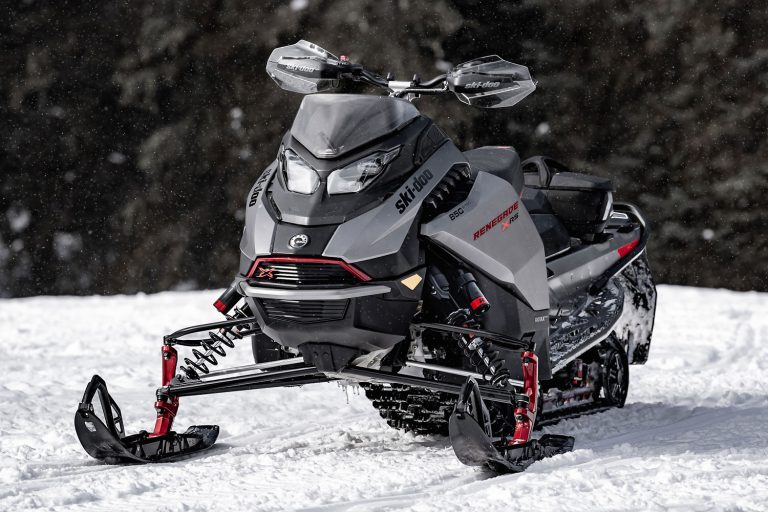
I know Smart Shox has been available for over a year from Ski-Doo and to be completely transparent we had a limited build Gen4 Renegade with Smart Shox over a year ago. However, there’s a small wrinkle to this story.

The Smart Shox equipped Renny did not have the Smart Shox compatible ECU “chip”. Why? The same reason about a bi-jillion cars and trucks are running around missing “chips” which run all manner of accessories: Supply chain and Vendor problems!

So… we rode a Renny X-RS all last season that was defaulted to a “get home” setting on its adjustable KYB dampers. Let me tell you about the “get home” default compression damping setting. It feels like the shocks are filled with cement instead of oil!

This, of course, is not anything like the ride quality we experienced at Snow Shoot. Knowing Ski-Doo’s Smart Shox are revolutionary in their ability to semi-actively adjust to terrain you are riding over, we did not pass any opinions on the PR model Renegade we rode last winter.

This is why I can’t wait to ride the new Gen5 Renegade X-RS with Smart Shox (with a chip installed!) What we experienced in Yellowstone was nothing short of remarkable when riding deep and fast into moguled, choppy and rolling trail surfaces.

To make this all ring true you must realize Ski-Doo’s current rMotion 137-inch skid provides the best ride in the biz without Smart Shox. One would think to discern an improvement over the current rMotion set up would require a huge improvement in overall ride quality. Correct?

Here’s the beef. Smart Shox do tangibly improve on the rMotion’s amazing compliance. It’s the kind of improvement that has you getting off the sled, standing back and saying: “This can’t be right, can it?”.

At the end of the day – to use an overworked expression – I need to get on a Smart Shox equipped Ski-doo and let it swallow some high quality, gnarly trail surfaces. Like I said at the beginning of this commentary. I can’t wait!

SNOWMOBILE MARKET UPDATE

0

To say the snowmobile business has changed over the past two-and-a-half years would be a huge understatement.

Entering model year 2023, the industry is selling oh-so-close to 100-percent current model year sleds. This means the OEMs have not been “carrying” unsold past models all summer. In fact, in a number of situations OEMs are unable to meet consumer demand for 2023 sleds.

Last spring’s early order programs were categorically the most successful programs of this type ever run by the manufacturers. Essentially, model year 2023 was sold out in a matter of days. Yes, the OEMs are building some 2023 sleds for in-season sale, however, that number is – as we’ve been told – relatively small. Factor in this stunning reality: There are literally no non-current (MY 2022 and older) snowmobiles lying around at the factories or at dealers.

Consider how good this is for the four sled-makers. They are building an enormous percentage of their current 2023 sleds for an end user with a name and address. The sleds are deposit-paid and when they arrive at their respective dealerships they get paid in full by you. No, or very little, messy and expensive wholesale financing costs are required. No carry-over costs for 2022’s either.

The specter of wholesale financing is a costly, much maligned and genuinely disliked part of the retail snowmobile business. It is a cost that’s been built into the actual manufacturing and marketing budgets of the OEMs for decades. However, not anymore. Or at least not this year.

It’s no secret to any of us that the COVID lockdown induced “stay in your own country” mentality the past two years has created demand for all kinds of luxury items. Here’s a weird one: The hot tub industry has not been able to meet demand for hot tubs. People couldn’t go on their warm weather vaycays so they upgraded their homes with stuff like, you guessed it… hot tubs.

The powersport industry as a whole has been under the same sort of never-seen-before demand for snowmobiles, ATVs, SxS, motorcycles, boats, RVs, motorhomes and more. People work to play and when the lockdowns took away some of our freedom, people responded with the highest demand the industry has ever seen for new product.

The big question is this: Is this sustainable? More succinctly, can this go on for another year or years? It is a great question and as yet it cannot be answered.

The very first issue going forward is an age-old one. Many OEMs in this industry ran their businesses on the principle of overbuilding every year. In other words, build more than you can sell this year and allow some crates to stack up at the factory and at dealers. Wholesale financing costs of carrying these past models ahead for a year was mostly covered by the manufacturers who would then load up dealers with a mixture of non-current and current sleds at the annual dealer show.

This kind of approach to selling all powersports vehicles was entrenched in the industry. It was the way things operated. Now, as a result of COVID, the OEMs are openly expressing it’s a new day in the business and that it doesn’t have to go back to the old model if all four of them can resist the temptation to overbuild.

However, there is a fly in the ointment: Inflation and the predicted arrival of an economic recession. If the economy slides backward to a minimal degree the business’s excellent demographic profile is strong enough to sustain the good times. However, if there is a serious recession in the free world it may mean the OEM’s and dealers could be forced to carry (wholesale finance) more unsold sleds in inventory and go back to the old model.

There are other significant forces at play here as well. Is it possible the amazing spike in sled interest might slow as people go back to spending their money on fair weather vacations and other recreational activities? Dunno for sure.

I mentioned that our demography is a significant contributor to the success the snowmobile biz has and is still enjoying. Snowmobilers are avid and committed to this winter recreation. Overall they have the money to participate in the sport at a very high level.

Another distinctive is the high percentage of self-employed participants. It’s a great place to do business because of the relative financial strength of the snowmobiling public.

If I did not answer your specific questions here it’s because this whole situation is largely moving in uncharted waters. I can’t, and a surprisingly large number of industry participants cannot definitively say what’s next.

OFF TRAIL? NO TRAILS

0

Time for another trip into the reality of the cost associated with off-trail riding in areas where it is prohibited.

I know, I’ve been harping on this topic for a long time. About 10 years actually, when you count the editorials and stories we’ve covered in Supertrax and the online contributions on this website we’ve made.

In any case, I am not convinced we are making enough progress in this department. The International Snowmobile Manufacturers Association (ISMA) launched a public awareness campaign called “Take the Pledge” which was based on snowmobilers taking responsibility for spreading the word about off-trail riding to their peers and pledging to not transgress themselves. It was, well, a public awareness campaign.

Did it or any other associated communication about how serious the problem of trespassing is in our sport right now make any difference? Some sanctioning groups felt the fact a lot of people got the message – albeit force fed – helped with the problem.

What do I mean? The Ontario Federation of Snowmobile Clubs (OFSC) made it mandatory – when snowmobilers were contacting the OFSC – to listen and watch a video before being able to move forward with a Trail Permit purchase.

Sure, the number of views the video got was impressive. You know what else is impressive? The number of crossover on/off trail snowmobiles being sold that carry a marketing message expounding the free-riding capabilities of these models.

To the OFSC’s credit they felt their home-grown video and awareness campaign helped trim some of the trespassing associated with free-riding numerically. Unfortunately, it’s literally impossible to statistically quantify what “trim” represents.

So, here’s the skinny. I’m not going to come down on the OEMs for continuing to produce more and better X-over snowmobiles. Not a chance. Why? Because the OEMs are responding to you – the buyer – and your preferences.

To fundamentally stay in the snowmobile manufacturing biz a manufacturer absolutely must build and offer for sale snowmobiles that meet the market’s preferences head-on. That my friends, is called “Market Driven Capitalism”.

Here is the root problem. It’s the continuing profound lack of understanding too many snowmobilers have about the consequences of off-trail riding – particularly in flatland, trail-oriented locales.

Here’s what continues to go on: Despite exposure to the ISMA promoted video, the serious consequences of riding off-trail on private land persists. In some jurisdictions it’s getting worse. What does worse mean? It means private landowners with trails on their property are saying loud and clear they’ve had enough with snowmobiles riding off the prescribed trail on their lands. They’re kicking us off their land in both the US and Canada.

This reality has been our Achilles heel for too long. We simply cannot sustain what is considered to be the off-road industry’s largest and most developed interconnecting trail system in the world. Let me say it again. “We can’t sustain persistent off-trail riding”.

Yes, there are places in some jurisdictions where off-trail riding is allowed on certain lands. Specifically, there are some places to free-ride in the US and Canada. However, an ever-increasing number of free-ride predisposed riders are continuing to trespass on land with prescribed trails crossing them. This problem continues to be the biggest threat to organized snowmobiling’s continued viability. Sound serious? It is.

There is nothing wrong with free-riding on lands where you have permission. Conversely, it is absolutely the sno-mo-equivalent of suicide to free-ride on public or private lands where free-riding is not allowed. This goes for any land with a marked and groomed established snowmobile trail. No mixing of words here. You must stay on the prescribed trail at all times. You must not deviate from this discipline.

If you own a X-Over sled do some research this fall into the availability of land where you can legally free-ride. It’s out there. Trouble is its way easier to just follow the groomed and marked trail until you reach a clearing, pull off the trail and rip it up. Isn’t it?

Invariably, that kind of action produces a zero end game. It’s happening right now and it is going to continue to happen if we don’t pull up our snow pants and get serious about protecting the incredible snowmobile trail resources we have in North America.

Listen and watch the ISMA “Take the Pledge” video. Tell your friends to read this article and talk meaningfully about altering your riding parameters to not include free-riding – unless it is specifically allowed.

It’s a big challenge.

WILL THIS MAKE A DIFFERENCE?

0

In a snowmobile marketplace characterized the past two years by a dramatic inability to supply enough product to satisfy buyers, there are some exceptionally interesting all-new vehicles we might not have expected this fall.

The past two seasons have seen wild increases in new sled sales as buyers simply could not get enough snowmobiles to satisfy their needs. This led to a “take what you can get” mentality for both new and used sleds.

This never-seen-before reality has put the sno-mo OEMs in an enviable position. Truthfully, I can’t ever remember a time when there have been literally no unsold, non-current sleds.

Here’s what I think is a little weird, but exciting nonetheless: Unexpectedly, there is a significant amount of all-new 2023 product launching into key segments this season. Here are two:

THE SKI DOO NEO PLATFORM

The issue here cannot be overstated: Snowmobiling desperately needs more credible, truly value-priced models to inject increased participation and generate growth. Yes, the OEMs are selling snowmobiles in relatively large and highly profitable segments and these sales are occurring at near stratospheric price levels.

Most of a sled-builder’s profit comes from selling big power, full-featured models. The lower you go on the price scale, the less money OEMs make. It’s a fact that low MSRP sleds are a lot less profitable as a percentage of the revenue they generate.

I want to be careful in saying this but the new NEO series from Ski-Doo is from every measurable metric the sled we’ve been waiting for. The NEO is fully equipped with a 600cc liquid cooled, twin cylinder EFI engine, real clutches, full size dimensions, up-to-date front IFS and a never seen before long travel, single shock skid.

There’s a Brembo hydraulic brake, a 121-inch track and high quality bodywork that comes right from the G4 platform. Most importantly, check the MSRP of the NEO and NEO Plus.

These sleds are priced at a level that defies common sense but underscores how an OEM with the biggest market share, producing the most units, is capable of building a realistically equipped sled and selling it at an amazing price.

For the record, the NEO was a complete sell-out in just the first few days of Spring Break last April. I predict Ski-Doo will not be able to meet demand for these sleds again this year. Is this the snowmobile equivalent of the Sea-Doo Spark Personal Watercraft? Stay tuned.

THE NEW POLARIS S4

Suffice it to say the S-4 engine package is available in multiple models and its advent is significant in a big way. This new 4-stroke ticks virtually all the boxes, including every important piece of technology needed to compete with 4-stroke market leader, Ski-Doo. At first sight I quickly realized Polaris has not taken on this important segment without great thought and attention to detail.

The S-4 engine is – as expected – a derivative of the Pro-Star engine series used in Polaris’ off-road products. This makes great sense as Polaris has a stranglehold on the off-road biz, particularly the Side X Side segment.

This 1000cc Pro Star variant has a stellar rep for power and tough-as-nails durability. Most importantly, the engine can be produced in snowmobile trim, all the while piggybacking economies of scale created by the off-road division’s huge production volumes.

What needs to be emphasized here is this: Polaris is credibly in the 4-stroke snowmobile biz in a big way. How long before they add a turbocharger and produce 130, 150 and 180-hp variants? The bulk of the development work required to do this has already been done in the off-road biz.

In its first iteration, the new S-4 sits solidly in the 80 to 90-hp 4-stroke segment. This is a smart place for Polaris to start its 4-stroke program because, clearly, Ski-Doo sells a ridiculous number of ACE 900 95-hp sleds.

So, will these two technical developments generate robust sales to new buyers and brand switching? Hard to answer decisively at this point in the sales season. Because of COVID, new snowmobiles have sold to the bare walls the past two seasons.

With the market pressures of the pandemic now usurped by a relentlessly predicted recession, it’s hard to know what the next six months will look like and more importantly what will end up driving sales in MY 2023.