Home Blog Page 267

Great Choice For SOFTY

Dear Motorhead:

Great choice for SOFTY! I do have a question though. In your lead-up you mention that fuel economy & resale are considered criteria in your evaluations yet very little was mentioned in the actual piece about these two objective areas. Is Polaris improving in these areas? They haven’t been strong in either the last few years.

Keep up the great work.

Greg

Greg,

Thanks for your email!

Yes, Polaris has made significant strides in improving oil mileage. In fact, we’re finding a Liberty 600 or 800 can go up to 700 miles on a tank of oil.

This is E-TEC oil mileage territory. Fuel economy on the 600 Liberty Cleanfire is most often around 16-18 mpg but can slip lower at lake velocities. We should have included these comments in the show – thanks for keeping us on our toes.

Thanks,

Motorhead Mark

SKI-DOO SNOWMOBILES SWEEP CAINS QUEST PODIUM

Teams of two racers each, riding BRP designed and built Ski-Doo snowmobiles, took the top three spots in this year’s gruelling Cains Quest cross country race. This marks the first time a brand has swept the top three spots since the race began six years ago.

Cains Quest is a true cross-country race over five days where each team navigates to nine check points on their own – no course markers or guidance is provided.

The 2011 race presented some extremely challenging conditions right from the start as the course had to be changed completely due to unseasonably warm weather, and racers took off into rain that changed to a blizzard before the first day was over. With the change in route many felt this was the most rugged course seen yet.

Coming home first were Robert Gardner and Rich Knipping of Team Maine, known as Team 22 for those following the race reports. This was their first win in the last 4 races and marks the second straight win for BRP’s Ski-Doo snowmobiles.

Following closely in second position, just two minutes behind, were local racers Gary and Chris Travers. Rounding out the sweep were last year’s winners Eric Hall and Tim Lessard, also from Maine.

The three teams shared a few common elements; great preparation, skill and perseverance, combined with the power and reliability of their Rotax-powered snowmobiles.

The first and third place teams chose BRP’s Ski-Doo Renegade models powered by Rotax E-TEC 800R engines, while the second place team was on an older Ski-Doo Summit X-RS Hillclimb Edition sled featuring the Rotax PowerTEK 800R engine.

Both choices proved to work great as the teams experienced no failures, allowing them to focus on the obstacles Mother Nature would throw at them instead.

“BRP’s Rotax E-TEC 800R engine provided us with a huge advantage, almost unfair, compared to most of our competitors,” stated Robert Gardner from Team Maine. “Having to stop less often and carry less fuel is big in a race like this. Plus we never had to take out a tool to fix or adjust anything – the sleds were bulletproof the whole race.”

The 2011 Cains Quest results tell the facts about Ski-Doo performance and reliability. When you want the complete package of performance, fuel efficiency and reliability – Ski-Doo snowmobiles are your only real choice.

For complete race results visit the Ski-Doo X-Team home page at >a href=”http://www.ski-doo.com” target=”_blank”>www.ski-doo.com

Looking At A High-Miler

Dear Motorhead:

I’m looking to buy an ’08 Renegade X 600 HO SDI. It has 14,000 Kms on it. The owner told me that those engines go to 30,000 kms before you have to do anything to it. Should I be concerned about the mileage?

Thank you and I value your opinion on this.

Dan

Dear Dan,

Thanks again – for your email!

You better be able to buy the sled cheap as 14,000 klicks is high mileage in any one’s book. Personally, I feel any sled at 6000 miles (10 K klicks) should have all bearings in the chassis replaced including jackshaft, front drive and all skid tires. As well, clutch bushings, weights/rollers and sliding surface parts (torque buttons) need replacement.

If the engine is tight and compression is where it should be there are more miles in the engine – however, you can’t expect to go much beyond 10,000 miles without re-ringing.

By the way – the chassis details apply to either 2 or 4 stroke motors – obviously a snowmobile chassis doesn’t care what kind of motor moves it. The re-ringing of a two stroke is usually a good idea at the 10,000 mile mark and is actually cost effective.

Hope this helps,

Motorhead Mark

Martin Finishes 2nd in Points in Both Pro Classes

Polaris snocross racer Ross Martin (Judnick Motorsports) won his third Pro Open main of the ISOC National Tour at the circuit’s season finale in Lake Geneva, Wisconsin, March 18-20, and he finished the season second in points in both Pro classes.

The 2009-2010 ISOC Pro Open champion, Martin had three Pro Open wins and four second-place finishes in 2010-2011 to finish second in points, 15 behind the leader. In Pro Super Stock, he had one win and four seconds en route to finishing second in the standings.

Polaris racer Justin Tate won the ISOC Pro-Am Plus 30 Super Stock title and Brett Nastala (Redline Racing) won the Sport Super Stock title. Finishing second in points races were Jennifer Pare (JFP RACING) in Pro-Am Women’s Super Stock and Mike Bauer (Judnick Motorsports) in Semi-Pro Super Stock.

Martin Battles to the End for Titles

Ross Martin did everything he could to try to win the Pro Open title at the season finale. He won both of his heat races and won the main, accumulating the maximum points, but he fell 15 points shy of the title he won a year earlier. He finished the Pro Open season with three wins, four second-place finishes and a disappointing 11th place at the Western Nationals that cost him valuable points.

In Pro Super Stock, Martin also ran consistently for most of the season, racking up one win, four seconds and a third. But he had two finishes outside the top 10 that proved costly in his bid for the class title.

Pro Classes at Lake Geneva

Martin was joined by two fellow Polaris racers in the top 10 in Pro Open at Lake Geneva. Brett Bender (Hentges Racing) finished sixth, Matt Piche (Hulten Speed Sports) was eighth and Bobby LePage (Team LaVallee) was 14th.

In the final Pro Open points standings, Martin was second, followed by LePage in 10th, Bender in 11th, TJ Gulla (Hentges Racing) in 17th, Christian Salemark (Hulten Speed Sports) in 18th, and Matt Piche (Hulten Speed Sports) in 20th. Just outside the top 20 was Andrew Johnstad (Johnstad Racing) in 21st, followed by Danny Poirier (Hulten Speed Sports) 24th, and Iain Hayden (Team Rockstar Energy Polaris) in 25th.

In the Pro Super Stock main at Lake Geneva, Matt Piche finished fourth, followed by Justin Tate in eighth, Bender in 11th, LePage in 13th and Martin in 15th.

Martin finished second in Pro Super Stock points, 30 behind the winner, while LePage was 11th, Bender was 15th, Gulla was 16th, Piche was 18th, Salemark took 19th, Johnstad was 20th, and Tate finished 21st.

Pare, Bauer & Nastala Run Strong in Finale

In the Pro-Am Women’s Super Stock main at Lake Geneva, Jennifer Pare finished second, followed by fellow Polaris racers Stephanie Schmidt (Schmidt Racing) in sixth, Kendra Dallmann (LePage Racing) in eighth and Tabitha Bode (Team BSR) in 12th. Pare finished second in class points, just seven points from the title, while Dallmann was fifth in points, Bode was ninth and Schmidt was 10th.

In the weekend’s two Semi-Pro Super Stock races, Mike Bauer finished third and second to clinch second place in points. Bauer was third in the first race, while Andrew Lieders (Team LaVallee) was eighth and Colby Crapo (Leighton Motorsports) was 10th. In the weekend’s second race, Bauer was second and was joined on the podium by Kody Kamm (Kamm Racing) in third. Crapo finished sixth, Andrew Lieders (Team LaVallee) was eighth, Ben Lindbom (Patriot Racing) was 11th, Trevor Leighton (Leighton Motorsports) was 14th and Renaud Alexandre (Renaud Alexandre) was 15th.

While Bauer finished second in Semi-Pro Super Stock points, Crapo was sixth, Kamm was ninth, Alexandre was 10th, Lieders was 11th.

The weekend’s two Sport Super Stock races were swept by Polaris racers Brett Nastala (Redline Racing), who won the first race, and Jake Scott (Hulten Speed Sports), who won the second.

In the first race, Leighton took third, Brian Ludwig (LR Motorsports) was fourth, James Johnstad (Johnstad Racing) was fifth, Jake Scott was sixth and Jake Angove (Angove Racing Team) was 14th. In the second race, won by Jake Scott, Jordan Kraus (Relentless Racing) was third, Johnstad was fourth, Leighton was fifth, Ludwig was sixth, Nastala was seventh and David Fradette (Bristow’s) was 15th.

Nastala won the points title by nine points, Leighton was third, Johnstad was fourth, Ludwig was fifth, and Scott was sixth.

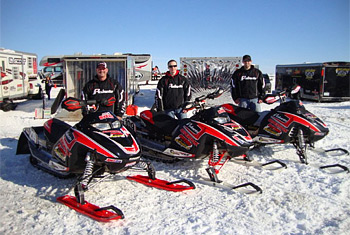
Byers Motorsports Year End Wrap-Up

After 4 months of winter and CSRA racing, it all came down to the season finale at Horseshoe Valley Ski Resort in Barrie, Ontario for the Dayco National Snowcross.

The Supertrax/ Byers Motorsports/ Polaris team was ready to put on a good show for the hometown crowd, still pumped after the performance at Kitchener. An amazing 60cm snow base made for one of the best tracks that we have had at this event.

Kyle came back from school to join us for the season finale to take on the Sport 600 class. Kyle was looking good in practice and didn’t take long to feel comfortable.

In Moto 1, Kyle got pinched out off the start but made up some time going up the hill being 6th at the top. He battled back and forth for positions all race and just after the white flag, he passed 2 riders in the bottom corner putting him in 4th.

At the bottom of the hill, he hit a rut and put the sled on the top of the berm loosing 1 position but holding onto 5th. In Moto 2, Kyle got a decent start and was 4th at the top of the hill. With one lap to go, battling for the 3rd position, Kyle hit a hole going up the hill that bucked him off the sled and sent the sled rolling hitting Kyle in the back. Kyle was ok after the crash but did not race the remaining of the weekend.

Jamie was ready to rock in the Semi-Pro Stock class after feeling good and looking fast in practice. Jamie got a great start in Moto 1 and was 2nd into the first corner after the long drag race up the hill. Jamie was running very close to first place and was looking for somewhere to make up some time.

On lap 3, Jamie went for the finish line triple to make up time but came up short and hyper-extended his knee on the landing and pulling off the track. Jamie iced his knee during the break and went out for moto 2. He finished 3rd in moto 2 but could tell he was favoring the knee. Unfortunately with 28 racers and a 10th and 3rd finish in the motos, for the first time in over 35 races, Jamie did not qualify for the final.

In Sunday’s Open class, Jamie took to the track for moto 1 and grabbed a 3rd place finish. In moto 2, Jamie’s Polaris IQ and Dayco XTX belt pulled hard all the way up the hill to put him into 2nd. He got to the inside of the leader at the bottom of the hill and made the pass for the lead.

Jamie led the rest of the race until the last lap, where he got passed in the second last corner but held on for 2nd at the finish. After qualifying 4th for the final, Jamie didn’t get the start he had wanted and was 6th going up the hill.

He ducked down to the inside of the corner at the top of the hill, where all the other racers had pushed out wide, and made the pass into 3rd. On Lap 4, Jamie cased a jump coming down the down-hill rhythm section, lost control of the sled and the sled went off the track hitting a light standard getting stuck, taking him out of the race finishing 15th.

“It wasn’t how we wanted to finish out the season. We had some tough luck and injuries didn’t help us.” Jamie said after the weekend. “We have to thank our dad and race tuner at the track, Rob, for having the sleds running great all season. We had a good and fun year of racing. We’ll take the summer off and prepare ourselves for next season.”

This season saw on average 25 racers competing in the Semi-Pro class. Some of this season best racing came from this class as it was very competitive with many close riders competing for the podium at every event.

Unfortunately injuries and bad luck kept us out of the National Podium after this weekend. We are happy with our Regional point’s results after not competing at one of the events when he went with Supertrax Magazine to ride the 2012 sleds at Snowshoot.

“Hats off to both our riders this season as they rode well, had some great results, and promoted us and our sponsors well.” said Team Owner/Tuner Rob Byers.

CSRA Season Overall Points Results:

#219 Jamie Byers

Semi-Pro Regional (Competed in 7 of 8 Events):
Stock – 6th
Open – 6th

Semi-Pro National:
Stock – 5th
Open – 4th (4 points out of 3rd)

#109 Kyle Byers

Sport 600:
17th (Competed in 3 of 8 Events due to College)

We have teamed ourselves up with some really great companies and people who provide great products that withstand the extreme conditions of Snowcross Racing. We would really like to thank ALL of our great sponsors for their support once again this season.

Thanks to All our Great Sponsors: Supertrax Magazine, Byers Motorsports – Polaris, Gamma Sales- Fly Racing, Coldwave, Dragon Optics, Amsoil, Dayco Belts, Creechers Design, Woody’s, CM Sports/Clean Media – Photography, Powermadd, Sled Pro, TekVest

2011 BEST IN CLASS: BEST BIG MILER

0

Brothers and Co-Publishers of Supertrax – Kent and Mark Lester debate their picks for 2011’s Best In Class Awards.

WINNER: Arctic Cat Z1 LXR

Mark Sez:

Last winter few sleds in our fleet endeared themselves to our crew in a manner as convincing as Cat’s Z1. The sled was exceptionally quick, handled in a linear and very predictable way on both tight, tree lined trails or wide-open groomed fire roads.

The floating front arm skid was ultra plush in jigglers but exceptionally bottom-resistant in gnarly, ungroomed whoops.

Most impressive is the way the Z1 looks after its pilot. Warmth is assured with a well protected rider’s perch and comfort guaranteed with the IRP system’s moveable seat and handlebars.

Okay, maybe the Z1’s even firing exhaust cadence more resembles a 1962 Farmall orchard tractor than the melodious tunes produced by Kent’s pick, the Yamaha Vector LTX. Still the Zee gave no gait to the Yammer on full pulls down Kevlar Lake.

Add in this reality: Oh great, Kenny, the Z-1 comes with skis you can actually use on snow! Get in front of it, brother: Yamaha’s cred is seriously undermined every time it delivers another snowmobile with those plastic things hanging on the spindles they call ‘skis’.

It’s clear the 1100cc 123-hp 4-stroke used in the Z1 represents the best power package from AC in the F-body. Mix in the fact the Z1 can get close to 20 mpg when ridden sanely and big miles become easy miles.

Kent’s Response:

Mark, how can you even compare the Z1 to the EFI Vector? I will grant you the two sled platforms described here measure up pretty nicely but there’s just no comparison when you rate the two engines.

The Vector’s 1049cc triple is a sweetheart of a snowmobile mill that delivers excellent throttle response, great top end pull and, when shifted out on trails, is the sweetest sound this side of an angel choir’s harp section.

Yes, there are issues with the stock skis but, hey, you’re gonna wear out the runners quick anyway and you can get some SnowTrackers or Qualipieces carbides to completely solve the problem.

Shoot, just buy some of those new Slit Rail skis and you’ll be the coolest dude ever. Come to think of it, you could use a little coolness.

Adjusting RUSH Suspension

Dear Motorhead:

I purchased a left-over 2010 Polaris 600 Rush at the beginning of this season. The rear suspension gauge tool was missing from the toolkit and therefore the dealer gave me one for a 2011 model. I assumed the same gauge tool is used for both 2010 and 2011 models.

At the end of the season I obtained a gauge tool for the 2010 model and noticed that the markings are about 20 lbs on the heavier side for the 2011 gauge as compared to the 2010 gauge. For example, the 220 lb mark on the 2010 gauge is equivalent to the 240 lb mark on the 2011 gauge.

I was wondering if Polaris found the original 2010 gauge caused the set-up to have a tendency to be too stiff and therefore changed the markings on the 2011 gauge to lighten things up or, is there a significant difference in the chassis or rear shock between the 2010 and 2011 models?

In March, 2009 I was able to do a test ride of the new 600 Rush and I was truly impressed at how well it rode. Apparently the Polaris folks who were traveling across the country demonstrating the new Rush had the suspension dialed-in perfect for my weight.

I have not been able to replicate the ride with the one that I purchased this past year. I’m sure it is something simple and when I discovered the difference in the suspension gauge tool at the end of this season, I thought perhaps this may be part of the problem I experienced.

Any suggestions would be appreciated.

Thank you,

Sam

Thanks for your email!

I think I understand your situation. First, the 2010 Rush was a work in progress when you test rode it – calibrations were still being finalized and obviously what you bought wasn’t what you rode in 2009.

The MY 2010 Rush rear suspension was substantially altered after the first year. The cantilever arm was completely re-designed and a cooler was added under the new snowflap system. Calibrations for MY 2012 have changed somewhat again and I believe the gauge used to set the rear spring preload has been eliminated from the tool kit.

After riding with the top suspension Engineers in West Yellowstone a month ago – we learned the proper way to set-up a MY 2011 or 2012 Rush. It’s all about ride height.

When seated on the sled you should measure 3-3.5 inches of “ride-in” or sag measured from the running boards to the snow compared to static unloaded ride height. This setting produced what we felt were the best ride responses of any Rush we’ve ridden so far.

Whether or not this formula will work on your MY 2010 Rush is another question. FYI – Do not attempt to update your 2010 with the new cantilever set-up. We’ve already inquired with Polaris on this and it is not update-able.

Hope this helps!

Motorhead Mark

2011 BEST IN CLASS: BEST TRAIL POWER

0

Brothers and Co-Publishers of Supertrax – Kent and Mark Lester debate their picks for 2011’s Best In Class Awards.

WINNER: 2011 Polaris 600 RUSH

Kent sez:

Now that all the hype has settled down and we’ve had a good look at the RUSH for a full season, we’re prepared to endorse it fully…and then some.

Our first year riding the actual production version of this groundbreaking sled was filled with fresh revelations. Yes, the rear suspension not only looks different but is a completely new way of thinking about the way a snowmobile handles terrain.

Frankly, when you’re seated on the RUSH you can’t tell if there’s any difference between it and every other shock-in-skid snowmobile built today.

The suspension doesn’t wow you until you realize this new concept is in its very earliest infancy. This was made even clearer when we rode the 2011 and sampled the updates and upgrades the Polaris engineers had made in just one year.

More impressive than any of this is the sled’s great handling. The adjective ‘great’ falls short when you actually get some seat time on a RUSH.

Its telepathic way of communicating the driver’s inputs to the trail is nothing short of spectacular.

You can reel in the tightest corners and rail through stutters like Ross Martin on this sled and rarely experience bottoming or hard impacts up through the suspension.

The RUSH’s ergonomics and rider comfort are a new standard and if you take advantage of Polaris’ option to select your own windshield height, this sled is as warm and cozy as sitting on Pam Andersons’s lap.

The new version of the 2-injector per cylinder Cleanfire is a quick revving, responsive 600 mill that delivers very good mileage and excellent power at every level. It already meets 2012 EPA emissions standards and represents the latest 2-stroke tech from Polaris.

The unspoken benefit of owning this sled is the instant rock star status you gain wherever and whenever you show up.

Its sizzle factor is sky-high and, deep down, isn’t that what we all want? You rarely get it packaged together in a sled as good as all this.

Mark Sez:

Honestly, I’m already weary of correcting you, Kent and we just got started.

First, the image of sitting in Pam Anderson’s lap is really wrong. Think about that, you may want to perform some edits.

Next, overlooking what is clearly the most revolutionary powerplant to hit the sno-mo-biz since the early 70’s: the DI 600 E-TEC, is colossally misguided. Ski-Doo is the leader in engine technology in the snowmobile industry, hands down, running away.

The 600 E-TEC simply overshadows every other sled in the 600 class based on its incredible power, drive-ability and stellar fuel mileage.

If that isn’t enough to win this BIC, what about the fact the TNT version of the XP is so light you have to tie it down in a snowstorm?

Kent, remember, light is right. Sure, the Rush gets the eye candy award and there’s definitely sizzle in the Pro-Ride suspension, however, Ski-Doo is already out front in the 600 class with the XP and E-TEC power.

OFSC Closes Provincial Snowmobile Trail System

0

The provincial snowmobile trail system operated by members of the Ontario Federation of Snowmobile Clubs (OFSC) for winter tourism is now closed for the season.

“Please avoid taking any foolish risks – for your own safety keep your sled parked until trails open again next winter.” That’s the urgent safety message from the OFSC as it warns all snowmobilers to stay off closed OFSC trails and not to trespass on private property.

The provincial trail closure means that grooming operations have ceased, regional trail connections are shut down, gates are locked and signs are being taken down. The snow base on most trails has disappeared entirely or is deteriorated to the point of being unsafe to ride, leaving many hazards exposed, including rocks, stumps and bare ground.

All ice is now becoming too unstable to support sleds or has melted away to open water. Spring run off and flooding is underway, making trails impassible, breaking trail connections and resulting in extreme danger.

The OFSC also cautions snowmobilers that off-trail locations and conditions are now unsafe for riding, including roads and open fields. The OFSC thanks all of its permit buyers for their support of the provincial trail system and their participation this winter.

We salute our clubs, volunteers and landowners who made it all possible and look forward to another great winter of OFSC snowmobiling in 2012.

The Ontario Federation of Snowmobile Clubs is dedicated to providing strong leadership and support to member clubs and volunteers, to establishing and maintaining quality snowmobile trails which are used in a safe and environmentally responsible manner, and to furthering the enjoyment of organized snowmobiling.

Visit OFSC.on.ca for more information.

2011 BEST IN CLASS: 150-HP SNOWMOBILE

0

Brothers and Co-Publishers of Supertrax – Kent and Motorhead Mark Lester debate their picks for 2011’s Best In Class awards.

WINNER: 2011 Ski-Doo MX-Z TNT 800 E-TEC

Mark Sez:

To say the 800 E-TEC was the “most awaited” new sled is not really accurate. Truth is, Ski-Doo actually lost sales last year when it held up the intro of the big block E-TEC knowing full well the delay would “unsell” a bunch of PowerTEK 800s already on order if the sheets came off the direct-injected 800 last fall.

So, this year we have the real thing. The most sophisticated, most efficient and one of the most powerful 800 2-strokes ever built, available to those (and only those) who early ordered one last spring.

I can’t believe Kent will actually attempt to respond to my incredibly logical and honestly, ridiculously obvious pick here for best 150-horsepower sled. Sure, the new Apex has EPS but everyone is wondering where the MSRP came from and why, after a mega-buck re-tooling of the entire bodywork package, the sled doesn’t look any different.

Look, Kenny, E- TEC is what snowmobilers want. It answers all the issues associated with 4-stroke weight and 4-stroke emissions.

No 4-stroke will ever be this light and produce over 150 ponies. The engine starts like a dream, idles electric-motor-smooth and literally sips fuel.

Add in this reality: The XP chassis with an E-TEC 800 ends up being the fastest non-turbocharged 2011 snowmobile. No contest, Kent. Why bother trying to counter this worthy selection?

Kent’s Response:

2011 Yamaha Apex

Mark, how short your memory is. Last year you were all over the Apex as best in this class and argued things like reliability and belt life in a class where performance and performance alone is king.

This year you’re telling us, despite the fact Yamaha made enormous improvements to an already great snowmobile, the same old Ski-Doo XP with an improved 800 knocks it off the podium.

I think your problem actually stems from early childhood but more than that, when it comes to snowmobiles, you see yourself as some kind of senior version of Tucker Hibbert.

C’mon, high performance customers ride their sleds on trails and want comfort, warmth and ride over just lightness.

The average performance customer doesn’t care two hoots about EPA certification or even if the sled smokes a bit. That buyer cares about one thing only – getting to the end of the lake first.

Moreover, that same person wants to be able to do it over and over and know his sled won’t turn into a bag of junk after two years. The jury is out on the 800 E-TEC. Is it reliable? Will it hold up?

There’s only one sled that’s proven itself here and that sled is the rock-reliable 4-stroke Apex.