Home Blog Page 253

2-Up Venture GT Gets EPS

0

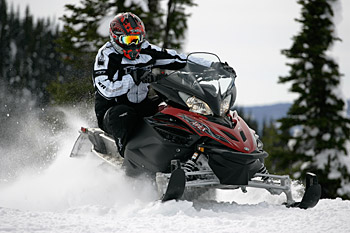
With the underhood similarities between the Vector and the Venture so obvious it just makes sense Yamaha would add EPS to its premium touring model.

The exact same power steering unit, skis and upper delta box steering support are used and the change adds genuine sizzle to one of the industry’s best-equipped tourers.

We’ve sometimes complained the driving compartment is a bit cramped for taller riders on this sled and Yamaha has answered with a taller handlebar riser and moved its position ahead a few inches.

The difference is immediately noticeable and allows more seat room for the driver. With the driver’s position a bit more forward, it makes the windshield more effective, too.

These changes amount to a significant update for the Venture GT and will certainly increase the sizzle factor of an already-good 2-up snowmobile.

Yellowstone to Implement One-Year Winter Use Plan

National Park Service planners will implement a “One-Year Rule” for the upcoming 2011-2012 winter season, in order to allow time to better address significant public input regarding the proposed long-term regulation.

More than 58,000 responses were received during the 60-day public comment period on the Draft Environmental Impact Statement (DEIS) that closed on July 18, with significant input on the long-term proposal’s requirements and approaches.

The goal had been to have a new long-term final Winter Use Plan / Environmental Impact Statement (EIS) and regulation in effect for the park by December 2011.

Among the issues that NPS wants to analyze further before issuing a long-term regulation are:

– Variable preset use limits
– Air quality and sound modeling assumptions
– Proposed Best Available Technology (BAT) for snowcoaches
– Adaptive management framework for emerging technologies
– Costs of avalanche mitigation efforts on Sylvan Pass
– The 10:30 entry time requirement included in the preferred alternative
– Opportunities for non-commercially guided access

In the near-term, the NPS plans to issue a Final Environmental Impact Statement (FEIS) and Record of Decision (ROD) that will select only the “transition year” portion of the preferred alternative.

In addition, the NPS will issue a final rule-allowing winter use for one year-allowing the same use levels with the same restrictions as the interim rule that was in place the past two seasons.

The rule will allow for up to 318 commercially guided BAT snowmobiles and up to 78 commercially guided snowcoaches per day in Yellowstone for the 2011/2012 season. It will also continue to provide for motorized oversnow travel over the East Entrance road and Sylvan Pass.

Following the issuance of the ROD and one-year rule, the NPS will immediately begin work to supplement the FEIS. The NPS intends to have a final supplemental EIS, a long-term ROD, and a long-term regulation in place before the start of the 2012-2013 winter season.

Why We think Polaris Gets It With Crossovers

0

We’ve evaluated sleds from either end of the crossover market and think Polaris is moving in a wise direction with its crossover product line-up.

For the record, those ends are as follows: The longer tracked, trail oriented crossover used for running deep flatland snow and bridging moguls on trails, to the extreme freerider X-Over genre catering to deep snow boondocking and hillclimbing with the intention of using trails as a means to an off-trail day of riding.

Polaris offers the Assault 144 Switchback, a completely serious, no compromise freeriding weapon seriously at home off-trail and not so much at home on trail.

With the addition of the Switchback Pro Ride 136, Polaris now offers a sled hugely capable at bridging moguls but equally as athletic in deep snow and flatland boondocking.

This multi-character lineup from Polaris gives what only one other manufacturer has right now: Sleds at either extreme of the X-Over game.

There’s a side to the Switchback Pro-Ride we need to discuss here. It’s the new platform’s ability to hone trails.

We honestly felt the Pro-Ride 136 was a completely no-compromise X-Over when it comes to trails.

Moreover, we also felt it takes the external shock suspension to a new and as yet, unreached plateau of plushness and mogul absorption.

Simply put, the 136 Switchback Pro-Ride is the best riding sled in the Polaris fleet, hands down.

So profound is the transparency of Pro-Ride in the Switchback, in the twisties we could not tell when we were on a 136 or a 121.

RADTKE INDUCTED INTO SNOWMOBILE HALL OF FAME

0

BRP’s Gordon (Gordy) Radtke , a veteran of 32 years in the Service department , was inducted into the Snowmobile Hall of Fame in Eagle River, Wisconsin on September 17th.

Sickness got in the way of Gordy attending the ceremony, but his three children and good friend Rich Klein were there on his behalf.

Gordon Radtke is a much loved icon in the BRP family, especially to those involved with Ski-Doo snowmobiles.

In a company filled with technically savvy people, Gordy has always been one of the best. From purely theoretical concepts to grass roots applications, Gordy has an innate understanding of all things mechanical, at every level.

And what makes him so unique is his equal enthusiasm in learning more and in sharing his knowledge.

Whatever the question, he answered it in such a way that no matter the audience, from physics professors to the merely curious, we understood.

Congratulations Gordy. Well deserved!

ARE TUNNEL ADJUSTERS REALLY NECESSARY?

0

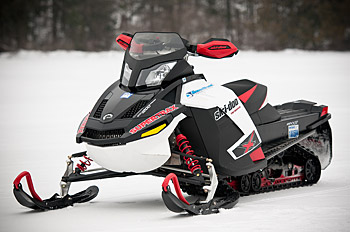
Ski-Doo’s new r-Motion skidframe comes standard with in-tunnel preload adjustment and gloves-on compression adjustment of both in-tunnel shocks.

However, available optionally (Spring Break) are out-of-tunnel adjusters for both spring preload and rear arm shock compression damping.

The preload adjuster is ultra slick, employing a hydraulic pump mounted on the left rear running board connected to a small hydraulic cylinder cradling the torsion spring pig tails.

This is a must-have feature and makes preload adjustments easier than on any sled in history.

Also, the compression clicker moves out and onto the right running board connected to the rear shock remote reservoir by a braided steel hose.

For MY 2012 the r-Motion rear suspension is only available on the MX-Z X package and XRS models. You’ll have needed to Spring Break order one of these sleds to get a copy.

If you’re looking for an r-Motion model we can unequivocally state the remote tunnel mounted adjuster thingy is a mandatory option.

You’ll definitely wish you’d shelled out for this superb feature.

ARCTIC CAT RACE SLED PROTOTYPE TESTING

0

I’m really pumped that the new 2012 Sno Pro 600 race sled is built on the same ProCross platform that we regular riders will get.

After five years of racing a competition-specific machine that had little connection to most of its consumer sleds, Arctic Cat is returning to the “race-what-we-sell” program that defined the ZR and early-Firecat eras. I see this as huge step forward that has the potential to accelerate the continual improvements that inevitably happen to sleds during their lifespan.

Arctic Cat is at its best when the creativity and feedback produced by its race program directly influences all of its snowmobiles. The amazing ideas generated through race development are staggering, from entire chassis and suspension platforms to individual components.

Examples that come to mind: Torque Sensing Link, Extra Travel Tunnel, laydown engine architecture, Slide-Action suspension, and even the ProCross chassis (which was formulated based on what was learned from the 2008-11 race sled).

This past spring I witnessed handful of engineers and racers spending the day testing one of the early prototype Sno Pro 600 race sleds.

This day included Brian Dick, Arctic Cat engineer and racer; Russ Ebert, engineer and crew chief for the Factory Team Arctic program; Steve Houle, owner of Speedwerx and builder of the 600 mod race engines that powers Open class race sleds; Dave Otto, mechanic for the Factory crew; and Factory racers Dan Ebert and Kyle Pallin.

This particular race sled proto had already seen test time in both snocross and cross-country environments, but this was the first time that Ebert and Pallin rode this version.

While the new-for-2012 ProCross race sled added a new and exciting element to springtime testing, the scene that unfolded this day was a repeat of what happens every year at this time: take the best stock race sled from the current year (in this case, Dan Ebert’s stocker exactly as it came off the track at Lake Geneva two weekends prior), and use it as a baseline to compare, tweak and improve the next year’s sled.

Last year’s race sled was highly evolved and arguably the best stock machine in snocross and cross-country. The goal for the new machine is to be even better. On this day the focus was acceleration comparison testing up a groomed hill.

Ebert and Pallin took turns on each sled, lining up side-by-side and drag racing to the top of the hill, while the rest of the crew observed whatever differences existed between the two machines.

After 6-8 runs, the crew would head back to the Factory Team trailer, where a new clutch calibration, ignition map or suspension tweaks was given to the 2012 prototype. Then it was back to the freshly groomed hill where another 6-8 drags determined the efficacy of each change.

Notes were taken, racer feedback was solicited, discussions ensued and slowly but surely, a direction emerged in terms of calibration.

More test sessions followed, at this location and in the Rocky Mountains. Different Team Arctic racers were brought in to gather feedback and test calibration.

Because this year’s racer is all-new, the company wanted as much time as possible to test component selection and calibration, the production schedule is later than normal, with sleds being produced in early November.

I’m always a little tentative to make grandiose proclamations about new machines that haven’t yet faced the competition. If history is an example of what to expect, then there will be many things learned during the first several races, with the usual teething gremlins getting sorted out via steady, noticeable improvement. If the wins don’t come immediately, it won’t take too long.

I gladly welcome this learning curve element of the new race sled, because there’s a strong chance that what’s learned on the track will eventually improve what we ride on the trail.

To read more great Arctic Cat editorial by John Sandberg, visit www.ArcticInsider.com. Be sure to register so you can post in the forum!

Regarding E-TEC: Some Objectivity Please!

Dear Motorhead:

With regard to the “HOW LONG WILL AN ETEC LAST?” article, some objectivity please!

I believe an ETEC will last. However, will it last as long as a 4 stroke? Hell no! Yes it will be cheaper to fix, but it will be fixed long before the 4-stroke.

As for fuel economy, let’s have a head to head on different terrain, different throttle settings at different mileage intervals over the course of a winter with documentation.

Then’s there’s oil consumption and lastly and often overlooked, RESALE. Check dealer black book. The ETEC outshines 4-strokes in many areas, but from a purely ‘money’ standpoint it takes a backseat to today’s best 4-stroke technology.

Greg F

Dear Greg:

We appreciate and respect your comments.

One more issue that’s of material consequence – weight. Until we get 4 stroke engines to produce similar power-per-kg as DI 2 strokes the E-TEC argument is hard to counter. No other vehicle outside of Off-Road MC’s are as sensitive to weight as snowmobiles. I

think E-TEC resale – not other EFI or SDI 2 strokes – but E-TEC specifically has exceptionally strong resale right now. In five years? Dunno.

We are convinced 4 stroke fuel economy is not in the same league as E-TEC. We have done same day comparisons every year since the first 600 E-TEC arrived and the difference is significant. Unfortunately, we have decided not to publish hard data mpg numbers because readers will inevitably mis-interpret what they mean.

Snow is a transient medium and it’s always different. So, we draw our conclusions from what we see and report it in a way that we believe verifies E-TEC’s superiority in fuel economy. It isn’t the odd time the E-TEC beats comparable 4 stroke mpg – it’s everytime.

Oil cost E-TEC vs 4-stroke gets harder to declare a winner as the miles pile up. 4-stroke oil economy is better if you ride more on your seasonal oil change. E-TEC is level – ride a mile and use the same amount of oil every mile.

Thanks,

Motorhead Mark

I agree with most of your comments, Mark. Much more difficult to achieve in a snowmobile application, but it would be sano if a snowmobile 4-Stroke could hold it’s durability & performance and drop to 2-Stroke weight levels.

Yamaha has recently achieved this in an award winning Marine Outboard product and the weight distinction in MX is small with the 450’s having clear performance advantages over the old 250’s & 500’s.

We wouldn’t dare to try to jump some of the triple’s we do today on the old 2-Stroke MX bikes.

I can tell you’re predisposed to Yamaha and that’s okay. However, think about this – the new 600 ACE from SD is a feather.

I would guess a turbo or more preferably a Supercharger could be fitted to that engine and the total weight of the sled might come in scary close to competitive 2 strokes – not necessarily SD’s – but the competition.

The engine – if it’s strong enough (probably isn’t) could be boosted to the 125 HP range and that would be as close to 2 stroke weight of any sled I can think of with 4 stroke power. Anyway, just a thought.

Won’t Believe The Hype

Dear Motorhead:

I find it frustrating when a magazine gets caught up in the hype and puts out false information. Stating that “the 800 E-TEC is the fastest snowmobile available without a turbo” is a flat out lie.

Have you heard of the Arctic Cat CFR 1000? How about the 800HO? Consumers rely on you guys to put out facts and un-biased opinions, not false advertisement.

Mark

Mark:

Thanks for your email!

Whoa! Let’s get something perfectly straight – ad hype has nothing to do with the fact in all our testing the 800 E-TEC is the fastest non-turbo sled in MY 11. Period.

We’ve got a CF-R 1000 and a couple 800 AC’s. Nope, not as fast. Maybe yours is but ours isn’t and it wasn’t last year either when we tested the limited build E-TEC 800.

Thanks,

Motorhead Mark

Yamaha’s Vector is Re-Thought for 2012

0

For 2012 the product planners have taken the next logical step and added EPS to the Vector line.

The new EPS Vectors will be available in both 121 and 136-inch versions and there have been some changes made to offset the extra cost of power steering being added.

First, the tried and true tunnel adjustable dial damping control for the Vector’s monoshock has been replaced with a new, more conventional clicker gas shock with the controls inside the tunnel on the shock itself.

This move not only has eliminated some weight and complexity but (the cable from the shock to the tunnel adjuster could sometimes be interfered with by ice) has allowed Yamaha to keep the overall price down, offsetting the extra cost associated with power steering.

Another price adjustment will be gained with the use of a pair of non-reservoir KYB aluminum gassers up front.

Frankly, we’ve always loved the variations of this shock absorber and, for trail riding, have found the overall ride of both Vectors and Apexes equipped with them to be superior to some of the more pricey reservoir and air shock packages Yamaha has offered.

The new skis and 15mm remount at the ski pivot, identical to the EPS Apexes, is also in place with the EPS Vector.

Unfortunately, Yamaha has walked away from offering a more budget-friendly iteration of the Vector without EPS.

Just like the Apex, there are no choices of EPS or not, available. Either you’re gonna love it and pay up or look at another 4-stroke without it.

Changes to the RUSH Front End This Year

0

For MY 2012 Polaris has changed the spindle angle (rake) of the RUSH front end including all the 121-inchers.

New, more laid back spindles are also moved forward effectively lengthening the sled as well.

New upper A-arms now have encapsulated ball joints replacing the former bolt-in Heim style joints used in the 2011 RUSH.

There’s a new extruded spindle with a slightly repositioned saddle bolt to round out the package.

Supertrax readers know we’ve had lots to say about RUSH handling. We’ve found the sled to be very stable and on-center, offering predictable and linear turn-in and easy to control ski-lift at the edge of carbide grip.

With changes made to the 2012 121 and 136 RUSH models, steering effort is markedly reduced while understeer at the edge of adhesion is pretty much indiscernible.

Also, ski lift when at the limit, becomes even easier to control, allowing the pilot to re-plant the inside ski at will with simple throttle modulation and steering inputs.

It all adds up to an even better handling RUSH and contributes significantly to the aforementioned transparency of the 136-inch shoe on the new Switchback.