Home Blog Page 206

Byers Motorsports Chicopee Snowcross Summary

After last seasons race was cancelled, the CSRA returned to Chicopee Ski Resort in Kitchener, Ontario to some of the most snow we’ve ever had at the event.

With more snow, the CSRA crew was able to extend the length of the track. Crowds filled the stands and along the track up the hill both days of the event.

In Saturday’s Pro Open action, Jamie hit the track in Moto 1 taking a 5th place finish. In Moto 2, he came off the sled halfway through the race in the down hill section, getting his foot caught in the toe-hold and dragged 40ft by the sled.

Jamie had injured his ankle a few weeks prior to this race and this brought it back. In the final, Jamie raced to a 10th place finish.

On Sunday, Jamie struggled with his ankle injury as the track had a lot of hard pounding landings and could not ride his normal race. In the motos, he finished 5th and 6th. In the final, he got a decent start and ran 6th for the first couple of laps before falling back finishing 10th.

The next stop is the CSRA Finale at Horseshoe Valley Ski Resort near Barrie for the Dayco National Championships. This is the home-town race for Byers Motorsports and the event always brings out a huge crowd to watch the races in the spring weather.

New for this year, the Pro and Pro-Lite class will be racing 3-days, starting with Friday night under the lights with the Vintage snowmobile races and Freestyle show. Currently Jamie is sitting 7th overall in Pro Open National Points.

Thanks to All our Great Sponsors: Supertrax Magazine, Byers Equipment Motorsports – Polaris, Dayco Belts, Gamma Sales- Fly Racing, Coldwave, Dragon Optics, Amsoil, Woody’s, Creechers Design, CMSports/Clean Media – Photography, Powermadd, TekVest, Digatron USA

PART II: 2014 ARCTIC CAT 7000 PROCROSS

0

Our fave 7000 ZR was the ProCross 137 variant using Cat’s all-new 137-inch floating front arm, Torque Sensing Link (TSL) equipped, torsion spring skidframe.

This skid gives the perfect balance of traction and mogul bridging for any trail rider disposed to occasional forays into deeper fluff.

You can still get the XF 7000 with a 144-inch skid sans torsion springs and a floating front arm, however, unless you’re riding preference is more than 50-percent off trail, go with the 137. It is exceptional.

We anticipated handling with the 1049 in the ZR (Pro Cross) platform would be similar to the 5000 ZR (the new nomenclature for the Suzuki 1100 4-stroke twin in 2014), but the sled proved us wrong.

The Yamaha triple is actually 12 pounds lighter than the 1056cc Suzuki twin and you can feel it. Turn-in is precise with just a hint of understeer that’s easily controlled with the throttle and forward weighting.

What we’re saying is this: Turn-in is not so aggressive it would upset a less experienced rider, but intuitive enough to satisfy an apex clipping, aggressive rider.

At mid-turn, the triple loves to be whacked, even with the 137-incher biting white top. The resultant instantaneous, torquey response tails out the chassis, exiting with skis planted and snow dust in the air.

Arctic Cat’s suspension calibration has taken a quantum leap in 2014 with the new 137 FFA skid. The floating front arm concept is widely accepted as the best way to eliminate vibes from trail jigglers. With the extra length of a 137 the sled literally vacuums trail trash.

Rear torsion spring calibration on the protos we rode in West Yellowstone was a real departure for Arctic Cat. Obviously someone got the memo trail riders only occasionally, not regularly, clear 100-foot doubles. Cough!

XF 7000s with the 137 track were sweet riding and will definitely get Cat back in the mainstream with trail riders who prioritize plush ride over bottoming resistance.

Here’s the secret formula. Take a legendary engine, shoehorn it into a sweet chassis, clutch it for hard acceleration and top end, stick in a smooth riding, mogul bridging skid and guess what?

You get a really good snowmobile!

+ ARCTIC CAT 7000 PROCROSS: PART I

TEST RIDE: 2013 Ski-Doo MXZ-X 600 E-TEC

0

Supertrax Magazine Co-Publisher Motorhead Mark Lester evaluates Ski-Doo’s 2013 MXZ X featuring a liquid cooled, direct injected, cylinder reed 594cc E-TEC twin with RAVE controlled exhaust valves churning out a claimed 118 horsepower.

This sled is light as a feather. The new XS bodywork improves rider warmth and mobility while directing more air to the CVT for improved belt performance and durability.

Gloves-on compression clickers on the front shocks and the rMotion rear skid features compression and preload adjustability on the running boards.

Subscribe to our YouTube Channel!

PART I: 2014 Arctic Cat 7000 ProCross

0

There’s no question Arctic Cat has been making solid, strategic and successful moves the past two seasons. To prove the point they’re about to bend the rules and minds of the sno-mo-industry for a third year in a row.

Enter the Yamaha/Arctic Cat engine supply relationship. Yep, check out your 2014 Arctic Cat brochure and there proudly for everyone to see is the proclamation certain 2014 models will use a Yamaha 1049cc triple for motivation.

Really, seriously? And Cat ain’t shy about it either. Frankly, why would they be? In what is sure to go down in history as a landmark homerun for Arctic Cat it somehow negotiated itself into a position where Yamaha is selling them their best 4-stroke engine – and, IMO, the best 4-stroke powerplant in the biz. Nice.

So what have we got here? Clearly, this engine loves living in the ProCross chassis. While it’s mounting and plumbing appear unusual – the exhaust makes a complete 180 under the fuel tank, turning forward to the right fender well, the shoehorning of this potent mill into the AC chassis feels about as good as any quad stroke package we’ve ridden to date.

Cat elected to use its effective and very tunable primary and secondary clutches for the Series 7000 ZR models the 1049 resides in. This is a smart move.

Arctic Cat has more tuning parts available for their clutches than Yamaha does for their clutch duo and maybe most importantly, the Cat secondary is a roller cam unit. Yamaha’s driven is not.

The sound of the new 7000 ZR when first lit is audibly pleasing. The 120-degree firing cadence of the triple is genuine gearhead music.

The exhaust header is exposed to snow from the tunnel and did not produce any noticeable heating in the right footwell.

Throttle response from first blip to full whack is exactly what you’d expect from this 130-plus-hp triple. The engine responds with 2-stroke urgency and actually feels like it has a healthy mid-range hook where the motor stands up and beats its fist on its chest.

This is a pleasing engine to ply and to prove it the 7000 ZR package was an instantaneous hit with every one of our riders.

+ PART II: 2014 Arctic Cat 7000 ProCross

TEAM ARCTIC CROWNED KING OF HILLCLIMB

When the big guns arrive for the biggest battle of the year sporting the highest-powered artillery, you just know that domination will ensue. That was the case at the 2013 Jackson Hole World Championship Hillclimb, where a talented corp of Team Arctic racers aboard M Series machines battled to seven wins including the ultimate “King of Kings” title.

The star of the weekend was perennial champion Kyle Tapio. Riding an Arctic Cat M800 HCR with the ProClimb chassis, Tapio waged a personal war against the gnarly course at Snow King Mountain, winning both the 800 Improved and 800 Mod finals.

But that was just a warm-up. When all of the class winners competed in the final King competition, Tapio proved who the true World Champion is by taking the Improved, Mod and King of Kings titles in convincing fashion.

“There’s a reason that Kyle is regarded as the King of Jackson,” said Al Shimpa, Team Arctic Hillclimb Coordinator. “For the second year in a row, he won two class finals, two King-of-class titles and the ultimate King of King championship as best of the entire event. He is truly an outstanding hillclimb racer.”

Joining Tapio on top of the Snow King podium were two additional Team Arctic teammates. David McClure won the 600 Improved class in addition to finishing second in 700 Improved and third in 800 Stock aboard his Arctic Cat M800 HCR. Likewise, Jeremy Archibald led a Team Arctic podium sweep of the 700 Improved class. Team Arctic racers scored 19 podium finishes at the World Championships.

“I’m so impressed with all of the Team Arctic racers and crews,” said Shimpa. “Everyone came to Jackson with their best effort, proving Arctic Cat dominated the toughest mountain race of the year. With three races remaining on the RMSHA circuit, I expect we’ll see a lot more wins before the 2013 hillclimb season concludes.”

About Arctic Cat – Arctic Cat Inc., based in Thief River Falls, Minn., designs, engineers, manufactures and markets all-terrain vehicles (ATVs) and snowmobiles under the Arctic Cat brand name, as well as related parts, garments and accessories. Its common stock is traded on the NASDAQ National Market under the ticker symbol ACAT.

More information about Arctic Cat and its products is available on the Internet at www.arcticcat.com.

Byers Motorsports Lake Geneva ISOC Recap

0

For one last time this year, we took the Supertrax, Byers Motorsports, Polaris IQ-R 600 south of the boarder to Lake Geneva, Wisconsin for ISOC’s Grand Finale.

We were amazed to see the amount of snow that was at the Grand Geneva resort for the race and the massive, technical 1:20min lap time track that the ISOC crew had built. As well as having a massive track, the event brought in thousands of spectators for the Friday and Saturday night races and had the 2014 snowmobiles on display.

Jamie set out on the track for the first time in Friday’s rainy afternoon practice to get a feel for the sled and track. With the help from Polaris Racings Tom Rager Jr., we made some adjustments to the sled to help with the up-hill drag and heavy snow conditions.

Fortunately the rain cleared up just before the Pro-Lite class races started. Jamie got a good start in Moto 1 but got sideways in the downhill rhythm section and came off the sled finishing 8th.

In Moto 2, he didn’t have the best start but was able to make his way to 6th. With 32 entries in the class, the first race hurt Jamie’s points to make the LCQ.

The temperature cooled and the sun came out for Saturday’s events. In Pro-Lite #2’s Moto 1, Jamie was mid pack on the start and was able to make his way up to 3rd on the downhill rhythm section. On the turn to go up the 3rd hill, Jamie was hit in the corner and pushed off the track and had to fall to the back. Once back on the track he rode hard to a 6th place finish.

In Moto 2, he didn’t get the greatest start but battled to a 5th place finish. Jamie qualified for the LCQ (Last Chance Qualifier) Saturday night, his Dayco belt hooked up and got him a great holeshot putting him in 3rd down the hill. He was held up at the bottom of the second downhill and fell back to 8th. He was able to make up another position but was just outside the transfer positions finishing 7th.

“I really enjoy coming down to the ISOC Events. It gives our sponsors some exposure out side of Canada and on ISOC’s online live streaming of the races. The tracks are always technical and challenging which I enjoy, I just wish we could have made it into the finals.” said Jamie after the weekend. “This also allowed me to get some more track time before our final two CSRA National Events.”

Our next stop is at Chicopee Ski Resort in Kitchener, Ontario this coming weekend for Round 6 of the CSRA Nationals.

This track has always played into Jamie’s cards as he won his first Semi-Pro Race there and has 3 of 4 podiums at the past 2 Kitchener events.

ETEC vs. Cleanfire

Dear Motorhead:

We have two 2010 renegade 600 ETECs and one 2012 polaris 600 switchback pro-R.

When drag racing, the Polaris gets out to a 2-3 sled length lead in the first 100-150 feet, then the ETECs blow the Polaris away on a lake run.

Do we have a dog or are Cleanfire engines geared only for corner to corner runs?

Richard

Richard:

Thanks for your email!

Your observations regarding the holeshot ability of the Polaris Switchback with its uncoupled rear skid are accurate.

We’ve found the Cleanfire 600 to be very competitive against the E-TEC 600 – I suspect you may have some clutching or belt issues with your SB.

Most often the Polaris Pro Ride sleds will holeshot the E-TEC and it usually takes speeds past 60-70 per to allow the E-TEC to catch up – from there we find the E-TEC does have more jam at the big end and can often win a full pull down a long lake.

Your situation seems like you may need a little tweak to your 600 Cleanfire. That’s how we see it here!

Hope this helps,

Thanks,

Motorhead Mark

RIDE IMPRESSIONS: 2014 Yamaha Viper LTX

0

A couple of weeks ago Supertrax had the opportunity to ride all the new 2014 models in Montana. Just so you know, the elevation was about 6,600 feet above sea level, so some of our engine evaluations are tempered by the high altitude. However, we did get a good chance to check out suspensions, clutching and handling on the key new sleds you’ve been waiting to hear about. Over the next days we’ll be filling you in on our riding experiences with these new sleds.

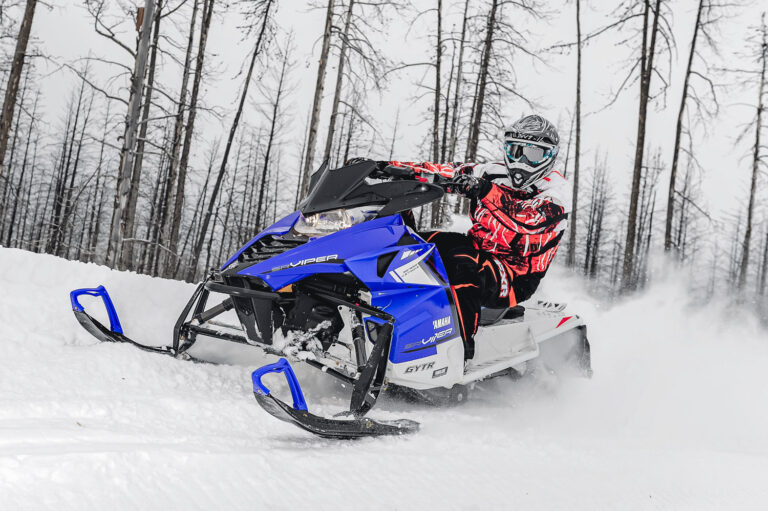
This is the sled so many readers have been waiting to hear about. We deliberately chose the 137-inch Viper here because it was the one that impressed us the most.

The slightly longer 137 track combined with the calibration of the 2-way coupled falling rate skidframe equipped with a sliding-style front arm and torque links on the rear arm delivers a premium ride.

The SE version with air shocks on the front is a slight bit less compliant at trail speeds but still close. We think the ride quality of the coilover equipped version is the best overall, however, and certainly amps itself with the 137 inch length.

The engine? All we can say is WOW! This is the sweetest sounding 4-stroke mill – and nothing has been compromised with the loss of rear exiting exhaust.

Its power delivery is just too suh-weeet! There’s no throttle lag, it has a midrange hit that makes you run for the Kleenex box to stop the nosebleed and then revs out smoothly and with big-time authority to the big end.

Remember how we’ve always stated that 4-stroke engines in the Cat ProCross chassis feel more like 2-strokes the way they handle? Yup, this one makes you forget it’s a 4-stroke. There’s very little push in the corners; the sled feels balanced and light – very neutral.

The biggest deal will be calibrating Yamaha’s clutches to work with this package. While we were at West Yellowstone a bevy of engineers were working feverishly to dial in the Yamaha clutches (the decision to go with Yamaha clutches was a fairly late development) and they were making real progress.

We think this package is gonna be a very good one and is certainly good enough to convert some 2-stroke lovers over to 4-stroke.

RIDE IMPRESSIONS: 2014 Ski-Doo MX-Z 900 ACE

0

A couple of weeks ago Supertrax had the opportunity to ride all the new 2014 models in Montana. Just so you know, the elevation was about 6,600 feet above sea level, so some of our engine evaluations are tempered by the high altitude. However, we did get a good chance to check out suspensions, clutching and handling on the key new sleds you’ve been waiting to hear about. Over the next days we’ll be filling you in on our riding experiences with these new sleds.

This sled takes riders in a completely different direction from what we’re used to.

Using a super-smooth, super quiet 4-stroke in a category that may not exist yet is a pretty bold move by Ski-Doo’s product planners.

We’ve had an opportunity to ride the 900 ACE in three different settings (two at sea level, the other at elevation) and we’re impressed.

Right now Ski-Doo is settling on final calibration with this new engine package utilizing drive-by-wire technology, and is very close to perfection.

The best one we rode was the MX-Z 900 at altitude. Although the engine couldn’t rev out as well at 6,600 feet as it did at sea level (we recorded 88-mph at this altitude), we were taken with the engine’s extreme smoothness and near-silent exhaust note.

Throttle tip-in on the units we rode in Montana was very smooth and linear and we can’t help but think this DBW technology will find itself on all Ski-Doo 4-strokes in the future.

With extremely light throttle pressure it really is a nice engine to ply for a long ride. We rode the MX-Z about 40 miles in Yellowstone and back home (sea level) we’ve experienced several 80-plus mile jaunts.

We think the biggest challenge Ski-Doo will face with this powerplant is tweaking hardcore snowmobilers’ mindsets to the fact this is sufficient power.

The truth is, with a very responsive midrange and a nice power delivery from engagement to trail speeds, it can run with some pretty heavy duty sleds and really is perfect for a large segment of riders. Certainly the riding experience is excellent – probably unlike any other snowmobile we’ve ridden.

Here’s a thought: Think this is a “tiny” 4-stroke? It’s only a measly 150cc’s smaller than Yamaha’s 1049cc rocket and Polaris has gotten mega power out of a 750cc twin with a turbocharger.

Any ideas where we’re going with this?

TEST RIDE: 2013 ARCTIC CAT F-1100 LXR

0

SnowTrax Television Co-Host Luke Lester evaluates Arctic Cat’s 2013 F1100 LXR snowmobile.

Subscribe to our YouTube Channel!