Home Blog Page 200

2014 YAMAHA VIPER WITH A 137 ROCKS!

0

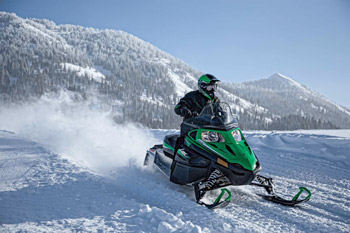
MY2014 is the year Arctic Cat decided to jump into the fray with a brand new 137-inch tracked model line to answer the call of buyers looking for more versatility.

Yamaha simply lucked out by being at the right place at the right time. How good is this track length in a Viper? Real good – and we’d unquestionably make it our first choice if we were surfing Yamaha showrooms with a money clip.

Although a 141-inch uncoupled version of the Vipe is included in the 2014 brochure, this 137-incher with full coupling, sliding front arm and torque links on the rear arm is a huge ride upgrade from former Cat-designed 141-inch uncoupled longtracks.

This year, you can put your money on the base model Viper LTX with aluminum bodied, rebuildable front shocks sporting coilover springs or upgrade to the SE that uses Fox FLOAT 3 air shocks.

These air dampers use an internal return spring to prevent stiction and provide more progressive movement. Both offer 10 inches of front travel.

Out back, the shock choices are the same on both the Viper LTX and the LTX SE. A 43mm front shock is mated with a 53mm rear arm gasser. The front shock is a preload adjustable coilover and the rear uses torsion springs. Yup, pretty conventional fare; but proven and effective.

We’d rate the ride quality of this combo as being spot-on with its Minnesota stepsisters and second only to Ski-Doo’s Renegade rMotion set-up.

In fact, we were shocked at how closely the Viper’s ride compares to the blockbusting new-tech of the rising rate rMotion.

WHAT THE HECK IS PD?

0

Yamaha has come up with a mind-bending concept called PD. It stands for “Performance Damper” and before you conclude this is some kind of new type of suspension shock, think again.

Amazingly, this is a conventional shock that is bolted to the frame of a snowmobile, usually under the hood, and it is designed to get rid of harmonic vibration and miniscule chassis movements due to flexing as the sled is being ridden. Total movement of the shock is measured in microns, so it’s very difficult to monitor the shock’s action with the naked eye.

The technology is patented by Yamaha, and Toyota, under license, has been using it for a couple of years on certain car models with measurable results.

By damping certain movements within the chassis of a car, counter effects to suspension action, bumps from the road and directional changes can be controlled much better and the net result is often much improved handling. PD is already being tested on snowmobiles and the test results have been pretty impressive.

When we first learned about this tech we though it was a con. After researching it, however, we’ve discovered the science here is valid.

We’ll be riding it this winter and can’t wait to see if it makes a discernable difference on a snowmobile.

Check the video below to watch Yamaha’s Chris Reid explain how it works. Pretty cool.

Still Big Demand For A SnoScoot!

0

A story recently resurfaced from our 2011 archives on this website that was pretty thought provoking.

The article was entitled: Is Yamaha Bringing Back the SnoScoot?

Get real here: The SnoScoot has been out of production for over twenty years and we heard that the company had destroyed all the dies and tools to build them a decade ago. Not much chance of that particular Yamaha returning to production.

What’s truly an enigma is that the SnoScoot was never really a big seller back when it was in showrooms. True, people who bought them loved them for their teenaged riders and, novice women riders loved their lightness and maneuverability. However, not enough people were interested to the extent they would pay the bucks to own one.

What’s surprising is that this recent article re-surfaced with so many readers responding to it at the beginning of the season two years after it was posted. Read the comments from Facebook; there’s more of them and more “likes” than we get with some of the current hypersleds we write about.

This tells us there’s a lot of interest in a) finding a used SnoScoot or b) buying a mid-sized sled for kids and beginners to move up to from their mini-sleds.

One reader commented it was a bummer that the snowmobile industry produced all these little 120cc mini-sleds and built a bunch of rabid potential enthusiasts who race and ride them and then hung them out to dry with no sleds for them to buy when they got too big for their mini. We say “amen” to that.

You know, Yamaha has incredible access to fabulous 4-stroke scooter engines and drivelines. Using some of the old rider-forward SnoScoot design parameters, one of these EPA approved 4-strokes producing about 30-hp would be an exciting prospect – especially if it could be priced less than $6000.

We’ll see.

Polaris Announces Buyback of Fuji Shares

0

Polaris Industries Inc. (NYSE: PII) announces that it has purchased all of Fuji Heavy Industries Ltd.’s (FHI) 3.96 million shares of Polaris’ common stock for a purchase price of $497.5 million, thereby reducing its outstanding share count by approximately six percent.

Polaris funded this purchase with a combination of cash on hand and $250 million of borrowings under the Company’s revolving credit facility.

Polaris and FHI have a long successful engine supplier relationship dating back to 1968, when FHI began manufacturing Polaris’ exclusive “Star” engine.

FHI was the sole manufacturer of Polaris’ engines from 1968 to 1995, at which time Polaris gradually began to produce its own engines for select models.

For model year 2013, FHI supplied approximately one-fourth of Polaris’ engines used in a number of models of snowmobiles and off-road vehicles.

For model year 2014 and beyond, the Company anticipates that the percentage of FHI-supplied engines will decline further as Polaris continues to significantly expand its own engine portfolio.

Scott Wine, Polaris’ Chairman and CEO stated, “FHI has been a valued partner and long-term engine supplier since 1968 and a significant, loyal and stable shareholder since we first began trading as a public company in 1987. FHI approached us with the opportunity to repurchase their entire block of Polaris stock at a negotiated discount to the most recent average market price. Our decision to repurchase these shares demonstrates not only the confidence we have in the fundamentals of our business, but also our long-term growth prospects and the commitment we have to provide an above-average return to our shareholders. However, this opportunistic share repurchase transaction in no way signals a change in our strategic direction. We continue to believe there are abundant opportunities to further expand and diversify our businesses both organically and through acquisitions and we have ample borrowing capacity and strong cash flow to fund the anticipated growth of Polaris.”

Polaris currently intends to issue $100 million of debt under an existing private placement Master Note Purchase Agreement before December 31, 2013 in order to reduce the borrowings under the Company’s revolving credit facility.

After taking into consideration the funding and transaction costs and lower outstanding share count, this transaction is expected to have only a slightly positive impact on the Company’s 2013 fourth quarter and full year earnings per share from continuing operations.

The Company’s previously issued guidance for full year 2013 earnings per share from continuing operations, raised on October 22, 2013, remains unchanged at $5.30 to $5.37 per diluted share.

On a pro forma basis, assuming this transaction had occurred on January 1, 2013, the positive impact on expected full year 2013 earnings per share from continuing operations would have been approximately $0.25 per share.

The Company’s share repurchase program authorization remains in place with approximately 1.6 million shares available for repurchase. The existing program does not have an expiration date.

Goldman, Sachs & Company acted as financial advisor to Polaris in this transaction.

Polaris is a recognized leader in the powersports industry with annual 2012 sales of $3.2 billion. Polaris designs, engineers, manufactures and markets innovative, high quality off-road vehicles, including all-terrain vehicles (ATVs) and the Polaris RANGER and RZR side-by-side vehicles, snowmobiles, motorcycles and small vehicles. Polaris is among the global sales leaders for both snowmobiles and off-road vehicles and has established a presence in the heavyweight cruiser and touring motorcycle market with the Victory and Indian motorcycle brands. Additionally, Polaris continues to invest in the global on-road small vehicle industry with Global Electric Motorcars (GEM), Goupil Industrie SA, Aixam Mega S.A.S., and internally developed vehicles. Polaris enhances the riding experience with a complete line of Polaris and KLIM branded apparel and Polaris accessories and parts. Polaris Industries Inc. trades on the New York Stock Exchange under the symbol “PII”, and the Company is included in the S&P Mid-Cap 400 stock price index.

Information about the complete line of Polaris products, apparel and vehicle accessories are available from authorized Polaris dealers or anytime at www.polaris.com.
HOW IMPORTANT IS HORSEPOWER?

0

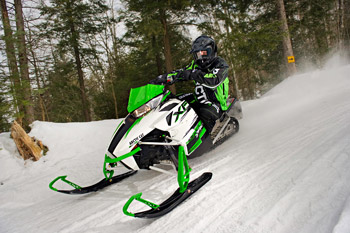
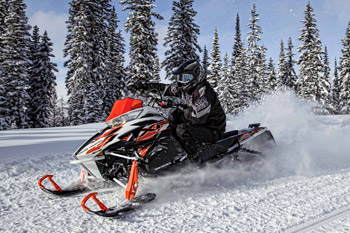
We’ve read emails and letters from our readers and viewers dissing certain sleds because their horsepower is lower than some competitive models.

It makes for interesting listening but we’re not sure horsepower alone is the defining factor making one snowmobile faster than the other.

Certainly, there are other important factors at play. Power-to-weight is a biggy. Provided drivelines are close to equally efficient, a heavier sled has to make more HP to beat a lighter sled with less ponies.

This is the case with say, the Turbo 9000 Cat and the 2-stroke 8000 Series. In a drag race, these sleds are mighty close and although the claimed power of both is about 15-17 horsepower apart, their weights are significantly different.

Here’s where it gets interesting. If you look at government EPA reports on snowmobile horsepower, by that rating system, every 2-stroke makes considerably less horsepower than the manufacturers claim. Meanwhile, the 4-stroke sleds tested report very close results to OEM claims.

Is someone lying? No. What is taken into account with the EPA system is a melding of torque and horsepower together.

Since 4-strokes make a ton of torque and 2-strokes tend to need RPM to generate big torque numbers, the duty cycle in which the EPA tests the sleds is different than what a performance shop would net on their in-house dynamometer.

Here’s our point: There are a number of factors that dictate what makes a sled go fast. Just because an 800 Indy makes less power (155) than a Ski-Doo 800 E-TEC (162) doesn’t necessarily mean one is going to beat the other on a trip down the lake.

WHAT KIND OF LYNX COULD COME TO NORTH AMERICA?

0

If BRP were to bring Lynx snowmobiles across the ocean, what would they be like?

Keep in mind, the key word here is “IF”! However, you know us well enough that we’re always postulating theories and making up rumors about what the sled-makers might be doing.

We’re not sure if they’re reading our stuff or we’ve just been lucky, but it’s kinda amazing how close we’ve been to the truth over the years.

This Lynx thing just won’t die and we’re beginning to think there’s more truth here than fiction.

Just in case you didn’t know, BRP, parent company of Ski-Doo also owns another snowmobile company in Finland called Lynx.

The Lynx line-up is pretty amazing and although these sleds use much of the technology found in Ski-Doos such as engines, TRA clutches and basic chassis platforms, there are considerable differences in bodywork, chassis layout and suspensions (Lynx uses a PPS skidframe).

There’s enough difference that Ski-Doo actually sells its whole line-up in Northern Europe right next to the Lynx products and buyers there swear their preference for the Lynx.

We were wondering what kind of Lynx would appeal to the North American snowmobile buyer? We’ve ridden these sleds and have a pretty good idea what they feel and perform like (there is a notably different tactile “feel” to these European sleds).

For certain, suspension design is a whole new ballgame and since Europeans don’t favor trails the way we do here, the suspensions are not as compliant.

We think a really big upgrade in shocks and calibration would be necessary. Also, engine selections within certain model categories could be different. Lynx uses a lot of 2-strokes and fewer 4-strokes in its line-up.

Keep in mind, these sleds would be “true imports”, assembled entirely in Finland, not in Valcourt, Quebec.

800 E-TEC GSX SE or 1200 Grand Touring?

Dear Motorhead –

I own a 2010 Nytro XTX, but my wife wants to start riding with me once in a while, so this machine really doen’t fit for us.

To tell you the truth I am missing my 2-stroke punch and was thinking about the Bombardier GSX 800 E-TEC.

Will it be suitable for 2 riders with the optional 2-up seat? I am 275-lbs and my wife is 130-lbs and my Nytro supension can’t handle that weight.

Do you think the GSX will be able to or do I need to go to the 1200 Grand Touring and limit my fun when I will go out with only the boys?

Thanks in advance for your response,

Marcel

Hi Marcel –

Thanks for your email!

Your concern is valid. I would highly recommend you opt for the GSX SE with the all-new air ride r-Motion 137 skid. This sled will accept an optional 2 up seat and as a result of the adjust-on-the-fly air ride system, you will be able to ride in comfort with your wife.

You’re correct in assuming a GSX 120 inch with the 2 up seat will be less compliant with a 400 pound passenger load. You can bump up the preload on the rear torsion springs however I would suspect you’d need to swap out the torsion springs for an optional higher pound rated set. This may then affect your ride quality when you’re alone.

The 800 E-TEC is a great engine with exceptional fuel economy and strong performance. Don’t think a 137 will be less sporty when you ride with your friends – the 137 r-Motion is virtually impossible to tell apart from the 120 version under all trail conditions.

Hope this helps,

Motorhead Mark

ADAPTIVE SNOWMOBILE SEAT

0

Here’s a cool product that was brought to our attention at the Novi snowmobile show this past weekend.

Goodwin Adaptive Action Sports has developed an adaptive snowHere’s a cool product that was brought to our attention at the Novi snowmobile show this past weekend.

Goodwin Adaptive Action Sports has developed an adaptive snowmobile seat specifically designed for snowmobilers with a paralysis, loss of lower limb or for those with difficulty standing.

The cushioned high-back seat is supported by a Fox Float 3 for the every day trail rider or a Fox Float evol RC2 shock for more aggressive riders to deliver outstanding bump compliance. There’s also a buckling seatbelt to ensure the rider is kept securely in place.

The seat also pivots side to side to enable leaning into corners and turns and side springs assist in returning the pilot to an upright position while adding stability during straightaways.

Goodwin’s Adaptive Seat can replace the stock seat on Ski-Doo sleds between the years or 2008 to 2014. It bolts easily in place and requires no drilling.

Visit GoodwinAdaptive.com for more information.

IS SKI-DOO’S 900 ACE ENOUGH?

0

We’ve been fielding comments from our readers and viewers about the new 900 ACE triple Ski-Doo is offering this year.

We’ll fill you in on what we’re hearing but first, it’s important to understand where Ski-Doo is coming from engine-wise.

Right now, Ski-Doo is arguably delivering the most comprehensive line-up of EPA-certified snowmobile powerplants compared to all other competitors.

With two 2-strokes that are super-good on fuel and EPA-efficient (600 & 800 E-TECs), too plus three 4-strokes offering clean exhaust and good (or even incredibly good) gas mileage, it’s sometimes difficult for consumers to figure out which engine provides the best combo for their individual needs.

It’s tough to argue the 800 E-TEC at 163-hp is falling short of delivering high performance value. However, a significant throng of performance-minded Doo-ers are opting for the over-achieving 4-TEC 1200 triple that makes 130-hp and a boatload of torque. Up to triple digits, 4-TECs are fast!

Likewise, if you’re getting out your checkbook this year for a new sled and you want to cruise trails, it’s tough to decide whether the 600 E-TEC or the 900-ACE is a better fit for your riding style. Prices on these two are pretty close.

Yes, the E-TEC is way faster (120-hp), but for long engine life, smoothness and all-day trail speeds, the 900 ACE (90-hp) makes incredible sense.

We were surprised so many Supertrax followers were so positive about the 900 ACE. We thought this performance range might be short of a bell-ringer for the snowmobiling masses.

The majority of those who reported in told us they would seriously consider this engine for their next Ski-Doo because it delivers power within a range in which they like to ride.

You can read some of those comments on this website in the article: 2014 Ski-Doo GSX LE ACE 900 (October 19, 2013).

Most of these were from people who hadn’t had the opportunity to put many miles on one so we’ll post more responses when the snow comes and the real production ACE 900s are on the trails.

POLARIS LIGHTENS UP ITS 550 LINE-UP

0

What was previously known as the IQ 550 is now, for 2014, the Indy 550.

The IQ 550 fan was a credible fan cooler, however, if you could drop more than 25 pounds from a sled and get better handling, better ride and improved performance – wouldn’t you?

Polaris took its Indy 600/800 chassis, a hybrid variant of the Pro-Ride RUSH platform, and slid its reliable 550cc fan mill inside.

The new Indy chassis employs what appears to be the same 121-inch coupled, dual shock, torsion spring skidframe used in the IQ. At the front, the uber-light cast bulkhead and all associated bodywork and front suspension are RUSH.

A major change is the use of a new CVTech PowerBloc, rubber-puck-style primary clutch and a new Invance secondary.

Yes, these appear to be cost-down items but the performance here is not just good, it’s doggone impressive!

Last spring, at six thousand feet elevation, the Indy 550 would wind up to an indicated 70-per without missing a beat.

Acceleration and backshifts were strong and the light feel of the chassis was undeniably a big step up from the heavier IQ platform.

If you want more flotation, the same sled comes with a 144 x 1.35 Cobra. It’s called, not surprisingly, the Indy 550 144.

The skid is dual shock, uncoupled and provides stupid flotation for an already featherweight sled.