Home Blog Page 133

YAMAHA’S ENTRY-LEVEL SLED

0

Yamaha revisited its SnoScoot this year and it looks like it will be a blazing success, filling a long awaited market gap.

However, the company needs to offer a full-sized model that appeals to mainstream buyers who aren’t necessarily interested in blistering speed but want comfort, fuel economy, a reasonable price and an acceptable level of engine performance.

An overview of the marketplace indicates there’s a niche out there for a 4-stroke sled in the 90 to 110-hp range.

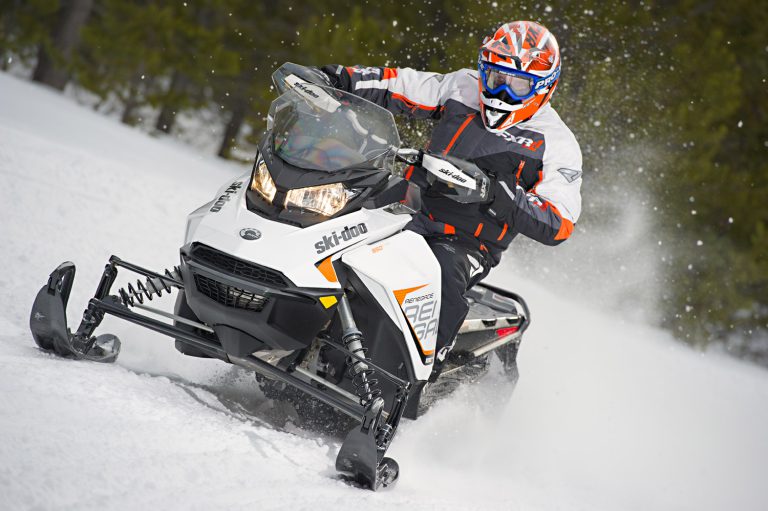
It’s hard to ignore the success of Ski-Doo’s 90-horsepower 900 ACE in its MX-Z and Renegade models. These sleds are strong sellers and account for some big numbers. Owners are really happy with all aspects of those sleds and Ski-Doo claims it’s the reason they are dominating in 4-stroke sales.

Yamaha has the raw goods to build a snowmobile that could steal some of the ACE’s thunder. Naturally, they could begin with a lightened version of the SR chassis built by Arctic Cat.

Weight could be pared in the skidframe by using Yamaha’s own SingleShot system but besides the chassis changes, utilizing its naturally-aspirated (non-turbocharged) version of the 1000cc triple used in Yamaha’s off-road YXZ Side x Side would deliver horsepower in the 110-hp range. This is a beautiful engine and would have incredible sizzle with the troops.

Yamaha also has its own roller clutch developed for the SideWinder that would be a great asset for a snowmobile in this power range.

By going with a less premium shock package, a simpler instrument layout and a few less bells and whistles, pricing could be kept under control.

Besides, have you checked the retail prices on ACE 900s? Those sleds aren’t necessarily cheap – but they sell like hotcakes!

SKI-DOO’S NEXT 4-STROKE

0

This year we’ve been waiting for Polaris to come to a decision on whether or not it will bring a new 4-stroke to snowmobiling, however, an even bigger big 4-stroke issue has to do with Ski-Doo.

The company tells us it leads the industry in 4-stroke sales with its 1170cc 4-TEC triple and its two ACE engines in 600 and 900cc configurations.

We wouldn’t even be asking the question if Ski-Doo hadn’t brought an extremely updated new G4 chassis to market, housing its 2-stroke engine selection. So far, all Rotax 4-strokes are offered only in the now-outdated XS platform.

What makes the question interesting is the fact the G4 platform has very little width allowance, even for a 2-stroke. The way the engine bay is laid out, narrow is the vogue and the new E-TEC 850 and any future engine designs will likely use the E-TEC’s “flat stator layout” that greatly reduces width.

It seems pretty clear that if Ski-Doo were to use the current 1170 and 900cc triples in the G4, there would have to be some pretty severe changes made to accommodate those engines.

We find it hard to believe, given Ski-Doo’s sales success in the 4-stroke segment, it didn’t think about this already. Two years in with the G4, we’re guessing Ski-Doo has been working on a new 4-stroke chassis design for the last three or four years, at least.

Ski-Doo certainly isn’t willing to see its 4-stroke customer base walk away from the brand because it isn’t offering the latest technology. It seems logical the company would merely design a wider front bulkhead to house the 4-strokes it already has. However, it wouldn’t surprise us either if Ski-Doo has an all-new engine, narrower and in the 1000cc range based on the ACE design, that will fit a new “G5” 4-stroke-only platform.

Ski-Doo never takes small bites out of the competition. Its next generation of 4-strokes could be radical!

THE NEW INDY

0

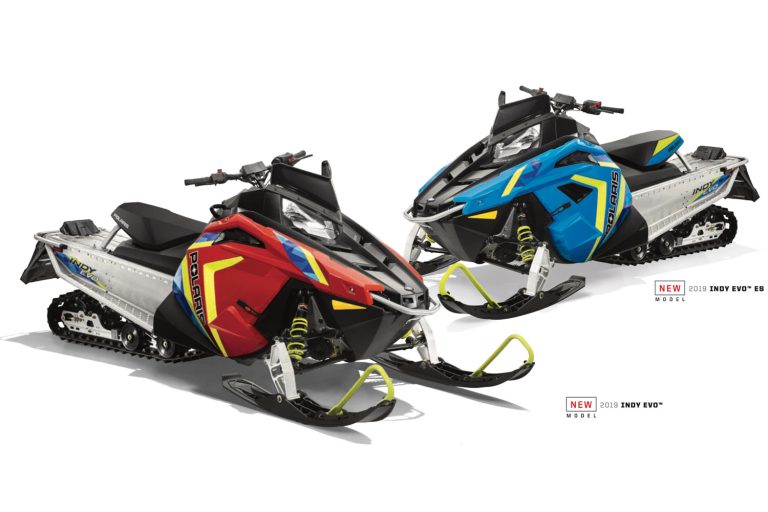
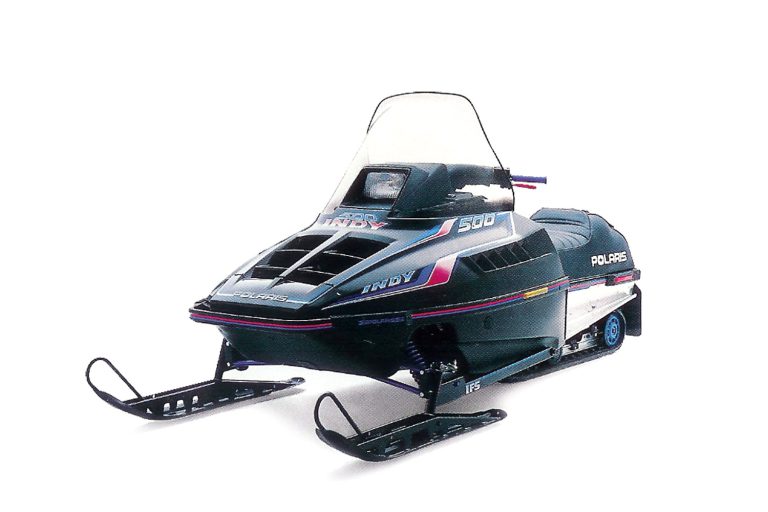
We’ve been speculating for a couple of years now whether Polaris will create a new-generation Indy anytime soon.

The success of the Assault 144, built on the AXYS platform is a strong argument a new Indy could have it all.

The Assault 144 has proven you can have a great riding shock-in-skid Polaris with all the lightweight benefits of AXYS. We can’t help but think it would be a no-brainer to apply the same tech to a new 129-inch Indy.

However, would that be enough to grab the wallets of the snowmobiling masses? Good question.

Certainly, there are a number of potential customers out there who love the handling, looks and lightness of the RUSH or 137 Switchback but can’t get their minds around those sleds’ unconventional Pro-Ride back ends.

Let’s face it, there are shock-in-skid systems that work pretty darn good and some of those RUSH shoppers are too easily migrating over to Ski-Doo and Cat.

Don’t get us wrong, we’re not saying this is the end of Pro-Ride. Nope, Polaris has evolved this suspension to near-perfection and there are thousands of converts who swear they’d ride nothing else, period.

We think one possibility may be the above-mentioned changes to the Indy but the Indy could become Polaris’ new 4-stroke chassis. Don’t stop reading yet; here’s the logic:

Polaris sells a ton of work-duty Indys with 550 fan-cooled engines in them. The competition has pretty much gone to small displacement 4-strokes like the ACE 600 and Kymco 700 twins for this segment and it would make the Indy a unique offering for Polaris with combined models accounting for significant volume.

If the same principle was applied to a turbocharged 4-stroke Indy for the performance market, we’d be real happy about that, too.

THE NEW TRACK LENGTHS

0

It wasn’t that long ago every trail sled had a 121 or 120-inch track (actually, both are the same length but there’s a difference in the pitch of the track where the drive sprockets engage it and the measurement on the snow can vary by less than an inch).

All quibbling aside, in the last decade there’s been a big shift over to baseline track lengths that measure 129-inches. It began with Arctic Cat first, then with Yamaha, then Ski-Doo and today the only OEM not offering a 129 is Polaris.

In reality, the on-the-snow footprint of a 129-inch track is about 3 to 3.5 inches more length compared to a 121. It’s not a lot but given the fact many sleds continue to drop weight, it can make a significant difference in the way a snowmobile handles powder snow and in its ability to accelerate and bite into packed snow.

One thing that’s made the 129 transition so successful is the fact it doesn’t appear to compromise handling. This may not necessarily apply to those multitudes that are choosing 137-inch trail sleds over either 120 or 129ers.

There’s a pretty big difference in the contact patch of a 137 compared to a 120 (between 6 and 7-inches on the snow) and this additional track length will numb down the sharpness in a sled’s steering response.

We’ve talked to many riders who tell us they are opting for a 137-incher as their first choice because a 129, although their second choice, doesn’t give them the off-trail versatility they’re looking for. The compromise in handling is acceptable to them for the deep snow benefit they gain.

Another interesting development is the crossover market appears to be a jumping ship from 137-inch tracks to 141, 144 and 146-inchers. New sleds like Cat’s High Country (141), Ski-Doo’s Renegade Back Country (146) and Polaris’s Assault 144 all offer excellent handling and great trail suspensions with longer tracks.

We think trail sleds will all be 129-inches soon and the crossover market will be exclusively 140-plus. We do doubt however, true crossover (trail and powder) track lengths will exceed 146-inches.

POLARIS 4-STROKE LOGIC

0

We’ve guessed, postulated and waited and so far we haven’t seen a hint that Polaris has any desire to begin offering a 4-stroke snowmobile any time soon. This doesn’t mean something isn’t brewing, however.

So far, Polaris has limited its market to only offering 2-stroke powered snowmobiles and has had pretty impressive success with that strategy.

The company continues to hold second-place market share in the industry and its SDI 2-stroke technology is fuel efficient and very powerful.

Here’s the rub: It’s questionable whether or not Polaris can grow its market share without dipping a toe into the 4-stroke market. Some authorities tell us that 4-stroke shoppers only comprise about 20-percent of the industry’s total sales.

This seems arguable as we continue to see more and more new-sled buyers at least giving serious consideration to 4-stroke sleds before buying.

Also, the Yamaha and Arctic Cat turbo-sleds have swayed a considerable number of high performance buyers over to the 4-stroke world.

Here’s the elephant in the room: Can Polaris sit out the 4-stroke market much longer?

We think the company has been building chassis prototypes and 4-stroke snowmobile engines for several years. So far there’s been no commitment to a final design but the engineering teams have the capability to pull the trigger on a new 4-stroke when the time is right – and do it on fairly short notice.

We’ve predicted an engine based on the very strong turbocharged DOHC twin used in Polaris’ off-road RZR 1000. This engine already delivers power in the 160-hp range and is CVT-friendly.

A twin would fit the AXYS front clip better than a triple – although considerable alteration of the engine bay would be required – especially if the engine were to be turbocharged.

Another twist would be an all-new engine using the RXR 1000’s head design but a 3-cylinder configuration instead of a twin.

We’re thinking MY 2019 might bring the answer we’ve been waiting for.

IMPACT OF SNOWMOBILING

0

Someone once said: “If you really want to be proud of your country, get out and take a look at it!” Snowmobilers do that every time we go for a ride – and although the experience of riding a powerful vehicle is exhilarating, so is the experience of being completely immersed in a pristine winter environment.

Sometimes I think about riding my sled out of a shaded forest glade on a zero-degree January day into an open meadow where the winter sunlight beams down, then running along the backside of a village where just a few hundred feet away, people are bustling about, going through their daily lives, oblivious to the beauty and freedom that lies within shouting distance.

Some environmentalists will try to tell you snowmobiles aren’t good for the eco-culture. These are the same ones who use major airlines at will to hop-skip across the continent so they can share their green message to the world.

They might need to learn that a single day spent on a snowmobile trail network reveals more appreciation for the environment than any number of lectures on a university campus.

Do snowmobiles compromise the flora and fauna and the air we breathe? As a total influence worldwide and given that so much progress has been made in clean technology the last decade, I’m shouting a profound “NO”!

Are we contributing to global warming and climate change? Certainly no more than a couple of thousandth percent points of what air traffic and industry pollutes in a single day.

I’m not meaning to condemn airlines or flying – we need to use these services ourselves sometimes. Rather it’s a criticism of the ‘experts’ who will try to sell the lie that snowmobiling is some kind of major contributor to environmental doom because it’s a fun and performance-driven motorized activity – a very soft target.

Frankly, although snowmobilers don’t tend to stand on soapboxes and orate about how they respect the environment, we’re out there amidst it, experiencing the beauty and fragility of a winter world 98-percent of the population are completely unaware of.

I haven’t met too many snowmobilers who profess to being eco-greenies, but I’ve met dozens of snowmobile club volunteers who go to painful lengths to ensure no damage or footprint is left when building or grooming a trail.

These same saints are the ones who pick up the garbage left behind by a few lazy and inconsiderate participants who unfortunately are found in every activity mankind is involved in.

There’s a big difference between preaching and doing. Every time you ride, be thinking about how you can enjoy it and then go home without leaving a mark.

Better yet, lift up your eyes every now and then from the 100 square feet of trail in front of you and take in the panorama surrounding you – and know this: You’re one of the very few who gets to see it!

THE NEXT VIPER

0

The introduction of the turbocharged SideWinder last year has provided a number of clues about what could happen with a second generation Viper.

Here are some things we think could be coming:

Utilization of the SideWinder’s YSRC roller secondary

This is the very least Yamaha could do with the 1049cc Yamaha triple and our guess is the company was doing field-testing with it all last winter.

New bodywork

Everything is there and already being used on the SideWinder. Yamaha has spent a ton of money designing and building molds for the SideWinder’s quick-remove body panels – makes sense a new Viper would use them, too – or at least a variation of them.

Electronic Throttle Control

YCCT (Yamaha Chip Controlled Throttle) is a flawless system and so far has only been used on the RS-based Vector and Venture. It’s well proven technology and a next-gen Viper would have a lot of sizzle with it onboard.

SingleShot Skidframe

Some have told us we’re nuts to even think about this but it makes sense from a weight-saving perspective. The 129 and 146-inch Vectors and Apexes with this skid work very well and it’s lighter. It would also make the Viper more distinctive from the Arctic Cat 7000 versions.

Power Steering

Certain upgrades of the Viper and the new Venture SR could adopt EPS. This long-tested tech is well proven and makes a deluxe version of anything Yamaha pretty appealing.

EX-UP

Here’s a stretch: Suppose the Apex’s unique EX-UP exhaust valve was adapted to the 1049 triple? Yes, there would be special challenges placing it in the tunnel of the SR platform. However, we think it could be done and may amp up the Viper’s power and torque without a lot of EPA hassling.

IEM & MFG. CELEBRATES 50 YEARS

Hope, MI: International Engineering & Manufacturing, Inc. (IEM), established in 1968, celebrates fifty years of success as the leading manufacturer of snowmobile traction products trademarked as Woody’s. The company will commemorate this occasion with their friends and fans throughout the 2017-18 show season, as well as with affiliates in the Spring of 2018 for a formal gathering. Their festivities will kickoff this year at Hay Days in North Branch, MN the weekend after Labor Day. Additional excitement includes Woody’s Facebook event called 50 Weeks 50 Giveaways, in which followers are given 50 chances to win prizes throughout the season.

Company President, Robert Musselman, states, “All of us here at IEM/Woody’s are extremely proud of this milestone. We would like to personally thank our enthusiastic supporters who helped make this achievement possible, including our customers, suppliers, distributors, manufacturers, employees, and the snowmobiling community. As we reflect on IEM’s first fifty years of successes and experiences, we also want to take this time to embrace our vision looking forward. We are excited for future opportunities in our industry and will remain committed to growth, diversification, and excellence in customer service and product quality.”

The story of a successful company began in the mid-sixties as James Musselman and Woody Kozlow put their minds together to revolutionize snowmobile racing by developing the first ever carbide runner. Instead of using three corner files attached to ski bottoms for handling and traction, they decided to use their knowledge of carbide wear characteristics and attach the carbide to a metal base. This was an instant breakthrough in the industry, and soon everyone wanted a pair of “Woody’s” carbides. Shortly after, carbide tip studs were developed and the pair became essential for racing, eventually making Woody’s synonymous with quality in snowmobile traction products.

Today, IEM is a small town, family-owned company managed by second generation Musselman family: Robert Musselman, President and Mark Musselman, Vice President. They currently employ 53 full-time employees, who are all considered family. Perseverance, hard work, innovation, and unwavering commitment to quality products and customer service is what transformed IEM into the international corporation it is today. To change with the times, an office renovation along with a new and improved website can be expected in the near future.

POSSIBILITY OF A CONSUMER G4 600

0

We’ve been stoking rumors of an all-new 600 from Ski-Doo ever since we laid orbs on the 850.

It just makes sense Ski-Doo would utilize its very advanced G4 platform for more of its models and, if this year is any indication, the company has already swapped out sleds like the Renegade Backcountry, the Freeride and others into the new chassis.

We think Ski-Doo and Rotax have been holding off a couple of years on the development and certification of yet another new E-TEC for the G4 – and that would be a 600-class powerplant.

With the recent debut of Ski-Doo’s 600cc snocrosser, the MXZ X 600 RS, there are some clues about what a new 600 would look like.

The RS, essentially a racing-only sled and engine, has a number of new tricks not used before in the old XS-based RS. First, the RS’s 600 (599.4cc) uses 850-inspired booster injectors, double reed valves and a shorter intake length (this gives the engine incredible throttle response and “snap” when you tip-in the throttle).

Also, this new 600 is a mono-block – much lighter – and has redesigned RAVE exhaust valves very similar to the 850.

We haven’t heard whether the 600 uses the flat stator and narrower width of the 850, but if it didn’t, it would be considerably harder to shoehorn it into the narrow G4 bulkhead.

We’re presuming this mono block is an-all-new casting along the lines of the 850 and will certainly accommodate the narrowness of the chassis.

All these changes are a pretty big investment and give clues to the fact there’s a new consumer 600 coming.

One question: Will it be a 600 or a 650? Although we made guesses about the 850, we never expected Ski-Doo to punch out the 800 to bigger displacement.

It changed all the rules and the company might be doing it again in the 600 class.

DEFINING FAST

0

We get lots of comments on articles we post about “fastest sleds”. Interest has amped way up the last two years with the introduction of new powerhouses like Yamaha’s SideWinder turbo , Cat’s Z9000 turbo and Ski-Doo’s 850 E-TEC.

To top all that, Cat is finally offering its long-awaited 800 DSI 2-stroke for MY 2018. These engines are among the fastest ever offered in the snowmobile business and, along with Polaris’ 800 HO, put tremendous focus on sleds that are categorized as “fast”.

The question is: What is “fast”?

Fully clutched out and pulling all the engine’s top end on a hard-packed surface resulting in a very high top speed is usually the definition of “fast”.

This may not necessarily be accurate because it could be the result of the engine being geared higher and the engine’s torque curve allowing the clutches’ calibration to go to maximum shift and pull really high speeds at top end.

The alternate definition is the rate of acceleration a sled can achieve in a set distance – sort of like a drag race. The shorter the “drag strip”, the “faster” the sled will seem when it beats other sleds with more horsepower in a short or pre-determined distance.

There are other factors that come into play, too. Clutching is one of the biggest: If an engine can get its drive system up to top speed by squeezing the primary harder and reaching optimum clutch shift-out, it can overcome other sleds with less efficient clutching but more power. Hardcore drag racers have known this for decades.

Traction is a big factor, too. Even at top speed at the end of the lake, these big, new engines are slipping the track a surprising amount unless you’ve installed some aggressive traction products.

It goes without saying that when accelerating in the drag race scenario, traction is a huge factor and if your rate of acceleration is lost to track slippage, it doesn’t matter how much horsepower or torque your sled is making.

So what’s fast this year? Without question, the two turbos are the fastest in both drag race and top speed situations. The huge torque numbers generated because of the Cat and Yamaha’s turbochargers allow for maximum clutch shift-out faster.

Frankly, even if these engines were producing less horsepower than their claimed 180-ponies, they’d still be faster than the 2-strokes by virtue of their gargantuan torque outputs and ability to squeeze the belt and still pull tall gearing.

Of the 2-strokes, we’ve found the Ski-Doo is fastest by virtue of its pDrive clutch efficiency and extra 50cc’s of displacement – once again, amping up the engine’s torque numbers so it can pull more top end with taller gearing.

Not far behind the 850 are the DSI 800 Cat and the Polaris 800HO. So close is the performance of the three 4-strokes that on any given day one can beat the other depending on weather, traction conditions and clutch tuning.

Let the arguments continue.