Home Blog Page 107

IN-SEASON VALUE SLEDS

0

Maybe you missed the boat when the opportunity came to early-order a new sled last year and now the old blister sadly sagging in your garage is looking pretty outdated.

Also, all your buddies are taking delivery of shiny new iron this month and you’re feeling left out.

The future looks bleak riding your 5-year-old beater all winter, trying to keep up, and now you’ve changed your mind and want a new sled… ASAP.

Problem is, all the specially equipped new stuff is accounted for at dealers and you don’t want to pay a premium price to get less.

Cheer up. There are deals out there. Here’s a few of our 2019 high-value favorites you should check out:

2019 POLARIS INDY 600 SP

All the sizzle is on the new Walker-Evans shock equipped Indy XC this year, but Polaris has mass produced an excellent 600 SP that is really well equipped and has all the appeal of the higher priced, highly touted-on-Snow-Check XC.

The difference? Basically, just the shocks. Although the 600 SP is only available as a 600, its 125-hp Cleanfire twin rocks and you get all the goodness of the new Indy chassis: Lightness, a 129-inch track, full AXYS platform with the new Pro-CC coupled skidframe and excellent, pre-load adjustable IFP gas shocks.

Best part? You’ll pay $10,999 USD for a brand new, completely up-to-date sled.

2019 SKI-DOO MXZ TNT

It’s tough to look through the Ski-Doo brochure past the ultra-equipped X-RS and X-Series models and fall in love with the TNT. The truth is, however, the mainstream TNT has a lot to offer for a reasonable price.

This is Ski-Doo’s bread-and butter in-season model and there are likely still some in supply at dealers. It’s available with both 600R and 850 E-TEC power, too, so that’s a good thing depending on what engine size your friends have bought.

Once again, this sled has all the up-to-date tech of the G4 platform with a 129-incher, rMotion with gas shocks and all the goodness of E-TEC. Keep in mind, the 600R is a completely new engine this year and claims about 125-hp.

The 600 will set you back about $11,399 USD and the 850, $12,749 USD.

2019 ARCTIC CAT ZR 7000 & ZR 6000

The ZR 7000 was updated this year with new bodywork and still has that bulletproof 1049cc Yamaha 4-stroke driving a TEAM primary and a roller secondary under its hood.

This is a super-reliable 130-hp, 137-inch sled that rides really good and is completely up-to date. You’ll pay $11,999 USD.

Don’t want a 4-stroke? You can get the 129-inch ZR 6000 with its proven DSI 2-stroke for $11,249 USD. It also has the latest plastic, same clutching combo as the 7000 and its engine makes power in the 125-range.

ANY NON-CURRENT 2018 or 2017 YAMAHA

If you’re lucky, you still might be able to find a brand new-still-in-the-crate 2017 or 2018 Yamaha. These sleds are discounted to clear the decks this year and constitute excellent value.

There are few changes across the board compared to new ones and these sleds ride, handle and perform pretty much the same as the 2019s, depending on the model.

Think about it. You can save hundreds, maybe even thousands of bucks locating one of these brand-new non-current Yammers. Definitely worth going on a hunt for the one you like.

Good luck!

2019 SKI-DOO ENDURO TURBO

0

Last March we received a 2019 Ski-Doo G4 Enduro at Supertrax headquarters and had a chance to long term test ride it.

This version of the Enduro was particularly interesting to us because it came with Ski-Doo’s new 900 ACE Turbo engine. Keep in mind, the Enduro is available with four engine options: 600 and 850 2-strokes, the naturally aspirated 900 ACE and this turbocharged one.

We had experienced an abbreviated sampling of the sled in West Yellowstone in February but did not have the opportunity to thoroughly wring it out at real-world altitudes and snow conditions until we had this particular one in March.

The Enduro represents a sled appealing to a specific market segment and that segment has been changing the last few years. Once shunned by ultimate performance riders, the Enduro, equipped with top performing engines, is definitely a sled those hardcores are considering today.

Adding-in all the sizzle of the G4 platform and suspension adjustability makes the sled more appealing. Frankly, its ride and handling so closely mirrors a conventional 137-inch Renegade, there’s no difference.

What is different is a bit of extra weight from the air suspension apparatus – and that is definitely worth every ounce considering the comfort and adjustability it adds!

Yes, the G4 Turbo is heavier than the 2-stroke equipped Enduros but with the modified chassis (wider to accommodate the 4-stroke) and other engineering tweaks, the extra mass is well camouflaged.

If anything, as a trail-honer, the 150-hp Turbo, with its mountainous torque, may actually be first choice for the Enduro rider. We heard someone tell us, “This sled was designed to be a 4-stroke sled and actually acts best in that format”.

Those points are all arguable – especially if you’re a 2-stroke addict – but we think 4-TEC graduates are going to be very pleased with the handling and overall demeanor or this turbocharged Enduro.

The first question you’ll ask is: “Is this sled fast enough to justify a transition from a naturally aspirated 4-TEC to this pricier, more complex sled?”

Frankly, it’s difficult to compare the 2019 G4 Enduro to a 2018 XS Enduro with a 4-TEC. The two platforms are completely different and although equipped with the same rMotion air-ride and a RAS2 front end, behave completely different.

Some of it is simple ergonomics, the rest is engine placement and chassis balance. The fact this turbo engine weighs very close to the 4-TEC without a turbo is significant and means you can make a better evaluation.

This version of the G4 Enduro tracks great on twisty trails and its skis stay planted well, probably due to its 4-stroke weight. There’s almost no push in the corners and, if anything, the forward-weighted chassis tends toward oversteer. This is good for predictability and it’s easy to get the rear end to tail-out with the skis set.

One thing you won’t notice is the 2-stroke’s tendency to more easily transfer its weight with aggressive throttle application. Certainly, the wheelie thing is less common with either because of rMotion’s fully-coupled design, but there is no front end lightness response at all with the Turbo. Those skis stay put!

Ski-Doo isn’t exaggerating when it tells us it has pretty much eliminated turbo lag. There is none detectable off-idle or even when the engine is wound out, backshifts and then the throttle is tipped in again.

Honestly, we were not aware of any significant turbo misbehavior and thought the engine behaved very close to an inflated 4-TEC. The 20 extra horsepower shows itself in bottom end punch – when you’re running about 40mph and hit the throttle.

If you’ve got any kind of traction (or traction studs), this sled jumps to attention and catapults the rider with a significant kick in the ribs – noticeably stronger than the 4-TEC.

Sorry, but we’re not huge fans of the throttle thumb control on the 4-stroke turbo. It needs more spring and there’s a learning curve required to control the turbo’s off-idle, low RPM behavior. It’s not a problem once you’re underway, but this is a low-speed problem that shouldn’t exist.

Is it a logical move-up for former 4-TEC customers? We think so, but there are those who will complain about the price and those who will complain it should perform closer to the Yamaha and Cat turbos.

We still think it will be a big seller this year and a long list of staunch 4-TEC customers will move into turbo-world.

2019 Arctic Cat M 8000 Alpha One Walk Around & Impressions | Hay Days 2018

0

Luke gives you the low-down on the all-new 2019 Arctic Cat M 8000 Alpha One. Full Review coming straight to you on the upcoming brand new season of SnowTrax Television, which begins December 2018!

Subscribe to our YouTube Channel!

IS IT TIME FOR A YAMAHA 2-STROKE?: WE RESPOND

0

About a week ago we re-posted a Yamaha story asking: “IS IT TIME FOR A YAMAHA 2-STROKE?“. The response was incredible, with over 40,000 views, nearly 1000 likes and a ton of comments. Here are some of the comments and our responses:

Warren Garton: If anyone can address the longevity of the 2 stroke it would be Yamaha. This is still the number one difference of 4 vs 2 strokes.

SUPERTRAX: Warren, you got it right. The Yamaha 2-strokes built over 15 years ago were some of the most reliable ever – regardless of their displacement or class.

John Sissenah: They brought back the old 540, so I imagine they will wander into the 2 stroke segment once again.

Don Corty: They certainly have the technology and the pockets to produce a two stroke. Just wonder if the market is really there.

SUPERTRAX: Don, the 2-stroke market is definitely still healthy and accounts for over 70-percent of all snowmobile sales.

Russell Canfield: I would so buy a 2 stroke 800-850 Yamaha … but only a 2 stroke.

Brock Bolin: I find it far more likely if they did build a 2 stroke it would be powered by the c-tech 800 from cat.

SUPERTRAX: Brock: Hmm, not Yamaha’s way of doing things!

Claude Gosselin: I have owned an SR 440 racing sled and a1981 srx 440, loved them both. Would buy Yamaha again if they would build a lightweight 2 stroke sled. How many more people are thinking like me? Come on Yamaha, flex your engineering might!

Jon Bertolino: Everyone I ride with used to ride Yamaha’s. Everyone I ride with including me now drives ski doo. This story is repeated over and over-just insert a different group of friends and a different brand they moved over to. yamaha has lost almost all its customer base since 2003. No racing, nothing but rebadged arctic cats with yamaha motors. The nytro and apex worked for some but not many hence market share loss. No one wants a sled that has a motor that will run to 100,000 miles! Um – 1000-2000 miles a year average – 10 years 20,000 miles. Who wants a ten year old sled that is actively buying state of the art technology every couple years. The sled will be junk everywhere else less the motor. Guys who buy new sleds want hi performance and light sleds.

SUPERTRAX: Jon, don’t ever sell engine longevity short! It’s a huge deal.

Dave Mijal: Yamaha stated when they released the 2019 sleds that they have been in the snowmobile business for 51 years now and have no plans on getting out of it! they also stated that everyone should pay close attention to the 2020 model year sleds as they have something big up their sleeves! I do honestly believe it will be a 2 stroke sled! for everyone saying yamaha is done with 2 strokes for sleds what do you call the vk540?????? yamaha isn’t done with anything and their plan on turning the whole snowmobile world into 4 strokes like they did with motocross backfired on them and they do want to stay in the game and they will offer 1 to 2 more 2 stroke sleds! and my guess is since the new sno scoot was one of the best selling sleds of 2018 yamaha and cat both completely sold out of every one made! that yamaha will offer a sled anywhere from 300-500cc as a step up from the sno scoot to keep young riders interested and give them options that other brands don’t have!

Andrew Hill: Personally, I wouldn’t buy a Yamaha until they do, but I don’t see any 2-strokes coming anytime soon. I wish Yamaha would build their own chassis so there is truly 4 manufacturing companies still in the snowmobile business. I’m afraid Yamaha’s days may be numbered as far as sleds go.

Mike McNulty: Remember folks first and foremost Yamaha is a motor company. Some friends in the motorsports business have told me 2020 will be a marquee year for Yamaha. Wait and see, right? I just hope they decide to build their own sleds again. I have owned several Yamaha sleds in the past and would love to see new all Yamaha models.

SUPERTRAX: Mike, Although it’s true the newest Yamahas are based on Arctic Cats, Yamaha has had a huge affect on the quality and engineering of both products and Yamaha R&D has not been silent since the 2013 manufacturing agreement. The Yamaha sleds offered today are very much Yamahas, not just Yamaha engines.

Edward Hipkens: They need a 850 2 stroke. I think it would help their sales.

Roy Brough: Yamaha was my favourite brand of snowmobile until they ended the two stroke sled in Canada so I switched to Polaris.

SUPERTRAX: Obviously, this is a red-hot topic and there are plenty of opinions on whether Yamaha should build a 2-stroke 850 – or anything else 2-stroke.

Frankly, we think it would be an intelligent way for Yamaha to get into certain segments of the industry they’re not playing in with a lot of success.

For instance: The Mountain market – a Yamaha 850 in the Cat-based chassis would be an immediate winner and Yamaha already owns the Direct Injection clean technology to build an amazing 2-stroke of this magnitude (HPDI). Same with the very busy Crossover and Free-Ride markets where weight is the issue.

Also, in our opinion, Yamaha is not so set in its ways it would completely write-off the opportunity to be more profitable.

Remember, as one of our web commentators stated in a response: “Yamaha is first an engine company!” That is so true, and building a revolutionary 2-stroke is something that plays right into their wheelhouse.

We’ll be watching carefully!

HOW TURBOS CAN MAKE MORE POWER

0

There’s been so much feedback on the fact Ski-Doo’s new turbocharged G4s net out less power than Yamaha and Cat’s Turbos, it puts a lot of focus on turbochargers in general.

Here are a few points to consider:

1. Turbochargers, which spin in the 100,000 RPM range, are actually air compressors that cram pressurized oxygen (air is mostly oxygen) into an engine’s combustion chamber. Simply stated, the result is there’s a lot more oxygen in the cylinder and when the spark plug lights it off in the presence of gasoline, it makes a bigger bang.

2. This bigger bang effect mostly affects torque. There is a horsepower increase, but the most substantial benefit is that the torque generated by a turbocharged engine is higher than one that is naturally aspirated (carb or EFI).

3. Not only is the amount of torque higher when a turbo is used but it stays relatively consistent across the whole power curve. Thus turbo engines deliver more torque from just off idle right up to max RPM. This makes for some very interesting opportunities for clutching and gearing.

4. In modern engines, turbo pressure, or boost, is regulated by a valve-like device called an electronic wastegate. This system stops the turbo pressure from getting too high – or too low. These electronic wastegates are the reason the newer turbocharged engines maintain such consistent torque as the engine spools up revs – the boost is close to the same all the time.

Older turbo engines used to have mechanical wastegates to control boost, popping off pressure when it went beyond the regulated boost level. These were pretty inconsistent at operating across the full RPM range but did well at higher RPMs.

5. Most snowmobile OEMs set turbo pressure at realistic (low) levels to conserve engine life. Even a 2-pound boost can completely change the way a turbo engine makes power.

6. Usually, modifying the amount of boost a turbo engine makes requires a change to the engine’s ECU (computer). There are aftermarket computer chips that mess with fuel flow, boost pressure and the wastegate and then adjust the engine’s timing to accommodate.

These are actually pretty reliable (get references) and as long as you don’t go too crazy with the boost, will not harm your engine.

7. After making an ECU mod (new computer chip) you’ll likely need to modify your clutching – and maybe even your gearing – to get full benefit from the power increase.

8. Have fun!

2019 Yamaha Sidewinder SRX Walk Around & First Impressions – Hay Days 2018

0

Luke gives the SnowTrax Nation a quick overview of the 2019 Yamaha Sidewinder SRX. Full Review heading your way on an all-new season of SnowTrax Television, beginning December 2018!

Subscribe to our YouTube Channel!

FXR HELIUM HELMET

0

This low profile, ultra-lightweight, technical backcountry helmet provides riders with superb lightweight protection and excellent ventilation.

FXR’s Helium Carbon bucket has a cool impact absorbing chin composite and dual density EPS safety core to further protect your melon.

Other features include adjustable peak, 3-point break-away screws and a wide range of sizing to fit different sized brains.

Also available in composite fibre alloy.

Visit fxrracing.com to check out FXR’s full line of helmets and snowmobile gear.

SNOWMOBILE TRENDS WE’RE WATCHING

0

There are a few new and developing trends we’re watching with curiosity in the snowmobile industry at the moment.

First, 600cc 2-strokes are becoming ever more appealing than they were a few years ago. We think this may be because of the increasing price levels of the big-inch rides.

Frankly, Polaris, Cat and Ski-Doo have tremendous technology in this engine variation and these sleds are as much fun and in some cases, more fun to ride than an 800 or an 850.

The savings to be had buying a 600 are significant as well and you’re usually getting the same chassis features as you’d get on the bigger-inch sleds.

The nimble handling and inherent agility of a 600 is really appealing and on trail rides and even in powder, these engines can deliver the goods.

Another big development is the growing acceptance of 4-strokes among a herd of snowmobilers who would never have considered riding one a decade ago.

The 4-stroke image probably got a big boost (literally) with the advent of Yamaha and Cat’s velvety smooth, rideable but raucous 9000 and SideWinder turbos. When handling and rideability got amped up, these sleds suddenly got the eye of otherwise 2-stroke-focused performance riders.

There’s more to this than meets the eye, however. At the other end of the model selection, sales of 4-strokes making 100-hp or less are really booming.

ACE 900 and 600 and Cat’s 3000 continue to have strong sales pull and customers looking to keep their sled for a long time are really liking the appeal of a medium performance 4-stroke.

Another trend we’re watching – and this one depends on the OEM’s willingness to build them – is the increasing demand for value-priced snowmobiles.

Snowmobilers have had a life-long reputation for being buyers who worship the crispiest, newest technology and will trade up to get it no matter the cost. Times may be changing though and the rising cost of new high-tech iron may severely limit the number of potential customers shopping them.

Baseline models with some, but not all the latest tech may be becoming increasingly important to the sled-makers’ marketing strategies.

Instead of offering sleds like Ski-Doo’s MX-Z and Renegade Sport 600 Carb and Polaris’ 600 Indy (121) at the back of the sales brochure, it might be time to modernize them a bit but keep the feature lists more conservative and the price low. You could call that idea: “Offer less, for less bucks”. The trick, of course, is to not make the sleds so unappealing no one wants them.

It goes without saying, there are new challenges building sleds in this era but, most certainly, the OEMs have the goods and the innovative ability to succeed. We’ll be watching.

SLEDDER MAIL

0

We get so many responses to our web articles we’ve decided to repost some of our recent favorites from both supertraxmag.com and FaceBook. We’ll try to do this weekly, so send in your responses whenever you can!

Responding to “Low cost of Snowmobiling”

Branden Vovanovich: Trail permits and registration are pennies compared to the absurd amount that snowmobiles and accessories are starting to cost. A belt costs more than a season pass and registration, even for out of state residents.

SUPERTRAX: Branden, it’s not only a concern to you. Thanks for putting permit costs in perspective. Meanwhile, the associations and organizations are going crazy trying to keep costs in line. Grooming is really expensive.

Denis Gionet: We pay to play … 3 permits in our household… 2 seasonal and 1 classic. We ride 99% on trail with the odd excursion on nearby lakes or private property (friends and family).

I also help brush a nearby section of trail each fall before grooming starts, to lend a hand to a neighbouring club with limited resources and manpower. The little bit I do helps them get started, it gives me a day in the bush with a sled and a saw, and I spend time with a friend from our neighbouring club.

The little bit I do is minimal in the grand scheme of things, but if more people helped that little bit, trails would be opened quicker, the major club volunteers would be less burned out and the clubs in general would benefit. I certainly appreciate the efforts of the clubs, volunteers and landowners that permit us to enjoy our sport so much.

SUPERTRAX: Denis, we just want to say thank you for the extra stuff you do!

Responding to Supertrax evaluation of the 2019 SRX:

Aaron Shiferi: I own 2 yamaha btx sidewinders, WAY MORE YAMAHA than arctic cat in these machines than the Vipers. Too all the people who are bashing yamaha I would say go ride one of these sleds yourself. I know that I love my two way more than any other sled ive owned or operated. I still believe there are great things to come of yamaha in the next few years.

SUPERTRAX: Aaron, we agree. We think Yamaha is very committed to the business and is working on some new stuff that will impress. Actually, Yamaha still has a pretty serious team working on product development.

Franck St. Rock: Basically, it has the same configuration as the Thundercat. How can it be claimed as the fastest production snowmobile? There will be an identical model from “another manufacturer” with the exact same setup. Maybe clutching is different, but from what I can grasp from the previews, they are pretty much identical in all other aspects. Maybe they upped the boost pressure on the SRX vs ThunderCat?

SUPERTRAX: Franck, you’re absolutely right. At the end of the lake there’s a toilet paper thickness distance between the 9000 and the SideWinder. No turbo pressure differences we know of.

Responding to Supertrax evaluation of the 2019 Indy 850:

Charlie Ferrell: Guys I love you, but why would you reprint the polaris press release. Everything you’ve said here is the same stuff that has already said many times. This is nothing more then a polaris press release, come on…

SUPERTRAX: Charlie: We rode it. What else can we say?

Allison Day: Maybe a game changer for polaris but the other 3 have had 129’s for the last 4-6 years.

SUPERTRAX: Allison, there’s a lot more to the new Indy than just a 129 that makes it a game-changer.

Responding to Supertrax evaluation of the 2019 Ski-Doo Turbo:

Dave Earl Bilzerian: Could you guys be more Skidoo biased? The competition isn’t “already at 180” they were over 200 ten years ago.

SUPERTRAX: Earl, we’re aware the stock Cat Turbo made about 177-hp back then. It was only aftermarket modified & re-chipped 1056cc Cats that made over 200.

Dennis Barbier: How much money did BRP pay for this line? “The first shock was Ski-Doo’s move away from an engine (the 4-TEC) that has placed the company squarely in the lead in the 4-stroke realm.” What exactly puts them in the lead over say, Yamaha?

SUPERTRAX: Dennis, you need to check out the sale numbers. That’s what we were referring to, not the quality or performance of either Yam or Doo.

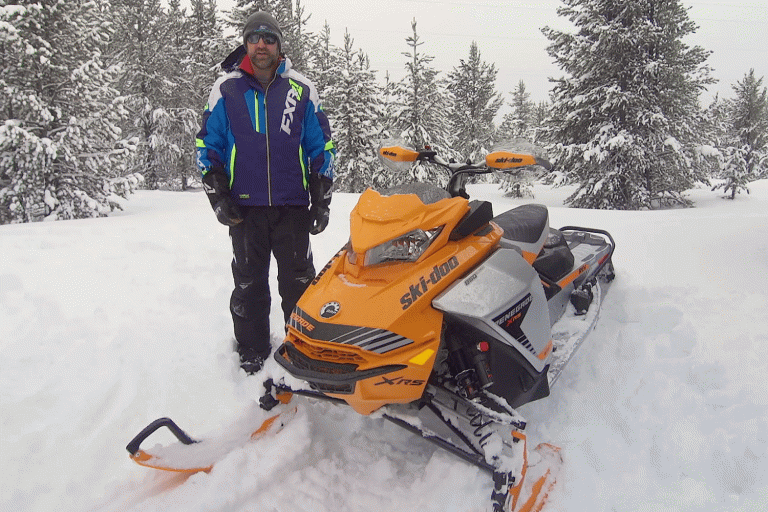
2019 Ski-Doo Renegade X-RS 900 ACE Turbo Walk Around & First Impressions – Hay Days 2018

0

AJ gets some seat time on the 2019 Ski-Doo Renegade X-RS 900 ACE Turbo and let’s you know his early thoughts on the sled. Full Review to come on SnowTrax 2019 which begins in December!

Visit ski-doo.com/snowmobiles/renegade.html for more details.

Subscribe to our YouTube Channel!