Home Blog Page 106

MOST POPULAR CROSSOVER SLED

0

We recently ran a poll on our SnowTrax Television YouTube channel and got some interesting results.

It was no surprise Ski-Doo led the poll in most categories but one question we were particularly surprised about was: “Which Crossover sled would you want to ride this season?”

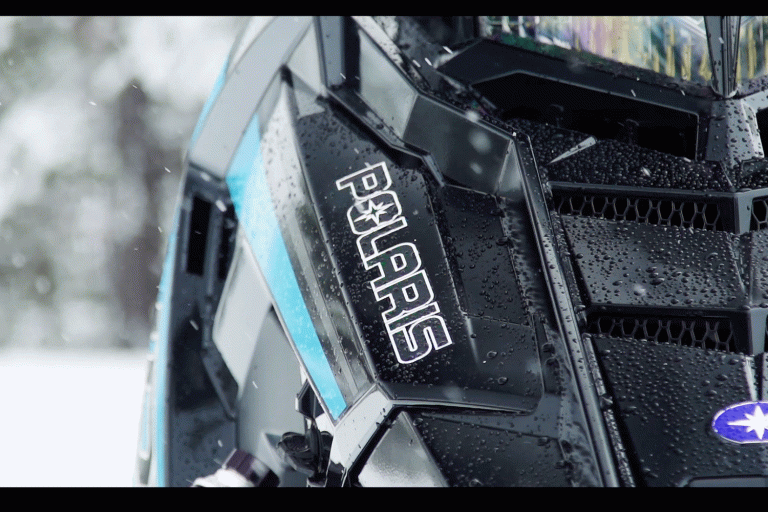
The 850 Polaris Switchback Assault 144 killed it in this segment, scoring a 44-percent positive rating, and rated significantly higher than the other very good sleds it was compared to.

We were a bit surprised at this result because the competition has really been stepping up to the plate with updates, upgrades and improvements to their crossover iron the last two years.

Meanwhile, the Switchback Assault is pretty much the same sled it was three years ago but now has a new engine – the Patriot 850.

The fact Polaris nailed it with the original Switch is pretty undeniable. There were over 1,600 poll responses and the closest the competition got was 34-percent (Ski-Doo Backcountry 850). 10-percent over anyone else is a pretty big margin and sends a strong message Polaris has got this category figured out.

We think one of the sled’s biggest assets is the Assault’s combo of good trail ride and a reasonably deep track. Polaris has leaned a bit more toward the trail-worthiness of the Switchback and kept the formula on track with true dual purpose targeting.

The others in the comparison have gone way far toward off-trail, offering deeper tracks (some to the extent you can barely ride them on trails) in an attempt to capture the love of wannabe mountain riders.

In our opinion, the crossover market is still a strong trail market and requires comfort and trail versatility over hardcore powder prowess. Obviously, Polaris gets this.

Subscribe to our YouTube channel at YouTube.com/SNOWTRAX

Vote for North America’s Top Snowmobiler! – ROUND 2

0

Vote daily at https://www.supertraxmag.com/NATS and win awesome prizes!!

In collaboration with Ski-Doo, we’re on the search again to find North America’s Top Snowmobiler and we need your help!

Review the current group of contestants. Watch their videos; check out their photos and vote for the snowmobiler who you think should move onto the next round of earning the coveted title of North America’s Top Snowmobiler!

Each round we will be giving away prizes from Woody’s, Superclamp, XPS Lubricants and Ski-Doo Accessories to lucky voters such as yourself. Vote daily and vote often because every time you vote, you’ll be entered to WIN!

The more you vote the better your chances to win these great prizes so continue to vote daily and help us find North America’s Top Snowmobiler!

Check out the 2019 Ski-Doo sleds at http://www.skidoo.com

Learn more about CKMP at https://www.carlkuster.com

#skidoo #thatskidoofeeling #CKMP

Subscribe to our YouTube Channel!

Tips for Buying a Used Snowmobile

0

Winter is coming and your buddies will be out riding soon. Don’t be left out of the fun! You can get some great deals on a used snowmobile!

But before you hook up that trailer, become an informed buyer so you don’t get stuck with someone else’s problem sled.

Read Warnert Racing Team Technician Cody Sandmann’s helpful tips for buying a used snowmobile.

What are the most important things I should check to make sure the sled is in good shape and safely operable? What should I look for in the suspension, skis, tunnel/body and track, headlights, etc.?

First of all talk to the owner and get a history of the sled. Ask questions such as “has it ever been wrecked,” “how long have you owned it,” “have you ever had any issues with it,” “do you have any service records?” From there, give the sled a once over. Take note of how many miles a machine has. DO REASERCH. I can’t stress this part enough. Each brand has had bad years and good years of sleds. Search forums, articles, and talk to your local dealer. Once you’ve decided you want to take a look at it, check to see the owner was correct on the odometer reading. Look for large damage to the tunnel and bulkhead. Look at the sled from the front and the rear and see if everything is straight. Bring a flashlight to look in those dark areas. Inspect that there are no leaks. Look for bad paint jobs or touch ups. Before looking at the sled ask the owner to not start the sled the same day your coming to look at it. When you get there, first put your hand on the engine to ensure they haven’t already ran it. Try starting the sled up. If it fires up with ease that’s a good sign, if it doesn’t you may have a problem that needs to be addressed. Not starting the sled the same day can prevent a shady owner from hiding a hard starting sled and can cost you $$$ in the future.

How do I know if the engine is healthy or if it’s wore out?

If you didn’t bring a compression gauge look for leaks in the engine (leaking crank seal, carb boot cracks or rips, and coolant leak). Does the sled start hard and pull over easily? This could be a sign of low compression. Look at the miles and look at the rest of the sled. General rule is that if the rest of the sled wasn’t taken car of the engine was probably treated the same way. If you did bring a compression gauge you’ll screw it into the spark plug hole and pull the engine over (with the throttle open and key off) about 4-5 times or until the gauge has stabilized. Anything less than 120 psi indicates lower compression. If you’re below 100, you’re guaranteed a rebuild.

What should I be watching for and listening for during a test ride?

Listen to the engine and drivetrain. The engine should be smooth running with no knocking, pinging, rattling, clunking. The drivetrain should also be smooth. Any ratcheting noises, high pitch whines, low rumble rubbing noises can signal a bad bearing, worn bushings, or some worn parts in the drive or track. Make sure all of your lights work, all of the switches function properly, and that you run the sled long enough to ensure the handwarmers (if the sled has them) work.

What are some red flags I should look for that would indicate the sled wasn’t properly maintained, took a beating, was in an accident or took a swim?

Look for cracks in the bulkhead and in the tunnel near your suspension mounting points. These are the first areas of a beat sled to fail. Look for high levels of corrosion, rust, etc. Ask the owner what they used to transport the sled. If they say an enclosed trailer or open trailer with a cover it’s a safe bet there wouldn’t be a ton of corrosion. If they say on a trailer uncovered I’d really examine the sled carefully as salt does its damage quick to sled, and with rust and corrosion the value of the sled goes down and your looking at future problems. As for taking a swim it’s hard to tell but look to see if there are high levels of corrosion in hidden places and maybe pull back some of the wire insulation and see if there is hidden corrosion.

If I decide to buy a used sled, what should I do for maintenance and inspection before I take it out for that first ride?

Inspect it from front to back. I’ve found in many cases what the owner said they did and what they actually did can differ significantly. Park the sled on cement overnight (or if no access to cement place a clean board under the sled) and look for those leaks.

Read Cody’s tips on how to get your snowmobile ready for winter.

DEFINING THE HYPERSLED

0

So, when we talk about hypersleds, what do we mean? In our Supertrax vocabulary it merely means “ultimate”, “top drawer performance”, “extreme”.

Really, even that description is not completely descriptive of what we mean. Some of our readers and viewers think it only refers to a snowmobile’s top speed or acceleration.

As you know, these results are only part of what makes a snowmobile an extreme performer. Frankly, if it was only about top speed and getting up there, the Yamaha and Cat Turbos would win the class every time. However, they don’t complete the whole performance story.

When we talk about hypersleds we mean it has to be about the performance of the whole sled – and that means handling, ergonomics and ride, too. This is one of the reasons the 800 and 850 2-strokes do so well in comparison to the super-powerful turbos.

The fact a 2-stroke’s low weight has so much to do with the overall performance of a sled is difficult to overlook. You can run an 850 2-stroke down a trail against a turbo and the 2-stroke will outperform the 4-stroke every time. It’s only on the wide open lakes and forest access trails the 4-stroke runs away – and not by that much.

Weight, or “power-to-weight”, is the great equalizer with snowmobiles and since snowmobiles are ridden in all kinds of situations: Powder, hard packed snow and tight, twisting trails, a hypersled has to outperform in every situation.

It really comes down to the type of rider you are and how you want to use your high performance sled. If you’re exclusively a groomed trail rider who likes to get out on the lakes once in a while and exercise the tach needle, the turbo is an excellent choice and will give you exactly what you want.

If you’re a trail rider who likes to run tight, groomed trails, play in powder, do some lowland hill climbing, grab some air or just use the sled in a hundred different ways, the big-inch 2-strokes will satisfy you better.

Ultimate is ultimate and it means it has to do everything well. Tough to compare the category when results are so radically different!

WILL POLARIS BUILD A 4-STROKE?

0

We’ve bantered the idea of a Polaris 4-stroke equipped sled back and forth for a couple of years now. Here’s some of our current thinking:

COST

The cost to develop an all-new snowmobile 4-stroke is high.

We’ve often speculated that Polaris could use a variation of its strong running off-road RZR 1000 4-stroke twin as a snowmobile engine. As time rolls on and the competition brings out new stuff, this seems less likely as the trend in performance snow engines tends to be toward triples.

The competition is doing a too-good job of marketing turbocharged and EFI triples and consumers like them. No matter how good a Polaris RZR twin is, will it have the sizzle of the current 3-cylinder competition?

How about this: What if a new 4-stroke Polaris was a triple? Yes, it would be a big dollar investment in a completely new engine for a relatively small market – unless of course, if it could be adapted for off-road use, too.

This brings up another point: The self imposed industry displacement limit for off-road stuff is agreed to be 1000ccs maximum. That would mean Polaris would be offering both a 1000cc twin and a 1000cc triple. Hmm.

MARKET

4-strokes only account for about 25-percent of the market. If half the potential buyers in the snowmobile biz were shopping 4-strokes, Polaris would be on it.

However, the sales numbers seem to plateau around 25-percent. Polaris would be entering a wedge of the market that is already dominated by many happy customers – and it’s only a quarter of the whole market.

What would be the potential for Polaris to own credible market share? Not that good unless the new engine was absolutely killer!

CHATTER

Nobody’s talking and every time we ask, Polaris has been pretty evasive about the viability of the 4-stroke market. There’s been no firm confession its design and engineering people are working on 4-stroke snowmobiles – and as you know, we’re pretty good at espionage.

What they do is quote us the sales numbers and the potential for growth in the industry in the 4-stroke sector. They claim it makes more sense to focus on building really good 2-strokes and applying their engineering efforts to dominating in that engine choice.

They’ve been very good at this and every model the company has brought out the last five years has been a homerun.

AN ALL-NEW VIPER

0

Other than the SideWinder SRX there hasn’t been a lot of new stuff from Yamaha for 2019. The company’s focus has clearly been on getting rid of non-current sleds and rationalizing its product line by deep-sixing some long established models like the Vector, Apex and Phazer.

Last year we wrote an article about what we’d like to see done to the next-Gen Viper (THE NEXT VIPER.

When the topic came up in discussion this year, we found it interesting how strong our opinions remained. Maybe we’re onto something – maybe not!

We’ve been in a bit of a quandary about the Viper. This 1049cc 4-stroke triple powered sled has been very popular with trail riders for several years but for some reason Yamaha has resisted upping its tech-load with new features. This year’s version is pretty much the same sled as it was in 2014.

This has been particularly puzzling because Yamaha’s inventory of unique design stuff is bursting at the seams for this sled. Here’s a few examples:

Drive-by-Wire:

Yamaha perfected YCCT electronic throttle control on the now-discontinued Vector, also used it on the 2-up RS Venture and it is excellent. There’s no throttle lag at all with it and it’s completely transparent and seamless in its operation. We can’t help but think Viper customers would love this – and it’s been field tested to perfection on the same 1049cc triple as the Viper.

Yamaha Roller Secondary:

The roller secondary developed for the SideWinder would be a welcome addition to the 1049 Viper, once recalibrated. This would put the Viper right into the wheelhouse of other trail-targeted 4-strokes and its excellent performance and backshift would no doubt improve overall performance without doing major engine tuning.

Up-to-date Bodywork:

It’s a no-brainer that the same quick-remove plastic the Arctic Cat 7000 uses should be used on the next Viper. Why not this year? Dunno!

EXUP Exhaust Valve:

This smart technology netted the Apex better bottom end and a significant boost in performance a few years ago. Why not adapt it to the 1049? The tragedy is, this technology is pretty much wasted now that the Apex is gone.

More Power:

With a new Viper, Yamaha needs to up the HP sauce. There needs to be a jump of about 5-10 horsepower in the next iteration and here’s proof: Guess what Ski-Doo did with the 2019 version of the 900 ACE in the G4 chassis? Yep, they added 5 more ponies and made every 900 ACE customer out there jealous and hungry to get at the newer, faster version.

Here’s a couple of things that are a bit of a stretch but could be adapted to a new Viper:

SingleShot Skidframe:

Some have told us we’re nuts to even think about this but it makes sense from a weight-saving perspective: The 129 and 146-inch Vectors and Apexes with this skid worked very well and it’s a lighter skidframe. This change would also make the Viper more distinctive from the Arctic Cat 7000 versions – something Yamaha purists seem to be barking about.

Power Steering

Certain upgraded models (Viper LTD) of the Viper and the new Venture SR could adopt EPS. This long-tested Yamaha-tech is well proven and makes a deluxe version of the Viper pretty appealing.

No matter how you cut it, it’s time for Yamaha to breathe new life into the Viper. Right now the Viper is the only 130-hp-class 4-stroke on the market that hasn’t been updated. We think customers are waiting for the next generation and will jump on it like a cat on tuna.

How to Prep Your Snowmobile for Winter: Expert Tips to Get Your Sled Ready

0

We asked our friend Cody Sandmann, team technician for Warnert Racing, to share some expert tips on how to prep your snowmobile for winter.

Cody gave us tons of great information to get your season off to a great start. As always, be sure to consult your user’s manual or dealer before performing any maintenance on your snowmobile.

What should you do with the old fuel?
Depending on how you stored the sled there are a few things you can do. If you used an additive you can top off your sled with fresh non-ethanol premium and run it low on the first tank. If you didn’t use an additive, you can drain your fuel system and flush the lines and put some fresh fuel in the tank. In some cases, your carbs, lines, and fuel pump may need to be cleaned if the fuel has gummed up during the summer.

Chain case oil – Do you really need to change it annually? How to tell if it’s time to replace?
Chain case oil breaks down with time while being used or even sitting. Depending how many miles you put on your sled or how you ride are factors that can come into play. For the average rider, yearly chaincase drain is a great way to help the life of the parts. For best results it’s ideal to drain the oil, pull your chaincase cover, inspect for any rust (on bearings or chain) along with looking for kinked chain links. If you find a bad chain or chunks inside the chaincase it’s a good idea to replace parts as necessary. Please refer to your owners manual on lube type and bolt torque specs.

Belt – How can you tell if its smoked from last season or if there is still life left?
Easiest things to look for are cracking, splitting, Kevlar® strands protruding from the belt side or look for discoloration on the belt edge. An overly dark area can show a burn mark from giving throttle while the track is frozen.

Steering – There always seems to be some slop in the handlebars to the tie rods. Is that normal or should I replace bushings?
There will always be a certain level of slop in the steering system from the factory. But sometimes there is a point where too much play is a concern. As you have pressure on the front end of the sled move the handlebars back and forth and note the amount of play. Trace the steering system from the post to the steering linkage to the tie rod and tie rod ends. If you find an “egged out area” or an area that has excessive play its time to replace the part. In some cases a tight steering system can have its problems. Rusty tie rod ends and linkage can pose tight steering and increased steering effort upon the rider.

Power valves – How do I clean those things? Do they need any maintenance?
Cleaning your power valves is a great way to help maintain the peak level of performance. Each brand has their own way of removing the valve system but in most cases it involves removing 2 bolts and removing the power valve housing that contains the guillotines (the metal parts that look like wood chisels) when removed you will inspect for excess carbon buildup on the guillotines and within the housing. With the assemblies out you’ll remove the excess oil from the moving parts and the port that goes into the cylinder via brake clean and heavy duty paper towel. Once you have removed all the carbon and oil you will need to replace the valve gasket (the gasket that butts up to the cylinder). Before installing the valve into the cylinder lightly coat with guillotine with the brand oil that you are using in the injection system. Refer to your owners manual and torque the mounting bolts down to spec.

Ski dampeners – How do I know if it’s time to replace them and how do I check for wear?
Easiest ways of finding a bad ski rubber is lifting the front end in the air (by the bumper or sturdy part of the a-arms) and move the ski up and down. If you have excessive play or a “floppy” ski, your ski dampeners will need replacing. Also look for cracks and missing chunks.

Carbides – How can I tell if they should be replaced prior to wearing off all the teeth?
Best way to identify if the carbide need replacing are looking for bends, chips, or missing mounting studs while lifting up on the ski.

Studs – Do I need to check the tightness of the nut? Or do you set it and forget it like the Ronco Pressure cookers that are for sale on late night TV?
Checking the tightness of studs really isn’t necessary unless you just installed them. With time, after installing new studs, the stud base and the backer compress the track and can sometimes be snugged up. If you just installed them (with 0 miles) ride with them for a few hundred miles and do a re-check of the stud tightness (via the nut or the stud base depending on the brand).

Hyfax/Slides – how do you tell when they are wore out?
Slides have wear indicators on them. It is a small line that is molded into the plastic and when they are wore down enough you will not be able to see it. Other ways are looking for pieces missing and to look for non-uniform wear.

Recoil Rope. Do I need to do anything with this?
Recoil ropes with time do wear and tear. Some things to look for are fraying and hard spots in the rope. If you have either its time to remove the recoil assembly and replace the rope. If you do find areas of fraying look for sharp areas that the rope could possibly rub on.

My sled will not start after sitting all winter. What should I do to get it going?
First of all look for the obvious; key turned to the on position, tether plugged in all the way, kill switch is in the ON position, and be sure your main fuel valve (if you have one) is on. If your sled doesn’t start, you first need to look at your mechanical abilities and start with the basics. Replace your spark plugs (maybe they fouled out or are wet after pulling the engine over so many times. if that doesn’t work take a small spray bottle with 32:1 mix and spray a small amount of fuel into the airbox (sometimes a fuel system needs that initial jump start to fill the lines up again and remove the air bubbles. And as a last resort pull your carbs off along with your fuel pump (if mechanical) and give it a good cleaning. For those of you with fuel injection a quick inspection of fuses wouldn’t be a bad idea as sometimes fuses do blow and they do control your fuel system.

Lastly – If you failed to put your sled to bed properly last winter, what are some steps you should take before you go out for your first ride?
Give that sled a quick once over. Look for leaks, worn parts, bent studs, bent carbides, etc. Check all your fluids and top off as needed. If you notice one of your fluids having a significant lower amount maybe look into seeing if there is a problem. Check to make sure your throttle lever moves freely and returns when you let off. Also take note of your brake fluid (or cable) and make sure that system is working properly also. Check that air box for mouse nests. No matter how hard or little you prepare your sled those little critters have a way of making your toy their home.

Is any other cleaning or lubricating required?
Give that sled a good wipe down with your preferred brand of cleaner or I suggest going into your cleaning supplies in your house and give the sled a good wipe down with Pledge®. Windex® your windshield, give the tie rod ends a quick shot of WD-40® and off you go. A word from the wise; don’t wipe your seat down with any sort of slippery cleaner or polish. That will just make the sled hard to ride overall. Wipe it down or clean it with soapy water.

Any other comments?
When starting your sled for the first time always have a fire extinguisher handy. I’ve had multiple accounts where the mice have made a home way up in the exhaust and a flaming ball of mouse nest leave at a high speed after you start the sled. Don’t run your sled in a closed area. I love the smell of snowmobiles as much as the next snow geek but those fumes after a prolong amount of time can burn your eyes and lungs. Let that sled warm up for a min before you go and mash the throttle. Be sure to wear all the gear all the time (gloves, helmets, boots, pants, etc.). Carry a map of the trail system your planning to ride in. If you ride in multiple areas keep those maps (up-to-date ones) in a dry Ziploc® bag. Lastly support your local snowmobile club. The people of the snowmobile clubs are the ones volunteering countless hours to make sure you can enjoy your favorite winter pastime safely.

ROTAX 900 ACE NON-TURBO

0

There’s been so much hype written about Ski-Doo’s 2019 ACE 900 Turbo, the all-new naturally-aspirated EFI version of the ACE 900 has been overlooked.

Although it’s not available in any MX-Z this year, it’s available in the 137-inch Renegade Enduro and Adrenaline platforms plus the new Expedition Sport and Grand Touring Limited.

First, it’s notable that this is the first time this compact 4-stroke has been used in the G4 chassis.

The new, wider-at-the-front G4 has a distinctive look and has been specially designed to accommodate the 900 ACE triple.

Our test riders have confirmed there’s a clearly identifiable uptick in the handling of this 4-stroke platform compared to the former XR.

With the extra 4-stroke weight up front, the skis stay more firmly planted under aggressive cornering with the “very rider-forward” ergonomics of the G4 and the sled tracks so that the tail comes around much more easily, putting the rider in a predictable oversteer situation (this is good with a snowmobile).

The ACE 900 engine has had a 5-hp bump in horsepower for 2019 and now registers 95-hp. Although that doesn’t seem earth-shattering, it is noticeable and adds to the sled’s on-trail manners.

Frankly, based on the power output of some 600 2-strokes of bygone eras, that power output is completely adequate for a big cross-section of trail riders.

All the standard features you’d get with a 137-inch 2-stroke G4 are included: RAS 3 front end, pDrive clutches, rMotion skidframe, a wide assortment of shocks including the Air-Ride system on the Enduro and the same gauge packages as you’ll get with any of the model designations of the Rennie and MX-Z you choose.

It was important for Ski-Doo to get this new iteration of the 900 right. This engine has become one of the largest sellers in the Ski-Doo line-up and constitutes a big chunk of the company’s sales volume.

Furthermore, there’s a herd of riders out there who have owned their current ACE 900 XS and XR for a few years and are probably looking to trade into something new.

This sled will definitely do the job for them.

Vote For North America’s Top Snowmobiler! – ROUND 1

0

Vote daily at https://www.supertraxmag.com/NATS and win awesome prizes!!

In collaboration with Ski-Doo, we’re on the search again to find North America’s Top Snowmobiler and we need your help!

Review the current group of contestants. Watch their videos; check out their photos and vote for the snowmobiler who you think should move onto the next round of earning the coveted title of North America’s Top Snowmobiler!

Each round we will be giving away prizes from Woody’s, Superclamp, XPS Lubricants and Ski-Doo Accessories to lucky voters such as yourself. Vote daily and vote often because every time you vote, you’ll be entered to WIN!

The more you vote the better your chances to win these great prizes so continue to vote daily and help us find North America’s Top Snowmobiler!

Check out the 2019 Ski-Doo sleds at http://www.skidoo.com

Learn more about CKMP at https://www.carlkuster.com

#skidoo #thatskidoofeeling #CKMP

Subscribe to our YouTube Channel!

Elka Suspension Announces New Line of High Performance Shocks

November 2nd, 2018 – Boucherville, Quebec, Canada

Elka Suspension is announcing its new line of high performance shocks for the 2019 Polaris Pro RMK with the 600, 800 or 850 engine. Always one of the most capable and best selling backcountry sled on the market, the Polaris Pro RMK now offers more engine options than ever. Elka’s first to market to release high performance shock upgrades for this machine. Enjoy deep snow riding at its best with a set of Elka shocks built for you!

For more information, visit www.elkasuspension.com or check out their Facebook page at: www.facebook.com/ElkaSuspension.

About ELKA SUSPENSION: Leaders in powersports aftermarket shock absorbers, Elka Suspension offers impressive performance and comfort improvements for both racing and recreational applications. The company has earned a solid reputation in the industry by providing premium-quality products at a competitive price within fast turnaround time. Its innovative shock absorbers have been used worldwide by many professional racers to win numerous races and championship titles.