Home Blog Page 108

WILL CAT MAKE AN 850?

0

If that question hasn’t been verbalized in the press, it’s certainly on the lips of many performance enthusiasts this year.

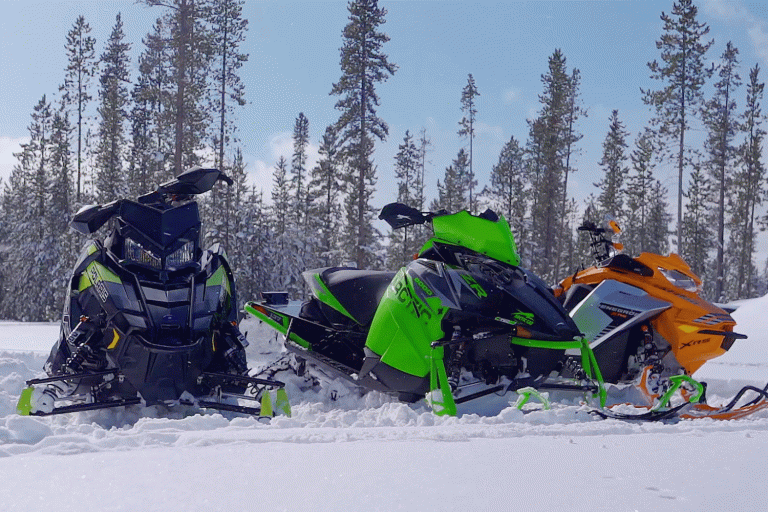
To re-state, the question being asked is: Will the slot-injected 800 Cat get its ticket punched by the new Polaris Patriot 850 and Ski-Doo’s 850 E-TEC?

Although the math says 800ccs should never be as fast as 850, we fully expect the DSI Cat’s actual performance to be fairly close. Why?

The fact is, no snowmobile engine delivers all of its power to the snow and extreme high performance production engines tend to hold back some of their potential for reliability reasons – especially early-on in product introductions to the consumer market.

Keep this in mind, too: Cat has known about the 850 wave for a while now and the key to matching on-the-snow performance will have everything to do with clutching, friction and perhaps, intentionally extending the 800’s power potential a bit further than last year. Last season, this 800 was making a claimed 162-hp and that’s mighty close to what the 850s are postulating.

The truth is, Cat only needs to make one 800cc ZR model that can run with the 850s. Think we’re wrong? Look at Yamaha’s new SideWinder SRX.

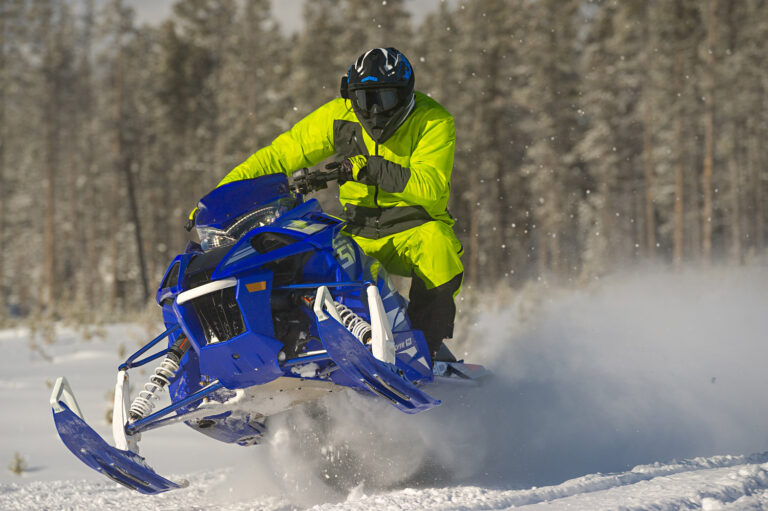
In the power department this sled is virtually the same as other SideWinders, but the SRX uses a low friction, one-inch deep track to get its top speed up into the twilight zone.

Sure, traction is an issue but, wound out on a hard-packed lake, that track enables the SRX to pull as much as two or three more mph up top. Technically faster? Yup. Making more horsepower? Nope.

When it comes right down to it, bragging rights are always about who gets to the end of the lake first, not who’s making more power in the garage.

Word is, Cat is working on a bigger 800-based engine for the future, but this year, in MY2019, Cat knows exactly what it has to work with – and work against. We’d put money on surprising performance from any 800 Cat this year.

Will the DSI 800 be faster than the 850s? We doubt it. However, we’re pretty sure this year’s 800 will be faster than last year’s.

HERE’S WHAT WOULD MAKE YOU SWITCH BRANDS

0

We read your online responses to the question with great interest and we’re very sure many of the marketing people from the snowmobile manufacturers had a good, long look, too.

We were really impressed with both the quantity and the quality of the answers and the long-term involvement of the respondents, many who have owned several different brands over their years of snowmobiling.

Based on the most frequently mentioned issues, here are a few observations we’ve summarized from your responses:

PART 1: 2-STROKE VERSUS 4-STROKE

1. Although there were a few riders who did the opposite, we were surprised how many of you have converted from 2-strokes to 4-strokes the last few years and are determined to stay.

2. The reasons for remaining with 4-strokes are:

a) Smoothness and vibration-free behavior of a 4-stroke (didn’t really see that one coming – mentioned often).
b) No 2-stroke oil smell on clothing.
c) Convenience of not having to carry or top-up oil supply. Also oil costs.
d) Perceived longer life and higher attainable reliable mileage with a 4-stroke.

3. The reasons for remaining with a 2-stroke are:

a) Lighter weight.
b) Perceived better handling (because of lightness).
c) Nice exhaust sound.
d) Perceived better acceleration.

4. Why You’d Change To a 4-stroke

a) Perception that the 2-stroke will need to be rebuilt more frequently.
b) Exhaust smell, even with today’s super-clean 2-strokes.
c) Noise, vibration and harshness levels of a 2-stroke.

Frequent comment: “If they made a really light 4-stroke (comparable to a 2-stroke) I’d buy it in an instant”.

5. Why You’d Change to a 2-stroke

a) Fear of expensive 4-stroke engine repairs long-term.
b) Extra 4-stroke weight affecting handling & get-stuck situations.
c) Perception 4-strokes limit off-trail capability.

PART 2: CHANGING BRANDS

Here are a few of the things responders said about changing brands and why they would do it:

1. Technical advancement by the OEMs is critical and complete chassis revamps are timely. The companies building the same vehicles over and over too long motivate the consumer’s desire to make a brand change to get something new and different.

2. Impersonal or “corporate” attitude of the manufacturer. Consumers want to feel a part of the brand and feel they have an attachment or perceived personal relationship either with the dealer or the corporation itself.

3. Racing and public persona. A brand with recent or past success in racing or a reputation for speed and innovation makes the consumer want to be part of it.

4. Riding demonstrations: Some consumers made a change simply because the dealer let them ride a different brand.

5. Recommendation of someone else. This can range from a trusted friend to a media review to a group of riders they know who have made the change to something new.

6. Availability. If the company makes only 2-strokes or makes only 4-strokes, those particular preferences can’t be served and those owners will not switch brands. (ie: “The leap is too big to buy a Yamaha if I can’t replace my preference for a 2-stroke”. Likewise, the same with Polaris making only 2-strokes.

TAKE-AWAYS:

1. We were surprised how few current owners were disappointed with the reliability of their current brand. Likewise, few of the respondents voiced concern about warranty work or bad treatment by a dealer. This speaks well for the level of quality control and customer service in the industry (exceptions, of course!).

2. Overall, we were surprised at the willingness of the consumer to change. It was almost “give me a good enough reason and I’ll switch brands”. It looks like this is an evolving trend in a business that has been entrenched in rabid brand loyalty for decades.

3. Choice: It appears manufacturers who wish to increase market share would be wise to expand into offering both 2-stroke and 4-stroke choices in their product menus. Certainly, embracing all the different categories of sleds gives the OEM a better shot at reaching the widest base of buyers and may be holding back consumers from making a switch even though they have respect for the brand.

4. It looks like 4-stroke customers are 4-stroke customers and 2-stroke customers are 2-stroke and never the twain shall meet. However, as mentioned above, it looks like there are more 2-stroke buyers who would make the switch to a 4-stroke than visa-versa.

NORTH AMERICA’S TOP SNOWMOBILER EAST vs WEST

0

Enter at: Enter at: https://www.supertraxmag.com/NATS

We’re on the search again for North America’s Top Snowmobiler and this time it’s a showdown between East vs West!

Capture all the glory by entering the North America’s Top Snowmobiler Competition! The 2019 WINNER will be awarded a 2020 Ski-Doo snowmobile of their choice as well as an all-expenses-paid mountain riding adventure to CKMP where you’ll hang out and rub shoulders with Carl Kuster and star in a feature story on SnowTrax Television as well as being the focus of an article in Supertrax Magazine.

To make the pot even sweeter in this winner take all battle the person crowned champion will also walk away with over $2500 in prizes furnished by Ski-Doo, Woody’s and Superclamp!

If you feel you have what it takes to win North America’s Top Snowmobiler in 2019 spark up your video camera, mobile device or whatever else you have to record a video and SHOW and TELL us why you are North America’s Top Snowmobiler.

Subscribe to our YouTube Channel!

Iron Dog board hires new executive director

Iron Dog Inc. has selected John Woodbury to be the executive director of the “World’s Longest, Toughest Snowmobile Race.”

Now in its 36th year, the Iron Dog attracts some of the best snowmachine athletes in the nation, who compete for cash and prizes as they navigate some of the toughest terrain in the state.

The Iron Dog Pro Class starts Feb. 17, 2019 on Big Lake and finishes Feb. 23 in Fairbanks. Racers travel more than 2,000 miles from Big Lake to Nome, then to the Fairbanks finish.

Woodbury is a lifelong Alaskan who has followed, reported on or participated in the race since its inception in 1984. He has run the Trail Class twice as part of the Iron Dog media pool, and has also covered the race via airplane. That coverage from land and air has allowed Woodbury to visit every checkpoint and gain unique insight into the workings of the Iron Dog race, and he’s made good friends along the way.

“Some of my best experiences as a journalist have occurred while covering the Iron Dog,” Woodbury said. “The checkpoints are filled with enthusiastic fans who are beyond generous with their time, their housing and their spare sled parts. But, I’ve got to say, the highlight in every checkpoint for me has been the folks you meet…and the delicious food they provide as the racers roar through. I’ve gained friends – and pounds – at every checkpoint.”

Iron Dog’s continued success as a legacy event in Alaska is due to the passion of its fans, supporters, sponsors and racers, Woodbury said.
“The thing about the Iron Dog is, if you already know about it, you love it. If you’re just learning about it, you’re going to love it,” he said. “It’s an event that is charged with the intensity of high-speed racing and tempered with chess-like contemplation. It’s a rollercoaster of emotions played out in a minefield of backcountry Alaska. You can’t help but become absorbed with the race.”

Woodbury said he plans to build on the passionate support base, and tap into the experience of the board.

Also new for the 2019 Iron Dog are a fresh slate of new board members. With four members recently elected to the board of directors, there is a solid mix of institutional knowledge and fresh new ideas, said Iron Dog board President Jeff Johnson.

“Iron Dog has been fortunate to have a stable and decisive board of directors for decades,” Johnson said. “There’s nothing more advantageous than surrounding yourself with experts in their fields who are willing to sacrifice their time and energy to create and maintain an event such as Iron Dog.

“Thanks to all the sponsors, volunteers, and fans who support Iron Dog,” Johnson said. “Your financial resources, endless hours of work and support are essential and appreciated.

“The board is excited to bring John on as our executive director. Having worked with him in the past, the board was confident that John was the right person to lead Iron Dog into the future,” Johnson said. “Thanks again to all the volunteers who help put on such an amazing race. It’s going to be another exciting year for Iron Dog.”

The Iron Dog board is comprised of the following members: Jeff Johnson, Eagle River, President; Roger Brown, North Pole, Vice President; Lee Butterfield, Anchorage, Secretary; Ginny Emmons, Nome; Jake Goodell, Anchorage; Penny McKibbon, Wasilla; Keith Manternach, Anchorage; Steve Mattila, Anchorage; Micah Huss, Big Lake; Dennis Falldorf, Anchorage; Doug Dixon, Anchorage; Unch Schuerch, Wasilla.

Woodbury owns Alaska Adventure Media, which publishes Alaska SnowRider and Coast magazines, among other titles. To focus on the Iron Dog executive director tasks, he has put those two publications on hiatus until May.

SKI-DOO TURBO LOGIC

0

We’ve been accused of being completely Ski-Doo-biased because we didn’t poo-poo the new Rotax turbo for making less power than a Yamaha or Cat turbo. Well, as Rowdy (Kyle) Bush says: “Haters will be haters”.

Yes, it’s true; the new Rotax 900 ACE turbo claims about 30 less ponies than either of its competitors (150 versus 180). We can’t deny it, nor do we really care.

The idea behind the new turbo was to give the hordes of now-deleted 1200 4-TEC 4-stroke owners a place to put their money when they decided to move up. The 4-TEC made a conservative 130-hp and mountains of torque – and yes, was a potent, much-loved powerplant.

So, logic would say: “Why spend all that money, design all that complexity and make the consumer spend more money to get a jump of 20-horses?” Good question.

We think there’s a bigger picture here and you need to look a couple of years into the future to understand it.

This engine and turbo combo already makes over 170-hp in the off-road world. Yes, the production Maverick X3 uses the same engine with an outsourced turbo (the snowmobile uses a Rotax-built one) to deliver a claimed 173 ponies.

As you know, when it comes to turbochargers, to make big lumps of increased power, it’s not much more complicated than increasing boost and doing some mapping changes. Do you really think Ski-Doo engineers haven’t already been experimenting with doing just that?

So, if you’re Ski-Doo, why not lay all the cards on the table and come with the biggest gun possible from the outset? We think there’s a place in the ‘Doo brochures for a conservative turbo (150-hp) and a no-holds-barred turbo (180-plus) sometime in the future. Maybe Ski-Doo sees it as two separate markets – and there’s a lot of sense in that premise.

Many high performance buyers aren’t interested in having the ultimate, king-of-the-hill rocket ship lake racer that may be compromised in other areas. The 150 Turbo makes sense for those buyers – and, no, they won’t feel ripped-off because they got passed by a Yamaha on the lake.

Furthermore, we don’t think this new SD turbo constitutes Ski-Doo’s way of using consumers to “test” its new product. We see this a well-thought-out strategy intended to change the marketplace. Wait, has Ski-Doo ever done that before?

IS ACTIVE SUSPENSION THE FUTURE?

0

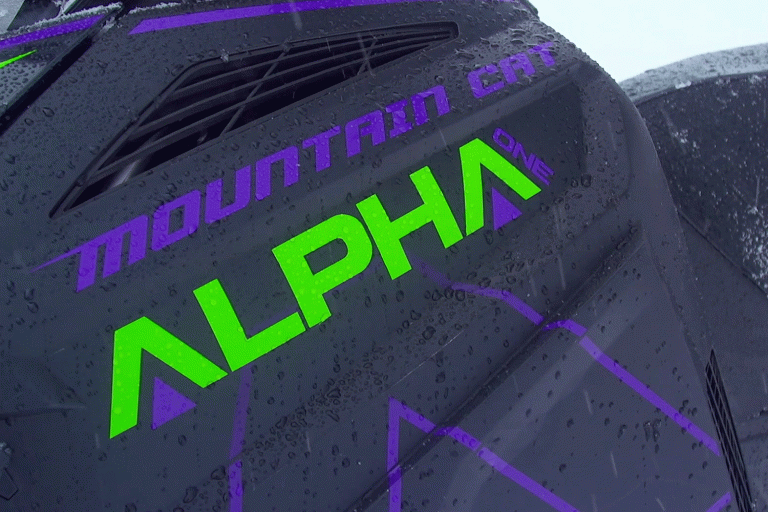
If there’s any one development this year that has stirred our imaginations it has to be Arctic Cat’s iACT suspension.

I know, you’re probably thinking, what about the Ski-Doo Turbo or the new 850 Patriot? True, those are biggies, but the concept of what we would call “semi-active suspension” speaks much more loudly for the future of snowmobiling.

Suddenly, we can envision a day when rider adjustability advances to the point where you don’t even have to think about the condition of the trails you’re riding over: The sled just automatically adjusts shock damping (maybe even the springs) to adapt to the terrain.

This concept was a pipe dream until we got into the details of iACT.

iACT does require the rider to input adjustments from the handlebars so the sled will adapt to washboard or medium moguls – but the fact you can simultaneously adjust both the front and the rear suspensions within a second is a giant leap ahead in ride compliance.

Here’s where we can easily see things going: Polaris already uses an advanced active suspension system on its off-road RZR side-by-sides. It’s called DYNAMIX and it’s capable of adjusting all corners of the vehicle at once – only without any input from the driver.

DYNAMIX uses sensors to determine the condition of the terrain you’re riding over – while you’re riding over it. It then automatically selects the correct amount of damping, sends the info to the shocks and they tune themselves to conditions almost instantaneously.

As you’re riding, the system keeps adjusting. Hit a jump and while you’re in the air the compression damping automatically goes to Firm for the best possible landing, then automatically returns to its preset level.

Our test riders have sampled DYNAMIX and claim it is not merely impressive but earth-shattering! The ride results are life-changing and simply exceed anything else available – at least as far as production vehicles go.

So, Polaris already owns this very impressive technology. How long do you think it will be before it shows up on a sled?

Polaris would be wise to jump all over DYNAMIX for snowmobiles before the competition gets going on copycat technology.

We think the proof will be in the riding this year and those who ante-up the cost for iACT will be so happy with it, it will open the door for even more competitive systems.

Walking Through The Swap Meet at Hay Days 2018

0

Luke and AJ venture through the endless aisles of Swap Meet while in attendance at Hay Days 2018 over the summer and Luke goes on a quest to buy that ‘special something’.

Subscribe to our YouTube Channel!

509 – 2019 Gear Line

0

For the past 14 years, we’ve made it our mission to design and develop the absolute best in technical snowmobile gear. Introducing the 2019 gear line from 509.

Now available at your local 509 dealer or at www.ride509.com.

https://youtu.be/XS0-BSnoj94

850 Switchback XCR vs. Renegade XRS

Dear Motorhead:

If you were choosing between the XCR 850 Switchback and the XRS Renegade which sled would you go with?

Comment from Facebook

Thanks for your inquiry!

This is a question we’ll be asked a hundred times this fall!

First, even though we’ve had lots of exposure to the new Polaris Patriot 850 we have not been able to run the Ski-Doo 850 nose-to-nose against it. This would help us answer your question because ultimately the comparo will come down to which is fastest (top end and acceleration).

Here’s what I can say from the exposure we’ve had to both 850’s individually. The Polaris feels softer at engagement and trail speeds. Not slower – just a more easy power curve while the Ski-Doo “feels” more abrupt and edgy.

As speeds rise – and according to my seat-of-the-pants-o-meter the Polaris feels stronger. At mid throttle north of 6500RPM the Patriot Polaris beats its fist on its chest and pulls as hard as anything I’ve felt right to shift RPM and past the C-Note.

Is this top end surge stronger than the Ski-Doo’s? Honestly – there was no way to quantify that unless we had both sleds at sea-level. The OEM’s frown on head-to-head drag races at Snow Shoot in West Yellowstone and at the 6600 foot minimum altitude there comparisons are not boiler plate verifiable.

I know I’ve left you with the impression the Polaris feels less powerful at low speeds compared to the Ski-Doo and the Ski-Doo feels less powerful at high speeds. This is my opinion based on very limited testing.

I can tell you this – we have both of these 850’s in varying platforms in our Press Fleet this winter and we will report on the results of heads-up comparison here at sea-level as soon as the snow is down and Kevlar Lake tightens up.

In terms of NVH it is immediately apparent Polaris has done its homework with its new and different engine mounting system. The 850 Patriot is buttery smooth – smoother than the Rotax.

In the meantime, here’s some opinion. Both these 850’s deliver more power than any normally aspirated snowmobile engine ever built. They both make at least 160 HP (probably more) and they both are blistering fast – right past 100 per.

I would also suggest you consider this reality. If you were Polaris – admittedly second to arrive in the 850 game, would you come to market with less or more power than the Ski-Doo?

Thanks,

Motorhead Mark

Arctiva introduces the new Pivot 2 Jacket

0

Janesville, Wisconsin – September 25, 2018 – Janesville, WI – Finding a unicorn used to be easier than finding performance snowmobile gear at an entry-level price. That changed when we released our Pivot line of gear. With its 100% waterproof construction and 200 grams of insulation throughout, the Pivot jacket and bib offer excellent protection from the elements without breaking the bank. New for 2018-19 is the Pivot 2 jacket. Offering all of the same features with an updated look, the Pivot 2 provides another option for the budget minded rider looking for performance outerwear. Sizes S-5XL. Suggested retail $149.95-159.95.