Home Blog Page 58

IPONE MAINTENANCE & CARE LINE

0

Getting the most out of your snowmobile requires a lot more than just topping up the oil reservoir whenever you go for a ride.

In fact, to get the most of any powersport toy and extend its useful life – adherence to a regular maintenance schedule is the best practice.

IPONE understands this and their broad assortment of MAINTENANCE and CARE LINE products are developed for supreme performance.

The MAINTENANCE line includes a range of products including brake fluids, shock oils, radiator coolant and transmission fluids.

The CARE LINE which was created to clean, shine and protect your machine is an extensive line made up of over 30 products and split between 5 product families. This includes everything from lubricants, degreasers, cleaners and polishes.

One of the things we love best about IPONE is their huge 750 ml aerosol cans and the multi position diffuser, or in layman terms – the spray nozzle. It tilts and locks in a closed position then can be opened to multiple angles and also reacts to the amount of pressure you apply, giving either a heavy soak or a powerful jet spray action.

These aerosol bottles are by far the nicest design we’ve ever used and because they are so much bigger, you don’t have to keep going back to the cabinet or store to grab more.

To view IPONE’s complete line of products visit IPONE.COM. Canadian residents can purchase IPONE through the Parts Canada dealer network.

IS THIS GROWTH SUSTAINABLE?

0

Seems like there’s nothing but good news from every corner of the powersport industry. Last summer saw record demand and sales-to-the-bare-walls of watercraft, ATVs, SxSs and RVs. The COVID reality has driven people to explore new and different ways to recreate.

Our sport, snowmobiling, is as I write this, carding what may very well be the largest annual (percentage) increase in sales in decades. As you read this the supply of new sleds is pretty much dry, finished, over, done. You can’t find a new sled for sale and if you do, you’ll pay full MSRP – maybe more.

Used snowmobiles have sold at a pace I have personally never witnessed. Sellers are getting ridiculous jing for anything – and I do mean anything – used. I’ve had a few convos with industry insiders over the Christmas break and there is one question everyone is asking themselves: “Is this sustainable?”.

For as many years as I’ve participated in this sport it has been widely recognized snowmobiling presents potential buyers (new entrants) with a plethora of barriers. Simply put, among other motorized recreational activities snowmobiling requires hand-holding and guidance to get into. Most often, new snowmobilers get into the sport on the seat of a friend’s snowmobile.

This being reality, the sport is living off an indigenous core of seasoned, experienced participants whose average age appears to be about 46. The rate of new participants has slumped to less than 5-percent annually. The industry has been able to make this kind of anemic growth work by cannibalizing amongst the sport’s four OEMs.

Enter 2020 and the whole picture has changed. New buyers and returning buyers (those who had snowmobiled in the recent or distant past) have come out in record numbers. These buyers represent what every OEM marketing guru dreams about: A genuine, legitimate expansion of the business with new (and returning) participants.

Here’s what is exceptionally interesting: The list of barriers we always felt were to blame for the poor rate of growth in the sno-mo-biz were serious stuff. Like needing a 4×4 pickup or SUV to tow a trailer in the worst driving conditions of the year or how about the need for thousands of dollars of clothing for your family including helmets, boots and gloves.

Hang on though, there are more barriers like: “where do I use this thing?” and “What do I do if I get lost?” – all concerns for the uninitiated. Just finding a place to go riding is often intimidating.

Maybe you’re thinking I’m nuts listing off these issues (and these are only a few of the many barriers), however, we veteran snowmobilers often take for granted the equipment we have amassed and the experience we have gained – all of which makes it easy for us to pack up, load up and travel to our fave destinations with four sleds and ton of gear in tow.

In 2021 you can almost throw out all the aforementioned barriers to snowmobiling. Oddly, it would appear the number one barrier limiting growth of the snowmobile industry has been warm weather vacations. Yes, I’m serious. People who live in cold, wintery climes are the number one market for a thousand warm weather, Caribbean vacation destinations.

Here’s what’s interesting – and maybe a little weird, too. Take away the opportunity to spend eight, ten or more K on a warm weather, mid-winter, family vacay and some of these people default to snowmobiling!

So what is it in the absence of a warm weather vacation there appears to be this dramatic increase in snowmobiling interest? “Who are these people” would be a good question for the marketing gurus to extract from new sled registrations. Maybe even surveying the used market using dealer records would further identify who these new buyers are. I can tell you one thing, the OEM marketing departments better identify this new group of buyers right now! Having this many newbies enter the sport all at once presents an opportunity of Olympic proportions!

It would appear the “barrier” our sport needs to rationalize is the unrestrained desire for fair weather, winter vacations. As an industry we must position snowmobiling as a legitimate alternative to a beach vacation – at the very least, a supplement to a warm clime holiday in the winter. All of this rationale and marketing needs to be in place, pronto, post-COVID.

Here is the alternative to figuring this out. When life returns to a state close to previous norms, there is the very real possibility all of these “COVID-market” sleds and equipment will simply be offered for sale. Watch what the prices do if this happens.

It’s clear this amazingly bullish market will continue for at least another year. This spring’s early order sales programs will set new records. Current demand guarantees lineups of buyers ready to put deposits down on new iron for next year.

What happens after that is squarely in the hands of the people who market snowmobiles. I can tell you one thing for sure – the OEMs need to learn how to communicate to a new group of people – right away!

INDY EVO OR ARCTIC CAT BLAST

0

COVID is doing some strange things to the powersports business. For sure, it’s shattering sales records as families trade their expensive annual, warm-weather vacays in on PWC, ATVs, boats, SXSs and yes, snowmobiles.

This fall, we’re hearing of dealers equipping completely new snowmobilers with sleds, gear, clothing and advice on what to do with the snowmobiles they’re taking home or to their cabin in big numbers.

Interestingly, for decades the OEMs have wallowed in indecision and ambivalence having little success expanding the sno-mo-biz and getting sleds in the hands of a new generation. The plans to accomplish this have been myriad, with lofty goals but until COVID hit, success at expanding the market has been at best, elusive. Go figure, a worldwide pandemic expands the sled biz?

For the record it’s not just new, entry level sleds selling like ice cream on a July day – it’s late model used iron as well. Check out the prices used sleds are going for all over the North American snowbelt! Frankly it’s crazy, making the cost of a new, fully warranted unit convincingly attractive. The problem? New sleds are in short supply.

So, here’s our opinion on some completely credible entry level sleds perfectly suitable as first rides or for family use (second sled).

We’ve penned a ton of articles on the new Arctic Cat BLAST. This is a really good first sled that offers respectable top end on hard pack (65 MPH). Handling is okay but the Blast would benefit from an anti-sway bar to level up the front end when pushing the sled into turns.

The BLAST has a full size sled feel and it fits full size adult pilots comfortably. Ride quality is okay – not fantastic – but certainly good enough for family trail rides and a pull up the lake.

The BLAST uses what we consider a high feature engine, albeit a single cylinder one. The 400cc liquid cooled 2-stroke produces remarkable thrust with a nice surge right off engagement and enough jam to keep pilots in the hunt on any twisty trail. The SDI engine uses a 3-stage exhaust valve to keep power strong down low and impressive up top.

The BLAST is not cheap, however, in today’s ridiculously demand-intensive market, we think price is less a consideration than is availability. Simply put, people want to be outside in the snow if they can’t go to the Bahamas this winter.

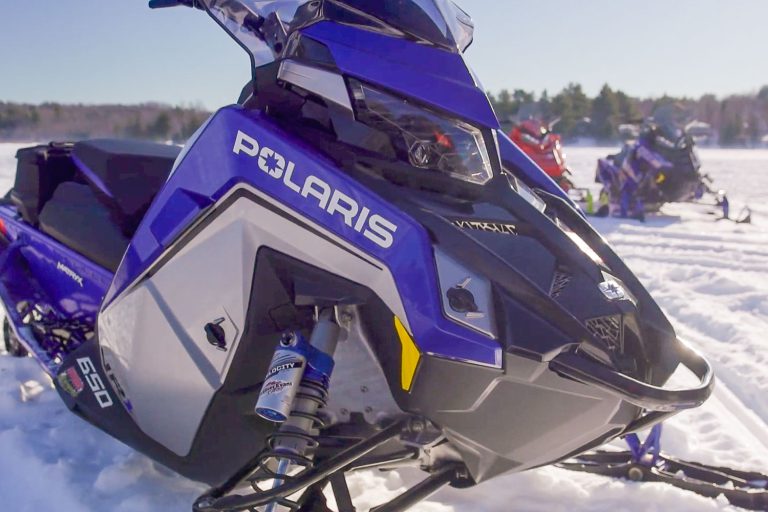
Here’s another impressive entry level ride able to double as a second sled for family use. Polaris is in the third year of producing the Indy EVO. The sled offers unique features, not the least of which is a complete upgrade package that will follow the skill level of the rider.

Literally, the EVO is a piece of ergonomic genius. The sled in its stock form sits very low and is not the least bit intimidating to first-time pilots. Engine power output is about 65 ponies – but speed is limited to 50 MPH, the right number for a new rider.

As your fleet of pilots grows and gains confidence in the safe operation of a snowmobile, the complete front suspension, IFS shocks and rear skid shocks and springs can be swapped out, increasing both width and available suspension travel significantly. At the same time a new ECU black box can be installed giving the 550 twin cylinder fan-cooled engine an impressive upward kick in top speed from the stock 50 MPH limit.

Here’s why the EVO is a great buy. The ability to upgrade the suspension and handling significantly and return it back to stock if you enlist a new pilot, is pretty much unprecedented. In case you’re wondering – yes – the EVO is the best handler in this segment.

2021 YAMAHA SRVIPER LT-X GT

0

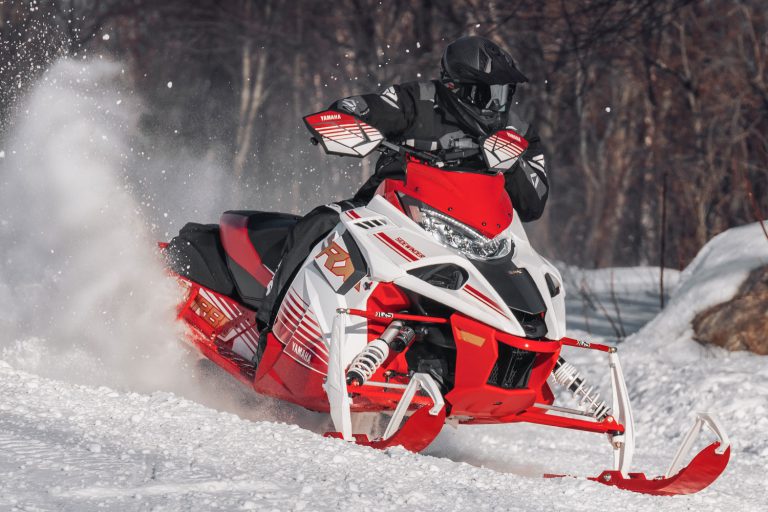
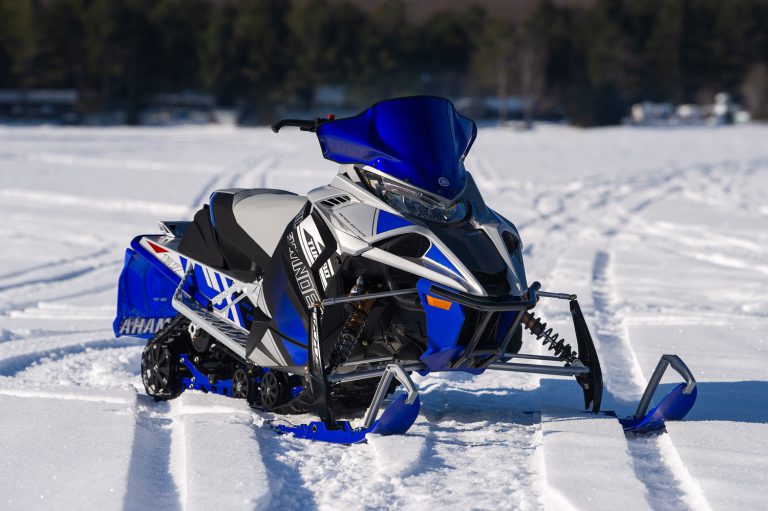
Yamaha Canada loaned us a new SR Viper LT-X GT with a standard-issue 137-inch track for a few weeks and we’ve had a good chance to put it through its paces.

At first glance, the Viper looks pretty familiar. It still uses the stellar 1049cc 4-stroke triple, spinning a belt-friendly YXRC clutch combo and it all rides on a tall front spindle IFS and a floating front-arm rear skid. There’s a sweet set of Fox QS3 shocks in in the mix as well.

In order to appreciate the Viper’s impressive 4-stroke performance, you have to plant your butt on its seat and take it for a ride. It takes about fifty feet to realize this is a seriously strong running snowmobile. Yamaha’s engineering team have been hard at work refining the details, amping up the power and torque and improving the Vipe’s ride and handling.

The recent update to quick-remove plastic bodywork was both an aesthetic and convenience improvement – but that’s old news now. Trust us – access to service items like the dry sump oil reservoir and the clutches is exponentially easier.

What we noticed first was the dramatic handling improvement gained by use of Yamaha’s new Stryke skis and tweaked spindles. Steering effort is markedly lighter, corner carving is completely linear and there is absolutely no darting or hunting on trails.

These skis take a line and hold it securely without any sudden and unwanted “lane changes” – and frankly, it makes the Viper feel like a completely different sled.

Last year Yamaha re-programmed its CPU and made some subtle tuning tweaks to bring the Vipe from its former claimed 125-hp to 130. We suspect there was a gain in torque numbers as well because this version pulls notably harder at the top of its speedometer.

The original 1049 was always a strong mid-ranger. The new calibration makes the Viper a serious contender down the lake at WOT. The Vipe keeps pulling and delivers not just strong bottom and mid-range but top end power rivalling 600 2-strokes at the end of the lake.

We did a top end run and the Yamaha speedo registered 150 km (93.2 mph). Pretty much what we expected, but the fun was in getting there. Acceleration was super crisp and throttle response was very immediate, especially at the top half of the speedo.
(FYI: A few years ago we wrote a speedometer accuracy test comparing all four OEMs and found Arctic Cat’s speedo readings to be the most accurate – about 97-98-percent true to the GPS. That was then and this is now, but we hope the Cat speedometer still remains so accurate. Keep in mind, the Viper uses the same instrument supplier as Cat.)

Yamaha has taken some criticism for not updating its skidframes commensurate with Ski-Doo and Polaris but honestly, we found the Viper’s sliding front arm, coupled skid rode really well in harsh rolling bumps on-trail and handled stutters with invisible competence.

Some of this compliance is due to use of Fox QS3 shocks up front and on the skid’s rear arm – but we can’t help but think someone nailed the calibration on those QS3’s.

The 137-inch Viper GT comes standard with a really sensible and sumptuous tunnel bag for storage and a two speed heated seat.

This is a snowmobile you can ride for hours and hours and never feel fatigued. We think the Viper best epitomizes what a 4-stroke sled should be. It’s easy to ride, powerful, plenty fast and may be the industry’s best reason to choose a 4-stroke over a 2-stroke.

Oh yeah, one more thing you tell us you love about 4-strokes – you don’t have to carry bottles of oil!

Snowmobiling Algoma Country in Northern Ontario

0

In a special two-episode Northern Ontario snowmobile destination ride, Luke is joined with his good buddy Tanner Graham as they explore the trails of beautiful Algoma Country. This multi-day adventure ride has them touring the scenic trails between Sault Ste. Marie to Dubreuilville. Part 1 follows Luke and Tanner along the ride as they make their way to the famous Halfway Haven Lodge for their midway pitstop.

Subscribe to our YouTube Channel!

2021 Polaris 850 Switchback Assault 146 Review

0

In this TEST RIDE AJ evaluates the 2021 Polaris Switchback Assault 146 in the all-new MATRYX chassis featuring the power-packed Patriot 850 engine.

Subscribe to our YouTube Channel!

WHAT’S NEXT IN SNOWMOBILING

0

Since we rarely ever stop thinking about snowmobiles (actually we stop thinking about sleds when we’re having lunch at Gary’s Grilled Cheese and Soup Emporium), we thought we would explore what the next thing – if anything – will pop up in the sno-mo-biz.

Here’s where we’re at right now. I’ve spoken with OEM dealers all over our part of the sno-mo-world and what’s going on is unprecedented.

Not even the snowiest year followed by a mega-early fall snow season has ever generated demand like we saw in December, 2020. Dealers are sold out of new sleds to the bare walls. They are also sold out of late model used iron. If you scan your local Buy and Sell or other online powersport advertising entities you’ve probably laughed at what private sellers are asking for used sleds. Take note – the good ones are getting silly cash.

Frankly, the market right now is nuts, gonzo, yes, even ridiculous. If your dealer gets another load of new sleds don’t expect the unsold units to sell for anything less than full MSRP. You might even see prices over MSRP. Like I said, unprecedented times.

Here’s your thought for the day. If you’re an OEM do you continue to push hard on your Engineering and Innovation Departments for new technology and class breaking new models and engines? Do you keep the throttle wide open on included features and focus on increasing the value of your sleds?

Or do you bask in what seems like this bottomless, COVID-generated-demand for stay-at-home-this-winter recreational vehicles. What we’re seeing in the biz this fall and early winter played out all summer in the ATV, SxS and PWC marketplace (as well as marine, motorcycle and RV). Specifically, let me speak to the PWC, ATV and SxS marketplace.

Where we live and operate, these powersport products were selling at full pop retail and higher all summer long. Simply put, people are serious about their recreational time. Let’s say it this way, people work to play and this year they had more money in their jeans because of COVID travel restrictions to their fave warm weather holiday destination.

Clearly, people are buying more powersport equipment than ever before. Are they buying (actually “did they buy”) new sleds this fall because of ground breaking, whiz- bang innovations? I don’t think so.

I suspect they bought new and used snowmobiles in record breaking numbers because they want to vent pent-up cabin fever and recreate this winter, just like they wanted to recreate this past summer using motorized equipment.

If you’re an OEM you have one calling right now: Get more product to your dealers who are literally screaming for sleds. We’ve heard some rumblings OEMs are dabbling with a “second build” of sleds before next spring’s early-order season begins.

Seriously, we get it. Why worry about next season’s early orders right now? Get more sleds into the pipeline and grow marketshare on the strength of this unprecedented demand for snowmobiles. Crank up those production lines and lean hard on OEM vendors to get building again – right now. If you can, build more 2021 sleds.

If this is what is going on, then don’t expect much in the way of innovation, or even new colors and graphics for a late season build. There may be as much as another 6-10 months of travel restrictions and even then it’s questionable how quickly people will willingly line up to sit next to a coughing, sniffling passenger headed for the Caribbean.

Demand for next spring’s build of PWC, ATV and SxS vehicles is already bullish. Expect the OEMs to generate heroic-sized production runs of these products beginning early in the new year.

Will the OEMs approach this once-in-a-lifetime opportunity to sell big numbers to the bare walls differently from a product perspective? Will innovation slow as production increases?

Dunno, but it’s going to be interesting watching this play out over the next few months.

KIMPEX CONNECT CARGO SYSTEM

0

Long gone are the days where only Ski-Doo riders could benefit from a quick mounting base system to attached accessories such as fuel caddies and tunnel bags.

While there has been a host of other aftermarket / OEM cargo systems introduced into the market as of late we’d have to say that the new Kimpex Connect system is the most comprehensible and arguably one of the slickest.

The Kimpex connect system is the first truly universal and lockable mounting base system in the market. Comprised of two parts, the Kimpex Connect system is designed for quick installation without the need of an adapter for the most popular snowmobile brands.

The mounting bases include an anti-opening hinge that ensures your cargo’s safety at all times. The hinges also allow you to lock accessories in place to prevent cargo theft at stopovers.

Its clever design allows you to install various accessories ranging from stackable fuel caddies, cargo racks and adventure tunnel bags.

Specifications:

• Compatible with most popular brands
• Tunnel drilling required on some models – drilling template included
• No adapter required
• Hardware included
• Anti-opening hinge with safety strap
• Lockable hinge – padlock not included
• No tool required for accessory installation
• Accessories not included
• More than one Connect system can be installed on snowmobile tunnels 137 inches and longer

Popular Accessories:

• 402110 Kimpex Connect Adventure Tunnel Bag
• 402120 Kimpex Connect Gas Tank Holder – compatible with Rotopax and Fuelpax gas tanks
• 402121 Kimpex Connect Gas Tank Stacking Kit 1
• 402122 Kimpex Connect Gas Tank Stacking Kit 2 for accessories
• 402130 Kimpex Connect Versatile Rack

For more information visit: kimpex.com

AIR RIDE OR REMOTE DAMPING?

0

When it comes to remote, from-the-handlebars, suspension adjustment you basically have two choices.

Over a decade ago Ski-Doo came with a mass-produced remote adjustment feature called Air Ride. This system has always used an onboard mini-compressor to alter the air pressure in a bladder inside the rear track shock. The rider adjusts a toggle switch on the left hand side of the handlebars to determine how much pressure is to be built up or released as required.

As pressure is increased, the air suspension becomes more resistant to collapsing. The effect is equivalent to having multiple springs available to soften or firm up the back end of your sled. However, there are no coilover springs surrounding the shock but there are torsion springs at play. Likewise, the air shock can be softened for one rider or less luggage by using the same handlebar toggle control to bleed pressure.

Air Ride is especially effective on touring sleds where an extra passenger may be onboard or significantly heavy luggage or gear is added to the back of the sled. Air Ride does not make a detectable difference to either compression or rebound dampening but it does tend to limit the bounciness of the back end of the sled with dampening features built into the rear shock. The response time with Air Ride is very quick and it is infinitely variable within the parameters the system allows.

Air Ride can be effective on a medium performance trail sled like the Renegade Enduro but is actually more commonly used on 2-up models like the Grand Touring or Expedition.

Remote adjustable shock damping systems like you’d find on the Yamaha SideWinder (iQS) or Arctic Cat Thundercat (ATAC) are a completely different animal compared to Air Ride.

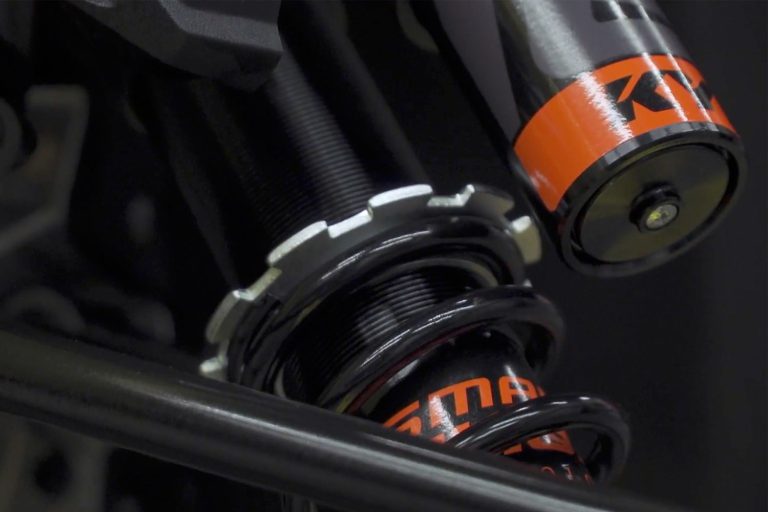
With either the Yamaha or the Arctic Cat systems, the rider can adjust the damping from a control switch on the left side of the handlebars. Since these two remote systems are paired with Fox QS3 shocks, there are three damping settings: Soft, Medium and Firm and the ride difference between those settings is significant.

Not only is the remote feature easy to use but the time response from when the rider presses the toggle to when the damping change actually occurs is a millisecond. The rider can set up for a gnarly corner and – at the last instant – and at any speed, get the rear shock to adjust to a firmer setting, fast.

With iQS and ATAC there is no change to the spring rate of the skidframe’s rear shock (conventional torsion springs are in place). Yes, it can be used to make an extra passenger more comfortable or when adding cargo weight by increasing the damping setting but neither iQS nor ATAC is available on a 2-up sled… yet.

To label one system better than the other is kinda missing the point. The real point, although these two remote-adjust features are fun and functional, is that it all depends on how you want to ride – and what kind of sled you prefer.

If it is damping adjustment you want, it’s ATAC and iQs. If it’s 2-up comfort and hauling, you want Air Ride!

RIDING SKI-DOO’S 2021 MX-Z SPORT 600 EFI

0

Some performance riders may be inclined to look down their noses at a 600 2-stroke sled that produces 85-hp; but after riding the MX-Z Sport some miles this winter it wouldn’t be us.

Sure, we’ve gotten used to 600 cube sleds that generate 110 or more ponies these days but competition-exceeding power wasn’t Ski-Doo’s intended purpose with this one.

What the engineering department was challenged to do was build a fully equipped snowmobile that could be delivered at an industry-low price. Oh, and one more thing: It had to avoid being boring. That means it needed to have good handling, a decent ride and enough power to hold the rider’s attention.

Did they get it right?

Based on our experience riding it this year, we have to say the 600 EFI Sport package is a homerun!

We honestly had to keep reminding ourselves this sled sells for thousands less than pretty much any other similarly equipped 600. Keep in mind, the Sport is a surprisingly well featured snowmobile. Built on Ski-Doo’s most up-to-date platform, the G4, and loaded with electric start, reverse, EFI, a nice digital display and a 129-inch track with 1.25-inch lugs, this sled pretty much has everything you could ask for.

Sure, we could tell you this is a snowmobile your wife or teenage offspring will love – and they will – but we can’t help but think the hardcore riders with keys to the garage will be sneaking a few rides on this sled this winter, too.

Why? Because this sled is all-out entertaining to ride – especially on trails. Frankly, 85 horsepower is enough to deliver trail satisfaction – even if you’re riding with more powerful sleds.

We were shocked at how snappy this EFI engine was. There are no exhaust valves and it’s really a pretty simple 2-stroke but its throttle response is excellent and it gets out of the hole quick and continues with surprisingly good mid-range power.

Yes, power drops off pretty significantly at about 80-per but you’ll rarely go that fast on any trail (or shouldn’t be) and even on the lakes it won’t lose sight of your riding buddies.

Frankly, we weren’t expecting this much engine performance, but Ski-Doo has fine-tuned this engine and clutched it so it always feels like it’s right in the meat of its power band. The EFI mapping delivers very crisp power, easy starting and… the 600 makes so little smoke we had to keep checking to make sure there was oil in the injector tank.

Yes, we’re raving about it but we also know you’re asking if there’s anything we’d change about the Sport. We’re digging deep here and probably going contrary to Ski-Doo’s conceptualization of what this sled is intended to be but… the SC-5 skidframe would be so much better if it was coupled.

We remember how well this skid worked before the days of rMotion and it was truly at the top of the heap back then. rMotion was an improvement on something that worked more than just adequately in the last couple of years the SC-5 was used in MX-Zs and Rennies.

Maybe there’s a way buyers looking for more plush can raid the parts department and buy coupler blocks for the Sport. Dunno – but it’s about the only thing we can think of to improve what Ski-Doo is delivering at a rock-bottom price.

As it sits, this is an incredible value snowmobile – maybe the best in decades – and we would guarantee those who have been able to find one this year are super smiley-faced.