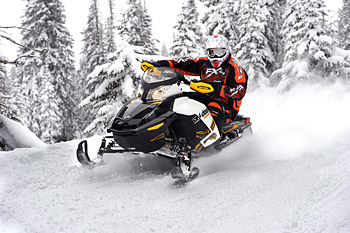
Here’s some sweet footage from the latest cult snowmo-flick Fourcast 2 by Jorli Ricker.
Visit highmarkfilms.com and download Fourcast 2 from iTunes now!!
Here’s some sweet footage from the latest cult snowmo-flick Fourcast 2 by Jorli Ricker.
Visit highmarkfilms.com and download Fourcast 2 from iTunes now!!
Arctic Cat Trail Permit Rebate Promotion Helps OFSC and FCMQ Federations
Arctic Cat is proud to show their support of Ontario’s OFSC and Quebec’s FCMQ snowmobile Federations in a promotion that will also help Arctic Cat owners get out riding and enjoying their amazing trail systems.
Arctic Cat will be providing a FREE Ontario or Quebec Snowmobile Trail Permit with every 2010 – 2012 Arctic Cat Snowmobile purchased from November 1 – November 30, 2012. [Excluding 120’s, Race, Rental, Government and Special Service Models]
For every qualifying 2010 – 2012 Arctic Cat snowmobile retailed during this promotion period, Arctic Cat will issue a refund to the consumer for the amount of $210 for Ontario and $280 for the Quebec Snowmobile Trail Permits.
Each consumer has to complete a rebate form available from their dealer, and submit a copy, or proof of purchase, of the Ontario or Quebec Snowmobile Trail Permits, as well as a copy of the Arctic Cat snowmobile warranty registration, and then mail it directly to Arctic Cat.
Once received, Arctic Cat will issue a check to the consumer for the cost of the Permit. (Limited to one Permit per snowmobile.) For more information on this Permit Promotion, please visit your local Arctic Cat dealer.
About Arctic Cat – Arctic Cat Inc., based in Thief River Falls, Minn., designs, engineers, manufactures and markets all-terrain vehicles (ATVs) and snowmobiles under the Arctic Cat® brand name, as well as related parts, garments and accessories. Its common stock is traded on the Nasdaq National Market under the ticker symbol “ACAT.”
More information about Arctic Cat and its products is available on the Internet at www.arcticcat.com.
Ski-Doo’s E-TEC direct-injected 2-strokes have set the standard for EPA compliance and offer no smoke, incredible start-up and idle characteristics while delivering unbelievable gas mileage and low oil consumption.
We know, it sounds like we’re going overboard with praise, but in five years the competition has only been able to get close to this kind of performance and no one has been able to surpass it – even with 4-strokes. Quite an accomplishment!
The truth is, until someone else steps up with a DI 2-stroke, Ski-Doo will continue to dominate. Here’s a tough question to ask: Can E-TEC be even better than it is now?
Some would argue this is a question that shouldn’t even need to be asked. If you’re leading, why try to improve?
We’ve noted with great respect that in the past BRP has not merely rested on its laurels and kept pumping the same stuff off the assembly lines.
It’s almost as though the company is in competition not with the, uhm… competition, but rather with itself, willingly forgoing its own technology for something better.
Case in point is the deep-sixing of the PowerTEK 800 (already pretty clean) and the SDI engines of a few years ago.
Apparently, with the E-TEC style of direct injection there’s still room for more improvement when the engineers adapt some more of the technology Rotax has already put into use in the Marine Outboard business.
The trick is in E-TEC’s stratified (highly misted) fuel charge at all RPM levels. Since snowmobile engines make huge horsepower with comparatively low displacement compared to much bigger-inch outboards, the fully stratified issue is more challenging to execute.
After multiple conversations with some of Ski-Doo’s engine people we’re convinced those issues have been fully worked out and there’s new technology sitting on the shelf waiting to be put into use on the next generation of E-TEC snowmobiles.
Recreational spending and outdoor activities are much bigger economic drivers than most people realize.
A recent study found that consumer spending on outdoor recreational activities generated $646 Billion dollars in national sales and services last year in the US alone.
Economic impact analysts report that snowmobilers in North America have generated more than $30 Billion on economic activity directly related to snowmobiling each year.
These expenditures include: Equipment, Clothing, Accessories, Snowmobiling vacations, etc.
The economic benefits of snowmobiling in North America generate jobs for approximately 100,000 individuals, mostly in rural parts of North America.
The snowmobiling community generates significant income tax revenues and state tax revenues as well as reducing unemployment and welfare payments. Millions of dollars in tax revenues are derived from snowmobile related businesses such as hotels, restaurants, manufacturers, service stations, insurance agencies, hardware stores, banks, credit unions, and more.
In addition to the positive economic impact, snowmobilers also pay millions of dollars in gas tax which helps build our trails, trail heads, and roadways to snowmobiling destinations.
An example of an economic impact study showing the growth of snowmobiling activity and the importance of snowmobiling can be seen in reviewing the study recently done for the New York State Snowmobile Association by the Potsdam Institute for Applied Research in Potsdam, NY. The organization showed a 1998 economic report of $476 million dollars.
In the 2012 report, snowmobilers were surveyed and the economic impact of snowmobiling was calculated to be $875 million dollars annually! Yes, this is an 84% increase in 14 years!
This is a substantive increase, above and beyond the growth of the economy, the rate of inflation. The positive impact snowmobiling has on t he economy compared to other activities is remarkable.
The survey also profiled snowmobilers and shows that snowmobilers have a high level of satisfaction with the snowmobile trails and with access to restaurants, fuel, and rated the overall fun of the sport at over 90%.
New York’s report was joined by a positive report from the South Dakota Snowmobiling community prepared for them by the University of South Dakota. The University found that snowmobiling generates $131.6 million dollars in annual economic impact in South Dakota. This economic activity gave direct and indirect support for over 1,400 full time jobs.
The direct effects of snowmobiling are impressive in providing employment opportunities for hundreds of workers in the snowmobile industry and the related hospitality industries and tourism industries.
The staff of Plymouth State University in New Hampshire conducted a study for the New Hampshire Snowmobile Association and found that the total impact on New Hampshire’s economy generated by snowmobiling was $586 million dollars annually.
The survey found that visitors to New Hampshire spend approximately $114.00 per visitor per day when snowmobiling in New Hampshire.
Yes, snowmobiling is an important part of the economic engine for all winter tourism areas. If you have the infrastructure of trails and related accommodations along with snow cover, your area will generate millions of dollars of economic activity by welcoming snowmobilers to visit and enjoy your area.
Individuals questioned in the surveys told us that on an average annual basis, the take 8 snowmobile related trips per winter. Typically a snowmobiling trip lasts two days and snowmobilers are finding the level of service and quality while snowmobiling is high and above average on the satisfactory table.
Snowmobiling is a very important part of the economic engine throughout North America and is growing in Northern Europe and Russia.
It is estimated that snowmobiling generates over $3 Billion worth of economic activity in the countries of Norway, Sweden, Finland, and Russia.
It is expected that the economic impact of snowmobiling will continue to outperform the GDP growth of most countries.
Dear Motorhead:
This season I bought a brand new 2013 Renegade X 1200 4-TEC. My old sled is a 2006 Renegade 800 with a track of 121″ track.
The type of driving we all do together is trail riding only and always fast in corners and out. The boys tell me that I’ll be the slowest of the group now and I’ll have a very hard time turning corners because the new sled has a 137″ track.
Should I call the dealer and tell him I made a mistake and I need a 121 track?
Yours truly,
CONFUSED
Thanks for your email!
Okay, first off your 2006 Renegade wasn’t a 121 – if it was a Renegade it was a 136.
Your friends might be nice people but they are wrong. Your new Renny XR 4-TEC with a 137 shoe will handle and carve apexes so close to a 120 XR you will never know the diff.
In fact, the Ski-Doo XS/XR Renegade 137 platform produces among the most transparent handling qualities of any X-Over sled in the biz.
You will not be slow because a snowmobile doesn’t know how long its track is – it simply drives “through” the track. The increased foot print (traction) will actually produce better acceleration and is often faster at the big end as well.
Go and enjoy your new ride – you’re gonna love it and I think your friends are jealous.
Motothread Mark
Due to the market’s obsession with weight, the manufacturers pull their corporate hair follicles out trying to reduce every ounce of mass possible – especially when it comes time to publish the weight results at the beginning of each season.
We’ve long been fans of Ski-Doo’s excellent Pilot 5.7 skis and appreciate the fact they can offer varying handling characteristics for different riders.
The weight thing comes into play when the dual-runner Pilots come out of the crate with only one carbide runner in place.
The reason: Unofficially, we think it’s to keep the overall advertised weight of the sled low.
Now, for those who love a hard carving sled with the ability to cut inside on other riders or to make hard pivots low in a turn at speed (kinda like a racer), the single carbide is excellent.
What you get though, is more twitchiness and more steering effort on frozen, hard packed snow and ice. Obviously, compromises many riders are willing to put up with.
We think the best trick, however, is to install the extra carbide runner the Pilot already provides space for.
Do this and the sled becomes much easier steering, loses the darting on the hard stuff and still offers the kind of maximum handling the XP-XS is capable of.
Yes, the turn-in is slightly softer but the sled cuts predictably and has plenty of bite to induce fantastic throttle steer to get the back end out in corners.
Yup, we’d use the extra ‘bide in a heartbeat!
There’s something shaking under the ground at Ski-Doo’s Rotax headquarters in Austria and we think it’s a newly re-tuned 4-TEC triple.
Think about this: It’s pretty common knowledge Yamaha is coming with a new, lighter all-purpose snowmobile chassis soon – perhaps even next year. Yamaha is not at all happy it is not leading the industry with the most 4-stroke sales and it looks like the battle is about to rage.
Ever since Ski-Doo’s 1188cc 4-TEC mill was shoehorned into the very light XR chassis it’s been a hit. Most surprising is its sales success with former 2-stroke owners looking for more reliability and longer engine life.
Many of these new 4-stroke converts are the same customers who normally buy the ultimate performing 2-strokes in the 160-plus horsepower range. It seems a bit strange when you realize the 4-TEC engine produces horsepower closer to the 130-hp plateau.
We’ve heard these people say they wish the Ski-Doo 4-stroke made more power but are willing to give up some of it because of the sled’s extreme lightness, good handling and great torque output.
Essentially, the result is a sled that behaves very closely like a high performance muscle sled, especially at the big end of its speedometer.
We think this big-inch 4-stroke (really, the biggest 4-stroke in the business) has great potential to make horsepower in the hyper-sled range and it doesn’t need a turbo or supercharger to deliver it.
If this engine was boosted via cam timing, three throttle bodies and perhaps even larger valves, it could make 150-160 very reliable ponies with only a minimal increase in weight.
We think this is definitely on the drawing boards and if Ski-Doo is planning on a new XR bodywork update similar to this year’s XS, it would be a great opportunity to own the 4-stroke hypersled market.
We’ve already written about two different direct injection technologies Arctic Cat could potentially use on its new generation of 2-strokes.
We told you about Yamaha’s system called HPDI (High Pressure Direct Injection) and Tohatsu’s TLDI (Tohatsu Low Pressure Direct Injection).
There’s at least one more system that comes under the category of low pressure DI and it is widely used and licensed in the marine and scooter business.
Orbital Injection is best known for its use in Mercury Marine 2-stroke outboards and was once licensed to BRP for use in some Sea-Doo models in the early 2000s.
The parent company, Orbital Engine Corporation (now Orbital Corporation), is from Australia and developed and patented the system in the early 1990s.
Orbital technology injects a mixture of fuel and compressed air into the combustion chamber under pressures not exceeding 2000 psi air pressure. When the air expands it atomizes the fuel.
The Orbital system is used in motor scooters manufactured by Aprilia, Piaggio, Peugeot and Kymco and, in outboard motors manufactured by Mercury and, yes, Tohatsu.
It’s interesting to understand each of these companies holding licenses have added their own technical improvements to the Orbital system to make it unique but have kept the basic principles intact. It’s very much like Ski-Doo’s (BRP’s) E-TECH set-up being a huge evolution of the original Ficht system.
The original Orbital was called a 2-part or 2-stage DI because it injected the air and fuel separately, both being under pressure (air pressure much higher than fuel pressure) and in a “sealed” environment – a bit of a tweak on TLDI.
At any rate, Orbital licenses are readily available and the technology is not only very good but has been proven over and over worldwide. Apparently Orbital has made over $150 million licensing its patent.
We think Orbital gives Arctic Cat the most room to “personalize” its DI and incorporate its own unique fingerprint on how the system operates, much like Tohatsu has done.
By: Kent Lester
It was 1976 and the family had rolled into Owen Sound, Ontario for a hockey tournament. At the time I only had a passing interest in snowmobiling but, as an unfettered gearhead, I was fascinated by anything with an engine – especially if it was a 2-stroke.
We were booked into the Days Inn for two nights and couldn’t help but marvel at the rolling snowmobile show in the motel parking lot. Trailer after trailer arrived and unloaded sled after sled all weekend. At one point I counted 80 snowmobiles in the parking lot. At that point, I decided that snowmobiling was something I both wanted and needed to get involved in. The rest is history.
Those were the days before OFSC amalgamation and the Grey Bruce was running under the auspices of the old Ontario Trail Builders Alliance. There were several clubs and a central grooming system, far ahead of its time, had been put in place. The Fathers had created a tremendous network of trails that reached south down into the Beaver Valley and went way north on the Peninsula to Tobermory.
There were already effective trail signs and the clubs were using old (they were new, then) Bombardiers pulling big drags to smooth out the terrain. I’d never even seen a groomer before and was amazed to discover these behemoths tracking right through the parking lot, making laser level “snowmobile roads” for the sleds to ride on. I remember driving home and thinking out loud: “Who did all this?”
As soon as I got back to Hamilton, I called my brother and told him: “Mark, we’ve just gotta get a couple of snowmobiles and a trailer. You won’t believe what I just saw!”
Thirty-two years later, the GGrey Bruce Region is still a fabulous place to ride. It’s reasonable proximity to big Ontario cities like Toronto, Hamilton, London, Barrie and Kitchener-Waterloo makes it easy to get to and its history of catering effectively to both winter and summer tourists means there’s plenty of good restaurants and accommodation along the way.
One of its best assets is its unique Southwestern Ontario location allows folks in smaller communities outside the region to ride from their homes right into The Bruce, connecting the small communities and towns there.
The entire Bruce Peninsula enjoys the benefits of lake effect snow and rarely is left with poor grooming conditions. The winters are cold enough to make frequent snow but never so cold you don’t feel like getting out on the trails. And these folks know how to build trails! You’ll find many 20-foot wide routes, meticulously groomed, and all heading toward fun destinations.
Whether you’re riding the expansive open field trails of the southern part or running the magnificent ribbon winding along the rim of Georgian Bay’s cliffs, you’ll find smoothness, plenty of access to food and gasoline and some of the best Ontario winter scenery ever.
One absolute don’t-miss destination is the Skinner’s Bluff Lookout looming 250 feet over Georgian Bay – and that’s only one. There are plenty of great views and vistas here.
Some of the trail routes may have changed over the years but the quality is still as impeccable as ever. Just as this region inspired me to get into snowmobiling decades ago, I can’t help but wonder if it isn’t doing the same to others today.
When the green flag drops on the 2013 snowmobile racing season, DRIFT Racing will be on the gas and at the front thanks to a growing team of racers and crew.
From its high-tech race wear to its ultra-warm jackets and pants, DRIFT gear will help its athletes reach the top in snocross, oval and cross-country with everything from grassroots Junior class riders to multi-World Champions.
“Racing and high-performance riding is built into the DNA of DRIFT Racing,” said Tom Schaefer, DRIFT Gear supervisor. “Our gear is inspired by the passion to win shared by all of our racing partners and fans.”
Look for the newest DRIFT Racing gear on these racers and teams in 2013:
Christian Bros. Racing – hits the snocross and cross-country circuits with huge talent and proven champions. As the ISOC Snocross Team of the Year, CBR is poised to be on the podium with pro’s Logan Christian and Garth Kaufman; Junior ripper Evan Christian; plus Tyler Adams, who is new-to-CBR-for-2013 and notched a Junior class victory at last year’s Eagle River Snocross event.
The CBR cross-country juggernaut will return as the undisputed leaders this season, having captured five Pro 600 class victories (out of six) last season. They are led by two-time defending high point champion Ryan Simons and D.J. Ekre, and will be joined by newcomer Zach Herfindahl, who rose to the top of Semi Pro classes last season.
Stud Boy/Goodwin/DOOTalk Racing – New to the DRIFT Racing program this season, the Stud Boy/Goodwin/DOOTalk.com racing team combines leadership in traction and performance with top results in National and Regional snocross competition aboard Ski-Doo snowmobiles. Led by Pro Zach Pattyn and Pro Lite racer Nick Pattyn, the team will also include Brett Nastala, Garrett Goodwin, Jake Pattyn, Justin Sparpana and Caydence Sparpana.
Country Corners Racing – A force in the Canadian snocross and cross-country competition, the CCR team will fly DRIFT colors for 2013 with racers Cam Darling, Kristyn Darling, Bob Holmes, Ben Holmes, Todd Lightfoot, Taylar Lightfoot and Jamie McPhail.
P.J. Wanderscheid and Wanderscheid Racing – The only five-time Eagle River World’s Champion (and the original DRIFT racer) aims to defend his 2012 TLR Cup title and win the coveted 50th Anniversary World’s Championship. A huge fan favorite everywhere he goes, P.J. and the entire Wanderscheid Racing crew bring the passion and excitement to the highest level whenever they hit the oval track.
USXC Race Circuit – As the official outerwear sponsor of United States X-Country, DRIFT Racing will have a strong presence at the new cross-country race circuit founded by snowmobile legend Brian Nelson. Likewise, top Semi-Pro racer Erik Bute will do battle in USXC in his second season aboard the DRIFT Racing program.
Oval Racers Alliance – As an organizational sponsor, DRIFT Racing is committed to assisting ORA with its goal of promoting the growth and awareness of ice oval racing in the Midwest through its grassroots events.
About DRIFT – DRIFT, based in Plymouth, Minn., designs, produces and sells high-performance race apparel for snowmobile and motorsports enthusiasts. DRIFT gear is available at powersports dealerships throughout North America.
For more information about DRIFT products, go to www.driftracing.com.