Home Blog Page 211

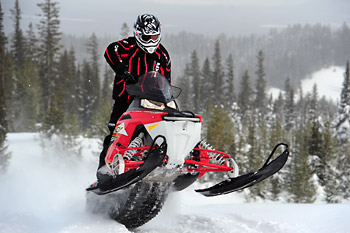
How To Fix Nytro Darting Issues

Dear Motorhead:

First of all, I’m a big fan. I love the show and I swear by the things I have learned from you guys.

I recently bought an ’08 Nytro RTX and I’m starting to worry about darting and weight transfer issues. I’ve never ridden a Nytro and I’m trying to get it ready for the 2014 season.

What are the most effective improvements I can make to my sled to improve handling and stability without breaking the bank?

Hope to hear from you soon.

Thanks,

Jason

Jason –

Thanks for your email!

2008 was the first year for the Nytro and it was the only year the sled had the front end geometry yours has. The sled with stock skis is quite nervous and has a vague on-center feel.

In 2009 the A-arms and spindles were updated and this improved handling, settled the front end but did not address the skis – which IMO were the biggest part of the problem. There are a couple things you can do which will make a huge improvement in handling and reduce darting dramatically.

Your first option is Snowtrackers. They advertise in Supertrax and have a ski modifier and special carbide which will stop darting, preserve turn-in and settle the handling so you can rail corners. They are relatively inexpensive and effective.

The second answer is Split Rail skis. These split profile skis come with a new spindle for your Nytro and they are the best answer to fixing the quirky handling of your 08.

These skis are not cheap however you will not regret installing them – particularly if you’ve ridden your 08 stock and experienced the darting and nervous on-center feel.

Suspension on an RTX is great for ditch banging however you will likely want to soften all the compression clickers to full soft and back the rear torsion springs to light.

Ride the sled this way and only increase compression damping if you experience persistent bottoming of the front ski shocks or the rear arm shock.

If you are of average weight the softest setting on the rear torsion springs should be plenty of preload.

Hope this helps.

Motorhead Mark
DOES YAMAHA HAVE A NEW 4-STROKE?

0

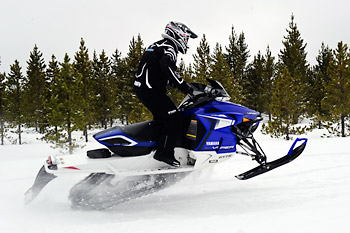
The impact of the new Viper has raised a lot of questions about where Yamaha will go with the Cat platform and its own list of powerplants.

Certainly, no one expected the Viper’s 1049cc triple to work so well in the Arctic Cat ProCross chassis. It truly does though, and that brings up the rumor Yamaha may be working on another group of 3-cylinder engines to cover more markets.

We specify three cylinders because we’ve spoken to several engine experts and they all agree the Apex counterbalanced 4-cylinder is simply too large to fit the ProCross without major retooling of the chassis. Even if it could be done (we believe it could), there’s the issue of extra weight.

By bringing a new triple based on the 1049 – likely bored and stroked to about 1200ccs – Yamaha could offer a 4-stroke hypersled making about the same horsepower as the current Apex. The advantage would be weight.

We think this is a viable guess because of Yamaha’s likely resistance to turbocharging any of its engines.

Although Yamaha has done this with factory authorized “kits” made available through its own dealers, we just don’t see the Big Y getting on the bandwagon with anything other than a naturally aspirated engine.

Here’s another crazy rumor. The mountain market comprises about 25-percent of the entire snowmobile market. It’s no secret mountain riders prefer the low weight and agility of 2-strokes.

What if Yamaha developed its own big-inch (800ccs) DI 2-stroke exclusively for mountain riding? The company already owns the patents and has the technology to do it – and it’s been well developed and consumer tested in the outboard marine biz.

This would open up Yamaha’s snowmobile appeal to a significantly larger share of the market. Yeah, we think we’re crazy, too.

WHAT ENGINE IS NEXT FOR POLARIS?

0

With the recent focus on Arctic Cat’s CTEC-2 EPA certified 2-stroke and the company’s supply relationship with Yamaha for 4-strokes, competitor Polaris has been somewhat overshadowed.

So what’s coming from Roseau, Minnesota? For the past five years, Polaris has made no bones about the fact it has felt the future of snowmobiles lies with 2-stroke engines.

Although its Weber-supplied 750 has been an excellent and surprisingly powerful engine when turbocharged, the brass still feel snowmobilers want the lightness and efficiency of 2-strokes. Recent info from ISMA (the International Snowmobile Manufacturers Association) seems to indicate this strategy may be flawed.

Fully 25-percent of the market is now 4-stroke and no OEM can afford to walk away from that many prospective customers.

We think, without saying much, Polaris has been working on both 4-stroke and 2-stroke development for a few years now. We fully expect to see direct-injected Polaris 2-strokes by MY2016 and a line of built-in-the-USA 4-strokes even sooner.

Polaris has had incredible results from its DOHC parallel twin 4-strokes used in its ATVs and SxS vehicles. There are already two that could be utilized as snowmobile engines and both are pretty impressive. The just-released 1000cc version produces a naturally aspirated 107-hp and there’s a completely under-stressed 900 that makes easy power in the 80-plus range.

By utilizing Polaris’s deep knowledge of turbocharging, these engines could cover a lot of bases and make power in ranges from 110-hp upward into the 180-hp stratosphere.

Both Cat and Ski-Doo have set the bar high for 2-strokes and you can bet Polaris is well aware of it. We think there are big things brewing and Polaris knows full well it won’t gain market share without major upgrades in engine development.

BRP LINQ SADDLEBAGS ADD STORAGE WITH STYLE

0

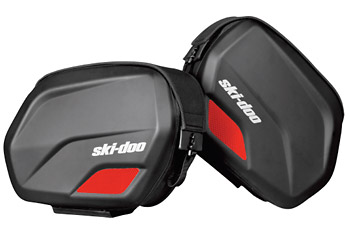
BRP is adding premium saddlebags to its innovative LinQ accessories line for snowmobilers with additional stowage needs.

The premium bags are a simple plug and play for the LinQ accessory platform base and offer a classy, integrated look and fit with most snowmobiles.

The saddlebags are constructed of a semi-rigid material that holds its shape well, while allowing for rugged use without damaging easily.

They offer 26 liters (6.9 gallons) additional carrying capacity. The black matte outer surface fits with all colors easily, and the integrated reflectors offer more night-time visibility.

They can be used in conjunction with other LinQ mounted accessories at the same time, doubling up to use the same mount as a tunnel bag or fuel caddy, and are removed or added independently as needed.

Items in the bags are easily accessed while on the trail through the weather proof zippers and top access flap with secure buckle. When removed from the machine each bag opens fully to allow easy packing and unpacking.

LinQ mount included. LinQ Cargo base not included.

For information on all the genuine BRP accessories to fit your ride visit www.store.ski-doo.com or your local Ski-Doo dealer.

Is There Room For Another Snowmobile Brand?

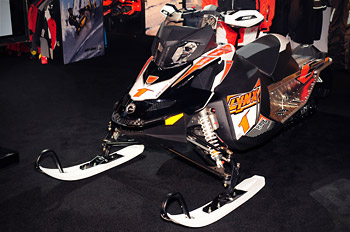
Our crew just returned from an exclusive tour of BRP’s impressive manufacturing facility in Finland. To say our guys were impressed is an understatement of heroic proportions.

This is where BRP builds the complete Lynx snowmobile line and some utility models for Ski-Doo and the sophistication, attention to detail and quality at this plant is amazing.

Let me seed your mind. Lynx is the number one selling snowmobile in Europe. Interestingly, Lynx participates in and is highly successful in European Sno-X racing.

Euro snocross is considerably different from what we see on this side of the pond. Our version is better compared with motorcycle Supercross while euro snocross is more similar to natural terrain motocross.

It’s no secret North American snocross has been struggling with both participation and spectator attendance the last five years. While this has been going on, a significant rejuvenation of interest in Cross Country snowmobile racing has emerged.

Legendary stories associated with events like the International 500 Winnipeg to St Paul XC are capturing the imaginations of a significant group of participants.

Here’s my point. Lynx snowmobiles are crazy good on natural terrain; in fact they rock. They’re very similar to Ski-Doo XS and XP models; the drive train is actually identical, however the rear suspension is completely different.

Lynx uses a skidframe called PPS, which stands for Pauli Piippola Suspension. Paulie Pippola is a real guy at Lynx and his suspension is the bomb for rough terrain. Since its introduction in 2006, PPS has evolved to 9 variations and spans the entire Lynx snowmobile lineup.

Let us paint a clearer picture: What if BRP brings Lynx to North America and uses Cross Country racing as its only venue, leaving Ski-Doo to compete in snocross.

The two brands never end up nose-to-nose but they cover both disciplines like a blanket. BTW, which form of racing do you think consumers identity with?

Our guys were profoundly impacted by this reality while in Finland. The Lynx brand is built tough and looks unique as a result of slightly different bodywork on some models when compared to Ski-Doo.

Their crossover models are not 137s but rather 144s. The brand is techy, imposing, and we think has the potential to immediately garner the cache (to North Americans) of an upscale import car – think Porsche or BMW.

While this diatribe is mostly idle musing about something we think is pretty cool, do you think North American’s would be attracted to the Lynx brand if made available on this side of the globe?

Engines, Engines, Engines!

0

It’s not new news anymore that Cat and Yamaha have formed an agreement together to share in chassis and engine development.

However, this makes for some pretty incredible opportunities for AC to get into some markets it hasn’t had strength in before.

Example? Yamaha has a menu of great 4-strokes, not the least of which is the already-in-use 1049cc triple used in the ProCross 7000.

However, two Yamaha engines that could be put to use are the Apex 998cc 4-cylinder and the 500cc twin used in the Phazer.

By utilizing the ProCross platform in different track lengths and variations, the 500 4-stroke could be used as a trail-happy mid-range sled in the 80-hp category or used to power a line of super-economical utility models.

The 998 4-cylinder is a different matter and its wider dimensions may not fit inside the ProCross bulkhead without creating a completely new front design.

Frankly, we wouldn’t bet against Cat shoe-horning this great mill into one of its sleds. A year ago no one would have guessed the 1049 would fit in a Cat chassis but the company is extremely resourceful and when it gets an idea, it knows how to run with it.

Then there’s the whole thing with Cat’s 2-stroke program. Yes, the company needs to use C-TEC2 in more displacement categories. Building a DSI 800 is almost a no-brainer – but think about this one: What about a 570 with C-TEC2?

Think about it. So far all fan-cooled 2-strokes in the industry fail to comply with EPA regulations.

The fairly economical-to-build C-TEC2 system would enable Cat to come out with the first EPA certified fan-cooled line of sleds for utility and trail use.

Not only would the pricing be way cheaper than using lower horsepower 4-strokes but it could open doors for Cat to get into new markets – much like Polaris is doing with its fan-cooled Indy series.

More Ski-Doo Engines – and Soon!

0

Ski-Doo’s been leading the industry with great direct injected 2-strokes and some truly innovative developments in 4-stroke snowmobile power, too.

Frankly, the company is so far ahead of everyone in 2-stroke technology, it could leave everything the same for the next five years and still be leading.

There’s always a wrench thrown in somewhere though and Arctic Cat has come up with a new 600 C-TEC2 engine that may outperform Ski-Doo’s DI engines in more than one way. The jury is out on this but from what we’ve seen so far, the new DSI Cats are doggone good.

So would Ski-Doo go to a different version of E-TEC in the near future? We think the technology already exists and its called E-TEC II and is used in the outboards built in BRP’s Evinrude Division.

This highly stratified (very fine) fuel charge used throughout the whole combustion cycle makes these engines even cleaner and a bit more powerful. We’ll see.

As far as 4-strokes go, we think Ski-Doo’s been working on a high performance 4-stroke program for about two years now. It’s 1170cc triple is an incredible engine and with the largest displacement in the industry and only one throttle body, is certainly very under-stressed.

We think this mill could safely and easily put out 150-plus ponies without supercharging or turbocharging. The question is, would a revamp up into this range be enough for the adrenaline-charged masses? We think the goal line is closer to 175-hp and that would mean supercharging.

Here’s another one: The new 900 ACE with a turbo could easily hit the 150-hp mark. After all, Polaris gets 140 ponies out of its turbocharged 750cc Weber twin and this engine feels as strong as any hypersled we’ve ever ridden.

Arctic Cat and Yamaha Celebrate Joint Production

As the very first Yamaha SR Viper units rolled off the assembly line at the Arctic Cat factory in Thief River Falls, MN, employees involved with the snowmobiles gathered to celebrate. The milestone was marked by a ribbon-cutting ceremony with executives from both Arctic Cat and Yamaha.

Arctic Cat Chairman and CEO, Claude Jordan addressed the crowd stating, “Every employee standing here should be proud of this history-making day. We are very excited how our relationship with Yamaha continues to grow and the successful future that lies ahead for both companies.” Jordan closed by saying, “Going forward we believe this relationship will provide tremendous value to Arctic Cat, our customers, our dealers and our shareholders.”

The all-new Arctic Cat 7000-Series snowmobiles are the result of an industry-first in the modern era: Arctic Cat is in a supplier agreement with Yamaha to leverage their respective strengths.

For the first time ever Arctic Cat riders can match the renowned Arctic Cat ProCross chassis and handling with high performance Yamaha 4-stroke power. The C-TEC4 1049cc, three-cylinder engine is widely regarded as the most responsive, highest performing 4-stroke in the 135-hp category.

Yamaha Motor Corporation, USA president, Toshizumi Kato stated, “Together we have made a snowmobile which has the best of both our snowmobiles DNA. I look forward to a future of mutual and beneficial growth for both Arctic Cat and Yamaha. Today, let’s celebrate our accomplishment thus far, for tomorrow the opportunities are endless.”

Arctic Cat Inc., based in Minnesota, designs, engineers, manufactures and markets snowmobiles and all-terrain vehicles (ATVs) / Recreational Off-Highway Vehicles (ROVs) under the Arctic Cat brand name, as well as related parts, garments and accessories. Arctic Cat is among the most widely recognized and respected brands in the snowmobile and ATV/ROV industry. The company markets its products through a network of independent dealers located throughout the United States, Canada and Europe, and through distributors representing dealers in Europe, the Middle East, Asia and other international markets. Arctic Cat trades on the NASDAQ Global Select Market under the symbol ACAT.

For more information, please visit www.arcticcat.com.

First SR Vipers Roll Off The Assembly Line

More than two years of engineering, development, manufacturing and logistics work came to fruition in Thief River Falls, Minnesota, as the very first Yamaha SR Viper RTX SE units rolled off the assembly line at the Arctic Cat factory.

The milestone was marked by a ribbon-cutting ceremony with executives from both companies and witnessed by the factory employees responsible for building the units.

“Our alliance is a show of great cooperation between our companies and this, I believe, is the biggest news to hit our business in decades,” said Yamaha Motor Corporation, USA president, Toshizumi Kato. “On behalf of Yamaha Motor Japan I would like to congratulate everyone on this major accomplishment of what we see here today. Thank you to the factory workers of Arctic Cat, you should be very proud of the work you have done.”

The all-new SR Viper models are the result of an industry-first in the modern era: Yamaha is in a supplier agreement with Arctic Cat to leverage their respective strengths.

Yamaha is undisputed in the snowmobile world for its leadership position in high performance 4-stroke engines. Arctic Cat is known for lightweight chassis and suspension design.

“Together we have made a snowmobile which has the best of both our snowmobiles’ DNA,” continued Kato in his remarks. “I look forward to a future of mutual and beneficial growth for both Arctic Cat and Yamaha. Today let’s celebrate our accomplishment so far, for tomorrow the opportunities are endless.”

Full SR Viper model production is planned to begin at the end of September, with dealer deliveries ongoing throughout the fall.

For more information about the all-new SR Viper models, visit Yamaha-Snowmobiles.com and follow Facebook.com/YamahaSnowmobilesUSA.

Test Results on E-15 Fuel Impact on Snowmobiles

0

The US Department Of Energy (DOE) released a study conducted by Michigan Technological University which was designed to evaluate the effects of E-15 fuel on current and legacy snowmobile engines and vehicles.

Three test scenarios were conducted to evaluate the impact of E-15 including cold-start performance and emissions; snowmobile drivability; and laboratory exhaust emissions over the useful life of the engine.

Eight engines were tested over a two year period. The vehicles were tested in the laboratory and on the trail in real life driving conditions.

The conclusion of the testing by the DOE is that E-15 fuel is NOT approved for snowmobile use. Observations made during the study support the US EPA’s decision to NOT APPROVE E-15 fuel for snowmobiles.

The testing was conducted since E-15 fuel is being introduced into the marketplace and is viewed by some as an important fuel enabling the United States to achieve the goals of the Reformulated Fuel Standard passed by the US Congress.

Ethanol is being produced throughout the United States. Ethanol producers use corn, switch grass, and other related plant products in the production of ethanol. It is the directive of the present administration that 13.8 Billion Gallons of ethanol be produced and distributed in the marketplace. The goal is challenging because US Gasoline consumption is declining rapidly.

Since it appears the E-15 fuel will be made more readily available throughout the United States, it is important that owners of snowmobiles and of other gas-powered products realize that E-15 fuel may impact on the various engines.

The 69 page study highlights that one of the key issues related to snowmobiles is that exhaust gas temperatures and muffler exit temperature consistently increase with the use of E-15 fuel. The increased temperatures range from 15 to 40 percent, depending on the vehicle. This rise in temperature occurs because of the leaner air and fuel mixture.

Since it has been recommended that E-15 not be approved for snowmobile use by the EPA, there is concern in the marketplace that mis-fueling of snowmobiles can occur. Recent surveys show that approximately 50% of all Americans fill up their portable gas tank or vehicles that they are towing with the same fuel used to fill their tow vehicle (car or truck).

Also approximately 2/3 of all Americans say that they assume that any gas sold at a gas station is safe for all of their vehicles – including snowmobiles, generators, boats, etc. Approximately 50% of Americans check the fuel pumps for warning labels when filling up their vehicles.

With various fuels entering the marketplace, it is more important than ever that customers carefully read any and all labels on gas dispensing pumps and understand the guidance messages placed on those pumps.

It should be noted that E-85 fuel has been available in the marketplace for many years. E-85 is a blend of fuel which is designed to be used in flex-fuel equipped cars and trucks only. E-85 is 85% ethanol.

It should NOT be confused with E-15 which is 15% ethanol. E-10 fuel is 10% ethanol and has been available and used throughout the United States for years and is approved for snowmobile use.

THE CONCLUSION OF THE TESTING BY THE DOE IS THAT E-15 FUEL IS NOT APPROVED FOR SNOWMOBILE USE.

The complete study is available online.