Home Blog Page 210

Cat Announces Engine and Co-Brand with Yamaha

0

Combining Arctic Cat’s snowmobile chassis and suspension with the leading 4-stroke engines lead to an exciting future

Arctic Cat Inc. has entered into an Engine Supply Agreement with Yamaha Motor Corporation to expand its purchase of snowmobile engines starting in the 2014 model year.

“Arctic Cat initially entered into an agreement to purchase the Yamaha 123cc 4-stroke engines for their youth snowmobile in 2009. This agreement has now been expanded to include select 4-stroke engines from Yamaha.” Arctic Cat’s Snow Division VP/GM, Brad Darling said, “The engine purchasing agreement with Yamaha, combined with the engines we plan to manufacture in house, will provide our consumers with the most well-rounded engine choices when it comes to technology, reliability and horsepower.”

Chairman and Chief Executive Officer, Claude Jordan, stated, “Our current Arctic Cat snowmobile chassis is renowned for its lightweight, bump control and precision handling. Combine that with our performance engine options from Yamaha, as well as our state-of-the-art engine manufacturing facility in St. Cloud, Minnesota, and we guarantee there will be exciting years ahead for Arctic Cat enthusiasts.”

In addition to expanding the engine supply agreement with Yamaha, Arctic Cat has also entered into an agreement to build select Yamaha snowmobiles in their Thief River Falls, MN factory per Yamaha’s specifications.

This agreement started in 2012 with Arctic Cat building the Yamaha SRX 120 youth model snowmobile and will now be expanded to include full size performance snowmobiles starting with model year 2014. These snowmobiles will be built to Yamaha specifications using Yamaha 4-stroke engines.

Regarding Yamaha, Jordan goes on to say, “We are very excited how this relationship continues to grow and the opportunities that lie ahead for both companies. Going forward we believe this relationship will provide tremendous value to Arctic Cat, our customers, our dealers and our shareholders.”

Arctic Cat Inc., based in Thief River Falls, MN, designs, engineers, manufactures and markets all-terrain vehicles (ATVs) and snowmobiles under the Arctic Cat brand name, as well as related parts, garments and accessories. Its common stock is traded on the NASDAQ National Market under the ticker symbol ACAT.

More information about Arctic Cat and its products is available on the Internet at www.arcticcat.com.

Ski-Doo Racing Updates

0

2013 BRP’s Ski-Doo X-Team racer Adam Renheim grabbed the FIM World SnowCross Championship this past Friday in Tuuri, Finland – his first and also the first for Ski-Doo snowmobiles – in front of over 25,000 fans.

Renheim, a Swedish Snocross champion, started his year off racing in North America for Warnert Racing before moving back to Europe to defend his national title and make a run at the World Championship.

But he didn’t make the World Championship task easy with a crash during qualifying that relegated him to the Last Chance qualifying session to make the big show.

Renheim made up for the slow start by winning the first of three races that determine the championship, and finished second in the next two to wrap up the overall title. Fellow Swede Petter Narsa grabbed second position on a BRP built Lynx snowmobile by winning the final race and finishing a close two points behind the champion.

Meanwhile back in North America the Valcourt Grand Prix took place Friday through Sunday in BRP’s home- town of Valcourt. Tim Tremblay was dominant on his Scheuring Speed Sports sled, winning all three Pro Open snocross races with different fellow X-team racers David Joanis, Darin Mees and Robbie Malinoski backing him up each day.

And in the vast remote area of North America known as Alaska, the Iron Dog race started Saturday and should wrap up by next Saturday after blitzing across 2000 miles of the most rugged terrain, in harsh weather conditions, known to snowmobilers.

As the teams approached the Nome, Alaska half way point Ski-Doo racers held four of the top five positions.

For more information on Ski-Doo snowmobiles visit us on Face Book, our On Trail and Elevation blog sites and at www.ski-doo.com

5 NEW VIPER MODELS AND A PHAZER X-TX!

0

ALL-NEW SRViper, R-TX SE, L-TX, L-TX SE, X-TX SE and Phazer X-TX Highlight Jaw-Dropping 2014 Model Introduction

Yamaha has sprung from the pack to unveil 6 new models for 2014, led by the eye-catching SRViper Series of snowmobiles.

“Today is a bold step forward for the Yamaha snowmobile division,” commented Chris Reid, National Manager, Product Planning & Research for Yamaha Motor Canada. “The ‘Viper’ name is legendary among snowmobilers, so we couldn’t bring it back for just ‘any’ snowmobile.
Our new Viper family offers snowmobilers the performance and versatility they crave with the reliability they deserve!”

At the heart of every Viper lies the legendary High-Performance, 3-Cylinder, four-stroke Genesis, the same engine found in the popular FXNytro series. Renowned for its arm-stretching throttle response and bulletproof reliability, the fuel-injected three-holer is complemented with Yamaha’s YVXC clutch system for added durability and strong performance.

Housing the potent Genesis in every Viper package is the dominating SRV chassis. The triangulated design forces load into the strongest parts of the chassis, increasing rigidity and lessening flex. Combined with the Genesis High Performance engine, it makes for a dynamic duo.

Other highlights of ‘Viper’ series snowmobiles are the SRV front suspension, Dual Shock SRV rear suspension, push button reverse and some of the most stylish decals and colours on snow.

But Yamaha didn’t stop with the Viper family, with a new incarnation of its fun-loving Phazer being unveiled. Enter the 144″ track-equipped Phazer X-TX. With the addition of Yamaha Tuner skis to go along with the most powerful 500cc engine on snow, the Phazer X-TX is a spectacular snowmobile on the trail, in the powder or any place in between.

The usual suspects are back for Yamaha as well, with most of the Apex, Vector, Nytro, Venture, Phazer, RSViking and SRX 120 models on the line for 2014. Only the FXNytro X-TX, FXNytro
R-TX, Phazer GT and Venture Lite have not returned.

For complete information on the exciting 2014 Yamaha snowmobile line, please visit Yamaha-motor.ca

TUNER SKIS WILL RULE IN 2014

0

With the mega-watt intro of the new Viper Series of Yamahas floating around in the ether, the floodlights are definitely not aiming at the rest of the Yamaha 2014 line-up.

The truth is, Yamaha has made one very significant change to all of its Apex, Vector, Venture and Phazer offerings by adding its revolutionary twin carbide “Tuner Skis” to each of those models.

These skis were used on the Nytro last year with big success and it’s pretty much a no-brainer the company would put them on everything for 2014. Supertrax has tested these skis on both the Apex and the Nytro and they are quite frankly, amazing.

With so many Viper models covering the bases in a multitude of segments you’re probably surprised Yamaha did not delete more of its established models.

There’s very little alteration in these offerings and it should be interesting to see how the established Yamaha models compete with the new Vipers – not the least of which will be the Nytro going head-to-head with the Viper RTX.

In fact, even the stalwart Vector will likely be somewhat overshadowed by the trail-targeted SR Viper as well. These sleds all use the same 130-hp 4-stroke triple and we can’t wait to compare the results between them on the snow.

Two areas the Viper will not intrude on will be the 162-hp hyper-category Apex and its variants and the Phazer.

The Phazer GT has been eliminated from the product menu but with the exception of the addition of Tuner skis, the rest of the Yamaha model line-up remains intact and pretty much unchanged from 2013.

2014 VIPER SELECTIONS ARE PRETTY COOL

0

There will be three different levels of Viper sleds offering three different track lengths from Yamaha for 2014.

The bright blue with white accents Viper RTX SE (also available in red and black) will feature Fox Float 2 air shocks on the front and Fox IFP gassers in the skidframe, along with a 1.25 x 129-inch RipSaw track. The skidframe is Yamaha’s adaptation of the ProCross Cat’s Sliding Arm setup using coupler blocks and torque links merged with a sliding front arm.

A base 129-inch model called the SR Viper is offered in black with red accents utilizing IFP gas shocks up front and IFP gassers in the skidframe calibrated for a plusher trail ride. A 1.25 RipSaw II track, a heated seat and a higher windshield are standard on this sled.

The 137-inch Viper LTX SE (also offered in blue/white or red/black) will appeal to trail targeted crossover buyers who want extra track length for forays into powder without sacrificing trail maneuverability and high quality ride.

This sled has the same fully equipped skidframe design as the 129-inch RTX SE series and sports a 137×1.25-inch deep track. Rebuildable, aluminum high pressure gas shocks are used in the skid and Fox Float 2s up front.

Even the slightly tamer base model Viper LTX (black with red accents) still includes a 137×1.25 inch RipSaw II, gas shocks front and rear, a heated seat and a mid-height windshield.

The RS Viper XTX SE (available in choices of blue/white or red with black accents) offers a dual shock 141-inch skidframe and track, Fox Float 2 air shocks up front and a Float air on the rear arm. This one also uses plastic mountain skis (slightly wider) and has a tall handlebar riser for stand-up riding.

As mentioned, all Vipers will run Yamaha’s EFI 1049cc 4-stroke triple with three throttle bodies and Yamaha clutches.

SO WHAT’S UP WITH YAMAHA?

0

If you’ve got your pulse rate settled down after the big news about the 2014 Yamahas, you’re probably asking what the heck is going on with this marriage of two very significant players in the snowmobile industry.

First thing: Both Arctic Cat and Yamaha swear this is neither a marriage nor a partnership, a buy-out, a sell-out or a harbinger of either. Yamaha and Arctic Cat are still separate and individual entities and there has not, nor will there be, any transfer of shares or holdings between the two companies. This is solely a manufacturing agreement that has significant benefits for both companies.

How? By building Yamahas in TRF, Arctic Cat gets to amp up its production numbers and can benefit by economies of scale when dealing with suppliers. It’s just a lot more practical to build a whole bunch of something instead of a smaller number.

On the other hand, Yamaha can make a quantum leap into the next generation of its products without the need to invest mega-bucks in research and development as it would with a completely new from-the-ground-up platform.

Note: Yamaha is still making a significant investment in R&D with the Viper but its investment is still millions of dollars less than it could have been.

Unless you haven’t noticed, the Rec industry, along with every other one, has been going through a recession the last five years and much of the money invested in survival by all companies has come from cuts to R&D budgets.

Does this look like Yamaha is getting out of the snowmobile business? Frankly, we can’t see any less commitment to the snowmobile biz than Yamaha had before. The fact is, this giant-step, unconventional approach is far more risky than anything we’ve seen in the recent past from any Japanese company.

Think about it this way: Would it have indicated a stronger commitment if Yamaha had continued to simply build nothing but the same sleds it did before? That line of thinking does not hold water because the Viper is going to guarantee a huge increase of traffic into Yamaha dealer showrooms and will answer many of the weight-issue questions customers have been asking for several years.

Suddenly Yamaha dealers will be offering a completely new line of sleds that cover the bases in categories Yamaha hasn’t been competing in.

Yes, some short-term thinkers will swear off the brand and simply refuse to accept the Viper as a “real” Yamaha.

We’d like to suggest for every one of those individuals, there will be double who will accept and love this change of direction.

Comments?

YAMAHA’S BLOCKBUSTER YEAR!

0

We’ve been busting to tell you what Yamaha has been up to and believe us, our heads are still reeling even though we’ve known about the 2014 model line-up for a few weeks now.

Yamaha is the big story this year and it will change the industry rules in a significant way.

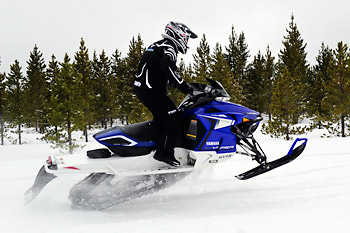
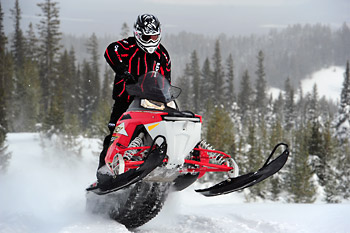
If you’re looking at the photos, you no doubt have noticed the 2014 Yamaha Viper looks a lot like an Arctic Cat. You’re not mistaken.

The new Yamaha snakes are being built in Thief River Falls, Minnesota and do share a lot of the technology with Cat’s ProCross series of sleds.

However, there are significant differences. First, all the new Vipers will have the rock-solid 1049cc Yamaha 4-stroke triple underhood – the one we’ve grown to love in the Vector, Venture and Nytro.

This bulletproof engine mounted in the Viper has a modified exhaust that instead of running under the seat and out the rear of the sled in typical Yamaha style, runs back under the front of the seat and exits at the right side front in a conventional exiting manner with the muffler located behind the right side engine panel.

There’s still a cooling effect with the front half of the 3-into-one pipe exposed to the air and snow inside the tunnel.

All Vipers will be using Yamaha’s 8.3-inch diameter primary and external helix secondary clutches. These tried and true clutches have a proven history of delivering incredible belt life and have been specifically tuned to suit this sled.

Look closely and you’ll notice there are cosmetic changes to the hood, side body panels, digital gauges and the windshields are definitely Yamaha-specific. All colors are reminiscent of current and past Yamahas – and the name Viper, for those who remember nearly a decade ago, was one of Yamaha’s most popular and best-selling marques.

Vipers will be offered with Yamaha-specific tracks in 129-inch lengths as well as a 137 and a 141. The 137-incher is designed for the trail-focused end of the crossover market and uses a fully coupled sliding arm style skidframe as does the 129. The 141 uses Cat’s very light mountain version skid without couplers, rate adjusters, torque links or a sliding front arm.

The sleds are being built to Yamaha’s exacting specifications. Suspension, drive system, fuel delivery, assembly calibrations and settings are being overseen by Yamaha engineers.

Shocked? There’s way more!

5 THINGS WE DIG ABOUT YAMAHA SLEDS

0

Okay, we’ll go out on a limb here and shoulder all the accusations of sucking up to the manufacturers. Feel free to send us your comments dissing us for loving one OEM more than the others. We’re ready.

We did have a discussion the other day, though, about the strengths we see in Yamaha’s snowmobile line-up and stuff we hope they will never take off the table as new products are developed. Here’s our list (we might do one of these for all of the OEMs, come to think of it):

1. Engines:

Yamaha is first an engine manufacturer and, man, are they good at it. Try to think of a single snowmobile engine that’s been about 99-percent bulletproof over its entire production run. It’s a Yamaha, right?

Now think of a company whose complete engine line-up has been incredibly reliable for the better part of a decade. Warranty claims are rare with any of these 4-strokes and unless they’ve been horribly abused, radically modified or smashed repeatedly with ball peen hammers, pretty much the whole fleet is still running. Incredible.

2. MonoShock:

This skidframe has so much going for it (ride quality, light weight, design simplicity) and it has not received enough credit for its performance. Since day one it has been used in sleds that are heavier than its competitors but it has always delivered a premium ride at the top of the industry. We stated earlier we’d love to see this skid in a sled that weighed 100 pounds less.

3. Clutches:

Yamaha’s primary and secondary clutch design is well calibrated, durable beyond sanity and offers such incredible belt life even on its highest performing engines, it defies logic.

4. Finish Quality:

You just never see a Yamaha sled that has mismatched panels, bad paint or stuff that doesn’t work the way it claims. The company’s ability to pre-test and work out glitches on new models before they are presented for sale is unprecedented and borders on the obsessive. It’s been the same for decades.

5. Resale:

Obviously the word is out on used Yamahas because it’s tough to score deals on anything used from an RX-1 to an Apex to a Vector. Why? Most of these sleds look and perform pretty much the way they did when they rolled out of the showroom.

Once again, if the former owner was into gross abuse, the theory may not hold water – however, any used Yamaha that has had basic storage and maintenance care over its life will bring top dollar.

IS POLARIS WASTING TURBO TECH?

0

2013 was a pretty clear indication Polaris isn’t focusing on either 4-stroke or turbo technology in the future.

Actually, since the intro of the RUSH and the Pro-Ride suspension, Polaris has clearly been moving away from delivering sleds with 4-stroke engines and has cut back production of its Weber-turbo package until it’s only offered in one 2-up sled for 2013.

We’ve had press sleds of this ilk in our fleet (Turbo Touring, Turbo LX, IQ Turbo) over the last few years and have always rated them as close to the top in our preferred rides. Every single time, we’ve found them to be fast, fun, reliable and – did we already say fast?

Unless you’ve ridden one of these sleds you can’t fully appreciate the level of performance they deliver. These are hyper-class sleds with power so impressive it feels like Polaris’ rating of 140-hp is an insult.

True, the turbo is programmed to amp up the boost, producing power of about 160-hp for a few seconds when you tip in the throttle, but this engine, in any of the platforms Polaris has been using it in, is way fast – way fast.

Warning: Don’t pick a drag race with one of these sleds when you’re riding an 800 2-stroke. It takes a really good one to beat this turbo down the lake.

So what’s the deal with Polaris not wedging this mill into the Pro-Ride? We dunno. It’s probably one of the best-kept performance secrets in the biz.

Actually, from the outset, it just hasn’t sold in very good numbers and that’s probably why Polaris doesn’t put much marketing emphasis on it. We think this sled, in the right chassis package (like the Indy), could resurrect the company’s confidence in building 4-strokes.

Arctic Cat has had substantial success with its turbocharged hypersleds and Ski-Doo may decide to move in the same direction.

It just seems like such a waste to shelve this great Polaris engine package when it’s so doggone good.

Waddya think?

ARE ALL CAT ENGINES BUILT IN AMERICA FOR 2014?

0

Arctic Cat has made it pretty clear it’s shifting its engine production to North America beginning this year and it’s no secret the company’s relationship with Suzuki has been wrapped up.

On the 4-wheeled side of things, Cat has been building its 4-strokes for the Prowler, Wildcat and its ATVs in a very modern plant in St. Cloud, Minnesota, about an hour west of the Twin cities for several years now.

However, we’re a bit curious about the enormous undertaking of the company to suddenly assemble every snowmobile engine in the USA and none in Japan in a single year.

Frankly, we could see a couple of the sno-mo-engines coming from St. Cloud this year, but self-building the whole fleet of everything from fan-cooled 570s to turbocharged 4-strokes is a bit of a stretch and could lead to a potential mess of reliability issues, couldn’t it?

Apparently, the St. Cloud plant has plenty of capacity and lots of room for expansion – this is a factor Cat has been calculating for several years as the Suzuki relationship has wound down.

The other thing to note here is that the ATV and SxS engines Cat has been building in the USA have been really bulletproof.

We recall when they moved the 500 class ATV engine over to the US facility, our test units suddenly went from being the slowest in that category to the fastest.

Out best guess for MY 2014 would be the company will build its well-tested 1056cc 4-stroke in St. Cloud and that Suzuki, under contract, will continue to build its 2-strokes for a few more years.

We’ll know in a few weeks so stay tuned.