Home Blog Page 205

3,000 Miles On A 2013 Renegade 4-TEC

0

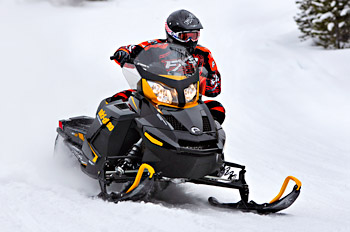
Here’s a report from one of our Supertrax riders, Harold McAdam who purchased his own Ski-Doo Renegade 1200 this year:

Put 3000 miles on my Renegade. The R-motion rear suspension was flawless even with Adrenaline shocks – very compliant over any terrain. Could bottom the sled but you deserved it.

Replaced the seat with the one-inch higher XRS seat. It matched the RUSH height and was far more comfortable. Also did not have that little back storage section I typically sat on (Harold is over 6-ft. tall).

Sled was very warm. Good body protection from the windshield and cowling. Fuel economy rivaled the 800 E-TEC’s at speed giving great range, typically in the 125-mile area.

Storage capability is great, even had the 2-up seat capability. Front end was the weakest point. Sled definitely pushed somewhat in the corners with the weight, and the adrenaline shocks required bumping up the springs and compression damping which compromised the ride somewhat.

Used a Shaper bar as the main carbide and installed a second carbide per ski and this is essential. Studded the track and this is also essential.

Motor was a low-end freight train. Absolutely in it’s element at 60-70 miles per hour. New clutch is a big improvement in terms of smoothness, but still a jerky slow speed set-up that is not friendly to a new or inexperienced rider. Belt wear was unbelievably good. Virtually didn’t have to adjust the secondary.

I installed Ski-Doo’s heat shroud on the secondary and it works so well I don’t understand why the company wouldn’t install it as standard on this model. Holds a spare belt and commonly used tools and improves belt life.

My personal reflection on the last couple of years is that for the average consumer, a 128 to 137-inch coupled suspension serves the need of a flatland trail rider best.

The 1.25-inch lug seems to be the norm as well, although, I think it would also be interesting to see some 1.35 and 1.5-inch alternatives to compare.

Which Is Better: Polaris RUSH or Switchback?

Dear Motorhead:

Is there much difference in handling and ride quality between the Polaris Switchback and RUSH Pro R 800?

Between the the 121 and 136, which one do you prefer for mostly ditch riding and on trail?

Thanks,

Greg H.

Dear Greg:

Thanks for your email!

It is strongly suspected 120/121-inch sleds may go away over the next few seasons. There really is no downside to the SB 136 Pro Ride. Handling is unaffected by the longer track and ride quality is improved substantially by the longer rails.

Floatation will obviously be better and because the Pro Ride suspension is uncoupled, weight transfer is actually better with the SB than the 121 where as with a normal coupled skid the longer rail versions do not transfer as well.

So, I really can’t see why – especially with the price differential so small – anyone would go for the Rush 121.

Hope this helps!

Mark

WHY NO 1100 TURBO IN SOFTY?

Dear Motorhead:

I have been riding snowobiles for 40 years and I don’t understand why when you’re picking your sled of the year you don’t compare Arctic Cats 1100 turbo against all other brands.

I ride with every brand in northern trails where power rules and no 2-stroke can hold a candle to the turbo.

I am 53 years old and I have owned a 2009 turbo and now a 2013 RR turbo and there is no 2-stroke can come close on trail or lake and when we go on a trip I don’t have to worry about looking for oil.

Every thing I own is 4-stroke, ATV, Boat Cars, Truck, Bike, Seadoo and also my wife’s Vector GT. I do not want to go back to a 2 stroke ever because the engines don’t stand up and the fuel at the pumps with ethonal is crap.

So next year when you want to talk about sled of the year, lets go test them in Cochrane and we’ll find out that all your 2-strokes are blowing up and the 800 polaris are so slow you will have to send out a search party at the end of the day.

Sledders my age that I ride with want power, handling and no injector oil to worry about. Lets bring those facts up next year and stop talking about sleds with outdated oil burning 2-strokes.

I have ridden and owned all the brands. I ride with dozens of different sleds every week and there is no substitute for horsepower. So next year lets compare the turbo cat and not that old smokey 800 cat.

Thanks from an old guy that knows what a real sled is all about. Oh ya, I run my turbo at 230 horses on pump gas thanks to Birch Point Cats . I havent had a sled with less than 200 horsepower since 1999. I do still miss my Thudercats. That was a real 2-stroke.

Kenneth G.

Dear Kenneth:

Thanks for your email!

We appreciate your passion for 4 strokes and in particular AC’s 1100 Turbo. We have not had the AC turbo in the SOFTY competition yet because of a number of factors.

When the Turbo was in the old “F” chassis no one around here could get very excited about the sled. It was heavy and not particularly good handling – however it was unrepentantly fast. Now the Turbo resides in the new Pro-Cross chassis we have given it consideration.

It didn’t make the cue last year (its first year in the new chassis) as a result of some reliability issues both we and readers mentioned on numerous occasions. Not the least of which was belt life.

This combined with some calibration issues with the rear suspension and we choose to take another model as the nominee.

This year the Turbo improved and was given serious consideration. However, the 800 128 Pro-Cross was so impressive with its power and even economy it was unanimously picked as our AC nominee. So, the Turbo has been considered and has been given its due.

Let me say this – for MY 2014 AC’s new 137 inch skid in an XF Turbo package will be formidable – however there is the new 600 DSI Cat which everyone was blown away with in Yellowstone in Feb.

One more thing – the Turbo, although much lighter in the new Pro-Cross chassis, is still heavy – and that requires buyers to make a significant compromise – whether they know it or not.

The trade-off is the Turbo’s imposing power for almost 70 pounds of weight right over the carbides (vs the 800).

So, we are paying attention and appreciate your comments!

Thanks for watching!

Motorhead Mark

RIDE IMPRESSIONS: 2014 SKI-DOO GSX rMotion

0

At Supertrax we’ve always been big fans of the smooth riding GSX series from Ski-Doo.

We like the adjustability its air suspension offers on long rides and the fact you can custom-tailor its ride results to different tastes and even to the varying kinds of snow conditions you’re riding over, all on-the-fly.

We were a bit surprised last month when we got to see Ski-Doo’s 2014 sleds and learned they had dumped the old SC-5-based air suspension and gone with the newer rising rate rMotion back end used in tandem with the on-board air pump and air shocks.

We honestly thought it might be a case of overkill since the last thing the GSX needed was any ride improvement. We were wrong.

What’s cool about the 2014 GSX SE line-up is you can order this luxury ride with different engines according to how you like to ride and what you require in an all-around sled.

Both the 600 and 800R E-TECs are available along with the 1200 4-TEC triple so you can go with a lighter, more agile feel in the 137-inch XR platform or you can get the awesome torque and mid-range of the heavier 4-stroke.

Another big change to the GSX line is the switch to the new XS chassis for the 120-inch GSX LE.

Along with better ergonomics and wind protection than the XP based GSX, you can now opt for the new 900ACE 4-stroke triple or the 1200 4-stroke or the 600 E-TEC 2-stroke twin.

The LE has also moved up to rMotion making it as close to an MX-Z as possible, albeit with a more softly damped combo of Motion Control shocks and gassers.

However, no fear of ever bottoming now. Features like a really nice tunnel bag, electric start (Oh, wait! Pretty much all Ski-Doo’s have electric start this year) and a bigger windshield come standard.

What can we say? Riding these sleds is so close to riding an MX-Z you can barely tell the difference.

Ride quality has taken a giant leap forward, especially with the air-suspended SE, and the GSX series offers some of the most versatile sleds you can buy.

There’s simply no compromise with the GSX. You can get everything you want right here, regardless of what kind of rider you are.

TEAM ARCTIC VICTORIOUS AT CLASH OF NATIONS

It’s been a season of snocross domination for Team Arctic’s Tucker Hibbert. After winning his sixth-consecutive X Games gold medal and then clinching the 2013 ISOC Pro Open National Championship, Tucker Hibbert solidified the season with a victory at Sweden’s Clash of Nations Super Snowcross event.

With 16 riders in the main event, including Logan Christian from Christian Bros. Racing, Hibbert ripped a monstrous holeshot and ran away with the win, while Logan Christian charged hard through the entire race finishing with a strong 3rd place podium.

Hibbert said, “It was awesome to come back to Sweden, take a win and finish the season healthy. It’s a great feeling flying across the world and having fans cheer for you. I’m always surprised by the amount of support and excitement from fans in Scandinavia.”

In the Pro Stock class, 16 year old Martin Moland from Norway had an outstanding win. Moland’s Clash of Nations win came shortly after he was crowned the 2013 bronze-medalist in the Norwegian snocross championship.

Luva Racing’s Alexander Berglund of Sweden rounded out the podium for Arctic Cat with a solid 3rd place finish.

Team Arctic Race Manager, Mike Kloety said, “Team Arctic has had a very successful 2013 snocross season and these wins and podium finishes at Clash of Nations make it an even better one! It’s truly fantastic to see the highest level of enthusiasm these snowmobile race fans have for Team Arctic.”

About Arctic Cat – Arctic Cat Inc., based in Thief River Falls, Minn., designs, engineers, manufactures and markets all-terrain vehicles (ATVs) and snowmobiles under the Arctic Cat brand name, as well as related parts, garments and accessories. Its common stock is traded on the NASDAQ National Market under the ticker symbol ACAT.

More information about Arctic Cat and its products is available on the Internet at www.arcticcat.com.

RIDE IMPRESSIONS: 2014 Polaris Indy 550

One of the reasons our expectations for fan coolers has been fairly low is due to the less than nosebleed velocities a 60-hp mill can produce.

Here’s the good news: Depending on how you equip your new Indy 550 (Adventure, Voyager, Indy LXT or Indy121) there’s as much as 50 pounds less weight carried.

There’s almost 30 pounds shaved from an IQ to a 121 Pro-Ride and it comes from the lightweight but much stronger cast bulkhead.

There are few rivets on the new Pro Ride chassis and there’s been an elimination of tons of stampings, braces and gussets from the use of a very sturdy clamshell bulkhead.

Obviously the weight savings are not realized in the rear of the Pro Ride 550. The skid and the tunnel appear nearly identical to the IQ 550. Don’t forget, Polaris uses its proprietary bonding system when assembling and this saves significant weight as well.

This familiar 60-horse twin has been around the Polaris parts book since the mid-1990’s. It’s a strong fan cooler but it wasn’t until it was inserted in the Pro-Ride that it impressed our pilots this much.

Frankly, the 121-inch tracked Indy 550 is a little rocket. From first squeeze the sled launches with authority shifting hard up to an indicated 75-mph top end.

The sled feels like a feather and you can throw it into turns with abandon knowing the front end will bite without a hint of understeer.

In bumps there’s no denying this chassis is happy with its light engine. The CVT Tech/PowerBloc primary is an uber-simple clutch that works exceptionally well here.

In fact, backshifts were really strong; the Invance secondary followed engine RPM in an almost telepathic way.

The new 550 uses a slightly laid back handlepole in comparison to its siblings. This more laid-back handlebar location is beneficial in the Voyageur and the Adventure models targeted at the utility, fur-hat crowd.

Ride quality is decent for this price range understanding those are pretty basic gas cell shocks all around. Again the sled’s inherent lightness gives a noticeably “athletic” feel to the 550.

Here’s the deal. Ski-Doo literally owns the utility snowmobile market with sales greater than all its competitors combined.

This assault (cough) into Ski-Doo’s turf with the new Indy Voyager and the Adventure along with the Indy LXT is going to be successful – guaranteed.

By just getting into this segment with credible product, Polaris will capture sales by being the alternative.

We think Polaris won’t be able to build enough 550’s this season for that reason alone.

Byers Motorsports Dayco National Season Recap

The Supertrax Magazine/ Byers Motorsports/ Polaris team was greeted to the largest track in CSRA history for the Dayco National Finale at Horseshoe Valley Ski Resort, just outside of their home town, with just under a mile long track.

Lap times for the just under mile long track were 1:35-1:45 mins. Large crowds filled the stands for the 3 days of Easter weekend racing action for the CSRA Finale including many Byers Motorsports family, friends and fans.

The finale weekend started off rough for Byers Motorsports as Jamie had a mechanical failure in Fridays practice, putting his machine out of commission for the weekend. The team worked hard swapping suspensions and components over to his back-up sled before the first Pro-Open qualifier.

Moto 1 took place at dusk and Jamie finished 4th. In Moto 2 under the lights, Jamie rode a great race finishing 4th. With long races, lap times and Vintage racing, the Pro Open final got under way at 11:20PM. Qualifying 7th for the final, Jamie lined up near the inside but got pinched out going into the first corner setting him near the back. When the checkered came out after the 14min+ final, he crossed the line just outside the Top 10 in 11th.

The weather for Saturdays racing was what the fans anticipated as normal for the Horseshoe event with 8*C and sun shining bright. In Moto 1, Jamie had a good race and battle going before hitting an ice edge in the berm at the top of the hill tearing the handlebars out of his hands and tossing him off the side of the sled.

Jamie got up quick and tried to get back on the sled but gravity took over and sent the sled to the berm at the three quarters of the way down the hill, finishing 6th. Jamie finished 6th in Moto 2. Starting back row in the final, Jamie was pelted with ice pellets off the start and rode smart for a 10th place finish.

Mother nature did a complete 360 on Sunday with cooler temperatures and the dreaded rain. Fortunately the rain lightened up before the main events. Finishing 6th in both qualifiers after struggling with the downhill section, Jamie lined up outside backrow in the final.

The track was very rough and the downhill section was all ice in the final. Jamie made a couple mistakes in the final, almost coming off the sled costing him some positions finishing 13th.

“It was a real bummer that we were unable to use our 2013 this weekend as we had it dialed in before the mechanical failure,” Jamie said after the weekend. “This season was a real learning curve in the Pro Class. We struggled throughout the year but know we can run near the top.”

This season Jamie was able to lead multiple laps of his first ISOC Pro-Lite qualifying race in Duluth, Minnesota as well as qualifying for the final. He battled head to head for the lead with 6-time CSRA Pro Open Champion Iain Hayden at the CSRA Kawartha Cup National as well as grabbing his first Pro Podium at the event. As a rookie Pro-Open racer, Jamie placed 6th overall in CSRA National Points.

For the last race of the season we had a couple other racers jump on the sled for the finale. Nick Micek made his snowcross debut in the Trail Sport 600 class grabbing multiple holeshots in his qualifying races finishing 7th and 10th in the finals.

Jeff Brand from TekVest, threw his leg over the Byers Motorsports Polaris for his first race this year on Sunday in the Pro-Lite Class after recovering from a broken femur last season. Jeff has been racing snowmobiles for 18 years and had not missed a year without racing.

For not being on a sled all year and racing this technical track, Jeff did well in his Motos and grabbed a lot of attention from the announcer.

Having some fun at the end of the season in the mechanics race, we had 2 first time racers; Nick Leigh and Jessica Brown. Nick had never raced before and won his race and Jessica placed 4th after never being on a race sled or racetrack before.

We would like to thank our sponsors for their great products and continued support as none of this would be possible without them; Supertrax Magazine, Byers Equipment Motorsports, Polaris Racing, Dayco Belts, Gamma Sales- Fly Racing, Coldwave, Dragon Optics, Amsoil, Woody’s, Creechers Design, CMSports/Clean Media, Powermadd, TekVest, Digatron USA

Which Sled Will Be Next Season’s Biggest Hit?

0

If you’ve voted or checked our poll results on this website, you likely have a pretty clear idea of which all-new sleds will be the biggest sellers next year.

Despite what the poll is telling us, since we’re gamblers at heart, we have a few contrary opinions.

The poll says (think of this as “survey says” from Family Feud) the new Yamaha Vipers will be the biggest sales success next year.

Yes, we would have to agree here and 44-percent think this to be true. We don’t think the numbers will be that high compared to say the number two finisher, though.

Poll says Arctic Cat’s new El-Tigre 6000 with its DSI 2-stroke comes in second with 26-percent. This is a pretty substantial prediction in that the El Tigre is only offered in one version, a 129-inch platform with the optimum suspension package at probably a fairly heavy cost.

Looking at the Yamaha you see three different track lengths, two completely different suspensions and two different model categories.

Also, you have to realize, tempering this, the 4-stroke market has not historically been as big a market as the 2-stroke. These things all come into play.

When you look at the bottom rung of the choices, the Polaris Indy 800, offered in only one model variation captures 15-percent as does the new Ski-Doo ACE 900 in all its variations. This is significant but we think it’s inaccurate.

We think the ACE will score second behind the Viper line – perhaps because of the multiplicity of many different models with the new engine. This would place the Indy and the El-Tigre closer together but with a higher percentage for both.

Despite the poll results, here’s where we predict the order will go with sales of new models:

1. Yamaha Viper (all): 33-percent
2. Ski-Doo ACE 900 (all): 26-percent
3. Arctic Cat El Tigre 6000: 21-percent
4. Polaris Indy 800: 20-percent

If you haven’t voted yet, there’s still a chance to do it. Click on and vote now.

Yamaha FX Nytro X-TX Track Upgrade

0

SnowTrax Television Co-Host AJ Lester fights through a cold to upgrade his Yamaha FX Nytro X-TX with a pre-studded Camoplast Ice Attack XT track.

Subscribe to our YouTube channel at YouTube.com/SnowTrax!

TEST RIDE: 2014 Yamaha SR Viper

0

SnowTrax Television Co-Host AJ Lester gives us a first look at Yamaha’s big news for 2014 – the SR Viper.

Subscribe to our YouTube channel at youtube.com/snowtrax!