Home Blog Page 190

2015 YAMAHA SR VIPER MTX 162

0

Yamaha is definitely in the mountain biz with this sled.

At first our riders were pretty skeptical about a 4-stroke mountain sled and its ability to compete with lighter 2-stoke climbers. One caveat: All the MTX Vipers we had to choose from were equipped with turbochargers!

At Yellowstone’s high elevation the extra power was nice but we would have liked to sample a naturally aspirated 1049 at altitude.

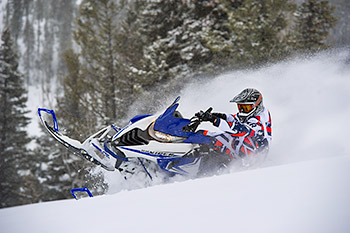
As far as the chassis goes, our riders were impressed with the sled’s ability to climb out of deep snow and maneuver through tight spots without hanging up.

We think this combo of redesigned skidframe, very good balance and the 135-hp level of power from this mill will be a credible mountain sled – perhaps not at the level of some of the most radical 2-strokes but nevertheless, capable of some pretty cool mountain performance.

2015 ARCTIC CAT PANTERA AND XF 6000

0

Although we couldn’t possibly provide feedback on every new Arctic Cat sled we rode in Montana a few weeks ago, we can cover our impressions of two of the newest models we actually had seat time on.

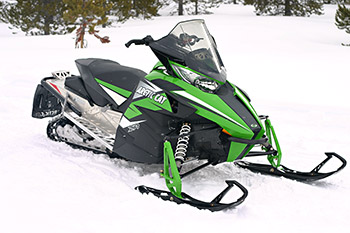
The 2015 Arctic Cat Pantera is one amazing sled! One of our test riders, generally inclined toward rather radical riding feats, told us this: “I just wish they could put that suspension in every sled made.”

Our lead photographer informed us: “Whenever we went out onto the hills to shoot, I just grabbed the Pantera and rode it every time. Its handling and ride are so good you can’t believe it and with that 7000 mill, it just rails”.

Generally, everyone agreed this sled sets a new standard for comfort, ride and handling in a 2-up 4-stroke.

Cat’s 600 CTEC-2 in the 2015 Arctic Cat XF is an extremely impressive mill and loves life in the ProCross chassis – particularly in this 137-inch tracked version. This engine sounds great, spools power relentlessly and makes you wonder why you’d ever want an 800.

Cat has recalibrated the rear suspension on the Sno-Pro versions of all its 137-inch sleds and it makes a very nice improvement in stutter compliance.

One comment after riding this sled: “I can’t figure out why this 600 feels so much lighter than even the 800. There’s not that much difference but the sensory feedback says this sled weighs way less.”

Yamaha Podium Finish at Pinedale HillClimb

Yamaha once again proved the skeptics wrong, this time it occurred in Pinedale, Wyoming during the White Pine Hillclimb.

Pro rookie racer Gavin Balls rocked his brand new Yamaha SR Viper M-TX to a second place finish in the 700 Mod class, giving him his first pro podium of his young and promising career.

More importantly, the wild romp up the hill helped further solidify Yamaha as a true contender in the Rocky Mountain Snowmobile Racing HillClimb Association (RMSHA), as well as the capabilities of the new SR Viper M-TX mountain sled.

While it wasn’t the victory the team knows it’s capable of securing, it was another giant step forward for Yamaha in the western market.

“They said it would be impossible,” said Yamaha Product Manager Rob Powers, referring to Gavin’s accomplishment. “The new SR Viper M-TX is a very capable mountain sled; its powerful, balanced, extremely maneuverable, and rock solid reliable. Every weekend we are proving that on the race track and in the backcountry.”

Gavin also just missed the podium in 600 Mod with a fourth place finish, and garnered a sixth place finish in 700 Improved.

Pinedale marked just the third race for the Yamaha HillClimb Team. Chad Jorgensen, Nathan Titus and Bryan Pack join Gavin, and Troy Johnson of Lincoln County Customs manages the crew.

“Every time we hit the hill we are making improvements,” said Troy. “We knew the Viper M-TX had potential from the very first race. We hit the Bear Lake HillClimb with zero testing, and we were qualifying in the top-ten.” Now that we’ve had some time to dial-in the sleds and get some seat time, you’re gonna see continued improvements from everyone on the team.”

Up next for the Yamaha HillClimb team is the legendary Jackson Hole World Championship in Jackson, Wyoming, March 20-23, 2014.

The team will use the additional time leading up to the race to further hone their skills and the performance of their SR Viper M-TX snowmobiles.

You can follow all the action throughout the season at facebook.com/YamahaSnowmobilesUSA and at youtube.com/YamahaSnowmobilesUSA

HERE’S WHY IT MIGHT BE TIME TO TRADE-IN

0

We’re happy to report this has been one of the longest, coldest, snowiest winters on record in most key snowmobiling areas. When was the last time you could see yourself riding into early April?

It’s amazing how a winter like this changes the rules. For instance, if you were looking for a good, used snowmobile at a bargain price late in the season, you were probably out of luck.

The reason was that riders who had cobwebbed their sleds in a barn or garage the last couple of years simply took them out and started riding them again. Some of these sleds were pretty old, too. We can’t recall a year when we’ve seen so much older iron (7 years or older) out on the trails.

Fact is, we can’t recall a year when we’ve seen so many new sleds, either. Most dealers are reporting sell-out conditions on 2014 and leftover 2013 inventories and have ordered up almost all new 2015s for next season because the OEM’s simply don’t have any still-crated 2014 leftovers to sell.

What does this mean? Well, it means the brand new one-year-old stuff is in short supply now and if you want a new sled you’re going to have to look at a 2015, not a non-current 2014 or 2013 this fall. As you know, this has not been the case in the industry for the last four or five years.

What it boils down to is a situation where demand is outstripping supply. Next season, buyers are going to be limited as to what new sleds they can buy (unless they early-ordered with a deposit) and they’re going to be severely limited as to the number of good, used sleds they’ll be able to find either at the dealer or privately.

The good news is, if you’re thinking of ordering up a 2015, you’ll likely get maximum trade-in value for your current sled or you’ll be able to sell it for good bucks privately. At Supertrax, we can’t recall a year when so many people have contacted us asking if we knew where a good used sled could be located.

The bottom line is this: There may never be a better time to early order a new sled than right now. It’s almost a no-brainer you’ll get good bucks for your used one and with this strong demand, prices aren’t likely to get any better on the new stuff than what you can negotiate on an early order deal this spring.

2015 Polaris RUSH AXYS

0

Whenever a sled is so radically changed and altered, it’s difficult to provide feedback based on one week’s riding.

We made a special effort to put in as much seat time as possible with the new AXYS platform and came away with some strong vibes.

First, this sled is light. You can feel the difference from the original RUSH immediately and the ride and handling are noticeably affected by it.

Second, the new 800 2-stroke is a winner! This mill rocks and may set the standard for every other 800 out there.

Comment: “This 800 feels like a great big 600 – it even sounds cooler and its throttle response at every power level is immediate and urgent.”

Some of our testers even claimed this was the fastest 800 they’d ridden – ever. We’re not sure and can’t verify this at sea level, so we’ll just say this is a very strong 800 and, wait for next year.

Rear suspension: One thing we noticed is the new AXYS suspension is way less sensitive to adjustment than the original RUSH. This is a very good thing and makes the sled way easier to set up for individual riders.

There’s plenty of alternatives with settings and everything is easy to get at to fine-tune the back end. Front end handling is much flatter and linear than the former RUSH and when the rear suspension is correctly dialed, the sled handles like it’s on rails.

We suggest all owners regardless of their weight or riding style dial back the clickers to “0” and adjust upwards as required. Start with lower spring preload and then work the clickers upwards gradually to harder settings.

We could go on with the slick electronics on this sled (the color dash display is awesome!) but there’s just too much to say about the AXYS.

We’ll give you more feedback soon.

2015 SKI-DOO SUMMIT X 174: Questions Answered

0

Yup, when the going gets tough, go big!

Our readers brought up a very interesting point about the new 174-inch Summit not fitting in the bed of a standard sized pickup (without hanging out the back several feet).

They also pointed out the extra length makes for some challenges fitting a couple of these behemoths in a 4-place trailer and then having room for a third or fourth sled in the back.

There’s always a few negatives when something truly revolutionary comes along and our feedback from some of the “mountain men” testing this sled in West Yellowstone seems to indicate it’s the beginning of a love affair.

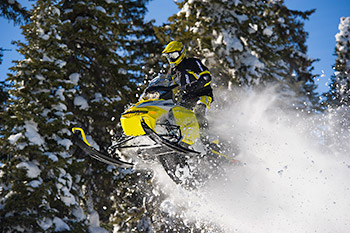
Our crew felt the 174 was flat-out amazing and would virtually climb verticals until your nerve ran out.

It also offered uncanny start-up in crusted snow with its weight spread out so thin it would barely break through the crust into the soft powder underneath.

Keep in mind this sled is a 16-wide with a 3-inch paddle and weighs in at almost the identical weight to last year’s Summit 163.

Mounting points for the skid have been moved back and the balance point for the sled is much nicer than in the past.

A 7-tooth driver set is now used and the combo of 800 E-TEC power and ideal clutching makes this snowmobile virtually unstoppable.

We think this will be the beginning of a trend in the biz as the competition considers the benefits of getting longer.

SKI-DOO CHANGES ARE BIGGER THAN YOU’D THINK!

0

We’ve been reading your online responses to the 2015 Ski-Doo intro we recently posted and want to reply to some of your comments and questions.

First, there were some responses that showed disappointment with Ski-Doo’s seemingly “mild” new model selection this year. Once again, we need to underscore how difficult it is and how long it takes for major engine and chassis changes to filter down through the process of validation until they are deemed suitable for public consumption.

Yes, we believe Ski-Doo is working on some very big changes within the next two years both to its engine line-up and perhaps even an all-new chassis platform (now that Polaris has come out with the lightest sleds ever).

But lets address the biggest changes this year – and it’s especially pertinent now that we’ve had a week to sample these sleds in West Yellowstone, Montana.

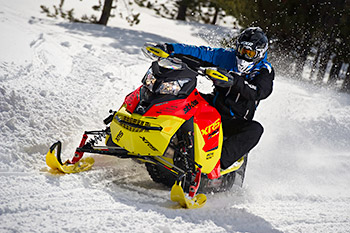
You’re not going to believe us when we say this but here goes: The new RAS front end Ski-Doo has added to its XS models (and some XRs) is a very, very, very, very big change to the way the MX-Z and the Renegade work.

The change was accomplished by spacing the upper and lower control arms about 12mm further apart and adding new spindles. This affected the sleds roll center (raising it) while maintaining a low center of gravity.

You immediately notice this change when you ride the sled aggressively on trails. The front end stays planted and there’s virtually no push or understeer at any point.

Ski-lift is obliterated and we detected no darting of any kind in both the early morning hard and frozen snow conditions in Montana and in the later-in-the-day softer snow when the temps were warmer.

We cannot underscore deeply enough how much more confidence this inspires in the XS chassis when you’re riding! It also makes for a beautiful marriage with the rMotion skidframe.

Another comment. We were a bit floored when we found out Ski-Doo was moving away from the 16-wide tracks it has perfected on the Renegade.

The combo of the RAS front end and the narrower track (15-wide now) allows the 2015 Rennie to respond to handlebar inputs instantly and carve like a Ginsu.

The handling gap between a Renegade and an MX-Z is almost eliminated and the 137-incher would be our preference, unequivocally.

BRP’S 2015 SKI-DOO LINE-UP

BRP today introduced at its semi-annual dealer meeting held in Québec City, Québec, the 2015 Ski-Doo snowmobile line that continues to bring industry firsts and innovation to the market.

Some 1,200 Ski-Doo representatives from Canada, the United States, Russia and South Korea witnessed the unveiling of the new Ski-Doo Summit X snowmobile with T3 package, the Renegade XRS model and the expansion to more models of ground-breaking technologies like Intelligent Throttle Control (iTC) and Rotax Advanced Combustion Efficiency (ACE) engines, plus improved systems like the new Response Angle Suspension (RAS 2) front suspension.

“The great winter season in most markets has allowed the Ski-Doo brand to expand its market share in North America to record levels by having the technology and products buyers were looking for,” said Yves Leduc, vice-president and general manager, North America division. “We are seeing the pay-off from our drive to improve the customer experience by providing innovative, reliable, high performing snowmobiles, as well as accessories and clothing that notably enhance the actual riding experience. The Ski-Doo brand keeps getting stronger as its market penetration in all segments increases every year.”

If there is one thing that defines BRP’s approach to its Ski-Doo snowmobile offering, it is a drive to always move forward, as no manufacturer has delivered more innovations to snowmobiling than BRP over the past 12 seasons.

That doesn’t change for 2015. For the deep snow mountain market, the Ski-Doo Summit X model with T3 package delivers the longest standard track and tallest lugs ever offered by an OEM that will take riders even further in powder conditions.

Trail riders will appreciate the new RAS 2 front suspension with improved big bump capabilities, improved roll centre and lighter weight, along with a new model, the Renegade XRS sled, for the most demanding crossover riders. And models equipped with Rotax 600 ACE engines get iTC technology added. Plus both 900 and 600 ACE-equipped sleds will see the only finger throttle offered by a manufacturer so riders can choose how they want to experience their ride for more comfort.

“The introduction of the 900 ACE engine in many models last season was a tremendous success worldwide and expansion this year will continue to build momentum not only for North America, but also for international markets,” said Chris Dawson, vice-president and general manager, International division. “Expanding this engine to our utility line of snowmobiles gives us a real advantage where buyers can now get all the benefits ACE and iTC deliver in both 600 and 900 versions.”

BRP (TSX:DOO) is a global leader in the design, development, manufacturing, distribution and marketing of powersports vehicles. Distributed in 105 countries, its portfolio of brands and products includes Ski-Doo and Lynx snowmobiles, Sea-Doo watercraft, Can-Am all-terrain and side-by-side vehicles, Can-Am roadsters, Evinrude outboard engines, as well as Rotax propulsion systems. BRP employs approximately 6,800 people worldwide.

www.brp.com

2015 SKI-DOO: Renegade Changes

0

Ski-Doo has continued the process of upgrading its very popular Renegade line-up in 2015.

Besides the addition of the new RAS2 front end on all REV-XS based Ski-Doos, a major change on many Renegade models is a switch to a 137×15-wide track.

All Rennies, with the exception of the more off-trail focused Backcountry and Backcountry X, which will have a 16-wide FlexTrack, will now use a lighter 15-inch track (varying lug depths available on early-order programs) to increase top speed potential and sharpen up cornering on trails.

An all-new model, the Renegade XRS, available with an 800 E-TEC, will come with an upgraded shock package, very cool paint and graphics and a 1.5-inch-deep 137×15 track. It’s only available on early order this spring.

The Freeride 137 with rMotion has moved up to the mountain biased FlexEdge track with choices of 1.75-inch and 2.25-inch lug depths. All Freeride tracks are 16-inches wide. Electric start is now standard on the Freeride 137.

Changes to the Renegade this year are specifically targeted at the trail rider who wants the versatility to occasionally go-off-trail. Obviously Ski-Doo is reacting to the sales stats that clearly show consumers are opting for the benefits of a sled that works well on trails but can be roosted in the powder when desired.

The competition has a long list of sleds measuring 137-inches for this purpose and it’s very clear Ski-Doo wants to maintain its dominance with light weight and industry-leading handling in the Renegade line-up.

2015 SKI-DOO: A New Front End for The XS!

0

Ever since Ski-Doo introduced its rising rate rMotion skidframe three years ago, the industry bar has been significantly raised in snowmobile rear end ride compliance. rMotion offers amazing ride control with no fear of bottoming and its easy adjustability has made it incredibly user-friendly.

Ski-Doo’s biggest problem has been rMotion is so unbelievably competent, the REV-XS’s front end ride and handling has taken a bit of a back seat in the evolution of the platform.

This year, Ski-Doo has made a bold step to modify the front end on all its XS models bringing it into full equilibrium with rMotion. The new front end weighs 1.75 lbs less and is called RAS2. Its most major change is the lengthening of the spindles, placing the A-arms 12mm further apart.

Although this seems like a small change, it’s actually huge. Since the sled’s “roll center” has now been raised 38mm (Note: Don’t confuse roll center with center of gravity.

A higher roll center is a good thing and a low C of G is most desirable) the sled corners even flatter and bump steer is reduced because the front end does not experience as much camber change as it cycles through its travel. The net result is a sled that is more stable in big bumps as speeds increase and has less roll when you’re throttling hard through the corners.

RAS2 is now standard on all MX-Z, Renegade, Summit and GSX models using the XS platform.