Home Blog Page 187

SKI-DOO MXZ IRON DOG SLED TO HONOUR ICONIC RACE

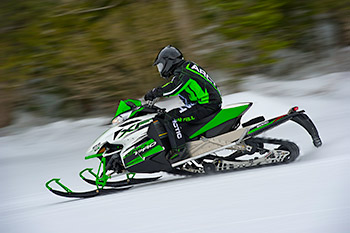
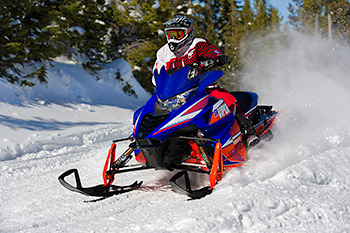
BRP introduces today the Ski-Doo MXZ Iron Dog Special snowmobile, inspired by and named after the iconic event.

The MXZ Iron Dog Special sled was designed for rough trail enthusiasts and features many characteristics used on Iron Dog champion machines, along with a distinctive color and graphics scheme.

BRP’s Ski-Doo MXZ Iron Dog Special sled uses a 128-inch (325-cm) track and rMotion suspension developed and proven in previous races and on the snocross race circuits.

This is the first time the configuration has been available to consumers; its added length increases traction for acceleration and braking, yet maintains the MXZ sled’s legendary cornering and bump absorption abilities.

The MXZ Iron Dog Special is available with both the Rotax 800R and 600 H.O. E-TEC engine choices and includes several race-specific chassis reinforcements and race-type suspension calibrations to accommodate the hard-core target audience.

“It’s great to see a manufacturer build a special sled like this one and name it after our race,” commented Kevin Kastner, Iron Dog executive director. “We’re enthusiastic to be associated with Ski-Doo snowmobiles and appreciate the support they put into their racers that make the Iron Dog such a remarkable event.”

“The Iron Dog race has a long storied history, and BRP’s Ski-Doo sleds have been at the forefront in recent years winning two out of the last three events,” said Louis Lévesque, vice- president, Global Marketing and Consumer Experience. “Many riders have chosen to race Ski-Doo snowmobiles in the Iron Dog the past several years because they’re known for being durable, fast and easy on the rider – and those are certainly attributes we’ve built into the MXZ Iron Dog Special snowmobile and our other sleds.”

Sébastien Thibault, race manager for Ski-Doo Snowmobiles and Can-Am Off-Road vehicles added, “More than anyone else, we use racing to make our snowmobiles better. That’s especially true of cross-country races like the Iron Dog because it’s an extreme version of how many snowmobilers ride every weekend. Consumers who ride their own Iron Dog Special model with their buddies will love what this unique sled delivers.”

The Ski-Doo MXZ Iron Dog Special sled will be available starting January 15 at select dealers across North America. Production is limited on this unit and it will only be available this winter.

For more information or to find a dealer, visit the ski-doo.com website.

WHO IS THE MOST AGGRESSIVE IN 2015?

0

We’ve had a few discussions recently about which manufacturer is being the most aggressive in the snowmobile marketplace.

Aggressive would be defined as going after new market share, pulling percentage points away from its competition.

With the intro of the new AXYS this year it would be easy to say Polaris is the most aggressive. This sled series has set the bar high for the competition with class-leading lightness, ground-breaking electronic innovation and a new 800 engine that rocks.

The company’s reach into the utility segment with its Indy series has been very successful and the company is still a very strong player in the mountain and free-ride categories. It offers tremendous value in its trail-based Indy line-up and impressive performance, too. Polaris is far from sitting still.

Yamaha is showing signs of being more aggressive with models like the RTX and LTX LE featuring very good fully adjustable suspensions. The company’s product line is now very closely tied to Arctic Cat and that may be a limiting factor as to how aggressive Yamaha can be in the marketplace.

Ski-Doo has addressed handling with its new RAS 2 front end and still offers top deck ride compliance from rMotion. Its 900 ACE 4-stroke is a big success and the E-TEC DI 2-strokes are still industry leaders in fuel economy and squeaky clean emissions.

The company is showing signs of being one-upped in some power categories and even in lightness and chassis design, though. With a huge share of market and some really great product, however, the company may be able to sit back and cruise a few more years without getting too aggressive.

Then there’s Arctic Cat. In the last two years this company has become a key supplier to Yamaha, brokering a deal to use the company’s stellar 4-strokes, has introduced a tremendously appealing new 600 2-stroke and introduced a highly successful chassis variation, the 137-inch XF series.

We think Cat’s aggressiveness will continue with some interesting engine and model variations, maybe even in MY 2016, and this is the year that will truly show who is being the most aggressive in the snowmobile market.

Dream about a new DSI 800 or using other Yamaha engines like the Apex 1000 4-cylinder or even a variation on the Phazer’s 500 twin. Then there’s the mountain market: Cat is tired of being in the shadows in this segment and may be coming with a gut-busting variation on what it’s been producing for the hills.

You be the judge.

Polaris Dominates Pro Stock in USXC

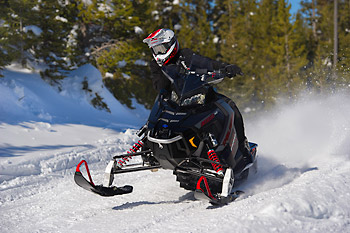
The Polaris AXYS platform is making a dramatic impact in cross-country snowmobile racing this season on the United States X-Country Snowmobile Racing (USXC) circuit.

In USXC racing on Jan. 3 at Detroit Lakes, Minnesota, Polaris racers on RUSH® models built on this innovative chassis finished 2-3 in the Pro Stock race, and six of the race’s top eight finishers were on RUSH sleds. In the Pro Open race, five of the top 10 finishers were Polaris racers on RUSH models.

In the USXC points standings, six of the top seven racers in Pro Stock points are on RUSH sleds built on the AXYS platform, as are four of the top 10 drivers in Pro Open points.

“The power-to-weight ratio of the new RUSH built on the AXYS platform has given us an advantage over the competition,” said Polaris Racing Manager Tom Rager, Jr. “The reduced weight not only helps with the handling, but also gives us improved acceleration and top speed.”

PRO CLASSES: AXYS Riders Dominate the Standings

In the Pro Stock race at Detroit Lakes, Gabe Bunke (Bunke Racing) took second and Ryan Faust (Faust Racing) finished third. Justin Tate (2-Eight Motorsports) was fourth, Spencer Kadlec (Bunke Racing) was sixth, Travis Faust (Faust Racing) was seventh, and Bobby Menne (131 Racing) finished eighth. Ryan Faust left Detroit Lakes as the leader in Pro Stock points, followed by these Polaris racers in third through seventh place: Bunke, Tate, Travis Faust, Kadlec, and Menne.

In both Pro classes, every Polaris racer is on a RUSH model built on the new AXYS platform, which is making its debut in cross-country racing this winter.

In the Pro Open race, five Polaris racers ran in the top 10, led by Nicholas Jahnke in fifth, Ryan Faust in sixth, Travis Faust in seventh, Tate in ninth, and Kadlec in 10th. Ryan Faust is currently fourth in Pro Open points, Travis Faust is fifth, Jahnke is sixth, and Tate is in seventh.

SEMI-PRO: Polaris Earns 3 of 6 Podium Spots

Polaris racers Alex Hetteen (131 Racing), Grant Weber (Faust Racing), and Taylor Bunke (Bunke Racing) all earned podium spots with strong finishes in the Semi-Pro races. Hetteen finished third in the Semi-Pro 600 and is currently third in class points, while Bunke is seventh in points.

In the Semi-Pro Improved race, Weber finished second, Bunke took third, and Hetteen finished ninth. In the points standings, Weber is second, Bunke is third, and Hetteen is in eighth.

Grant Weber led a 1-2-3 Polaris sweep as he won the Sport Open race. While Weber took the checkered flag, Jason Cleasby finished second and Robert Loire took third. Jeff Hayford was seventh and Michael Feigitsch finished eighth.

In the Sport 600 race, Loire finished second, Hayford was sixth, Daniel Herberg was seventh, and Kelsey Pladson (Bunke Racing) took eighth. Loire left Detroit Lakes as the points leader in both Sport 600 and Sport Open. Pladson is third in Sport 600 points and Herberg is fourth.

Jill Tangen won the Women’s Class race and Kelsey Pladson took second. Anne Pladson (Bunke Racing) finished fifth and Kalley Bardson was sixth. Tangen is the class points leader and Kelsey Pladson is in second. Anne Pladson is fifth in points, Brittany Christensen (Christensen Racing) is sixth, and Bardson is seventh.

Polaris racer Parker Thilmony finished second in the I-500 Class race, Robert Loire took sixth, Kyle Dickinson was seventh, and Michael Feigitsch was eighth. Thilmony also finished third in the Masters 40+ Factory Stock 600 race.

Andrew Diekmann earned podium finishes in both Expert 85 classes. He took second in Expert 85 and third in Expert 85 Improved. Matt Prusak finished third in the Trail Class race.
The next race on the USXC schedule is the Grafton (ND) 100 on Jan. 17.

Polaris is a recognized leader in the powersports industry with annual 2013 sales of $3.8 billion. Polaris designs, engineers, manufactures and markets innovative, high quality off-road vehicles, including all-terrain vehicles (ATVs) and the Polaris RANGER and RZR side-by-side vehicles, snowmobiles, motorcycles, and on-road electric/hybrid powered vehicles. Polaris is among the global sales leaders for both snowmobiles and off-road vehicles and has established a presence in the heavyweight cruiser and touring motorcycle market with the Victory and Indian Motorcycle brands. Additionally, Polaris continues to invest in the global on-road small electric/hybrid powered vehicle industry with Global Electric Motorcars (GEM), Goupil Industrie SA, Aixam Mega S.A.S., and internally developed vehicles. Polaris enhances the riding experience with a complete line of Polaris Engineered parts, accessories and apparel, Klim branded apparel, and ORV accessories under the Kolpin and Cycle Country brands. Polaris Industries Inc. trades on the New York Stock Exchange under the symbol PII, and the Company is included in the S&P Mid-Cap 400 stock price index.

Information about the complete line of Polaris products, apparel, and vehicle accessories is available from authorized Polaris dealers or anytime at polaris.com.

2016 ARCTIC CAT WISH LIST

0

We don’t see any major chassis changes from Cat’s trail sleds because the ProCross is darn good the way it is.

However, we think there may be a major revamp of the mountain segment targeting major weight reduction and, we hope, a new DSI 800 2-stroke.

We think Cat will finally say good-bye to its models based on the Twin-Spar platform and there’s not many left – mostly utility sleds and the baseline fan-cooled Lynx 2000 series.

The Pantera may be offered with a 600 CTEC 2 this year, perhaps as a shorter tracked version (137) focusing on lightness and one-passenger versatility.

We think its time for Cat to begin using some other Yamaha engines besides the 1049cc triple it has had so much success with. This is the third year into the Yamaha deal and Cat’s agreement with Suzuki will be ending sooner than later.

Thus, we’re looking for one of three engine options to take place. First, a new Apex powered model in a heavily (no pun intended) modified version of the ProCross. This would be an exciting direction for Cat and even more so, for Yamaha.

We think the biggest 4-stroke rumor would be Cat’s use of the Phazer’s 500cc twin in a lightened up and stripped-down ProCross. We’re leaning toward a displacement bump on this engine, however – to around 700cc – with the power output kept somewhere in the 90 to 100-hp range.

There’s a third engine possibility and we think it makes more sense than the 500 rumor – and it would be a bolt-in. Cat has had big success with its 5000 series 4-stroke twin but we think Yamaha’s carbed triple from the original Vector, Venture and Viking would be a great utility-entry-level engine for Cat to utilize.

This mill is the ancestor of the popular 1049 triple and could be a low-cost alternative to the 5000, still making power in the 110-pony range.

That’s all we’ve got for Cat but don’t be surprised if this on-the-ball company isn’t ready to go in a completely new and unexpected direction.

TEAM ARCTIC CRUSHES USXC IN DETROIT LAKES

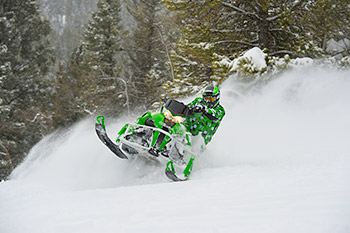
Team Arctic cross-country racers rang in the New Year with a crushing performance at the USXC J&K Marine 200 in Detroit Lakes, Minn., scoring wins in 16 of 19 classes and capturing 30 of 57 podium positions while leaving the competition nursing a painful hangover.

It was the second event of the USXC season and it showcased the dedicated racers and crews as well as the speed, handling and performance of the production ZR6000R XC and ZR4000RR snowmobiles with EFI engines.

Team Green’s stunning performance was headlined by Zach Herfindahl’s emphatic victory in the 100-mile Pro Stock final, where he led every one of the 10 laps to win by more than 20 seconds over the next finisher.

He and Pro teammate Wes Selby were the number one and two qualifiers in both Pro classes during the weekend. Selby’s run for the Stock class podium ended with a crash while battling for second place, leaving his sled inoperable, however he found solace with an impressive victory in Pro Open with Herfindahl taking second.

Lance Efteland delivered a dramatic performance to win both Semi Pro Stock and Open classes. He was joined by Hunter Houle, who won Junior 14-17 and both Expert 85 classes, as the only other multiple class winners at Detroit Lakes.

Other Team Arctic class winners at Detroit Lakes included Dylan Parsons, Ean Voigt, Dalton Fredrickson, Savannah Landrus, Keaton Black, Steve Martinson, Jesse Watland, Todd Frishmon and Erik Nymann. While capturing more than half of the available podium places, Team Arctic racers swept three podiums at Detroit Lakes.

“We’re so impressed with the hard work and effort on the part of our racers and teams since the last race,” said Mike Kloety, Team Arctic Race Manager. “The fantastic results at Detroit Lakes reflect that effort, as well as the strength of the new ZR6000R XC with the 600 C-TEC2 engine and the new ZR4000RR in the ProCross chassis. From here the cross-country events move onto the ditches and rivers, so the challenges continue for the rest of the season.”

The next stop on the 2015 USXC cross-country schedule is Jan. 17, 2015, in Grafton, ND.

Arctic Cat Inc., based in Thief River Falls, Minn., designs, engineers, manufactures and markets all-terrain vehicles (ATVs) and snowmobiles under the Arctic Cat brand name, as well as related parts, garments and accessories. Its common stock is traded on the NASDAQ National Market under the ticker symbol ACAT.

More information about Arctic Cat and its products is available on the Internet at arcticcat.com.

TEST RIDE: 2015 Polaris Switchback 800 Pro-X

0

SnowTrax Television Co-Host AJ Lester evaluates Polaris’ 2015 Switchback in the all-new AXYS chassis featuring an all new and potent 800 HO engine.

Subscribe to our YouTube Channel!

CELEBRITY QUIZ

In the latest issue of Supertrax we asked you, “Which of the following musicians recently had a snowmobile accident and then wrote a song about the experience?”

A: Justin Bieber
B: Taylor Swift
C: Blake Shelton

The answer is Taylor Swift (“Out of the Woods”).

Ex-boyfriend Harry Styles of band One Direction, crashed the sled they were both on and both were injured. Styles got the worst of it with about 20 stitches.

OUR 2016 POLARIS WISH LIST

0

With the 2015 AXYS turning out to be such a big success, there are a number of directions we could see Polaris going in 2016.

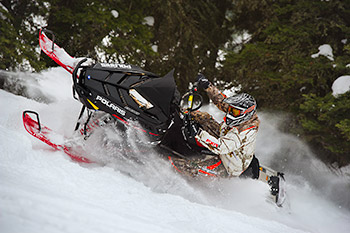
First, the new AXYS 800 with its lower engine positioning and lightened front end seems like a no-brainer to be married to a mountain platform.

This would become an even lighter RMK and the more powerful 800 would indeed be tough on the competition in a category Polaris already dominates.

Likewise, building a new Indy using the AXYS front clip would make a lot of sense and could keep this sled line in the hunt with whatever the competition brings for 2016.

As we’ve often mentioned, we would love to see Polaris offer a 4-stroke engine.

With the company’s big success expanding into the utility segment using its Indy platform, we think the next logical step would be to offer a 4-stroke for its customers here.

Ski-Doo has proven there’s a significant demand for 4-stroke utility sleds and 4-stroke sales in this category comprise considerable numbers.

Using one or more of the US-built engines from its ATV-SxS division would put Polaris squarely in the hunt with Ski-Doo and Cat here and the company’s deep experience with turbo-charging amps up the possibilities.

Last, we’d like to see Polaris put some focus on the 2-up segment. Its aging touring segment needs some focus and is mostly overshadowed by the AXYS Adventure. It just makes sense an Indy-AXYS hybrid would breathe life into this pure touring category.

Who knows, this may be an ideal application for that new 4-stroke we’re hoping for.

NEW 800 FOR THE RMK AND INDY

0

Many of our readers have been asking if we think Polaris will use the jazzed up 2015 Liberty 800 HO in the Indy or RMK in MY2016.

We think there’s a definite possibility this will happen but it’s a bigger deal than first appears on the surface. It’s simply not as easy as dropping the new engine into the “old” Indy or RMK belly.

When the AXYS was designed, Polaris went to a lot of trouble to ensure the engine’s mounting system would provide more rigidity for the chassis and maintain consistent center-to-center distance between the primary clutch and the secondary.

Some of this was to resist vibration but most of it was about increasing belt life when the new engine was producing considerably more power than its predecessor.

The old aluminum strap-style mounting system was scrapped and new cast mounts were built-into the cases. Also, the AXYS bulkhead and new mounts allowed the engine to be positioned deeper inside the belly of the sled to lower its CG and center the engine’s mass better.

The point is this: We think it makes good sense to upgrade the Indy and RMK’s power but it will likely mean a changeover to the whole AXYS front clip, not just a simple bolt-in.

Look for an Indy or RMK that looks a lot like an AXYS, if Polaris has the engine change on its agenda.

YAMAHA’S VIPER LE OFFERS ADJUSTABILTY

0

Yamaha’s top-line Viper, the LE, available as a 129-inch RT-X and 137-inch LT-X, is a more serious version of the SE.

The SE comes with Fox air shocks up front and gas shocks in the skidframe with pre-determined damping settings and no available adjustment other than spring preload. Upgrade to the LE and you get a fully adjustable suspension.

Up front there are Fox EVOL air shocks with reservoirs and both compression and rebound damping adjustability. The skidframe features Fox Zero Pro gas shocks without reservoirs but the good news is there are compression clickers that allow you to set up the suspension for various riding styles and rider weights.

This is a big deal and something not offered by Arctic Cat on its competitive 7000-series ProCross Sno Pro models – at least until you buy into Cat’s RR-series sleds.

Another option available on the LE is a 1.7-inch lugged track. This is a very aggressive track for a trail sled and is designed to add to the sled’s off-trail versatility. We’ve seen Polaris offer a 1.75-incher on its new Pro-X AXYS models in both 120 and 137-inch track lengths, too. It seems customers are asking for more track depth and Yamaha and Polaris are listening.

Even with a 129-incher, when the lugs are so deep, you can venture into pretty deep, dry powder without fear of getting stuck. The 137 would be the best choice if you’re riding off-trail a lot, though.

We’re anxious to sample the ride range the shocks allow for the Viper LE. We’re hoping calibration falls to compliance on the soft side and rideable stiffness on the highest settings.

Word is Cat and Yamaha have conspired on new settings this year for these premium sleds and the suspension calibrations have been softened so you can dial in more firmness as required or keep the shocks softer for more comfort on trails.