Home Blog Page 170

2016 SKI-DOO RENEGADE X 4-TEC

0

We put 90-miles on a production 2016 Renegade with the revisited 1170cc 4-stroke last week. If you hadn’t heard, Ski-Doo went with its drive-by-wire technology on this engine this year, expanding it from the ACE 600 and 900 engines.

This setup gives you three different riding modes, depending on the trails you’re riding and whether you prioritize mileage over performance.


Since the trails had just been groomed we kept the Rennie in Sport mode all day and were impressed with its strong acceleration, especially from 60 to 80-mph. At this speed the sled rockets itself forward like an 800 and surprisingly, for a 4-stroke, keeps accelerating hard beyond 80.

This is a fantastic engine in the upper ranges and its largest-in the-industry 1170 cubes of displacement generates enormous torque when that crank is spinning. It feels like a hypersled.

Throttle tip-in from idle and low speeds is very smooth now with DBW and Ski-Doo has pretty much beaten-up the throttle lag problem of the past. Throttle effort at the thumb flipper is extremely light.

Truthfully, we’d prefer a bit more throttle spring – it’s almost too light and when your one-handing it to adjust your goggles or give signals you have to be careful the sled doesn’t lurch from a sudden off-balance application of throttle.

In powder we noticed the typical riding demeanor you get with a 4-stroke sled. It feels noticeably heavier than an E-TEC and when you get it off its line or out of a groove set by the sled ahead of you it wants to “pendulum” itself in its own chosen direction.

This requires some preplanning and throttle control because the sled will understeer in fluffy snow. On hard packed snow this tendency is much less and the weight of the heavier engine works to the rider’s advantage.

We also found the adjustable skis work great. We had to do some road running with marginal snow left on the pavement and found a “sweet spot” we could adjust in where the skis were floating on top without grinding the carbides on the pavement (be careful not to retract the skags too much or you’ll grind the bottom of your skis off).

No complaints with handling or suspension with the X. This is a fully evolved chassis and Ski-Doo has done a great job with it. It feels nimble and lighter than the other 4-stroke we had on this ride, a Cat 137-inch Limited, but we’re not completely sure which one is fastest because both sleds had really low mileage on their odometers.

Overall, we felt the Cat was a bit more engaged with the trail than this particular Rennie but both are a pleasure to ride.
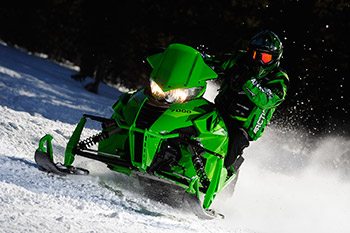
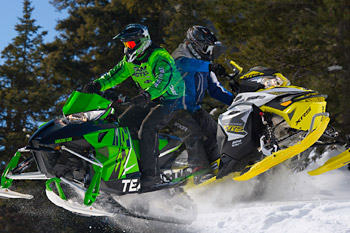
TEAM ARCTIC GRABS MORE WINS AT 2016 CC OPENER

Team Arctic cross-country racers rang in the new year with an overwhelming display of strength to capture 14 wins in 21 classes and 44 out 63 podium finishes at the USXC season opener on Pine Lake in Gonvick, Minn.

Competing with the 2016 ZR 6000R XC and ZR 4000RR snowmobils, Team Green once again proved their handling, speed and durability were second to none in top level cross-country competition.


The highlight win of the weekend came in the 100-mile No-Bull Triple Crown Enduro 600, where the Team Arctic/Christian Brothers Racing duo of Zach Herfindahl and Wes Selby delivered an overpowering win aboard their Soo 500 mod sled with the Speedwerx modified C-TEC2 600 Arctic Cat engine. Team Arctic racers also captured five of the top-10 Pro 600 class positions.

Lance Efteland picked up where he left off last season in the Semi Pro classes, taking two first place finishes.

Dustin Schwandt captured the Sport 600 class while Hunter Houle and Ean Voight gave a preview of what’s to come in the Expert 85 classes as each racer claimed a first and second respectively.

Team Arctic dominated the support classes, with Jordan Bute, Garet Grzadzielewski, Ryan Weidemann, Lydia Sobek and Paul Brown capturing class wins. And Karl Valtinson and Jesse Watland kept the Classic IFS and Vintage spirit alive by taking victory in their classes.

“We’re really pleased with the awesome performance of our drivers and crew, as well as our ZR series snowmobiles,” said Mike Kloety, Team Arctic Race Manager. “We swept the podium in seven classes; captured the most wins and podium positions; and won the prestigious Enduro 600 final. It was an excellent result for the first cross-country of the season and something we’ll build upon as we head into the ditches for the upcoming races.”

The next USXC cross-country race is Jan. 9-10 in Devil’s Lake, ND.

The Arctic Cat brand is among the most widely recognized and respected in the recreational vehicle industry. The company designs, engineers, manufactures and markets all-terrain vehicles (ATVs), side-by-sides and snowmobiles, in addition to related parts, garments and accessories under the Arctic Cat and Motorfist brand names. Arctic Cat Inc.’s world headquarters is located in Minneapolis, Minnesota. Its common stock is traded on the NASDAQ Global Select Market under the ticker symbol ACAT.

More information about Arctic Cat and its products is available at arcticcat.com.

Polaris Acquires 509

Polaris Industries Inc. (NYSE: PII) today announced the acquisition of 509, an aftermarket leader in snowmobile helmets and goggles.

509, a privately owned company based in Spokane, Wash., joins Polaris’ growing portfolio of aftermarket apparel and accessories brands, which includes Klim, Kolpin, and Pro-Armor. The terms of the transaction were not disclosed.

“We are always exploring opportunities to make Polaris a stronger, more competitive global company. As we look toward the future, parts, garments and accessories will continue to be a growth driver for Polaris,” said Steve Eastman, President of Parts, Garments and Accessories for Polaris. “509 is a growing brand that resonates with snowmobile enthusiasts and complements our current portfolio. As snowmobile enthusiasts ourselves – and having worked with 509 on co-branded goggles for three years – we like their products, we like their brand, and we like their team.”

509 will continue to operate as a distinct brand under the leadership of Tom Delanoy, founder of 509, who will continue in his role of President. Operations will remain headquartered in Spokane. 509 was advised by The Meriwether Group.

“The 509 brand was created from an authentic and passionate love of snowmobiling,” said Tom Delanoy, 509 founder and CEO. “We have a passion for making highly technical riding gear and producing award-winning films and media content that truly captures the amazing experience of snowmobiling. 509 is very excited to be a part of the Polaris family. Sharing the same passion and vision with the company that mass produced the first snowmobile six decades ago is truly a great fit for us. We look forward to banding together and building an exciting future for the 509 brand.”

Polaris is a recognized leader in the powersports industry with annual 2014 sales of $4.5 billion. Polaris designs, engineers, manufactures and markets innovative, high quality off-road consumer and military vehicles, including all-terrain vehicles (ATVs) and the Polaris RANGER and RZR side-by-side vehicles; snowmobiles; motorcycles and on-road electric/hybrid powered vehicles. Polaris is among the global sales leaders for both snowmobiles and off-road vehicles and has established a presence in the heavyweight cruiser and touring motorcycle market with the Victory and Indian Motorcycle® and Slingshot brands. Additionally, Polaris continues to invest in the global Work and Transportation vehicle industry with Global Electric Motorcars (GEM), Goupil Industrie SA, Aixam Mega S.A.S., and internally developed vehicles. Polaris enhances the riding experience with a complete line of Polaris Engineered Parts, Accessories and Apparel, Klim branded apparel and ORV accessories under the Kolpin, Cycle Country and Pro Armor brands. Polaris Industries Inc. trades on the New York Stock Exchange under the symbol “PII,” and the Company is included in the S&P Mid-Cap 400 stock price index.

Information about the complete line of Polaris products, apparel and vehicle accessories is available from authorized Polaris dealers or anytime at polaris.com.

ARCTIC CAT’S NEW YCCT 1049 ENGINE

0

We’ve been puzzled by this question ever since Yamaha announced it’s drive-by-wire YCCT (Yamaha Chip Controlled Throttle) system on the Vector last January.

It just makes sense, should Yamaha put this control system on the Viper in MY2017, why wouldn’t it make the same setup available to the 7000 Cats?


There’s a couple of ways to look at this. First way: Yamaha is really trying hard to make its Viper a distinctive Yamaha product and cut some of the strings attached to Thief River Falls, Minnesota where the Viper is built.

Although the relationship between the two sled-makers is going very well, it would give Yamaha some kind of an edge against the 7000 Cats and would make the two models more un-similar – maybe something Yamaha owners have been hoping for.
Think of a YCCT equipped Viper with a SingleShot skidframe – Yamaha enough for ya?

The other way to look at this is to make the YCCT engine available in both the Viper and the 7000 but only as an early-season-purchase feature and only on the highest end versions of those sleds, the Viper LE and the 7000 Limited or El-Tigre.

This way it provides more incentive for buyers signing up for the next year’s sleds early and also gives both companies the opportunity to consumer test the YCCT technology before going in 100-percent with it on all models.

I guess the third option would be to just put it on all of the above sleds in every category. That’s pretty much the way the shared technology program has been working so far and that would match the Viper head-on with what Ski-Doo is offering with its DBW 4-TEC.

ALL ABOUT A NEW ENGINE

0

The buzz in the sno-mo biz right now centers on the expected arrival of new engines for MY2017.

Let’s make this perfectly clear: Right now we don’t know what’s coming for sure. In just a few weeks we will know what’s coming but we won’t be able to tell you about it until March.


I said that so I can go on a rant about what we think might be coming without getting in trouble with the OEMs.

Obviously, we have some strong suspicions, however our suspicions are based on what we know about the market, what we know about the OEMs and what we know about the past. Here’s some deductive reasoning, Supertrax style.

SKI-DOO:

It is not just time, it’s past time for SD to launch a new engine platform, particularly a new E-TEC DI 2-stroke.

BRP owns the DI market for outboards producing the highly successful Evinrude E-TEC line using E-TEC technology on a mountain of different engine variants. Twins, triples, V-fours and V-sixes populate the Evinrude line of E-TEC engines.

Something else is unique about Evinrude’s flavor of E-TEC and it’s something we think is overdue for Rotax snowmobile engines using E-TEC DI. Fully stratified Direct Injection.

The outboards use a second-generation hammer head, voice-coil injector compared to what we’ve come to know since 2008 on Ski-Doo E-TEC sleds. This new injector delivers a stratified (read: lean) charge across the entire RPM operating range. E-TEC injectors on Rotax snowmobile engines produce stratified combustion to just above idle RPM.

The reason we’re amped about E-TEC II, as we believe it will be called, is power. The leaner the mixture the more power the engine will make.

The other benefit will be even better 4-stroke-beating fuel economy and of course, reduced emissions. We’re pretty sure Ski-Doo will show us a new engine next month. Whether it’s a 2-stroke or a turbocharged 4-stroke is the big question.

ARCTIC CAT:

You don’t have to be too in-tune with the calendar to realize Arctic Cat has to be readying at least two new engines.

First, there’s little doubt a slot injection DSI 800 must be well along in its development. Will we see this engine next month? We don’t know, however we would wager substantial jing on the arrival of a reinvigorated, domestic built, Arctic Cat 800 twin with the company’s dual stage slotted piston injection system in the next twelve months, max.

The other engine story at Cat has to be the emergence of more Yamaha power. Five years ago we were told MY 2016 would be the last year for Suzuki power and we think this makes even more sense knowing in the ensuing five years Arctic Cat and Yamaha entered into a co-operative engine supply/manufacturing agreement.

If you read the Supertrax interview last month with Cat’s snowmobile VP, Brad Darling and Peter Smallman-Tew, snowmobile VP at Yamaha, you heard clearly the marriage is going very well and that we should be ready for something pretty impressive soon.

I read those words as meaning 1) “Pretty impressive” = big power, maybe turbo 2) “Soon” = this year!

Stay tuned.

YAMAHA’S 2-STROKE MOUNTAIN PROGRAM

0

We’ve talked about Yamaha’s HPDI (High Pressure Direct Injection) on this website before.

If you haven’t read about it here you may still be aware of the fact Yamaha owns 2-stroke DI technology and actually produced it for a number of years on its 2-stroke marine outboards.


It’s a totally different system than Ski-Doo’s DI E-TEC but produces very similar results. I’ve experienced this technology on the water and these 2-strokes are flat-out phenomenal engines and have all the desirable features of 2-stroke Direct Injection. They burn very lean, use little oil, produce almost no smoke and make great power.

Our point is this: Yamaha has been getting very serious about the mountain market the last two years. It’s MT-X line of 4-stroke Vipers is getting a lot more attention lately and its 1049cc 4-stroke triple is proving to be a decent performer in high altitude situations.

It’s doubtful, however, the MT-X will steal many Polaris, Ski-Doo and Cat 2-stroke-loving mountain hardcores away from their selected brand. You could say it’s an uphill battle (pun) for Yamaha trying to sway vertical customers into the 4-stroke genre.

A DI 2-stroke, however, would change all the rules. Remember, up until a decade ago, Yamaha was building some really awesome 2-stroke sleds. The 700cc triple in the SRX comes to mind but some of those early 600 twins were also really fast, lightweight powerplants.

Knowing how Yamaha operates, any new 2-stroke would likely be a complete new blueprint and the use of HPDI may necessitate a from-the-ground-up rejig of any engine designed for a snowmobile, anyway.

What’s even more interesting is, with the Viper, Yamaha now has a really competitive chassis to put a 2-stroke in.

Hey, maybe we’re dreaming in Technicolor here but when a company owns great technology and it’s just sitting on a shelf somewhere in Hamamatsu, doesn’t it tweak your brain to think what could be possible?

ARE 2-UPPERS A DYING BREED?

0

If you talk to some people you’d think 2-up snowmobiles are no longer relevant.

Others will tell you they’re the first sleds they look for when the new models come out. What do we think?


There are a couple of things at play. First, the new breed of Adventure Touring sleds offer some pretty good alternatives to a purebred 2-passenger sled.

With long tracks and plenty of room for an add-on seat, backrest and luggage, you can convert a 137 or 146-inch crossover sled into a 2-upper in minutes.

The comfort level is very good, too, although some of the built-in amenities like rear seat handwarmers or passenger footrests are not always available. The best thing is you can take the seat and bags off and have a nimble trail sled when you don’t have a passenger along.

The pure 2-up sleds these days have become icons of comfort and convenience. Comprehensive gauge packages, big, plush seating, warm windshields and all the built-in warmth and comfort features make them very nice sleds to tour long distances with an extra rider.

Handling and ride are exceptional because these tourers are custom-tuned from the factory to handle the weight bias of gear and extra bodies.

Arctic Cat and Ski-Doo have invested heavily in the 2-up market with some very radical changes to their line-ups the last two years.

Ski-Doo revamped its Grand Touring models for 2015 utilizing the XS platform and last year Cat brought us a completely revised Pantera 7000. This year, there’s the Pantera 3000.

Yamaha has basically stood pat with its Venture line-up but these sleds still comprise an important element of the company’s total sales.

Polaris has taken a different tack and has pretty much phased out its big-inch tourers and attempted to steer customers toward the Switchback Adventure and its seating and baggage accessory list for 2-up shoppers.

It’s not the only situation in which Polaris marches to its own drummer – and it seems to be working for them.

Do we think the 2-up sled is on its way out? We don’t. There’s still a big commitment from the majority of OEMs to provide sleds in this category.

We do, however, think the 2-up sled will morph into something different in the next few years. But that’s a topic for another day.

WOULD THE INDUSTRY BUILD A TURBO 2-STROKE?

0

It’s been a few years but I had occasion to ride a 600cc 2-stroke with an aftermarket turbocharger a while back and, man, was it impressive.

I believe the stock engine at that time made about 110-hp and with the turbo it jumped up to about 150. That was more power than the big-inch, naturally aspirated sleds were making at that time and it felt like the boosted twin was literally trying to tear itself out of the engine bay.


Throttle response was good – with some lag – but the sled felt like it had gained about 300ccs of displacement. The increase in torque was the most evident – the sled easily lofted its skis, transferring its weight rearward and the studded track dug in like a drag racer. Pretty impressive, and my impression was that the 2-stroke responded to turbocharging way better than a 4-stroke.

We’re wondering, with the increasing use of turbocharging in the 4-stroke off-road SxS market, if more snowmobile OEMs besides Arctic Cat will be offering turbos in the near future?

The reason we’re raising the question about 2-stroke turbocharging is because it makes such a huge difference and can be added with little modification to the 2-stroke engine.

Think of a 160-hp 800 twin boosted to 200-ponies. Even with sophisticated fuel management systems like Cleanfire, slot injection and E-TEC, a turbo could be made to work and it would avoid the need for OEMs to increase 2-stroke engine displacement.

Yes, there seems to be a resistance to building 2-strokes any larger than 800ccs and the cost to re-certify a new engine could really be prohibitive, not to mention the sheer risk of warranty problems from a super-lean 900, 1000cc or larger mill.

Sometimes we’re so close to the business, we miss the obvious. A turbocharged 2-stroke would be a huge coup for whoever offered one. In limited numbers, we think the market would get on board in a flash.

TEAM ARCTIC PREVAILS AT ISOC SNOCROSS NATIONAL IN FARGO

0

Team Arctic snocross racers prevailed at Round #3 and #4 of the ISOC National series in Fargo, ND, capturing eight class wins, 19 podium finishes and the top spot among the competitive brands. From the youngest classes to the premier Pro Open category, Team Arctic racers and the Arctic Cat ZR6000R SX once again proved to be the winning combination.

Tucker Hibbert captured his second Pro Open win of the season in Fargo with a masterful, dominant performance in Round 4 that all but erased the frustrations of a chaotic first turn pileup the previous evening that left him out of contention for the win, but still able to salvage a fourth. Hibbert remains in the Pro Open points lead.


Team Arctic’s Martin Moland delivered a storybook performance en route to winning the Pro Lite final ahead of teammate Montana Jess on Saturday. The young racer from Alta, Sweden, was originally planning to return home after the Fargo round. But after a strong showing in Duluth, his dad offered an incentive: win in Fargo and Martin could stay and race the full season. With focus, grit and determination, Moland won and will finish the ISOC season with the expert help of the Frattalone Race team.

Team Arctic maintained its place atop the support and youth categories at Fargo. Ryley Bester continued his perfect season in the Junior classes at Fargo, winning the Jr. 14-15 and 16-17 finals in dominant fashion. Baily Forst took his first win of the season in Sport Lite #2, while Eric Downs continued his winning ways by leading a Team Arctic podium sweep of Jr. 10-13. Likewise, Taven Woodie notched her second win of the season in Jr. Girls 9-13. Andy Pake was another first time winner in Fargo, leading a 1-2-3 finish for Team Green in the Transition 8-12 final.

“To leave Fargo with the most wins and most podium finishes of any brand is both gratifying and a huge relief,” said Mike Kloety, Team Arctic Race Manager. “It was a marginal track that left zero margin for error. Our racers and teams stepped up to the challenging conditions and proved themselves by hauling home the most hardware, which makes everyone at Arctic Cat even more proud. Now they can rest up for a few weeks while the cold temps and snow return for the rest of the season.”

The next ISOC snocross national is Jan. 8-9 at Canterbury Park in Shakopee, Minn.

The Arctic Cat brand is among the most widely recognized and respected in the recreational vehicle industry. The company designs, engineers, manufactures and markets all-terrain vehicles (ATVs), side-by-sides and snowmobiles, in addition to related parts, garments and accessories under the Arctic Cat and Motorfist brand names. Arctic Cat Inc.’s world headquarters is located in Minneapolis, Minnesota. Its common stock is traded on the NASDAQ Global Select Market under the ticker symbol ACAT.

More information about Arctic Cat and its products is available at arcticcat.com.

SKI-DOO X-TEAM RESULTS FROM FARGO

0

With no natural snow to be found and temperatures well above freezing throughout the weekend, Ski-Doo X-Team snocross racers battled slush, mud and fellow competitors to wrap up one of the most successful weekends in recent history for the brand at the Makita Tools National Snocross event outside of Fargo, North Dakota.

Scheuring SpeedSports’ Tim Tremblay opened the weekend by winning the coveted Pro Open final on Friday, leading fellow Ski-Doo racer, BOSS racing’s Adam Renheim across the line. Although still early in the season, Tremblay is in the thick of the championship battle; for Renheim, it was his first Pro Open podium in the three years he has come from his home in Lima, Sweden to race in the US.


Tremblay’s teammate Lincoln Lemieux made a strong charge from deep in the field to finish fifth in the Pro Open final.

On Saturday, Lemieux was the top X-Team racer in Pro Open with his third place finish; Tremblay overcame a mid-pack start to finish fifth.

One of the feel-good stories of the weekend was Team Bauerly Racing’s Shane Sewell capturing his first Pro Lite podium (2nd place) when he turned in a strong ride Friday night. Sewell, who is an accomplished national-level motocross racer from Indiana, has experienced more than his share of hard knocks trying to carve out a path in professional snocross. Sewell was injured in the first weekend of the season two weeks ago in Duluth, Minn., but bounced back strong in round three and is gaining valuable confidence after also making the final on Saturday.

The Pro Lite class was a strong point all weekend. X-Team racers captured multiple top-five finishes each day.

– Maxime Taillefer finished fifth on Friday and raced to a podium in third on Saturday, climbing back into the championship chase.
– Swedish import Marcus Ogemar Hellgren, who has been impressive in his rookie season in the U.S., was fourth on Saturday.
– Kevin Wallenstein has been very consistent in the class and with his Saturday fifth place, he’s positioned himself second in points just ahead of Taillefer.

Ski-Doo riders dominated the Pro AM +30 podium with multi-time east coast Pro champion Danny Poirier taking his second straight win in the class aboard his Ingles Performance MXZ. Poirier will now head back to Québec to prepare for the East Coast Snocross (ECS) season, no doubt a relief to defending class champion Kurt Bauerly. Bauerly finished third in Saturday’s final behind weekly rival Patrick Brodeur, who is riding for the Anderson Racing squad this season. Poirier-Bordeur-Baurerly are 1-2-3 in the points race in the class so far.

Marica Renheim successfully returned from injury, winning the Pro AM Women’s final over Megan Brodeur. Renheim sat out the season opener after crashing in a Sport Lite prelim race, but was back in full form this weekend. Brodeur, who picked up the win in Duluth, finished second on her Anderson Racing machine and maintains a three point lead over her closest challenger.

In a heart-breaker, Ingles Performance mainstay Leo Patenaude’s chance at a Sport class win slipped away in the final corner of the main event when he was bottled up behind lapped traffic. Deteriorating snow conditions created a narrow, one-line track forcing Patenaude to check up to move around the lapper, and the second place rider slipped by both of them.

It was still a great finish for the Hartland, Vt. Racer, who now sits second overall in the class as the series takes a holiday break before resuming action at Canterbury Park in Shakopee, Minnesota on January 8-9.

Pro Open Round 3
1st Tim Tremblay, Ste Jeanne D’Arc, Quebec 2nd Adam Renheim, Lima, Sweden
5th Lincoln Lemieux, St. Johnsbury, Vermont

Pro Open Round 4
3rd Lincoln Lemieux, St. Johnsbury, Vermont 5th Tim Tremblay, Ste Jeanne D’Arc, Quebec

Pro AM +30
1st Danny Poirier, St Theodore d’Acton, Quebec

2nd Patrick Brodeur, Derby, Vermont 3rd Kurt Bauerly, Otsego, Minnesota

Pro AM Women
1st Marcia Renheim, Lima, Sweden
2nd Megan Brodeur, Coaticook, Quebec

Pro Lite #1
2nd Shane Sewell, Westville, Indiana
5th Maxime Taillefer, Laval West, Quebec

Pro Lite #2
3rd Maxime Taillefer, Laval West, Quebec
4th Marcus Ogemar Hellgren, Ostersund, Sweden 5th Kevin Wallenstien, Cadillac, Michigan

Sport #2
2nd Leo Patenaude, Hartland, Vermont

Sport Lite #2
4th Riley Bear Seven, Sisters Falls, Manitoba

BRP (TSX:DOO) is a global leader in the design, development, manufacturing, distribution and marketing of powersports vehicles and propulsion systems. Its portfolio includes Ski-Doo and Lynx snowmobiles, Sea-Doo watercraft, Can-Am all-terrain and side-by-side vehicles, Can-Am Spyder roadsters, Evinrude and Rotax marine propulsion systems as well as Rotax engines for karts, motorcycles and recreational aircraft. BRP supports its line of products with a dedicated parts, accessories and clothing business. With annual sales of over CA$3.5 billion from 107 countries, the Company employs approximately 7,600 people worldwide.

brp.com