Home Blog Page 158

ARCTIC CAT 9000 INTERVIEW

0

Supertrax:

Prior to the 2017s being introduced we had access to a Viper with a 1049 triple and an aftermarket turbo installed. How would you rate that experience? What did you learn?


Luke Lester:

I think the most interesting bit of info we gathered from our time with the 1049 turbo was that the motor could easily handle the power. There were no concerns about engine durability. On top of that, we got just a taste of what this motor, when pushed harder, was capable of… and it was impressive to say the least.

Supertrax:

What’s your opinion of turbocharged snowmobiles in general?


Luke:

I love the power. There really is nothing that can equal the feeling of a boosted snowmobile putting huge horsepower to the ground. I also feel they need to be as invisible as possible. We learned all about turbo lag when the first crop of turbo sleds became available, and determined turbo lag is a big issue on a sled.

Today, manufactures have found ways to drastically reduce, if not nearly eliminate lag, making it more difficult to tell weather your riding a sled with a turbo, or just one that makes insane power.

Supertrax:

What was your reaction when you first heard the 2017 Cat Turbo would be using a 998cc 3-cylinder Yamaha engine instead of the former 1056cc Suzuki twin or even the 1049? Was dropping 50 cubes a good or a bad thing?


Luke:

I can’t describe how happy I was to hear they were dropping the Suzuki twin in favour of the Yamaha triple. Its quickly becoming clear that a triple delivers the kind of power snowmobilers both want and need. The torque of a twin with the top end of an inline 4. It’s not at all a surprise to see Arctic start with the 998 though. It’s a logical move when you consider the implications of cross platform development of that engine in snowmobiles in the winter and off road vehicles in the summer.

Supertrax:

What have you found to be the most impressive feature of the new 9000 series Cats?


Luke:

Historically, high horsepower turbos have been heavy. The Suzuki turbo certainly fit this description. So the new 9000 being lighter with the mass more centralized is a big improvement. Second, the new design of the bodywork is just fantastic. This is the best fit and finish we’ve ever seen from Arctic Cat. Its functional, its easy to remove and the fastening system is flawless… and it looks fantastic.

Supertrax:

How does the handling compare with, say, a Cat 8000 2-stroke?


Luke:

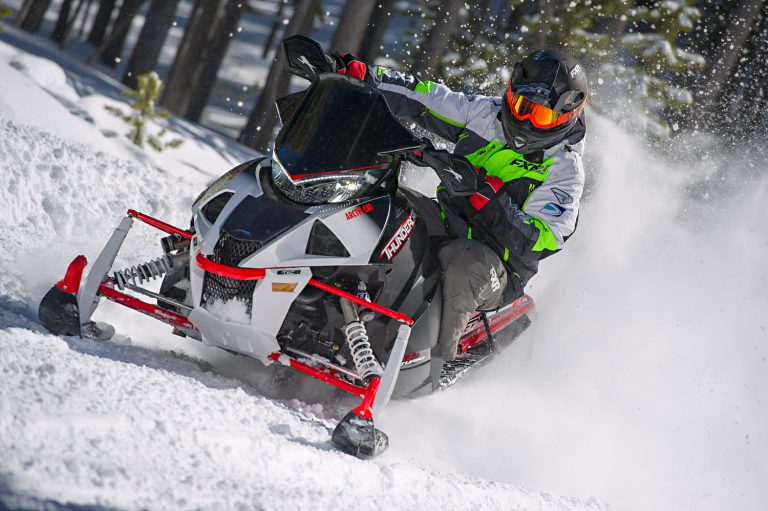
Thanks to better mass placement and overall lighter weight the new 9000s handling is far closer to that of the 8000 series 2 strokes than ever before. Yes, you can still feel the weight, but it doesn’t have the same negative effect on the vehicle in the corners.

In fact, in some circumstances, that extra bit of weight helps keep the skis on the ground and provides better bite in the corners. I would say it’s not quite AS flickable as the 8000, but overall handling is really good.

Supertrax:

What do you feel is the 9000’s best application: Trail, crossover, freestyle, mountain? 


Luke:

First, and most obviously, is on the trail. Because it handles so well, yet produces so much horsepower with so little turbo lag, it’s a real pleasure to ride all day. There’s no tradeoff to get the horsepower. But that horsepower is definitely there when you want to unleash it on some unsuspecting victim. 

Next is in the mountains. There will never be a replacement for a high horsepower, lightweight 2 stroke engine, but the lighter you can make a turbocharged 4 stroke, the better it will get in the steep and deep. hen you consider that the turbo is going to maintain most of its horsepower from sea level all they way up to 10 000 plus feet… the higher you go, the better that sled starts to look and feel.

Supertrax:

Is 180-hp too much or is there still room for more in the marketplace?


Luke:

10 years ago people would have said 180hp is way more than any person could need or handle, bBut we know different now. I think there will always be room for more horsepower in the snowmobile industry. There will certainly always be people to buy these increasingly powerful hyper sleds. The question isn’t “how much power is too much?” The question is “how much power is possible. “
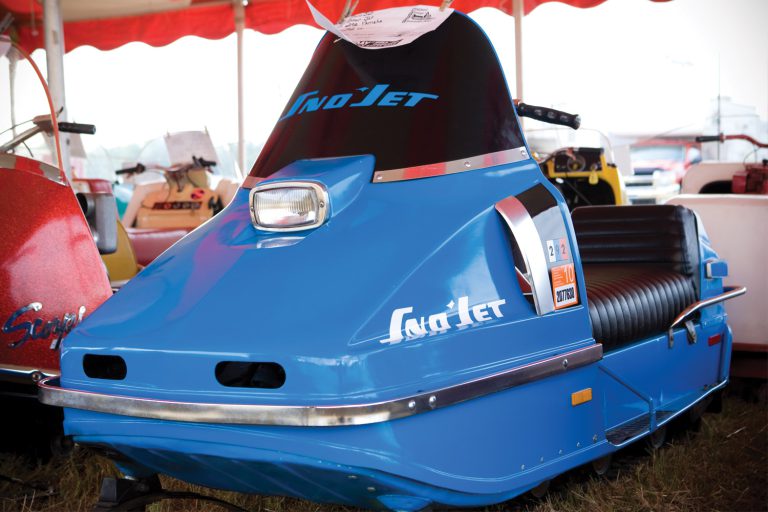
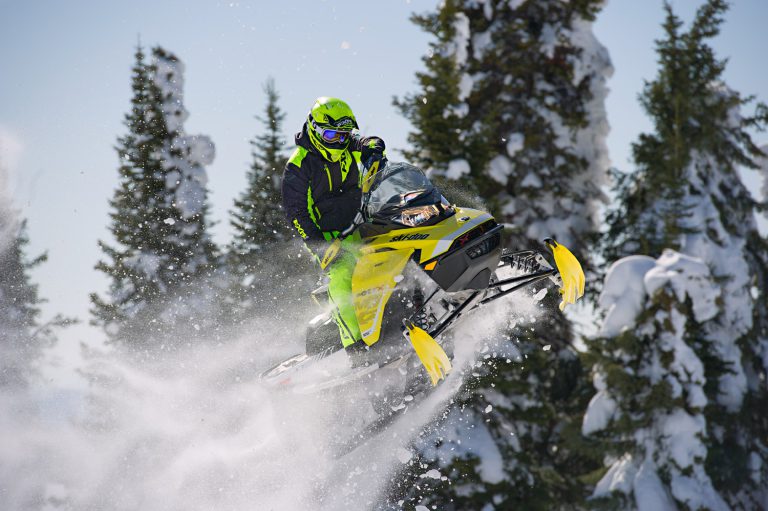
Sno-Jet Prioritized Lightness

0

Sno-Jet began in Thetford Mines, Quebec in October 1964 and the original design was the brainchild of two fiberglass workers, Paul-Emile Roy and Maurice Fillion.

The two later formed a partnership with an accountant named Theberge and a plumber by the name of Pelchat. By 1965, production was up from 25 sleds the first year to 1,150 and 4,400 the third year.

By 1968, the original owners realized they couldn’t keep up with the rapid growth of sales and sold the company to the Conroy Company of Texas and put itself under the wing of the Glastron Boat Company.

After only five years, total sales ballooned to 25,000 snowmobiles. Unfortunately, this was the peak of production for the brand and sales continued to fall all through the early and mid-1970s.

By 1976, after the Arab oil embargo, Sno-Jet was annexed by Kawasaki, a company just getting its feet wet in the business.

Sno-Jet ‘s claim to fame was aluminum construction. Many of the earliest sleds used aluminum tunnels and bulkheads and the company’s pure racing Thunder Jet, introduced in 1972, was so light the competition felt it had an unfair advantage.

Other model names used by the brand throughout its history were: Jet Flight, Star Jet, Super Sport, Super Jet, Astro Jet, SST and Whisper Jet.

Until 1970 the company used Hirth 2-strokes exclusively then converted to Yamaha engines until the end of its days.

Interesting to note, in its prime in 1975 the Thunder Jet’s Yamaha twin, in racing form, made a whopping 65-hp.

SKI-DOO’S 850 ENGINE

0

There’s no doubt Ski-Doo has slain the snowmobile sales marketplace the past 13 years. “REV” has become at least as iconic as the name “Indy” was in its hayday.

Ski-Doo has demonstrated real leadership in protecting its huge (rumored to be more than 50-percent) market share by “one-upping itself”, as visionary CEO, Jose Boisjoli, calls it.

In Boisjoli’s estimation he would much rather be one-upped by his own products than wait until the competition catches up.

The 800 class has become entrenched as the “top performance” segment. Every OEM either has an 800 2-stroke or makes an equivalent 4-stroke in the 135-165-hp zone.

As it turns out, Ski-Doo’s Series III Rotax 800 E-TEC was getting long in the tooth. The engine has been around in E-TEC trim since 2008 and even earlier as a carbed PowerTek variant.

The production E-TEC 800 arguably produces 150 to 155 horsepower and over the years that 800 has displayed some crankshaft reliability issues when the odometer climbs into the teens.

Performance and drivability have always been good with the Series III E-TEC but the arrival of the Polaris AXYS with its all-new Liberty 800 HO two years ago, moved the bar.

The Ski-Doo faithful will roll their eyes at this assertion, however under repeated pulls up Kevlar Lake, the Polaris 800 HO was the consistent top speed king against the E-TEC 800.

Ski-Doo was not oblivious to the fact the 800-class horsepower bar was moving upward. Along with the arrival of the Polaris 800 HO there has been continual and increasing promises of a domestic 800 DSI Arctic Cat.

In any case, Ski-Doo did what leaders do: It changed the rules and crafted an all-new 850cc E-TEC twin and essentially sent the competitions’ 800s back to the drawing board.

The 850 gets an all-new induction system using “boost injectors” on otherwise dry throttle bodies.

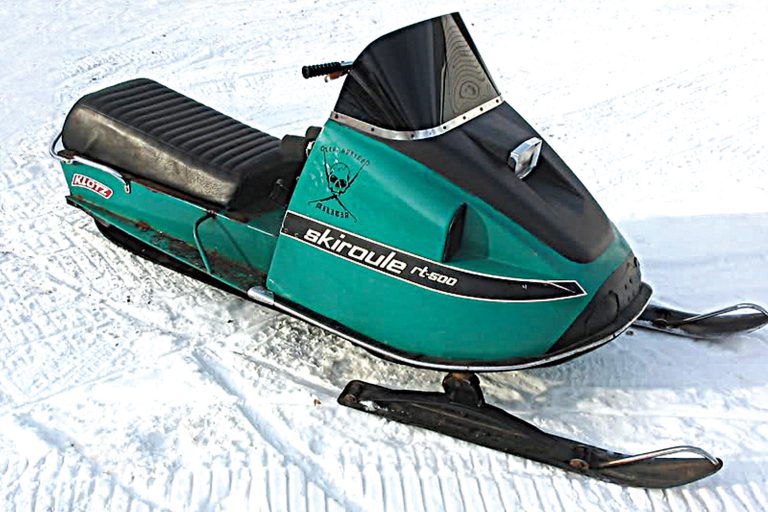
Skiroule Was Known For Style

0

The creator of Skiroule snowmobiles, Rejean Houle of Wickham, Quebec was an avid 20-year-old entrepreneur who built prototypes of his ideal snowmobile and then sold his concepts to the Coleman Company, makers of outdoor camping equipment.

The original Skiroules bore an amazing resemblance to the Ski-Doo Olympique.

In the beginning, Skiroules used tunnel-top mounted Sachs engines and by 1970 were known for their low-slung, very aero hood styling, belying their relatively high-positioned engines.

The company used the RT acronym to describe its model line-up and RTX denoted its highest performing sleds and racers.

In the late 1960s the sleds used bogey wheels but in the early 1970s Skiroule graduated to a slide rail suspension with dual outboard coilover shocks mounted on a reverse angle and integrated into the steel rear bumper.

Canadian Tony MacKeen did the original top-mounted engine hood styling and had to re-adapt his designs when Skiroule eventually relocated the engine into the bellypan in the mid-70s.

Skiroules were always at the top of the heap when it came to sleek, low, good looks many felt were decades ahead of anyone else.

Engine choices were mostly Kohler 2-strokes in 291, 338 and 447cc (50-hp) sizes. One Skiroule, the RTW, offered a now-very-collectible 23-hp Sachs Wankel.

By 1972 sales from Skiroule-Coleman’s 750 dealers had climbed to $19.2 million.

In 1977, Coleman decided to focus its efforts on camping equipment and in a difficult economy, closed its doors on snowmobile production forever.

174-inch Mountain Sled Shootout

0

We’re in the steep and deep for a good ol’ fashioned shootout between two of the industry’s 174-inch mountain machines – Ski-Doo’s Summit X 174 and the Polaris 800 Pro RMK 174 LE!

Subscribe to our YouTube Channel!

TEST RIDE: 2017 Arctic Cat ZR 9000 Thundercat

0

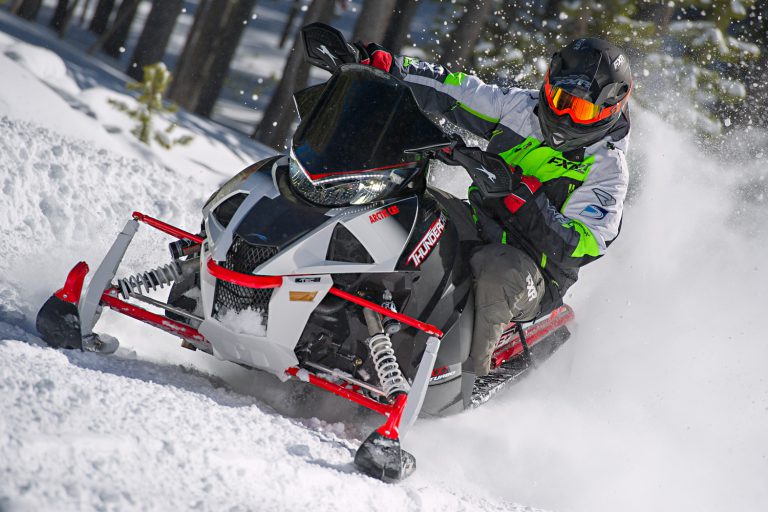
Motorhead Mark evaluates Arctic Cat’s 2017 ZR 9000 Thundercat!

Subscribe to our YouTube Channel!

Ski-Doo Freestyle Overhaul

0

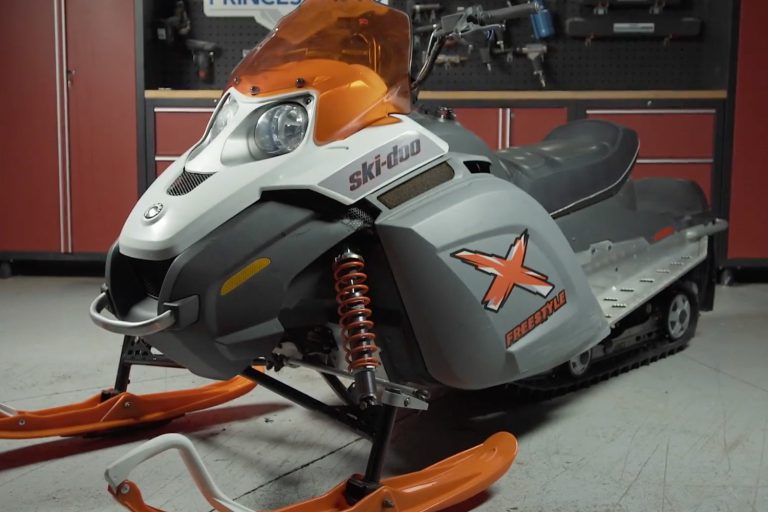
AJ and Vern are in the TRAIL TECH shop overhauling a Ski-Doo Freestyle barn-find that Vern just scooped up for his daughter and getting it back in tip top shape for some fun in the snow.

Subscribe to our YouTube Channel!

Arctic Cat To Be Acquired by Textron

0

MINNEAPOLIS–(BUSINESS WIRE)–Arctic Cat Inc. (NASDAQ: ACAT) today announced that it has signed a definitive merger agreement under which Textron Inc. (NYSE: TXT) will acquire Arctic Cat in a cash transaction valued at approximately $247 million, plus the assumption of existing debt.

Under the terms of the agreement, which was unanimously approved by the Arctic Cat board of directors, Textron, through a wholly owned subsidiary, will commence a tender offer to purchase all outstanding shares of Arctic Cat at $18.50 per share in cash, representing a 40.7 percent premium to the closing price of Arctic Cat’s common stock on January 20, 2017.

Arctic Cat anticipates that tender offer materials will be provided to shareholders no later than February 7, 2017. The completion of the acquisition is subject to customary conditions and regulatory approvals.

“Arctic Cat’s board believes that Textron’s offer delivers compelling and immediate value to our shareholders,” said Christopher Metz, Arctic Cat’s president and chief executive officer. “This transaction presents increased opportunities for the business to leverage our combined scale, accelerate growth and enhance product innovation in ways that will benefit our customers, dealers and employees.” Textron is a multi-industry company with over $13 billion in annual revenues and approximately 35,000 employees.

Arctic Cat will become part of Textron’s Specialized Vehicles business, maintaining its iconic Arctic Cat brand, as well as its current manufacturing, distribution and operational facilities, with a focus on growing the business.

Arctic Cat and Textron Specialized Vehicles have complementary product portfolios of recreational, utility and specialized vehicles. The combined businesses will be well positioned to be a powersports industry leader with a wider product line-up, and allow for more aggressive investment in product development, dealer networks, marketing and customer service.

Metz added: “We are proud of the progress our team has made to lay the foundation for Textron to continue taking this company forward. Textron plans to build on Arctic Cat’s strong brand and history of innovation. We expect many Arctic Cat employees to benefit from expanded career opportunities as part of a larger, more diversified company. On behalf of the Arctic Cat board and management team, we thank our dedicated employees for their hard work, commitment and pride in making Arctic Cat an enduring competitor and beloved brand in the powersports market. We are excited about Arctic Cat’s future.”

The Arctic Cat brand is among the most widely recognized and respected in the recreational vehicle industry. The company designs, engineers, manufactures and markets all-terrain vehicles (ATVs), side-by-sides and snowmobiles, in addition to related parts, garments and accessories under the Arctic Cat® and Motorfist® brand names. Arctic Cat Inc.’s world headquarters is located in Minneapolis, Minnesota. Its common stock is traded on the NASDAQ Global Select Market under the ticker symbol ACAT.

More information about Arctic Cat and its products is available at arcticcat.com.

Textron Specialized Vehicles Inc. is a leading global manufacturer of golf cars, utility and personal transportation vehicles, professional turf-care equipment, and ground support equipment. Textron Specialized Vehicles markets products under the E-Z-GO, Cushman, Textron Off Road, Jacobsen, Dixie Chopper, Ransomes, TUG, Douglas, Premier and Safeaero brands. Its vehicles are found in environments ranging from golf courses to factories, airports to planned communities, and theme parks to hunting preserves.

Textron Inc. is a multi-industry company that leverages its global network of aircraft, defense, industrial and finance businesses to provide customers with innovative solutions and services. Textron is known around the world for its powerful brands such as Bell Helicopter, Cessna, Beechcraft, Hawker, Jacobsen, Kautex, Lycoming, E-Z-GO, Greenlee, Textron Off Road, Textron Systems, and TRU Simulation + Training. For more information visit: textron.com.

Chaparral Snowmobiles First IFS

0

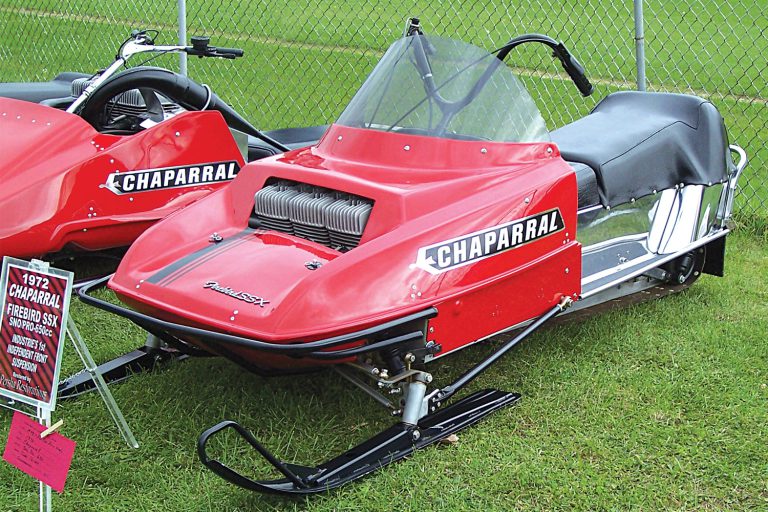
In 1967, Chaparral Industries, originally known as “Snow Birdies”, opened a plant in Grand Junction, Colorado. Production later moved to Denver. The earliest sleds featured a fiberglass tunnel, had the gas tank mounted under the seat and used JLO engines.

In 1972, auto racing legend and Indy 500 Champion, Bobby Unser and Chaparral engineers copied racecar technology to create the first snowmobile with independent suspension.

It debuted on the oval racing Firebird SSX in 1972 and had a completely weird, later banned, huge airfoil bolted to the front bumper in front of the driver to increase downforce.

Those Firebirds were 440 and 650 free-air Fuji triples with CD ignitions, triple carbs and strangely routed triple pipes. The 650 produced 105-hp!

Its independent front end was a dual radius rod, trailing arm design using coilover shocks and a swaybar and delivered 5-inches of travel.

This design was a precursor to what the famous Polaris Indy used and was later adopted by Ski-Doo and Yamaha.

Chaparral racers tell us there was a lot of scrub and bump steer with the IFS design and the company was never quite able to get it figured out.

Interestingly, the earliest SSX IFS racer (1972) used an aluminum skidframe with outboard mounted shocks and 4-inches of travel but relented and went to a more durable and heavier steel one in 1973.

In 1974 Chap abandoned the IFS front end and went back to a more conventional leaf spring design.

Then owned by Armco Steel, Chaparral ceased business abruptly in 1974 and many felt it was due to the recession caused by the Arab oil embargo that left thousands of unsold snowmobiles from all brands in inventory.

There were offers considered by American Motors to buy Chaparral but in the end, there was no solution.

2017 POLARIS RUSH XCR

0

The XCR 800 left the stage back in the early 2000s and the name quietly vanished into Polaris history. Today, the XCR returns in a package we’ll proclaim is fully worthy of the title.

The wannabe racer category has been around since the arrival of the Ski-Doo XRS and Arctic Cat’s RR series.

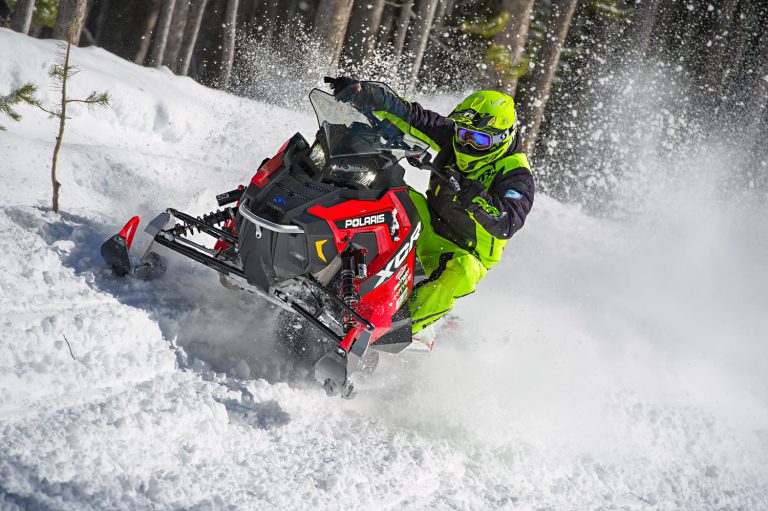
The new AXYS-based RUSH XCR puts Polaris in the wannabe biz with a bonafide limited production competition race sled, available to the masses.

The new XCR uses the Pro-S chassis, not the Pro-X platform, which means it is relatively low and looks like it might actually be vulnerable to underbody damage.

That being said, the XCR is not marketed as a Polaris Sno-X weapon. It is
specifically targeted at the race discipline its esteemed acronym once dominated: cross-country racing.

Its equipment package includes beefed-up chrome-moly front and rear swing arms and rear “crank”, plus rail doublers and solid racing tires. Special Walker Evans Needle piggyback reservoir, racing shocks with XCR-spec valve codes are not just wannabe pieces but true high performance dampers.

One of the most XCR-like pieces on the sled is a somewhat cobby but legitimately iconic disc brake cooling duct riveted to the hood.

This piece alone speaks volumes about the legendary status of the XCR name. The brake delivers both steak and sizzle with a PRT (Polaris Racing Technology) rotor and pads designed to shed heat and resist fading under racing conditions. There’s a special hardened jackshaft as well.

Under the hood the story is simple: Stock Liberty CleanFire Injected power in either 600 or 800 dimensions is your choice. We suspect the 600s will be gobbled up quickly as they more closely match current sanctioning rules for XC racing.

In today’s EPA mandated emission certification maze, sparking up a new, pure cross country race mill would be overwhelmingly costly. Ski-Doo plays by these same rules with the XRS.

Nonetheless, both the 600 and 800 engines used here are strong performers, particularly the 800 Liberty HO. The engine produces north of 150-hp and spools up like the throttle cable is hooked to your frontal lobe. The word “instantaneous” comes to mind.

The 800’s fuel mileage is surprisingly good considering the output available. The 600 is a little heavier on fuel than we would like, however, clutching from the venerable P-90 derived primary and a TEAM roller secondary is as tight and responsive as any XCR has ever delivered.

In our books, legitimizing the XCR name revolves mostly around handling and rough terrain ride quality. In these two categories the Rush XCR does not just excel – it exceeds expectations, especially our expectations.

The low-slung look of the Pro-S based XCR conjures up images of the mid-90s XCR 440 and this RUSH XCR positively rails the twisties.

The sled’s DNA is calibrated for cross-country forays and in this department we have to say the XCR is completely formidable. You can take this ride deeper toward the apex in twisty, gnarly turns than any sled we’ve ridden. Bloodlines here are good. There’s no lowering of the XCR bar whatsoever.

In terms of ditch banging and rough trail navigation, the XCR is telepathic in its disposition. The sled can be pushed deep, way deep at speed into rollers and junkers that would make mortal pilots cringe.

Even when the XCR bottoms front or rear, it doesn’t kick sideways but rather announces the event with a firm response while staying on your chosen line. The chassis builds confidence in a way you have to experience to appreciate.

There’s no substitute for the kind of power the 800 HO extrudes. It is deeply torquey, overwhelmingly responsive and will stretch your forearms past 100 per. However, the XCR’s defining characteristic is its ability to take all of that available power and get 100-percent of it to ground.

The AXYS XCR has resurfaced in a package that’s fully worthy of its name. This is not just a good sled – this is a great snowmobile that will go down in snowmobiling history with no excuses made about its engine or its ride and handling performance in the most severe terrain.

The XCR is back!