Home Blog Page 149

BOSS RACING RESULTS FROM DEADWOOD

0

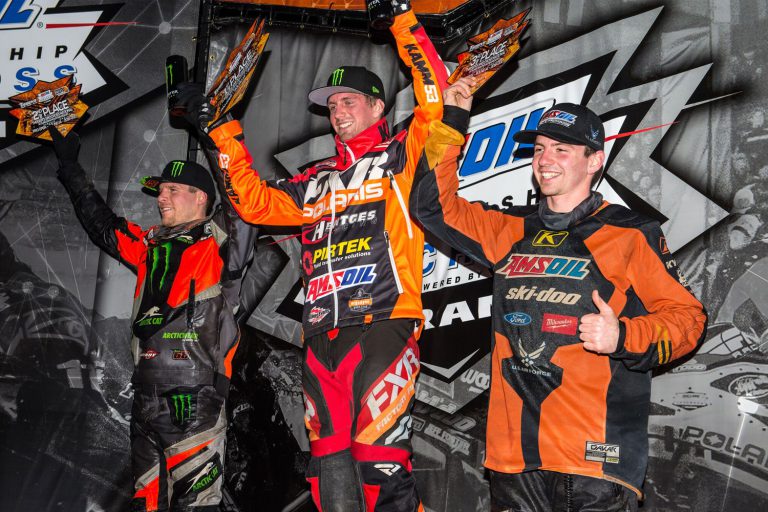
Aki Pihlaja survived his first visit to the rough and tumble Days of ’76 rodeo arena in Deadwood, South Dakota, escaping the mid-season rounds of the national snocross tour with a third place podium on Friday.

Both Pihlaja and Pro Open racer Adam Renheim experienced the difficulties that come with the bump and run style of racing that Deadwood is famous for. Aki was turned over at the start of Saturday’s final and had to race from the very back of the 15 man field. Remarkably, he was able to make his way up to the sixth position at the checker flag and still finish ahead of his closest competitor in the Pro Lite championship.

The weekend did not go as well for Renheim, who was involved in a couple of crashes and pileups which were a common occurrence. As a result, Adam was not feeling the best on Saturday and was unable to start the Pro Open main event.

The national tour will be off this weekend as the team makes its way to Aspen, Colorado for the ESPN Winter X Games. Adam will be looking to repeat or improve his performance of last season, when he captured a Silver medal at the event, propelling him to a strong second half of the national tour.

Polaris Snocross Racers Dominate

0

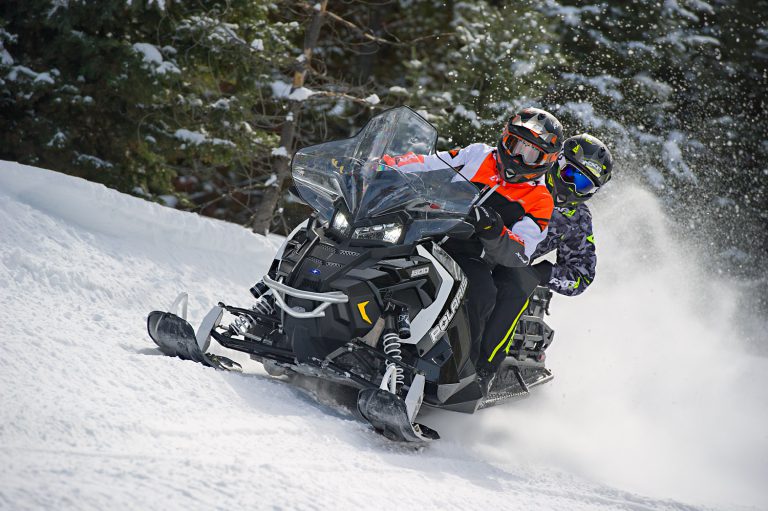
Polaris snowmobile racers won on snow and ice this past weekend.

Polaris snocross racers swept the top three spots at the AMSOIL Championship Series Pro Open final on Fri., Jan. 20, and Nick Van Strydonk won the Eagle River World Championship on Sun., Jan. 22, on the famed, half-mile, ice oval.

Snocross Racers Dominate in Deadwood
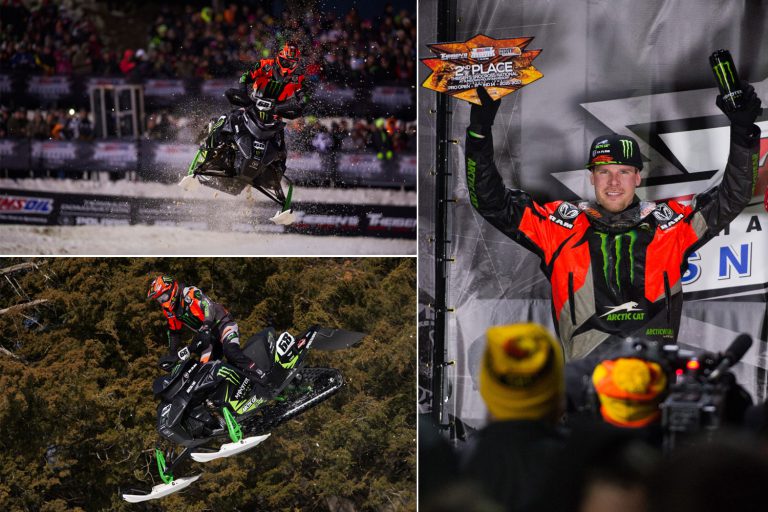
In Friday night’s Pro Open snocross final in Deadwood, SD, Polaris racer Ross Martin (Judnick Motorsports) won for the first time this season. Kody Kamm (Hentges Racing) took second and Ryan Springer (Carlson Motorsports) finished third. Springer also reached the podium with a second-place finish on Sat. night. After eight of the season’s 17 rounds of racing, Kamm is second in Pro Open points and Martin moved up to fifth with his win.

Polaris racers won both of the weekend’s Pro Lite finals with Zak Mason (Team LaVallee, Loctite, Polaris, Red Bull) finishing first on Fri. and Evan Daudt (Daudt Racing) winning on Sat.

Polaris racer Elina Ohman (Davies Racing) won both Pro-Am Women’s finals keeping her winning streak alive at all eight races this season.

Van Strydonk Wins Second World Title
Polaris Ice Oval Racer Nick Van Strydonk (T&N Racing) won the 54th annual Eagle River World Championship on Sun., giving the Tomahawk, Wis., racer two world titles in six years. He won as a 21-year-old in 2012, and led nearly start-to-finish to earn his second World Championship at age 26.

Beau Van Strydonk (T&N Racing), the champion’s cousin, finished fourth on Sun. as five racers on Polaris-powered race sleds finished in the top nine. Jordan Wahl (Jimmy John’s/Wahl Bros./Polaris Racing) finished sixth, Matt Ritchie (Ritchie Motorsports) was eighth and Joey Fjerstad (Felegy/Wahl/Polaris) was ninth.

Polaris snocross racer Andy Lieders (Roehl Transport/FXR) won the Pro Open Snocross World Championship outrunning the field on the snocross course built in the ice oval’s infield.

Polaris Industries Inc. (NYSE: PII) is a global powersports leader with annual 2015 sales of $4.7 billion. Polaris fuels the passion of riders, workers and outdoor enthusiasts with our RANGER®, RZR® and POLARIS GENERAL™ side-by-side off-road vehicles; our SPORTSMAN® and POLARIS ACE® all-terrain off-road vehicles; VICTORY® and INDIAN MOTORCYCLE® midsize and heavyweight motorcycles; SLINGSHOT® moto-roadsters; and Polaris RMK®, INDY®, SWITCHBACK® and RUSH® snowmobiles. Polaris enhances the riding experience with parts, garments and accessories sold under multiple recognizable brands, and has a growing presence in adjacent markets globally with products including military and commercial off-road vehicles, quadricycles, and electric vehicles.

polaris.com

WHAT WE THINK OF CAT’S NEW 800

0

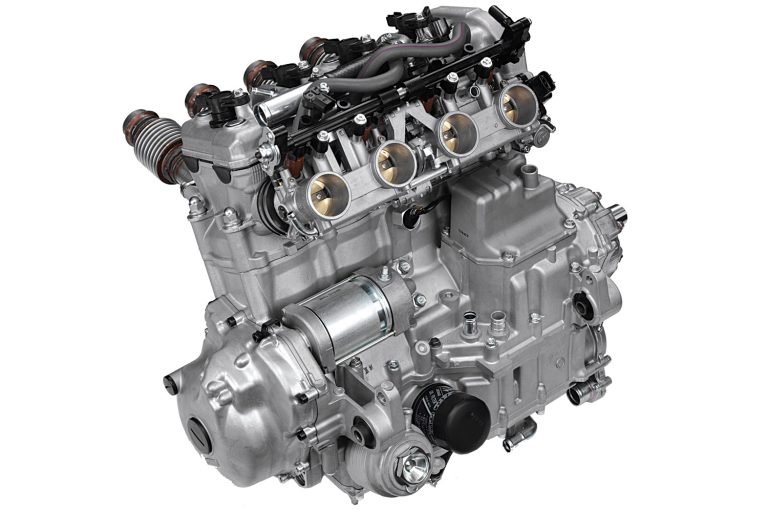
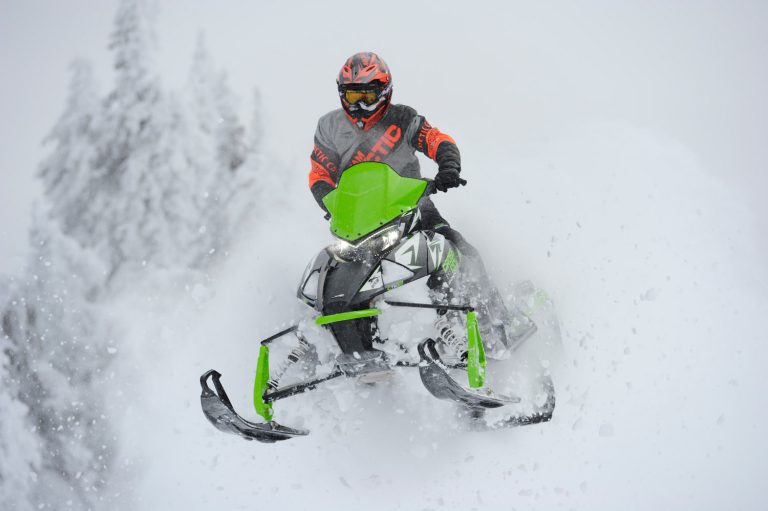
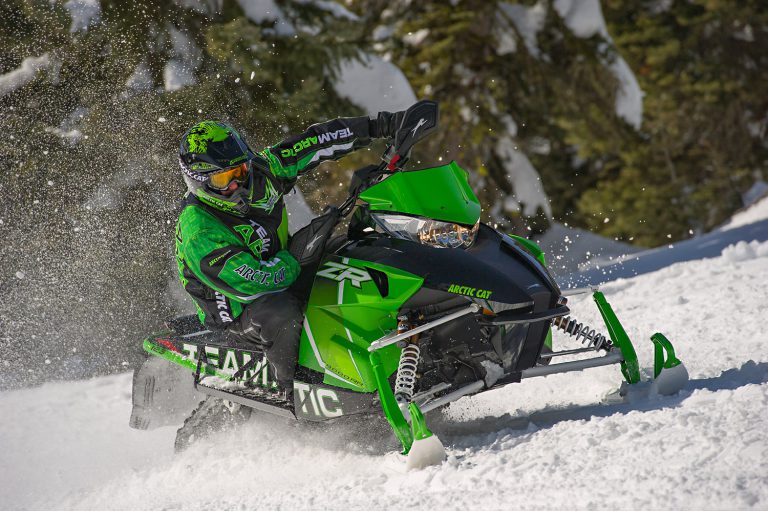
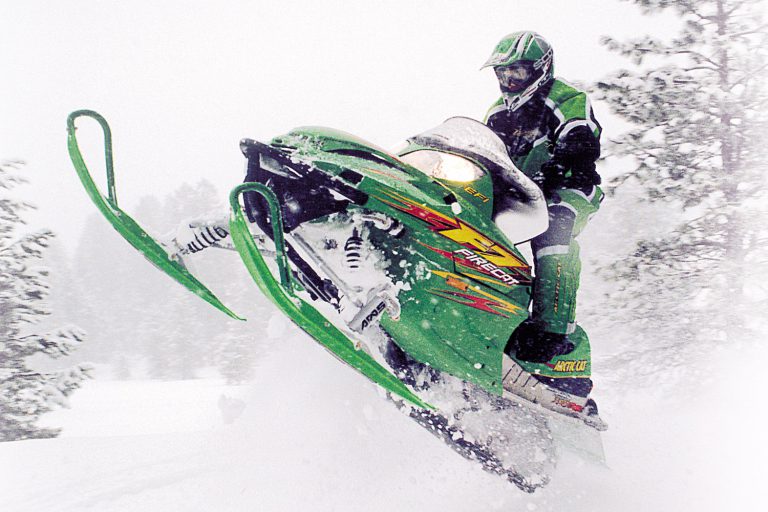
We had a brief ride on Arctic Cat’s new 800-powered ZR800 last week and came away impressed. The new engine is a mirror image of Cat’s 600DSI, slot-injected twin but has a couple of differences.

The engineers have used two “side valves” per cylinder the 600 doesn’t need and these valves, located inside two small ports on either side of the exhaust port allow the 800’s big pistons to pass by the humongous exhaust ports without hanging up the piston rings.

These ladies wristwatch-sized valves are mechanically operated and work in tandem with the electronic exhaust valves to open and close during the various cycles of the engine (intake compression, combustion & exhaust).

There’s also a valve located on the fuel rail that regulates the “flutter” in the rail and keeps both injectors working in sync.

Other than the fact this engine has more displacement, it appears to be dimensionally identical externally to the 600 and especially to the old Suzuki 800.

Riding this engine is a different story. Although we suspect the top end is about the same as the old 800 (not too shabby, really), bottom and mid-range are completely different.

This engine pulls with immediacy down low and snaps to attention whenever you get into the throttle off-idle.

Mountain riders are going to love the way this engine responds in powder when it looks like there’s a possibility of getting stuck. Just crack the flipper open and this mill responds with telepathic reflexes and gargantuan bottom end.

Same goes for the mid-range. On trails, this engine feels very muscular and when you dip into it at about 40-mph, it just lofts the skis and takes off with authority. The speedo keeps climbing smoothly and we observed no flat spots, burbles or hesitation anywhere in its power curve.

This new 800 is certainly much more civilized than the Suzook 800 and runs very much like the 600. We think it will prove to be a formidable foe to the Polaris 800 and maybe even Ski-Doo’s 850.

One thing is for sure, Cat 800 owners are going to see a big improvement here and will love this new powerplant!

NORTH AMERICA’S TOP SNOWMOBILER – FINALS

0

The search for North America’s Top Snowmobiler has been narrowed. Who will it be? BEN HIETPAS from the USA or JUSTIN EVANS from CANADA. It’s up to you to decide! Cast your vote and win great prizes!

Click here to vote daily!

Rupp Was All About Speed

0

By 1965 Mickey Rupp had established himself as a well-known and very competent auto racer with his sixth place finish that year in the Indy 500.

From the earliest years, as was his dream, Rupp snowmobiles became synonymous with performance.

The company built its first prototype in 1964 and then began production in Mansfield, Ohio.

Originally powered by Tohatsu 2-strokes, Rupp graduated to Kohler power and eventually to a red-hot but tempermental Xenoah liquid-cooled twin with CDI that featured a coolant heat exchanger in its hollowed-out, aluminum front bumper.

Aluminum construction was one of the hallmarks of Rupp and it’s why they are still sought after as vintage racers now.

In fact, the concept of a hollow aluminum cooler probably was the predecessor to the heat exchangers we see on all liquid-cooled sleds today.

Also, the Rupp Nitro 440 featured reed valve induction and that, too, was a rarity in the mid-1970s. Primary and secondary clutches for racing Rupps were provided by Arctic Cat.

Model names associated with Rupp were: Yankee, Rally, Spirit, Sport, American. Magnum, Rogue and Nitro.

Although Rupp snowmobiles were always known for their extreme performance proven in successful racing results, and their innovative technology, Mickey Rupp was forced to close the doors in 1978 and the company then focused on manufacturing Gorman-Rupp pumps in Mansfield.

Mickey continued to race boats and airplanes well into his retirement years.

ARCTIC CAT 9000 INTERVIEW

0

Supertrax:

Prior to the 2017s being introduced we had access to a Viper with a 1049 triple and an aftermarket turbo installed. How would you rate that experience? What did you learn?

Luke Lester:

I think the most interesting bit of info we gathered from our time with the 1049 turbo was that the motor could easily handle the power. There were no concerns about engine durability. On top of that, we got just a taste of what this motor, when pushed harder, was capable of… and it was impressive to say the least.

Supertrax:

What’s your opinion of turbocharged snowmobiles in general?


Luke:

I love the power. There really is nothing that can equal the feeling of a boosted snowmobile putting huge horsepower to the ground. I also feel they need to be as invisible as possible. We learned all about turbo lag when the first crop of turbo sleds became available, and determined turbo lag is a big issue on a sled.

Today, manufactures have found ways to drastically reduce, if not nearly eliminate lag, making it more difficult to tell weather your riding a sled with a turbo, or just one that makes insane power.

Supertrax:

What was your reaction when you first heard the 2017 Cat Turbo would be using a 998cc 3-cylinder Yamaha engine instead of the former 1056cc Suzuki twin or even the 1049? Was dropping 50 cubes a good or a bad thing?


Luke:

I can’t describe how happy I was to hear they were dropping the Suzuki twin in favour of the Yamaha triple. Its quickly becoming clear that a triple delivers the kind of power snowmobilers both want and need. The torque of a twin with the top end of an inline 4. It’s not at all a surprise to see Arctic start with the 998 though. It’s a logical move when you consider the implications of cross platform development of that engine in snowmobiles in the winter and off road vehicles in the summer.

Supertrax:

What have you found to be the most impressive feature of the new 9000 series Cats?


Luke:

Historically, high horsepower turbos have been heavy. The Suzuki turbo certainly fit this description. So the new 9000 being lighter with the mass more centralized is a big improvement. Second, the new design of the bodywork is just fantastic. This is the best fit and finish we’ve ever seen from Arctic Cat. Its functional, its easy to remove and the fastening system is flawless… and it looks fantastic.

Supertrax:

How does the handling compare with, say, a Cat 8000 2-stroke?


Luke:

Thanks to better mass placement and overall lighter weight the new 9000s handling is far closer to that of the 8000 series 2 strokes than ever before. Yes, you can still feel the weight, but it doesn’t have the same negative effect on the vehicle in the corners.

In fact, in some circumstances, that extra bit of weight helps keep the skis on the ground and provides better bite in the corners. I would say it’s not quite AS flickable as the 8000, but overall handling is really good.

Supertrax:

What do you feel is the 9000’s best application: Trail, crossover, freestyle, mountain? 


Luke:

First, and most obviously, is on the trail. Because it handles so well, yet produces so much horsepower with so little turbo lag, it’s a real pleasure to ride all day. There’s no tradeoff to get the horsepower. But that horsepower is definitely there when you want to unleash it on some unsuspecting victim. 

Next is in the mountains. There will never be a replacement for a high horsepower, lightweight 2 stroke engine, but the lighter you can make a turbocharged 4 stroke, the better it will get in the steep and deep. hen you consider that the turbo is going to maintain most of its horsepower from sea level all they way up to 10 000 plus feet… the higher you go, the better that sled starts to look and feel.

Supertrax:

Is 180-hp too much or is there still room for more in the marketplace?


Luke:

10 years ago people would have said 180hp is way more than any person could need or handle, bBut we know different now. I think there will always be room for more horsepower in the snowmobile industry. There will certainly always be people to buy these increasingly powerful hyper sleds. The question isn’t “how much power is too much?” The question is “how much power is possible. “

Sno-Jet Prioritized Lightness

0

Sno-Jet began in Thetford Mines, Quebec in October 1964 and the original design was the brainchild of two fiberglass workers, Paul-Emile Roy and Maurice Fillion.

The two later formed a partnership with an accountant named Theberge and a plumber by the name of Pelchat. By 1965, production was up from 25 sleds the first year to 1,150 and 4,400 the third year.

By 1968, the original owners realized they couldn’t keep up with the rapid growth of sales and sold the company to the Conroy Company of Texas and put itself under the wing of the Glastron Boat Company.

After only five years, total sales ballooned to 25,000 snowmobiles. Unfortunately, this was the peak of production for the brand and sales continued to fall all through the early and mid-1970s.

By 1976, after the Arab oil embargo, Sno-Jet was annexed by Kawasaki, a company just getting its feet wet in the business.

Sno-Jet ‘s claim to fame was aluminum construction. Many of the earliest sleds used aluminum tunnels and bulkheads and the company’s pure racing Thunder Jet, introduced in 1972, was so light the competition felt it had an unfair advantage.

Other model names used by the brand throughout its history were: Jet Flight, Star Jet, Super Sport, Super Jet, Astro Jet, SST and Whisper Jet.

Until 1970 the company used Hirth 2-strokes exclusively then converted to Yamaha engines until the end of its days.

Interesting to note, in its prime in 1975 the Thunder Jet’s Yamaha twin, in racing form, made a whopping 65-hp.

SKI-DOO’S 850 ENGINE

0

There’s no doubt Ski-Doo has slain the snowmobile sales marketplace the past 13 years. “REV” has become at least as iconic as the name “Indy” was in its hayday.

Ski-Doo has demonstrated real leadership in protecting its huge (rumored to be more than 50-percent) market share by “one-upping itself”, as visionary CEO, Jose Boisjoli, calls it.

In Boisjoli’s estimation he would much rather be one-upped by his own products than wait until the competition catches up.

The 800 class has become entrenched as the “top performance” segment. Every OEM either has an 800 2-stroke or makes an equivalent 4-stroke in the 135-165-hp zone.

As it turns out, Ski-Doo’s Series III Rotax 800 E-TEC was getting long in the tooth. The engine has been around in E-TEC trim since 2008 and even earlier as a carbed PowerTek variant.

The production E-TEC 800 arguably produces 150 to 155 horsepower and over the years that 800 has displayed some crankshaft reliability issues when the odometer climbs into the teens.

Performance and drivability have always been good with the Series III E-TEC but the arrival of the Polaris AXYS with its all-new Liberty 800 HO two years ago, moved the bar.

The Ski-Doo faithful will roll their eyes at this assertion, however under repeated pulls up Kevlar Lake, the Polaris 800 HO was the consistent top speed king against the E-TEC 800.

Ski-Doo was not oblivious to the fact the 800-class horsepower bar was moving upward. Along with the arrival of the Polaris 800 HO there has been continual and increasing promises of a domestic 800 DSI Arctic Cat.

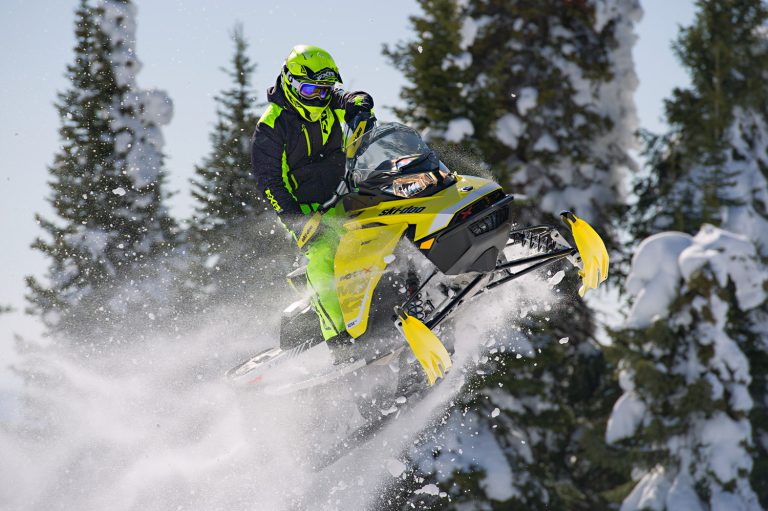
In any case, Ski-Doo did what leaders do: It changed the rules and crafted an all-new 850cc E-TEC twin and essentially sent the competitions’ 800s back to the drawing board.

The 850 gets an all-new induction system using “boost injectors” on otherwise dry throttle bodies.

Skiroule Was Known For Style

0

The creator of Skiroule snowmobiles, Rejean Houle of Wickham, Quebec was an avid 20-year-old entrepreneur who built prototypes of his ideal snowmobile and then sold his concepts to the Coleman Company, makers of outdoor camping equipment.

The original Skiroules bore an amazing resemblance to the Ski-Doo Olympique.

In the beginning, Skiroules used tunnel-top mounted Sachs engines and by 1970 were known for their low-slung, very aero hood styling, belying their relatively high-positioned engines.

The company used the RT acronym to describe its model line-up and RTX denoted its highest performing sleds and racers.

In the late 1960s the sleds used bogey wheels but in the early 1970s Skiroule graduated to a slide rail suspension with dual outboard coilover shocks mounted on a reverse angle and integrated into the steel rear bumper.

Canadian Tony MacKeen did the original top-mounted engine hood styling and had to re-adapt his designs when Skiroule eventually relocated the engine into the bellypan in the mid-70s.

Skiroules were always at the top of the heap when it came to sleek, low, good looks many felt were decades ahead of anyone else.

Engine choices were mostly Kohler 2-strokes in 291, 338 and 447cc (50-hp) sizes. One Skiroule, the RTW, offered a now-very-collectible 23-hp Sachs Wankel.

By 1972 sales from Skiroule-Coleman’s 750 dealers had climbed to $19.2 million.

In 1977, Coleman decided to focus its efforts on camping equipment and in a difficult economy, closed its doors on snowmobile production forever.

174-inch Mountain Sled Shootout

0

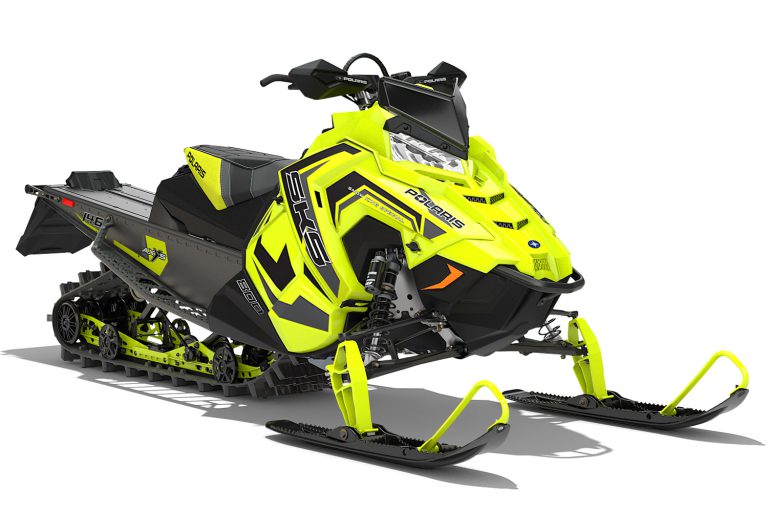
We’re in the steep and deep for a good ol’ fashioned shootout between two of the industry’s 174-inch mountain machines – Ski-Doo’s Summit X 174 and the Polaris 800 Pro RMK 174 LE!

Subscribe to our YouTube Channel!