Home Blog Page 125

SUSPENSION PART 3: ARCTIC CAT SLIDE-ACTION

0

In this series, Supertrax takes a look at some of the most popular skidframe designs and evaluates their performance.

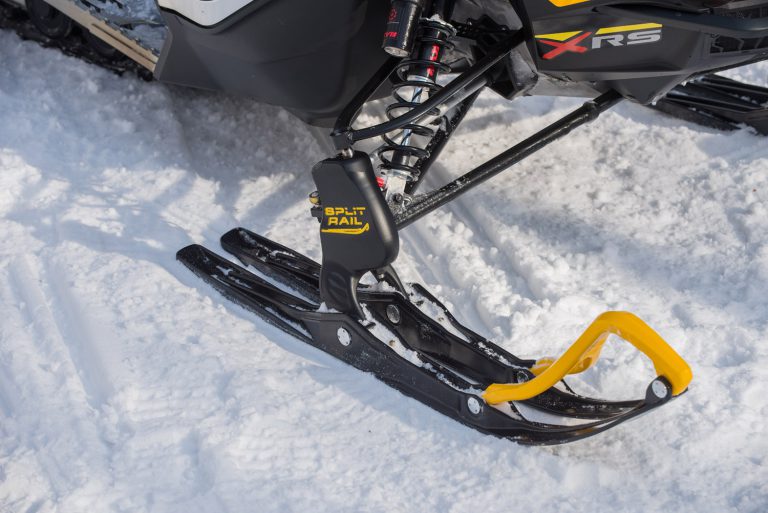
Slide-Action could be called a conventional shock-in-skid suspension but it incorporates some suspension tricks Cat has initiated over the years.

It uses a front arm coil-over shock and a rear arm torsion spring and shock combo. Slide-Action is fully coupled, so both the front and rear of the rail can respond to bumps – or both together depending on where the coupling moment is adjusted on the couplers themselves.

Kirk Hibbert and Cat’s engineers designed the Torque Sensing Link a number of years ago and it has since been adopted by the competition. The TSL levers at the rear arm upper pivot points are designed to respond to the increasing track rotation as acceleration increases, actually pushing the rear of the skid down harder onto the snow surface increasing traction and allowing maximum travel.

This race-developed trick works best when you’re driving over moguls at high speed with the throttle wicked up. Because the skid is pushing downward, geometric forces are allowing the skid to absorb the hits in the sweet spot of the suspension’s travel without bottoming out.

The second trick is the front arm’s sliding action – another innovation invented by Cat. Under acceleration, the front arm slides on its lower pivot allowing the arm to get either longer or shorter in accordance to rotation speed and resists track deflection – a particular challenge with all ultra-long travel suspensions.

Cat has done a ton of work with shock calibration the last couple of years and was first to suggest to FOX a simpler compression damping adjustment system called QS-3. These shocks, in all forms, are the cream of the industry but Slide-Action really is a great skidframe no matter what shocks you’re using. It bridges the gap between high performance ride quality and plush trail response without compromising either.

2019 POLARIS INDY EVO

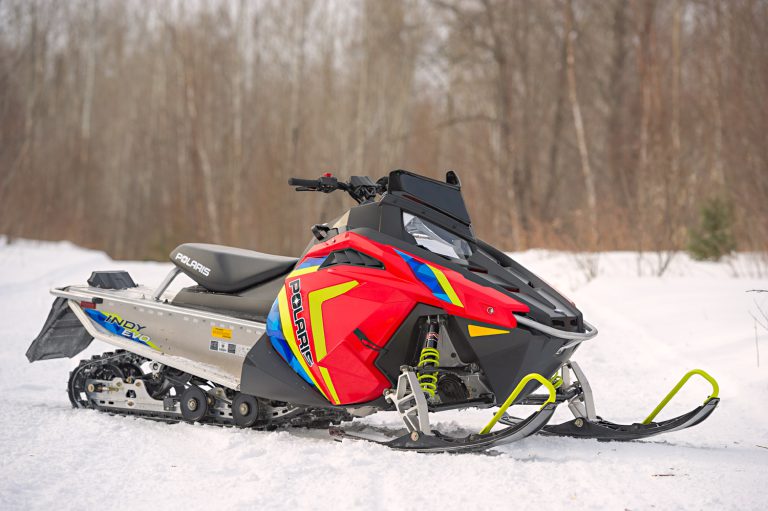
Polaris INDY®, the most legendary name in snowmobiling, is now the most inviting name on snow as Polaris introduces the new INDY EVO™, a trail-ready snowmobile built specifically for new riders. The INDY EVO™ delivers a comfortable, sporty and confidence-inspiring ride experience that will fuel a new rider’s passion for snowmobiling.

New riders need a sled built for them that’s the right size and offers easy, confidence-inspiring steering and handling. They want a sled with power they can control so they can confidently enjoy trailing riding with family and friends.

Perfect Fit for New Riders

Created using Polaris advanced design engineering, the INDY EVO™ is lower and narrower than a full-sized sled. Coupled with a lower seat height, this hunkered-down stance lowers the center of gravity to enhance the feeling of stability and confidence.

INDY EVO™ ergonomics are designed to fit a broad range of riders and positions them for ultimate comfort, control and confidence. The low, narrow bodywork provides outstanding visibility, yet delivers excellent wind protection with AXYS-style integrated airfoils and a wide range of windshield options.

Purpose-built, flat, low bars provide excellent leverage, and the easy throttle flipper accommodates hands of all sizes. The cockpit is roomy, providing ample knee room for the active INDY riding style.

Confident Handling, Easy Steering

The INDY EVO™ Independent Front Suspension is engineered for a stable yet effortless ride on trails. It features shocks designed and calibrated specifically for the INDY EVO™ chassis and the adjustable-stance IFS allows the sled to evolve with the rider.

The all-new INDY EVO™ ski was designed exclusively for this sled, plus delivers confident handling with reduced steering effort.

Just-Right Performance & Fun

The proven Polaris 550cc fan-cooled engine delivers just the right amount of power for new riders. Speed is electronically controlled to a maximum of 50 mph, and stage-tuning kits will be available to adjust the vehicle’s performance and ride as skills grow.

The INDY EVO™ is available in two models, with manual start or electric start.

Many Polaris accessories are available for the INDY EVO™ so riders can customize and personalize their sleds to suit their style, and optimize comfort, convenience and cargo solutions.

Polaris Industries Inc. (NYSE: PII) is a global powersports leader that has been fueling the passion of riders, workers and outdoor enthusiasts for more than 60 years. With annual 2016 sales of $4.5 billion, Polaris’ innovative, high-quality product line-up includes the RANGER®, RZR® and Polaris GENERAL™ side-by-side off-road vehicles; the Sportsman® and Polaris ACE® all-terrain off-road vehicles; Indian Motorcycle® midsize and heavyweight motorcycles; Slingshot® moto-roadsters; and Polaris RMK®, INDY®, Switchback® and RUSH® snowmobiles. Polaris enhances the riding experience with parts, garments and accessories, along with a growing aftermarket portfolio, including Transamerican Auto Parts. Polaris’ presence in adjacent markets globally include military and commercial off-road vehicles, quadricycles, and electric vehicles. Proudly headquartered in Minnesota, Polaris serves more than 100 countries across the globe.

Visit polaris.com for more information.

1975 SKI-DOO 245 RV TNT

0

In 1962 I had my first ride on a Husky snowmobile at my buddy Richard Hiley’s 6th Birthday. Now 55 years later I’m still riding with as much enthusiasm as I did those many years ago.

I can’t even begin to guess how many sleds I’ve owned over the years, but I can tell you that every dollar spent was worth it.

Most often, we rode and repaired our sleds from Monday to Friday (mostly fiberglass repairs, which I became very adept at) and raced them on the oval track on the weekend.

Back in those days we bought and sold sleds with regularity. Did I have a few stinkers? Sure I did and I didn’t keep them very long.

In the fall of 1976 I traded my 1965 Sunbeam Tiger for a 1975 Ski-Doo TNT RV 245. I was running mostly Polaris sleds on the oval track back then and one day I laid my eyes on the 245 RV and I had to have one.

To me this was a sled I could run in A & B stock and be competitive as it was a light sled at 340-pounds, low to the ground, stable, wide ski stance, dual Mikunis, tuned exhaust and it was just a cool looking snowmobile.

It didn’t take me long to figure out why the seller was itching to unload it as this sled drove me nuts. In the hands of Pro Racers the RV did decently well, but I was certainly no Pro Racer.

Every weekend I was right in the mix in the first couple of heats of the day, but every heat the sled got slower and slower. We tried everything and couldn’t figure it out. We jetted, we clutched, and we packed snow around the Y-pipe and cylinders and heads. You name it we tried it. If, I made the finals – and I didn’t make many that year, I usually watched everyone take the checkered flag while I finished last.

I sold that sled that fall and for the life of me I cannot remember what I traded or sold it for, but I was happy to get rid of it. It was without a doubt the most frustrating sled I ever owned and would not be missed.

Several years later I was in a buddy’s race trailer and he was lapping the rotary valve out of his 250 MotoSki mod motor. Intrigued I asked why and he just smiled and replied, “When the engine gets hot the aluminum engine block and rotary valve case expands causing friction with steel rotary valve.”

Can’t say I saw that one coming, but looking back, I’m sure my buddy Dave had the answer to my frustrations. You live and learn I guess…some lessons later than others.

Now back to that 1965 Sunbeam Tiger that I traded straight-up for. I was browsing thru a classic Car trader and there was a 1965 Sunbeam Tiger listed for $75,000!

As the saying goes, It is what, it is.

2018 POLARIS SWITCHBACK 800 XCR

I’ve had the opportunity to put some decent miles on the new Switchback XCR so far this winter. I’m more impressed with the production XCR Switchback than I was with the pre-pro models we rode last spring in Yellowstone.

The build quality of the new XCR is the best I’ve seen from Polaris: The hood panels and fenders align perfectly, mount on and off like greased lighting and the overall feel of the sled is one of tight, purpose-built quality.

Our XCR is powered by a Cleanfire 800 Liberty HO with some minor tweaks for the 2018 model year. Among the most significant is a new thermostat that tangibly aids in cold engine warm-up. The rest of the AXYS Pro-XC chassis is textbook Polaris: Tough, unbreakable and functional.

It’s generally accepted here at Trax World HQ the Switchback genre of the AXYS is the best looking and most proportionally correct iteration of the legendary Pro XC suspended platform.

Here’’s what we think you need to know most about this new XCR variant. This is – IMO – the best handling snowmobile money can buy. Handling traits this variable castor IFS generates using the Pro-S lowered ride height (as compared to the Pro-X) that produces corner-carving response unequalled in the biz.

One more incomparable with the XCR: The jackshaft brake. This brake stands alone in the biz with Arctic, Yamaha and Ski-Doo all moving to drive-axle mounted binders. As far as I’m concerned, this is not progress. The Polaris jackshaft-mounted system provides incomparable depth of modulation, precise feel while generating the cleanest, sweetest mechanical noise in the biz.

The new XCR 800 Switchback is one of those sleds that not only meets but, in many instances, exceeds our expectations!

PERSONAL FAVES: Ski-Doo Formula Plus

0

Everybody’s had that one sled that stands out from the rest. It defines the fun of snowmobiling and every time you reflect back on it, there’s a little twitch in your heart. In this series we asked our staffers to share their faves. Read what Harold McAdam, Public Relations Editor, Supertrax has to say about the Ski-Doo Formula Plus.

It all started in October, 1968 when I took delivery of my shiny 1969 371 Nordic. At the time I thought for sure it was the greatest snowmobile ever made.

Looking back again, the absolute game changer for me was when Ski-Doo finally figured out their early 1980’s Blizzards were definitely not the best sleds and launched the 1985 Formula Plus chassis (PRS). For me, that’s when Ski-Doo hit the proverbial “nail on the head.”

I had been riding a 1979 Karpik inspired Blizzard 7500 that I truly loved, but reliability was certainly not its strong point. I persisted for five years with that chassis because I was not enamored with the newer Blizzard chassis and design.

For me, the 1985 Formula Plus captured the superb handling characteristics of the former RV chassis but had an independent front end, a fast, reliable liquid-cooled rotary valve twin and even a rear suspension that worked decently. Best of all, it was reliable, didn’t blow belts and I managed to pilot this sled for over 10,000 miles in the ensuing two years.

Following that sled I owned almost every model year of this chassis, however, in 1989, I went to my friend, Gerard Karpik, to install an 870 triple in the same chassis.

So there it is: When I look back, my 1985 Formula Plus Skidoo was my greatest snowmobile ever, but I won’t be surprised if I have to re-evaluate this choice someday and I suspect my Renegade 1200 4-stroke might tip the balance.

PERSONAL FAVES: 1996 Arctic Cat Cougar

0

Everybody’s had that one sled that stands out from the rest. It defines the fun of snowmobiling and every time you reflect back on it, there’s a little twitch in your heart. In this series we asked our staffers to share their faves. Read what SnowTrax Television Co-Host AJ Lester has to say about the 1996 Arctic Cat Cougar

Probably the most pivotal sled in my snowmobiling life is one that is often forgotten by most people. I believe this sled was really underappreciated in its time: It was a liquid-cooled 1996 Cougar 550. I’m pretty sure my dad bought it for me at a local Cat dealer as a leftover sled from the previous year.

In stock form it was nothing short of plain, albeit slightly pleasing with Arctic Cat’s 1990’s styling and graphics – but just begging for a little love.

And love it would get. Thinking back, it may be one of the reasons I’m the custom-build guy these days, spinning wrenches in the Trail Tech shop for SnowTrax and DirtTrax Television. We took that Plain-Jane ’96 “Coug” and turned it into something I’ll never forget.

That season at Supertrax World Headquarters, the powers-that-be decided the Cougar would get overhauled and turned into a project sled. Since it was my personal ride, I was pretty excited.

The bits and pieces that were grafted into the Cougar turned out to be an M-10 skidframe with matching green sliders, a Cobra-Tech checkered flag low windshield and matching green ski-skins – because plastic skis weren’t yet a “thing”. We also decided to stud the track.

Looking back, it seems like very little actually went into it, but, for the day, this was a rockin’ set up. It’s funny because it seemed like every time we stopped on the trail folks were checking it out and admiring the mods we’d made.

Maybe it was just me being only 12 years old, freshly licensed and having my first taste of trail-riding on my own but it was perfect and left me with an everlasting gobstopper-like appetite for our sport and the addiction to upgrading my vehicles that continues to this day.

PERSONAL FAVES: 1978 Yamaha EX 440

0

Everybody’s had that one sled that stands out from the rest. It defines the fun of snowmobiling and every time you reflect back on it, there’s a little twitch in your heart. In this series we asked our staffers to share their faves. Read what Kent Lester, Co-Publisher, Supertrax has to say about the 1978 Yamaha EX 440

I had only been a snowmobiler for about four years when I found a decent two-year-old 1978 EX440 in the classifieds. I had had a series of ET 250s and 340s prior to this and the jump to a “huge” fan-cooled 440 was intimidating.

I chuckle about this now because that sled probably didn’t put out more than about 55-hp – pretty lame when you consider today’s turbocharged Yamahas make close to 200.

I added a set of phenolic reeds, studded the track and took the whole sled apart to de-rust, clean and grease the skidframe. It was a leaf spring sled so I didn’t have to do much maintenance to the front end. However, I did add a set of carbide runners to the steel skis – unbelievably, a pretty big deal back in 1980.

I remember standing in my garage looking at that sled and feeling so proud of my first “performance snowmobile”. Was it fast? Not by today’s standards, but it sure seemed like a handful at the time.

I believe that sled was the one I took on my first long distance tour (nearly 1000 miles) to Quebec. It ran flawlessly and its four or five inches of rear suspension travel and nice foam-filled seat provided all the comfort I could have dreamt of on those smooth, beautifully groomed trails.

Years later I graduated to a series of more modern IFS Polaris, Ski-Doo and Arctic Cats I loved, but that EX 440 has always stuck in my mind.

PERSONAL FAVES: 1992 Polaris Indy 500 EFI

0

Everybody’s had that one sled that stands out from the rest. It defines the fun of snowmobiling and every time you reflect back on it, there’s a little twitch in your heart. In this series we asked our staffers to share their faves. Read what John Arkwright, Sales Rep & Contributing Editor, Supertrax has to say about the 1992 Polaris Indy 500 EFI

I couldn’t even begin to guess how many sleds I’ve owned. Of all those sleds many have been memorable and some were just plain… let’s say, less than desirable!

To pick my favorite one is tough because I’ve had so many great ones! Right now I have a Ski-Doo 900 ACE Renegade that gets phenomenal gas mileage, has a superb ride, great handling and is sooo quite.

Okay, I would have to say my all-time favorite sled was my 1992 Indy 500 SP EFI. In 1991 I had had a chance to try an early, limited build 500 EFI and I was quick to go to my Polaris dealer and get one SnowChecked. While some SP owners had some issues with EFI starting at first (which Polaris quickly had an update for), mine was flawless.

The EFI system with two throttle bodies made for a feather-light throttle pull and gave that 488 Fuji crisp throttle response. It pulled surprisingly hard down the lakes, making this sled an absolute hoot to drive.

The first year I owned it I installed 96 studs and cut a half-inch out of the 2-into-one header for a bit more bottom end (I don’t know if it really made any difference).

The second year I went to Starting Line twin pipes and a Marv Jorgenson chip and installed a 133-inch SKS track kit. In the mid ’90s I installed a FAST M-10 suspension.

I put a lot of miles on that sled over the years and about all I did to it every year was put on a fresh belt, install new carbides and a set of plugs. After that just gas and oil.

Truth of the matter is, of all the sleds I’ve owned, I kept this sled the longest and if I had the chance, I’d buy it back in a heartbeat!

SnowTrax 2018 – Season Premiere Sneak Peek

0

Coming up in the Season Premiere of SNOWTRAX TELEVISION…

In the first of a two part adventure packed story, AJ heads east to Newfoundland, Canada where he hooks up with the 5 Toes Riding’s best ambassador and North America’s Top Snowmobiler 2016 Winner – Troy Burt.

While there, they waste little time and head to the West Coast Mountains where they pilot some new Gen4 Ski Doo Summits in the high elevation terrain and check out some of the cool landscape features including the 30 meter deep Lomond Sinkhole near Bonne Bay Pond.

Then in our first of two TEST RIDES, we recruit one of our enthusiastic youth test riders to get their honest impressions on the 2018 Yamaha SnoScoot.

Then Luke rings out every ounce of joy there is to be had with the C-TEC2 800 DSI engine as he reviews the 2018 Arctic Cat ZR 8000 137.

SnowTrax Television 2018 airs on OLN and WILD TV in Canada and Outdoor Channel across America.

OLN:
Season Begins: January 6
Weekly Airings:
Saturdays: 8:00 AM ET
Sundays: 9:00 AM ET

Wild TV:
Season Begins: January 1
Weekly Airings:
Mondays: 9:00 PM ET
Wednesdays: 10:30 AM ET
Fridays: 7:30 AM ET
Saturdays: 2:00 AM ET
Sundays: 9 :00 AM ET

Outdoor Channel:
Week #1 Starts January 2
Week # 1 airings are the following:
Tuesday: 2:30 PM ET
Thursday: 8:30 AM ET
Sunday: 3:00 PM ET

Subscribe to our YouTube Channel!

FXR BOOST X JACKET

0

Cool casual style meets technical outerwear. That’s the best way we can describe the Boost X jacket from FXR.

As one of our favorite jackets from FXR, the Boost X jacket has kept us warm, dry and looking great. The bomber style cut provides a comfortable fit with plenty of room for movement in the arms and shoulders.

Its combo layering system provides what we feel is the best combination of warmth ratings. On really cold riding days, the thick insulated liner keeps you toasty warm. Come the longer days of sunlight in March, you have the option of zipping out the liner completely or opening up vents to moderate your heat level.

On days when the snow is plenty and deep the Boost X Jacket really comes into its own. The adjustable shock cord hem provides a tight seal across your torso and the lycra hand cuff extensions prevent any snow or drafts from getting underneath the jacket.

When needing to take a break with your helmet off, the removable and adjustable hood works perfect from keeping your head dry and all the pockets from large side ones to strategically placed arm and chest pockets keeps all your essential belongings safe and in place.

The Boost X Jacket is available in 9 color combinations and because we like this jacket so much, we’re giving one away. To enter go to supertraxmag.com/fxr

For more information on FXR’s full line of jackets and snowmobile gear go to: fxrracing.com