Home Blog Page 89

NOT HAPPY WITH SHOOTOUT RESULTS

Luke –

I watched your segment on the short track shootout (CLICK HERE) and I think the whole story is biased and not accurate with the statements I think there should be no winners or losers to pick snowmobiles in categories only reflects to the people ride them if they have yellow or blue underwear they will certainly lean that way!

Everyone knows Arctic Cat was light years ahead of the competion when the 91 EXT hit the snow and the tall spindle front suspension again is years ahead of the rest and that’s why Cat is building Yamaha snowmobiles!

Cat is certainly the best built sled on the snow in every category and the last thing you want to do is pull on a Cat’s tail!

Dave

Dear Dave –

Thanks for your comments and glad to hear you’re watching the show.

We constantly get told we’re biased to one manufacturer or another. More often it’s by Yamaha and Arctic Cat guys because we have more criticism for many of the sleds from these 2 brands. Before I go any further I’d like to just say that I understand where this frustration comes from, but it’s simply the nature of what we do. We do not cater to loyalties and simply report the truth on the good and bad of what we test. Period.

Our short track shootout was one that viewers had been asking about for a while. The results were not just the opinions of one or two of our crew. They were based on the opinions of our WHOLE crew who each ride thousands of miles every season and get a unique opportunity to ride competing sleds that they don’t own back to back, day after day. Something few, if any, consumers get to do.

This gives us a very interesting perspective because we have NO investment in the sleds we ride. I didn’t spend my own money on any of them so I have no reason to want to praise or defend one over the other. Also, riding the sleds back to back…literally jumping off the running boards of one onto the running boards of the other on the same day, same trail, exactly the same conditions gives us the ability to identify what works and what doesn’t from one sled to another. There is NO better way to determine which one rides the best, or which one has the best handling, ergonomics etc. Riding a buddy’s sled from time to time doesn’t cut it.

So saying our story is biased only does one thing. It points out your own bias toward one of the sleds that did not win, in this case, the Arctic Cat ZR. You’re not happy because it didn’t do as well as the others so you accuse us of being biased.

Why would we be biased? How does that benefit us. All 4 manufacturers advertise with us. It does us no good to unfairly praise or criticize one sled over another. We get no more or less money either way. You, on the other hand, want to be told that your sled, or the sled you like the most, IS the best. You have a desire to be right or to have your own opinion validated. That IS an example of bias.

In terms of picking winners, we do this for one very good reason: our viewers overwhelmingly demand we pick winners. We have done “comparos” in the past and the majority of our viewers don’t like the format. They WANT to know which one we think is best…they WANT a winner.

In some instances there is a good reason to simply compare and not compete, but in a case where the 3 sleds were looking at are direct competitors with the same intended usage, similar features aimed at the same buyer, it is literally our JOB to find the best of the bunch. If you want to know what we think of each sled on its own, watch the test ride. The entire purpose of a shootout is to pick a winner.

Your comment about Arctic Cat being lightyears ahead of the competition with the 91 EXT is irrelevant. It is not 1991 any more. Snowmobiles today are not judged based on sleds a brand built 28 years ago. Furthermore, the tall spindle design is a very good one – there is no question, but the true test of a design is how it actually performs. Not one of our crew would ever say Arctic Cat sleds handle badly. They certainly do not. In fact, for 2020 we fully expect Arctic Cats new front end to push its sleds near to the top of the list when it comes to front end ride and handling.

However, as I said before, we get to ride all these sleds, back to back, day in and day out. In our well informed opinions, based on tens of thousands of miles of actual real world experience, Arctic Cat’s original tall spindle front end did not ride or handle as well as some of its competition. Due to your obvious bias toward Arctic Cat I can see why you might not like or agree with our findings, but at the end of the day, our job is to report the truth as we see it, not simply cater to the loyal followers of one brand or another.

The Arctic Cat/Yamaha relationship is based on a long list of factors. One of which is that Yamaha sees real value in Arctic Cat’s platform, but don’t for a second think that THIS is the only reason Yamahas are based on Arctic Cat chassis. There is WAY more to it than that.

To your final point that Arctic Cat sleds are the best built sleds on the snow in every category, this is what gives away your bias the most. I don’t blame a fan for having strong opinions toward his brand. I have strong opinions about GMC and Chevy trucks, Ducati motorcycles and SCOTT mountain bikes. They are fantastic products based on my own experiences. However, I wouldn’t for a second try to argue against a professional test rider for any of these products that I know which one is best more than they do. In fact, I go to these sources for advice when it is time to buy a new toy… I read, watch and listen to their reviews and opinions and I base mine on what they say. Maybe I still let my own bias impact my decision making, but I’m not going to come out and say they’re flat out wrong. They have way more experience with these products than I ever will.

Thanks!

Luke

2019 Real World Sled of the Year

0

It’s that time of year again as Luke reveals which sleds stood out as the best-of-the-best in model year 2019 from Arctic Cat, Polaris, Ski-Doo and Yamaha along with presenting the model that stood atop of all others through 18 categories of evaluation in our presentation of the highly coveted SnowTrax Real World Sled of the Year Award.

Subscribe to our YouTube Channel!

2019 REVOLUTIONARY ADVANCED DESIGN AWARD

Trax Media Inc. and SnowTrax Television are pleased to announce the winner of the prestigious 2019 Revolutionary Advanced Design Award (RAD).

SnowTrax Television selects from the most important and potentially influential new designs in the snowmobile industry yearly and presents the RAD Award to the OEM that has furthered the sport with the most revolutionary advanced design.

This year’s RAD winner is Arctic Cat and its Alpha series mountain sleds equipped with its unique, radical and overwhelmingly innovative single slide rail rear suspension system.

Alpha series mountain sleds have opened up vertical riding to a new and less experienced group of participants by simplifying techniques needed to proficiently navigate mountain terrain. The Alpha’s single slide rail suspension allows the sled to be ridden across side hills with previously unheard of ease and proficiency.

The Alpha concept is genuinely radical in its execution with the sled’s skid able to roll side-to-side with unbelievable ease. This side-to-side movement is unequaled by any other system in the industry.

A secondary benefit of the Alpha suspension is its ability to shed snow from the skid frame improving overall efficiency through reduced weight. The Alpha skid employs a hollow aluminum beam with the front torque arm, rear swing arm, slide rail hyfax and rear idler truck attached. As a result the track is virtually unrestricted in its ability to roll from side-to-side.

According to SnowTrax Television’s AJ Lester Alpha makes vertical riding easier and more fun: “It is not often an innovation comes along that actually makes you a better rider – Alpha is precisely that kind of innovation!”

Congratulations to Arctic Cat on the release of its revolutionary Alpha mountain suspension. The company is the worthy recipient of the SnowTrax Revolutionary Advanced Design Award Award for 2019.

2020 Polaris Timbersled RIOT Conversion System Walk Around & First Impressions

0

After a full day’s ride, Luke is at the Polaris dealer event detailing his first thoughts on the 2020 Polaris Timberlsed RIOT kit.

Subscribe to our YouTube Channel!

2019 REAL WORLD SLED OF THE YEAR ANNOUNCED

Trax Media Inc. and SnowTrax Television are pleased to announce the winner of the coveted annual Real World Sled Of The Year award.

SnowTrax Television takes pride in the comprehensive and in-depth process the editors and hosts of snowmobiling’s most watched, longest running enthusiast television series employ to determine the Real World Sled of the Year award winner.This year’s winner is none other than Polaris’ new Indy XC 850 with Pro CC suspension.

From a competitive standpoint this season produced an incredibly close battle between the Indy XC 850 and Ski-Doo’s MX-Z XRS 600R. When push came to shove, according SnowTrax TV’s Luke Lester, the nod ultimately went to the Polaris. “The new Indy XC won over our critical and discerning riders with its amazing handling, rear skid ride compliance and the new Patriot 850 engine’s formidable, seamless and smooth power delivery.”

SnowTrax Co-Host AJ Lester went on to say this about the annual Real World Sled of the Year award, “It was not only a close battle between first and second place but a significant turn of events when perennial fourth place finisher Yamaha stepped up and carded a solid third place with their formidable 180 HP Sidewinder SRX Turbo.

Polaris offers multiple rear suspension options with its AXYS rider balanced platform. After wringing out the competition and Polaris’ own AXYS variants it was the Indy XC’s all-new Pro CC double coupled, long torque arm rear skid which turned the tables and won every SnowTrax staffer over.

The legendary Polaris variable castor double A-Arm IFS was also a key contributor to the Indy XC’s winning score. This front suspension system delivers what SnowTrax consistently proclaims as the industry’s best ride quality while generating the most intuitive handling of any modern snowmobile.

Finally, the all-new Patriot 850 engine puts Polaris in an enviable position in the 850 class with its imposing, yet easy-to-manage power at trail speeds and its remarkable lack of NVH as a result of a revolutionary proprietary engine mounting system. The Patriot 850 does not use torque stops to control engine movement.

Congratulations go out to Polaris for winning the industry’s most meaningful accolade – the 2019 SnowTrax Television Real World Sled Of The Year Award!

2020 Yamaha Viper L-TX GT Walk Around & First Impressions

0

AJ guides you through his initial thoughts on the 2020 Yamaha Viper L-TX GT following a ton of riding time.

Subscribe to our YouTube Channel!

2020 Polaris INDY XCR Walk Around & First Impressions

0

Luke is at a Polaris dealer event going through his initial impressions of the 2020 Polaris INDY XCR following a ton of seat time.

Subscribe to our YouTube Channel!

Will Yamaha Add Another 2-Stroke To Its Lineup?

0

We’ve already written our views on Yamaha’s decision to offer its 2020 Transporter this year.

This 153-inch sled, powered by a Dual Stage Injected Arctic Cat 600 2-stroke is certainly a departure from the entrenched 4-stroke-only mentality Yamaha has been sticking with the last 15 years.

The fact is, the Transporter’s deep snow capability as well as its entirely decent trail capability is a pretty good alternative for hardcore Yamaha customers looking for a semi-mountain, quasi-crossover sled that is light enough to give good deep powder performance and still be 100-percent appealing on trails. Oh, yeah, it can also be used as an ice-fish-hut tow-sled or a cargo hauler.

The question we’re asking ourselves right now is this: Is Yamaha’s decision to sell a 2-stroke model a look into the future and a confession the company is looking to expand its model menu to include more 2-strokes next year?

Lets just step back, stroke our chins and consider the possibilities. Suppose the 2020 Arctic Cat Sno-Pro was a harbinger of something Yamaha customers would be interested in.

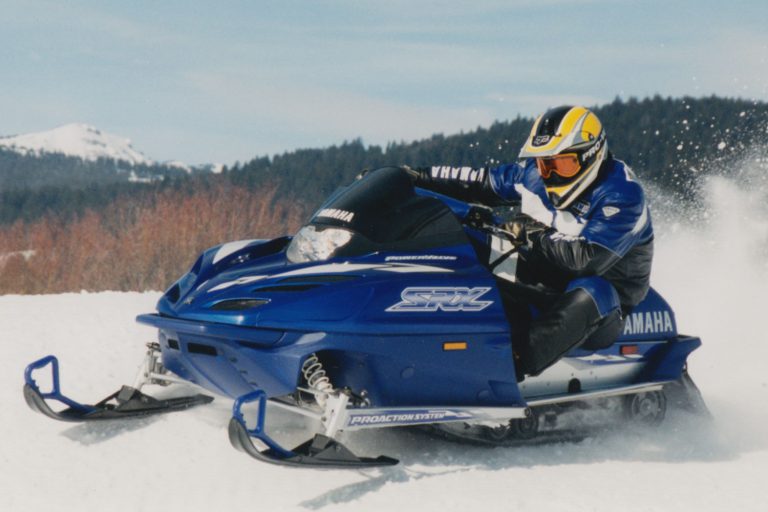
This rethought Arctic Cat mirrors many of the design facets Yamaha has built into the SRX. With the suspension slammed lower because of increased ride-in and a one-inch track and using Cat’s CTEC engine, a tweaked-by-Yamaha version – lets call it the “Enticer” – could have some appeal to Yamaha customers who have been looking for a “Big Y” 2-stroke sled targeted for the trails.

Yamaha could use its excellent roller secondary from the SideWinder and add in some Yamaha-specific tweaks to give it a unique identity. Suddenly, the company would be a player in the 2-stroke market.

600 or 800 2-stroke? We’re guessing a 600 at first. Why? By next year Yamaha dealers would have familiarized themselves with the 600 and would have parts inventory in place from the Transporter without having to stock a lot of 800 parts.

Also, who knows where Cat will be two years down the road with its 800 C-TEC engine program. If it becomes an 850 within that time period, then Yamaha could intro a new version of the Enticer with big inch 2-stroke power.

Actually, the whole idea sounds kinda Enticing, doesn’t it?

The Legacy of Arctic Cat Snowmobiles

0

Based on close to 60 years of history, Mark, Luke and AJ have a sit-down discussion about the ongoing legacy of Arctic Cat Snowmobiles and how the iconic brand has shaped the snowmobile industry along with the Arctic Cat snowmobiles they felt were the most influential.

Subscribe to our YouTube Channel!

2020 ARCTIC CAT ZR 8000 SNO PRO

0

For years, the bread-and butter sled in the Arctic Cat line-up has been the Sno-Pro. This sled variation has been offered with 600 and 800 2-strokes and even some years with a 700cc or a 1049cc 4-stroke triple.

The idea behind the Sno-Pro seems to have always been that it’s a starting point for performance riders. Although its IFP gas shock package has been very good, more sophisticated dampers like FOX QS3s and Kashima coated high performance shocks have been reserved for the more expensive Cats like the RR and Limiteds.

As it is (or was) the Sno-Pro provided a lot of ideal trail riding features inherent with the ProCross chassis and was a versatile, fun ride for the masses. The 137-inch LTX version was especially appealing because of its excellent deep snow manners combined with its trail ability.

This year, it looks like Cat has re-targeted the Sno-Pro as a still-reasonably-priced sled but now one that offers some fairly serious high performance groomed trail capability.

Not only does the 2020 Sno-Pro offer the new ARS II front spindles and geometry but it has adopted the T-Cat and Limited’s lower ride height. The idea here is to lower the sled’s center of gravity and raise its roll center so handling is sharpened to a razor edge.

We can attest to this thinking after spending some hours on last year’s Yamaha SRX and ThunderCat. The idea is to maintain the same amount of travel but calibrate springs so the sled has more ride-in or sag at static position when the rider is seated. There’s also a change to the skid’s slide rail mount for the front arm. It’s now about an inch higher and the front arm sits much flatter at static.

The Thundercat and SRX relied on adjustable-on-the-fly 3-position damping to ensure no bottoming-out in the whoops, but the new Sno-Pro relies on dual rate springs and non-adjustable gas shocks to deliver a flatter, more stable trail riding stance in the corners.

Some of Cat’s marketing refers to the Sno-Pro’s ride as “firm”. This is actually a little misleading as the engineers have told us the shock damping and spring rates are pretty much the same as last year.

The actual spring rates and damping is somewhere between the former LX and the 2018 Sno-Pro except the springs now have the dual stage feature. For the last ten years sled-builders have been working to improve ride quality and offer consumers more and more plushness with more stable cornering. Cat’s intention is to deliver the best of both worlds.

Another clue the Sno-Pro is intended for high speed trail and ditch running is its one-inch deep track. This is definitely a departure as sleds in this class have always offered a minimum 1.25.

Here’s the contradiction: The Sno-Pro has a longer track – presumably for going off-trail – but has a shallow-lugged track which would appear to compromise off-trail performance. Hmm. Seems like a mix-up.

Here’s what we suspect is happening. Because Cat doesn’t offer an 850 (yet) there has probably been some pretty severe navel-gazing about horsepower and top end performance.

Cat has already shown us it has a new version of the 800 C-TEC for 2020 with new cylinders, pistons and rods – making arguably 165 horsepower.

Along with the suspension and track change, just like the T-Cat and SRX, it’s pretty much assured this 800 will pull as hard as the competition’s 850s at top end.

It’ll be up to the consumer to figure out how to get one of these monsters to hook up, though, and buyers will likely decide to stud-up that one-incher after a couple of pulls down Kevlar Lake with the track spinning past the C-note.