Home Blog Page 76

BRP WINS LAWSUIT AGAINST ARCTIC CAT IN CANADA

June 15, 2020 at 2:50 PM EDT – The Federal Court of Canada handed BRP an important victory against its competitor Arctic Cat regarding BRP’s frame patent, which was at the heart of the Ski-Doo REV revolution; The Federal Court of Canada issued a permanent injunction prohibiting the sale, use and distribution of all Arctic Cat snowmobiles in Canada that infringe BRP’s Canadian patent; The effective date of the permanent injunction is set for July 6, 2020; The Court also ordered Arctic Cat to pay BRP a royalty of CA$135 per unit that infringes the frame patent since MY2008.

Valcourt, Quebec, June 15, 2020 – BRP (TSX: DOO; NASDAQ: DOOO) announced today that the Federal Court of Canada has rendered a decision favorable to BRP in a lawsuit launched in December 2011 against Arctic Cat, where BRP argued that Arctic Cat infringed certain of its patents related to BRP’s revolutionary Ski-Doo REV snowmobiles.

Snowmobile enthusiasts will remember the launch of the Ski-Doo REV in 2002, which completely revolutionized the rider experience with its aggressive, sporty forward positioning of the driver and strong, lightweight frame.

“I couldn’t be more pleased with the decision of the Federal Court of Canada”, said Martin Langelier, Senior Vice President, General Counsel & Public Affairs at BRP. “Innovation is part of our DNA and today our ingenuity, which makes our company and products unique, is recognized and protected against intellectual property violation. The REV platform was and is still a game-changer in the snowmobiling industry and to have it protected in Canada is an important win”, concluded Langelier.

The Federal Court of Canada issued a permanent injunction ordering Arctic Cat and its Canadian dealers to stop the sale, use and distribution of any snowmobile which would infringe BRP’s frame patent. It also ordered Arctic Cat to pay BRP a royalty of CA$135 per unit that infringes the frame patent since MY2008.

The effective date of the permanent injunction is set for July 6, 2020.

About BRP – We are a global leader in the world of powersports vehicles, propulsion systems and boats, built on over 75 years of ingenuity and intensive consumer focus. Our portfolio of industry-leading and distinctive products includes Ski-Doo and Lynx snowmobiles, Sea-Doo watercraft, Can-Am on- and off-road vehicles, Alumacraft, Manitou, Quintrex, Stacer and Savage boats, Evinrude and Rotax marine propulsion systems as well as Rotax engines for karts, motorcycles and recreational aircraft. We complete our lines of products with a dedicated parts, accessories and apparel business to fully enhance the riding experience. With annual sales of CA$6.1 billion from over 120 countries, our global workforce is made up of approximately 12,600 driven, resourceful people.

brp.com

90-DAY WARRANTY EXTENSION ON BRP PRODUCTS

BRP Inc. (TSX:DOO; NASDAQ:DOOO) has decided to make the current period a little more bearable by announcing a 90-day extension to all of its manufacturer limited warranty, expiring between March 15 and June 30, 2020, across all its powersports product lines (Ski-Doo®, Lynx®,, Sea-Doo® and Can-Am®).

This initiative is an indication of BRP’s commitment to deliver an exceptional customer experience, even during these challenging times, and is part of the recent “Together, We Ride” project which is a reminder that tough times require new responses. Since some BRP dealers have temporarily closed or are partially open, we wanted to ensure that our customers can fully benefit from their warranty.

“In the current context, people already have a lot of other things on their mind. We didn’t want their warranties running out to be one of them, especially with reduced service department capacity. We wanted to make sure we make things as easy as we can by being the first OEM in North America to offer a 90-day warranty extension on all our powersports products,” said Delton Bohlman, Vice-President, Global Customer Services Parts & Accessories at BRP. “Together, We Ride is not just a catchphrase for us: we are all in this together and we need to do our part to help each other get through it.”

Customers who qualify do not need to take any action to be included in the warranty extension program, they will be automatically prolonged.

The 90-day extension applies to all limited warranties and B.E.S.T. extended service coverage which are set to expire between March 15 and June 30, 2020.

We were born out of adversity. We pride ourselves on thriving in the face of uncertainty. Now more than ever, we defy conventions, rise to the challenge, and push ourselves to innovate – no matter what. Our ingenuity and our desire to overcome, because of (and not despite) the challenges we face, is in our DNA. We’re all on a bumpy ride right now. But we’re coming together for every employee, every dealer, every owner, every enthusiast, across our brands, to ensure we thrive for our future adventures. #TogetherWeRide

We are a global leader in the world of powersports vehicles, propulsion systems and boats, built on over 75 years of ingenuity and intensive consumer focus. Our portfolio of industry-leading and distinctive products includes Ski-Doo and Lynx snowmobiles, Sea-Doo watercraft, Can-Am on- and off-road vehicles, Alumacraft, Manitou, Quintrex, Stacer and Savage boats, Evinrude and Rotax marine propulsion systems as well as Rotax engines for karts, motorcycles and recreational aircraft. We complete our lines of products with a dedicated parts, accessories and apparel business to fully enhance the riding experience. With annual sales of CA$6.1 billion from over 120 countries, our global workforce is made up of approximately 13,500 driven, resourceful people.

LINDSAY AND SADIE LESTER INJURED IN ATTACK

Lindsay Lester and Sadie Lester, wife and youngest daughter of AJ Lester, Co-Host of SnowTrax and Dirt Trax Television, were seriously injured in an unprovoked attack perpetuated on them last Sunday the 12th of April by two St. Bernard dogs.

Lindsay and Sadie were jogging from their home on in the village of Haliburton, Ontario when the dogs appeared and attacked Sadie. Lindsay was subsequently bitten and mauled as she attempted to protect Sadie.

Lindsay and Sadie were airlifted from the Minden, Ontario Hospital Emergency facility to The Hospital for Sick Children (SickKids) in Toronto where Sadie underwent 4.5 hours of surgery. Sadie will require more surgery over the next months. Lindsay was treated and released from the hospital. However as a result of COVID-19 precautions Lindsay remained in the hospital as the only family member allowed to care for her daughter.

This past Friday afternoon Sadie was released from the hospital and was welcomed home by a ribbon of more than 70 cars lining the entire length of their street including a Haliburton Fire Engine and two Ontario Provincial Police Cruisers. Family, friends and people from the community waved dozens of signs and banners supporting Sadie and Lindsay while horns honked to welcome them home.

AJ and Lindsay would like to extend their sincere appreciation to the Haliburton EMTs, and the staff at the Minden Hospital Emergency Department, the Minden Ontario Provincial Police, Ornge Aviation and everyone involved in Sadie’s care at the Toronto SickKids Hospital.

Most importantly the family would like to express their appreciation for the thousands of people and groups across North America who continue to pray for Sadie and Lindsay’s recovery. “We are so thankful and humbled by the outpouring of prayer and support for Sadie” commented AJ. He went on to say: “God has been faithful during this ordeal and we believe there will be a good outcome”.

The community has responded by posting: “Pray for Sadie” signs on their homes and driveways and displaying #prayforsadie unicorn stickers on their cars.

POLARIS 7S DISPLAY

0

It’s been about 10 years since the auto industry discovered the youth generation is not as into cars as it was in the 70’s, 80’s and 90’s.

There was a day when teenagers counted the minutes until their birthday arrived so they could hustle to the DMV and get a driver’s license. This is less so these days – and it’s changed the way cars (and trucks) are optioned.

Today, you see even the cheapest, most minimalist model cars equipped with Bluetooth, back-up cameras, USB ports and smartphone compatibility right from the factory. It’s working, too. The younger generation is shopping cars again and enjoying the driving experience.

Somebody at Polaris grabbed onto this concept and has adapted this thinking to snowmobiles (and, we presume, off-road vehicles). Polaris’s new 2021 Ride Command system is absolutely eons ahead of what the competition is offering. Simply stated: there is nothing, nada like this in the snowmobile business so far!

This full color, huge by snowmobile standards, 7-inch touchscreen technology, glove compatible electronic display offers seven different digital gauge faces besides tach and speedo and a GPS that will blow your mind.

Its satellite connection allows you to track the position of other members in your riding group and its data base includes trails anywhere in North America and lets you set waypoints to monitor your route anywhere. Gasoline, food and accommodation destinations are included in the database.

You can pair your smartphone with it to make phone calls or take advantage of any of a long list of its features – even if it’s just to listen to music via helmet speakers.

Easy to use, too. You can access its different modes either by using touchscreen or by a handlebar mounted control – even by toggling the controls on the perimeter of the actual screen unit. The best part: Its response is fast and reliable, something even the auto biz hasn’t figured out in some circles.

What blows us away is how easily this all works. The huge screen is super-easy to read on-the-fly and the mapping and data flat-out inspires confidence in where you’re headed.

This is where things are going and the competition better hustle to match what Polaris is doing here. Is it worth paying extra for this feature? You bet it is. Anyone who’s planning a snowmobile trip with a group will be the hero of the day using Ride Command’s features.

Besides all these advantages, RC is just plain fun to use and adds a new and as yet unrevealed aspect to snowmobiling! Oh, and don’t get us started talking about Polaris’s new climate controlled electronic hand and thumb warmers. Insane!

COMPETITION HEATING UP IN THE VALUE CLASS!

0

It looks like the industry has caught onto the market’s demand for cheaper priced, well-equipped sleds.

Ski-Doo’s new G4-based 600 Sport is a perfect example of how OEMs can use existing technology to build low-cost but entirely up-to-date weapons that grab the attention of snowmobile consumers.

In Ski-Doo’s case, it went a step further when the all-new Sport included a powered-down version of the 600R twin with EFI instead of E-TEC.

Cat has bought into the trend, too. The new BLAST, featuring a 400cc EFI single and a slightly downsized chassis, is capturing the imaginations of a larger segment of the market.

Polaris may have started the whole trend a couple of years ago with its 65-hp, fan-cooled EVO. This fun, versatile sled has caught on and its super-low pricing allows its owner to step up power and suspension with various “kit” parts to make it appeal to a wider fan base.

Polaris may be sitting on an even bigger powder keg than we realize, however.

We checked the 2021 Polaris brochures and observed the company is still offering the old Pro-Ride (front clip) 600 Indy 121 this year. It’s deeply hidden from view but still exists.

This sled uses a very light but somewhat dated original shock-in-skid platform and is powered by a 600cc Cleanfire twin making 125-hp.

Although we think its suspension could be better, handling is stupendous and its clutching is great. Yep, old technology, but good technology, and lotsa power.

The AXYS-based Indy 600 SP 129 would be an interesting competitor for the Sport but it’s pricing, its 125 HP Clean Fire SDI engine and high tech rear skid doesn’t match the Ski-Doo Sport’s old school SC-5 rear skid and its much lower TBI 85 HP output.

Here’s our proposition – and you can throw this out the window if you like, but we think there’s some credibility here.

What if Polaris offered a value-priced 121-inch 600 Indy SP based on the last AXYS platform and a shortened Pro-CC skid, downgraded to steel bodied gas cell shocks and a 1.0-inch track with a less intense gauge package while keeping the EPA-approved 125-hp Cleanfire 600?

This would be a one up on the new Ski-Doo Sport and keep customers happy in the power department without cutting into Indy 650 sales.

Polaris could even take it a step further and create an EFI version of the 600 SP with less sophisticated mapping running CVTech clutches and a mechanical oil pump, keeping the power under 90-hp to make the GOV happy and the price lower.

No matter what the outcome is, Polaris has enough excellent parts in the bin to build a stunning competitor to the new Sport. Call us next year to see what happens!

IS SKI-DOO’S NEW PILOT TX SKI BETTER?

0

It’s no secret the innovative tuneable (TS) ski from Ski-Doo was a great idea. When the TS arrived about 6 model years ago we praised the concept and the execution as it related to the XP/XS platform. Understand the original TS unit was developed and intended for use on the XP/XS chassis.

The ability to raise and lower the carbide runner in and out of the bottom of the ski meant you could dial in turning response to match virtually any trail condition. The idea caught on like wildfire and we here at Supertrax/Snowtrax sang the praises of this innovation.

In MY 2017 when the first G4 platform arrived, replacing the XP/XS with a radical new further-forward rider position and a completely re-jiggered engine orientation, things became fuzzy.

The issue was this: The TS Ski, which performed so well and demonstrated such versatility, became a handful to tune and achieve optimum steering balance and front end bite.

Compounding this reality was a profound “hooking” response mid-turn, if you dropped the steering carbide too far out of the ski bottom to achieve bite in loose snow. Things got worse when you cranked the carbide back up and into the ski blade in an effort to reduce bite. This counter-action most often netted understeer.

After much trailside fiddling and testing we concluded, as did many of you, the Pilot 5.7 ski and a handful of aftermarket boards were far superior in their response on the G4 and covered a much wider range of trail conditions than was possible with the then current tuneable ski.

THE ISSUE

Strangely, Ski-Doo was slow to respond to a jillion inquiries about the original TS ski’s performance on the G4 chassis. It wasn’t until last year, before we saw the new Pilot TX ski, that an open admission from the engineering department verified what we had thought all along: The original TS ski was not designed for the G4’s extreme rider forward ergonomics. Okay, we get that, but why keep equipping sleds with skis that are so finicky?

BTW – it was possible to get the original TS units to work on a G4. The problem was exacerbated by the necessity to continually re-adjust the skis as the trail surface changed to maintain optimum handling and on-center balance. Pleasing initial turn-in and mid-corner bite was a continual and most often elusive pursuit.

THE FIX

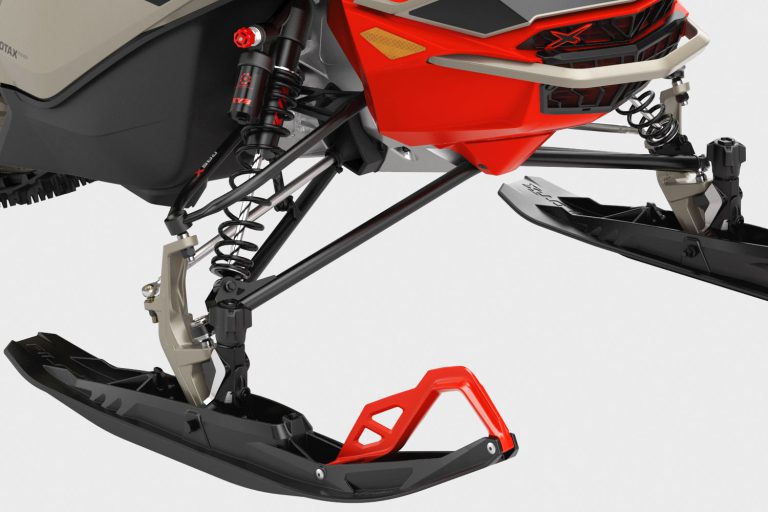
For MY 2021 Ski-Doo has re-invented the tuneable ski, which is now called the Pilot TX. Changes made to the ski blade profile and carbide are myriad. The ski now has a deeper and longer center keel and uses a longer carbide as well. These two changes amount to a completely new ski and most importantly, a completely different response to tuning inputs. So dramatic are the changes in the ski’s performance, everyone around here noticed the improvement immediately.

The TS-X ski works equally as well on the G4 2-strokes as it does on the 4-strokes. We did experience more push at higher corner entry speeds on the 4-strokes, but that is mostly due to the extra inertia from the heavier 4-stroke engines. This was easily countered by dialling-in more carbide depth.

HAPPY

We are standing and applauding Ski-Doo’s new Pilot TX ski and its performance on the G4 platforms. It delivers a much broader range of response as you move the carbide in and out of the ski blade. Simply put, the Pilot TX is a more forgiving ski. This edition of the tuneable ski works every bit as good as the original TS Ski on the sled it was designed for – the XP/XS platform.

A Tribute To Rob Kincaid

0

Rob was quite possibly THE most genuine guy we’ve ever met. His dry but incredibly witty sense of humor was infectious and his insane, but true stories about his life experiences would leave you in stitches. There’s no question the man could ride a snowmobile, but what we respected and admired most about Rob was the deep and sincere love and pride he felt for his family and friends. He will always be remembered and will forever be missed. The snowmobile industry will never be the same without him. Rest in peace, Rob.

WHAT’S YAMAHA’S NEXT 2-STROKE STEP?

0

Hmm, that’s a tricky question. Just to be clear, we’ll phrase it another way: “Will Yamaha offer more 800 2-strokes in other categories?”

There. That says it better. Our best answer is this: It depends.

It really depends on how Yamaha customers adapt to the 2021 800 2-stroke mountain sleds already in the stable. If sales are good, we’re certain the company will smell blood and start the ball rolling toward offering other 2-stroke models – Trail sleds, Crossovers, FreeStylers, to be exact.

If sales do not meet expectations, there could be a “Full Stop” put on the possibility of more 2-stroke X-TX models or maybe B-TX 800s.

Hey, what am I talking about? Just slipped those in and wasn’t sure you’d notice.

An X-TX 800 could be based on Cat’s baseline RIOT using a dual rail skid and the trail front end assembly found on the SnoPro. With it’s QS-3 shocks, plush, uncoupled 146-inch skid and a 1.6-inch track this is a really good sled both on-trail and off, and is perfect for comparisons to Polaris’ Switchback Assault. It’s a true crossover sled.

Maybe the B-TX 800 would scoop some attention in the harder-core FreeStyle market. This sled would mirror the RIOT X and use the single rail skidframe along with softer spring and shock calibration (compared to a mountain sled), the skinny spindle mountain front end and a 2.5-inch or deeper track.

Yes, unfortunately, these sleds would likely be exact copies of Arctic Cats. Clutches, bodywork, ergonomics – everything the same. Insert upside-down smiley face here.

It looks like Yamaha is pretty much on course to fill showrooms with models that are technically the same as Arctic Cats except for paint and graphics.

Somewhere in the corporate world a decision has been made along these lines and it looks like that’s what Yamaha customers are going to be dealing with.

The upside is, these sleds are really good snowmobiles and feature very cutting-edge technology – besides looking fantastic in Yamaha blue.

It’s fun to let the imagination go wild about this, but everything hinges on the success of the new M-TX 2-stroke mountain program.

Keep in mind, if Yamaha only sells two 800 mountain sleds this year, that will be two more mountain sleds than it sold last year. The sales numbers don’t need to be stratospheric, but they do get Yamaha into a market it hasn’t been competing in for a while.

Come to think of it, using the 800 2-stroke in any market puts Yamaha into a category it hasn’t been competing in.

Sounds like a win-win!

2021 Ski-Doo Renegade X-RS 850 Walk Around Overview

0

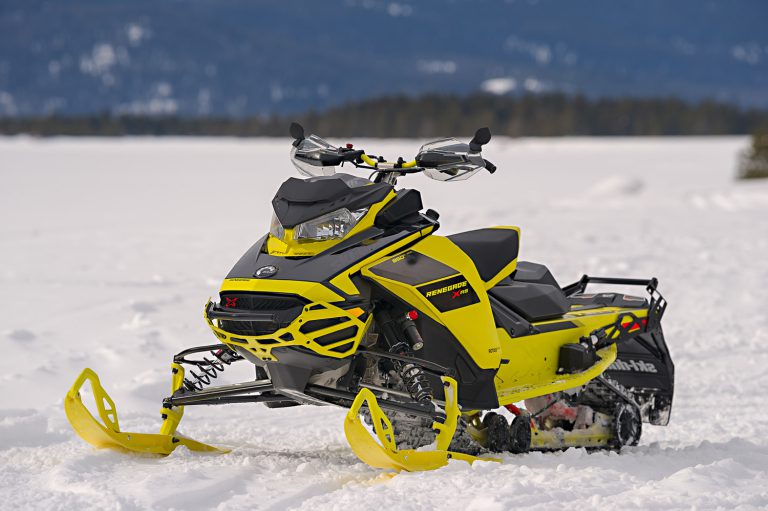
We just had a brand new 2021 Renegade X-RS dropped off at our front door featuring the new RAS X and rMotion X suspension, Rotax 850 E-TEC engine, new 7.2-inch wide digital display and new Pilot X skis. Watch as Luke gives a first look at this sled and provides a full overview, sharing some opinions and details after getting a chance to ride it last month in Montana.

Subscribe to our YouTube Channel!

CAT’S NEW CHASSIS

0

There is no doubt it’s Arctic Cat’s turn to level a new snowmobile platform.

In fact, Cat has exceeded the industry-established (by Ski-Doo and Polaris) five year chassis cycle by almost five years.

Yes, my green underwearing friends, it was MY 2012 when the current ProCross platform was introduced. Surprisingly, it remains strikingly familiar to this day.

We don’t ascribe to making changes simply to meet an arbitrary timeline. However, the current ProCross platform has been tweaked and touched up numerous times – and the net effect has been generally good.

But not all good. Two glaring areas are overdue for a re-think that in all likelihood, will require some significant component shuffling.

FIRST TO GET SHUFFLED

For sure the industry has come a long, long way since 2012 in terms of rear suspension compliance. The ProCross continues to use exactly the same skidframe – the “Slide Action” in 129 and 137-inch variants.

The Slide Action setup has never been widely known for plushness, however, it is an effective ditch banging set-up that’s rock solid reliable and genuinely bulletproof.

Unfortunately, there’s the stark reality of how good the other guys, namely Ski-Doo and Polaris, rear suspension systems are in MY 21. Here’s our thinking on the issue:

Why not develop a new rear suspension based on the same foundational designs as rMotion and Polaris Pro CC? These extra long front torque arm designs are clearly the future for trail sled suspension.

The bigger issue with this thinking is whether or not such a skidframe design could be shoehorned into the current ProCross architecture.

SECOND TO GET SHUFFLED

The next issue requiring attention is the seat. The current ProCross seat continues to be both too soft and too low, even after a re-jiggering of the seat more than five years ago.

The question we have is whether or not the seat can be made firmer and taller while incorporating a flat top all at the same time.

This may require some chassis and component adjustments revolving around where the rider interfaces with the rear torque arm and drop-link mounting positions.

Clearly the complete re-do of ProCross bodywork two season ago netted more space for the rider to move around while providing vastly improved underhood service access.

WHAT WORKS

The ProCross bulkhead, with its radically spaced upper and lower A-arms has served this chassis well. In particular, the wide spacing has allowed for the fitment of a very broad range of power packages including the most powerful production snowmobile engine in the biz, the Yamaha 998 Turbo.

Considering this chassis can swallow a tiny 65-hp, 400cc liquid cooled single in the BLAST and a bevy of potent 2 and 4-stroke engines is remarkable.

The most recent IFS tweak for MY 2020 that raised the lower balljoint location on the spindle has been among the most significantly tangible improvements in the chassis’s nine year history.

The ProCross now turns-in and holds its line through the center of turns with both predictability and absolute precision.

DEEP THOUGHTS

When it’s all said and done, the ProCross is undoubtedly the most versatile snowmobile platform in the industry. There is actually very little needing a re-think – however – we believe a new skidframe and ergonomic updating would keep the ProCross fresh for at least another couple years.