Home Blog Page 69

CAT’S 2-STROKE FUTURE

0

Arctic Cat has been proving its commitment to the sno-mo-biz in MY 2021 with the intro of solid performing, all-new models and breaking into a new segment with the BLAST and its variants.

Frankly, we think Cat is as committed to the industry as it’s ever been and intends to stay in the business for a long, long time.

Here’s what we’re speculating on: What does the 2-stroke future look like at AC?

Although Cat leads the industry in the power department with the Thundercat, its meat and potatoes product line is its 2-strokes – specifically its biggest inch 2-stroke, the new SDI 800 twin. This engine finds a home in so many different types of Arctic Cats – Trail, Crossover, Mountain – even Utility – that it provides a significant allotment of the company’s sales.

It’s no secret, although the 800 CTEC2 is a very powerful and fast 160-ish-horsepower engine, Ski-Doo and Polaris are both offering 850s. That sizzle factor alone – more displacement – is something the engineers at Cat have to deal with, and so do their dealers in the showroom wars.

We have zero doubt Cat is working – right while I’m writing this – on a larger version of the 800. Could it be a new 850 to be introduced in MY 2022? Dunno – but here’s what I’m thinking and the more I mull it over, the more I could see it happening.

We would not be surprised if Cat completely hurdled over the 850 2-stroke fence and introduced a new 900 twin. Yes, Cat already offered a Suzuki-built 900 twin almost two decades ago – and it was very successful.

It’s a different day now, though, and 2-stroke engines are much more refined and way more technical. Using nice clean, lean Semi-Direct Injection tech and all the balance refinements of new big-inch engines, a Cat 900 could be a homerun.

It would immediately grab the attention of the market and put the company a giant leap ahead of the competition. Cat would instantly go to the front of the bus!

A 900cc SDI 2-stroke could make power in the 170-plus range, be EPA certifiable and blow the socks off the lake racing public.

My guess is, if this were to come true, Cat would take the same route Polaris did by offering both the new 900 and the current 800 in the same models. Even the high performance market has some limitations and, depending on pricing, those shoppers may feel the 800 is more than sufficient for them.

We like this theory – and it’s purely speculative at this time, but wouldn’t it be an exciting development?

We think it makes a lot more sense than coming with a me-too 850!

2021 Yamaha Mountain Max 154 800 2-Stroke Walk Around Overview!

0

AJ takes a break from his first ride aboard Yamaha’s 2-stroke Mountain Max 154 to give you his impressions and a quick look at all the details about this sled.

850 ETEC TURBO TRAIL SLED

0

It looks like Ski-Doo’s decision to offer a turbocharged 2-stroke production engine was a good one. The Summit turbo and for 2021, the 850 Turbo Freeride, begs the question if there’s a bigger plan up ahead.

Most certainly, from the time the turbocharged 850 Summit was introduced in January, trail riders and lake runner’s imaginations have been running loose. You can only dream in Technicolor about a 200-plus horsepower turbo Renegade or MX-Z. Is it a pipe dream or not?

Ski-Doo put a lid on rumors pretty soon after the Summit appeared indicating the idea of a factory built turbo-2-stroke was only designed for higher altitude use and that under no circumstances does the turbo 850 produce more than the 165 max HP it is designed to produce at sea-level.

It is never-ever-never-ever intended for trail or lake sleds at sea level. That doesn’t mean that savvy computer gurus can’t tweak (and are doing exactly that) the waste gate controller on the new turbo.

Sounds like it makes sense – but the last time I heard, Ski-Doo was in the business of selling snowmobiles!

From everything we’ve heard SD does not intend to use the 850 engine with added turbo boost on trail sleds. Why? By the engineers’ open admission this engine was designed to produce and is maximized at 165-hp. To deliver more power using a turbo would require bigger rods, bigger crank and other expensive re-tooling activity which would amount to a whole new engine. The engine isn’t designed to deliver 200-hp, however, it is designed to deliver 165-hp reliably in the thin air at 8000-ft thanks to a turbocharger.

Having said all that, in our opinion, if this engine-turbo combo proves to be reliable, there’s a chance you’ll see a beefed up and massaged version on more sleds – including flatland models. I mean, really, can you imagine a 200-hp lake sled that was actually, genuinely light? Wow, we’re liking it!

Here’s another thought – and it’s a big deal. Ski-Doo is fighting to keep the market share dominance it has accumulated over the last fifteen years. What if a competitor beat them to the punch and offered an 850 Turbo Indy or a Procross 800 Turbo – even a Yamaha whatever with a turbocharged 2-stroke? It sends shivers up our combined spines thinking about it!

And another thought: Guess who is in the business of manufacturing turbochargers these days? Yep, Ski-Doo makes its own TBCGRs right in the Rotax plant in Austria and has a considerable use for them.

We wonder if once the shoe has dropped and the market has been toe-tested, if there’s a possibility Rotax might deliver a turbo 2-stroke for the masses.

Some of The Best Snowmobiling Quebec Has To Offer!

0

Motorhead Mark treats his beautiful wife Barb to a couples getaway as they set out to explore all the picturesque trails and friendly hospitality that the Québec region of Abitibi-Témiscamingue is famous for.

Subscribe to our YouTube Channel!

MYSTERY SLED: 2021 ARCTIC CAT RIOT X

0

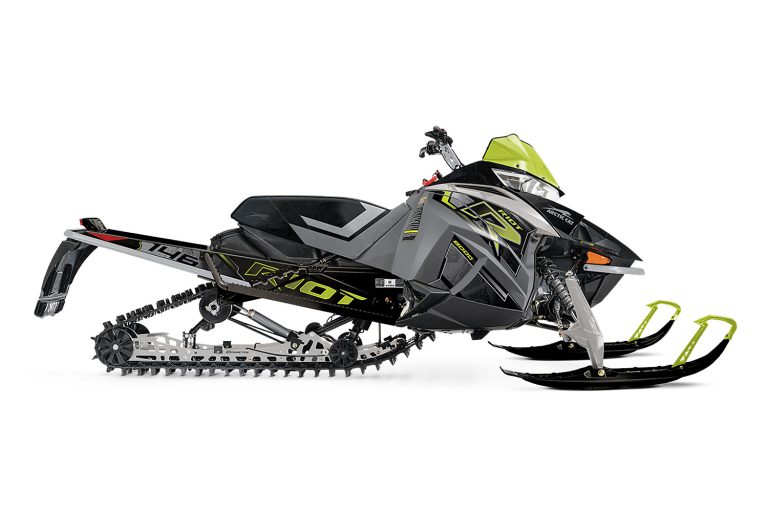
We’re calling the new RIOT X “crossover” this year’s winner of the “Mysterious Sled” award! Why?

Last year’s RIOT X, targeted at the buyer who was about 60-40 into powder riding versus trail riding, was an efficient crossover that could perform decently on the trails but really excelled in the deep stuff.

This year’s RIOT X has targeted the 90-10 ratio of riders who ride 90-percent in the powder and only use their “crossover” to get from their staging area to the hills. To call this sled a crossover is like looking at an emu with its head stuck in the sand.

After riding it, you just can’t deny this is a mountain sled with a short track and softer calibrated, more adjustable suspension.

It uses Cat’s very powder-specific Alpha single rail skid and that feature alone sets it apart from the competition’s crossover sleds.

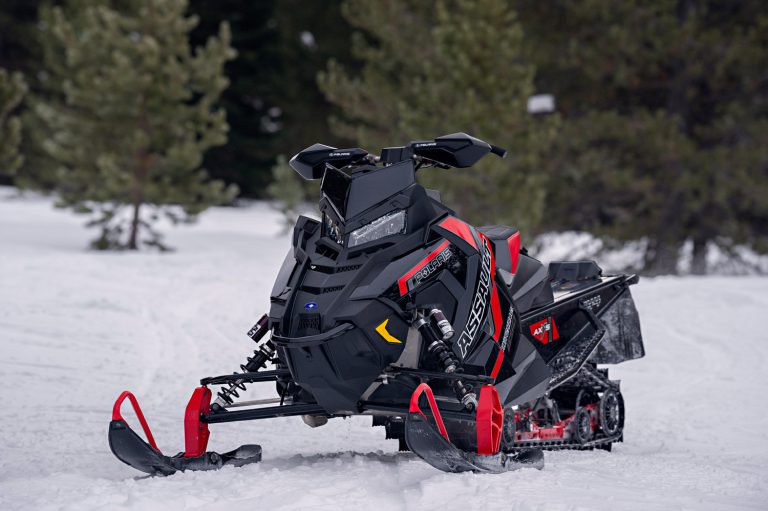
Although our test team in West Yellowstone, Montana loved the RIOT X Alpha in the powder and the trees – and claimed it was absolutely incredible for handling due to its relatively short 146-inch track length and 2.6 paddles, they much preferred the true crossover RIOT with its dual rail suspension and shallower paddle, for trail use. It was pretty much agreed the dual rail, plain vanilla RIOT was the Polaris Assault’s best competitor.

If you’re comparing, the RIOT X falls more in line with the Polaris SKS – which also leans very heavily toward powder and vert use – no excuses made by Polaris.

Our best explanation to describe the function of the RIOT X Alpha is that it is extremely competent in fluff and can actually climb with some of the most aggressive pure mountain sleds – a lot due to its excellent 800 CTEC2 SDI twin.

This engine offers lightning-quick throttle response and makes the kind of power that deep snow use demands. The RIOT X will still, however, be a compromise on trails despite its excellent QS3 shocks and lighter spring setup.

There’s really no problem here – except for the language used to describe a sled like the RIOT X. This sled in no way “crosses over” between trail and powder.

It’s as boldly about deep snow riding as any all-out mountain sled and is designed to get you to that stuff where you can play all day, not to take for a 200 mile trail ride.

As long as you realize that fact, you will fall in love with this very competent short tracked mountain sled!

2021 Switchback Assault 146 Walk Around and Overview

0

AJ’s got his hands on a 2021 Polaris Switchback Assault 146 featuring the 850 Patriot engine and the all-new L7 display. Watch as he combs over just about every detail he can think of to give you the most in-depth overview of this new sled.

Subscribe to our YouTube Channel!

FXR RIDE PACK 20

0

This 5-star reviewed backpack has been a favorite gear item amongst the Supertrax/SnowTrax staff this winter.

The Ride Pack’s attention to detail in its style and quality allow the user to wear the pack comfortably like and additional layer of clothing during snowmobile rides as well as an everyday bag for travel, work, sports or school.

Comes in a variety of attractive color combos.

• Lightweight and durable construction

• Removable, breathable, suspension system easily converts from ride to casual configuration
• External shovel blade and handle storage
• X-system padded chest straps allow increased arm dexterity and comfort
• Load-spreading kidney belt with pockets
• Stowable waterproof shell cover
• Fleece lined goggle storage
• Full access clamshell zipper main compartment
• Adjustable cargo cinch straps
• Organizer pockets for cargo
• External water and snow probe pocket with ties
• 1 YEAR WARRANTY

Visit fxrracing.com for more information.

SNOWTRAX TV 2020 – Season Finale Sneak Peek

0

Coming up on the next episode of SNOWTRAX TV…

It’s time for Luke to reveal the 4 sleds we think stood out as the best-of-the-best from each of the four manufacturers in 2020, then from these he presents our choice for the highly coveted SNOWTRAX Real World Sled of the Year Award.

Then AJ presents the 2020 SNOWTRAX Revolutionary Advanced Design award to the manufacturer that pushed the envelope the furthest in terms of technological advancement in the snowmobile industry this year.

Finally, AJ’s high up in the mountains delivering his full review of Ski-Doo’s 2021 850 E-TEC Turbo powered Summit Xpert 165.

SKI-DOO’S 600R vs 600 EFI SPORT

0

The old adage stating an internal combustion engine is nothing more than an air pump can be graphically illustrated in two new Rotax engines powering Ski-Doo snowmobiles.

The new 600R E-TEC engine arrived two seasons ago as a completely new design producing 125-HP. When we received word of the new 600R and had to sign embargos keeping it a secret, we were surprised Ski-Doo didn’t write chapter two of its “How to One Up the Competition” novel.

What do we mean? The writing was clearly on the wall after Ski-Doo introduced the 850 and smashed the 800-class mold. Why didn’t they drill bigger holes and make the 600R a 650R? Obviously, the rest of the story is history.

BACK TO OUR POINT

The new 600R E-TEC engine employs every trick in the Rotax 2-stroke book to deliver a pleasing surge of EPA compliant thrust. The engine is a pleasure to squeeze on tight trails or big pulls up Kevlar Lake.

A new, lighter and rationalized E-TEC injector is used along with new E-RAVE exhaust port modifiers. The engine’s durability and anti-wear properties are improved with an exotic cylinder coating process that sprays the aluminum cylinders with a super hard and durable liquefied metal that’s finished by an equally exotic polishing regimen.

The 600R, while closely mirroring the 850, does not have a 2-piece forged crank. Rather, it uses a conventional, pressed together “built” crankshaft. The new 600R idles smoother, delivers low-end power more efficiently and transitions to shift RPM virtually seamlessly when compared to the Series III 600 E-TEC it replaced.

The engine has been a hit since its intro. Keep in mind, the 600 class is still the most prolific engine size in the biz.

INHALE

Remember what we said about an internal combustion engine being an air pump? That is undeniably true and proven by the way the newest 600 using EFI facilitates the 600R E-TEC platform by simply altering its ability to inhale and exhale – more commonly stated as its ability to “suck and blow”.

Clearly, the 600 EFI engine is built on the same cases, crank and cylinder castings. The big change comes with the substitution of the complex and costly E-TEC direct injection fuel delivery system.

This includes the substitution of E-TEC’s complex, 50-amp electrical system and engine control module (ECM) with a more garden variety, low pressure, throttle body EFI fuel system.

E-TEC injects fuel directly into the combustion chamber from the cylinder head mounted injector after the rising piston closes the exhaust port. The 600 Sport EFI introduces fuel into the throttle body located outside the combustion chamber and scavenges that fuel under the piston, up the transfer ports and into the combustion chamber.

On the exhaust side of these two engines the exhale differences come into play. The 600R E-TEC uses ECM controlled servos to activate the RAVE port modifying “guillotines” in response to a jillion inputs into a highly complex 3-dimensional ECM map.

Essentially E-RAVEs compliment E-TEC’s precision injection of fuel and assist the direct injection system by holding unburned gasses in the combustion chamber. As the E-RAVEs move up and out of the exhaust port, the engine is able to pump more air for increased high RPM power.

EXHALE

On the exhaust side of the 600 Sport EFI engine there’s no exhaust valves – period. The 600 EFI engine relies on a tuned expansion chamber to hold up unburned exhaust gasses using reverse pulse waves resonating back to the fully unrestricted exhaust port.

However, it must be noted both the volume of incoming fuel and air and the volume of spent exhaust gasses leaving the 600 EFI are dramatically reduced when compared to the 600R E-TEC. This is why the 600 Sport EFI delivers 85-hp and the 600R E-TEC produces 125-hp.

I know what you’re thinking – would the 600 EFI produce more power by bolting on 600R cylinders? Let me say this – don’t even think about it! Switching cylinders would require a complete re-mapping of the Sport’s EFI ECM. It Is doubtful the new EFI system could deliver the volume of fuel needed to make a Frankenstein version of the 600 Sport.

SDI, DSI, EFI

The idea of EFI for 2-stroke use is not new. Arctic Cat’s Suzuki 800 twin used a very effective throttle body EFI system for many years to produce heroic power. Just to be clear – EFI isn’t SDI.

Semi-direct injection introduces fuel to incoming air in the transfer or boost port on the cylinder. SDI is currently in use on Arctic Cat’s new 800 twin and Polaris Liberty and Patriot engines including the all-new 650.

Dual Stage Injection (DSI) is used by Arctic Cat on its potent 600 twin. DSI injects fuel on the top of the piston at relatively low RPM and then transitions to injecting fuel both on top and under the piston with the same injector as RPM rises.

That’s all we can tell you about the new 85-hp Ski-Doo 600 Sport engine, for now. One question we are poised to answer is whether or not an aftermarket expansion chamber could increase the 600 Sport’s output. Stay tuned.

THOUGHTS ON YAMAHA’S 2021 2-STROKE OFFERINGS

0

Now that the dust has settled and everyone has had a look at the 2021 Yamaha line-up, we’re wondering where the intro of a line of 2-strokes is going to go with Yamaha down the road.

We’re not so focused on the new Venom (400cc 2-stroke single) line as much as we are on the SDI 800 2-stroke Yamaha is using in the Mountain Max and the Transporter.

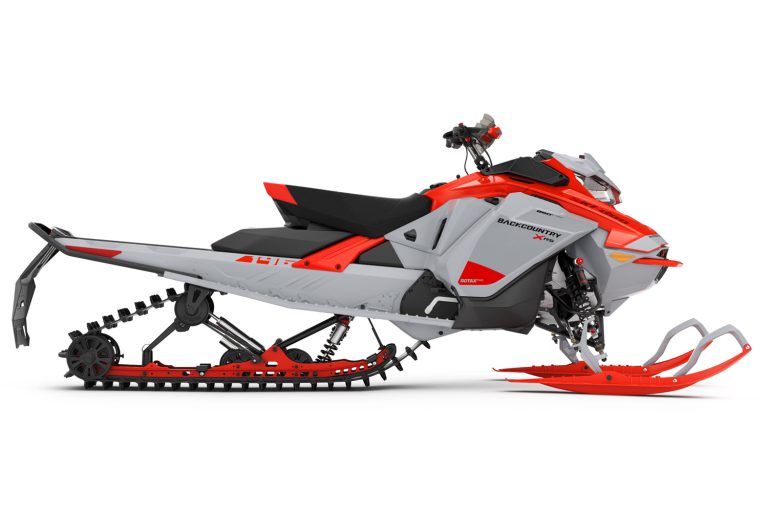
BTW: In our opinion, the Transporter 800 is so close to being a Crossover sled – given the fact the industry is going with longer and deeper tracks on sleds like the RIOT, Assault and Backcountry, that the Transporter logo could easily morph into a crossover-adventure hybrid without having to use too much imagination. Certainly, its upgrade in power adds a ton of appeal for Yamaha buyers who want to spend more time off-trail than on.

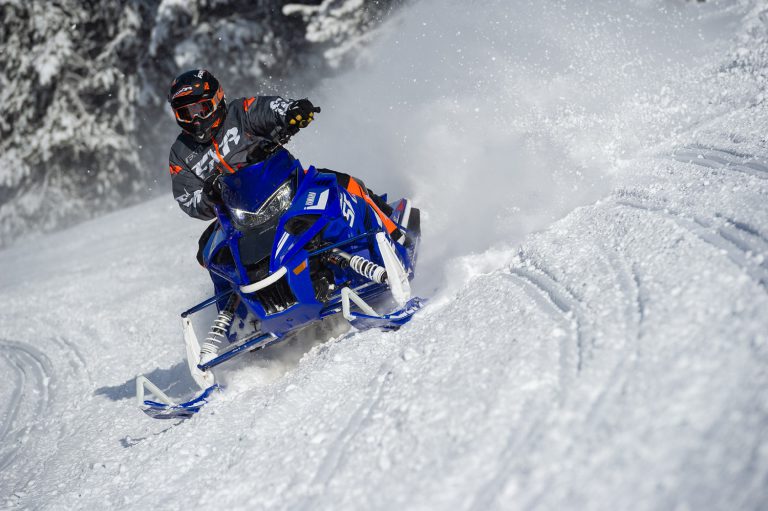
Getting into the mountain market with a high-tech, lightweight 2-stroke sled makes the Mountain Max super-appealing to two types of buyers: First, the most obvious is the Yamaha guy who has wanted to be an altitude rider the last couple years. The Mountain Max will fill the bill nicely.

The second type is the rider who can’t get an Arctic Cat because he-she didn’t lay down the fresh to get in on an early-season purchase. True, this isn’t a problem now, but in-season, when the Cat offer expires on early-orders, the only Cat-like mountain sled you’ll be able to see in showrooms will be the Mountain Max, provided the Yamaha dealer early ordered some of them for inventory. We think a lot of purebred Cat artists will be shopping for an M-Max then.

Another point is Yamaha’s pricing. So far, the published premium on a Mountain Max is about $600.00 more than the Alpha One. Frankly, this is a bit troubling but if you give it some consideration, you need to remember that Cat is offering killer prices on all of its sleds if you slap down a deposit early.

Since there are no in-season, in showroom Cat sleds available and if Yamaha holds its price to where its intro puts it, the Mountain Max’s price tag may turn out to be pretty reasonable later in the season.

As far as value goes, customers who step up for the Mountain Max 800 will not be disappointed. This is a truly fine snowmobile, well-researched and with some real props against what Polaris and Ski-Doo are offering.

We think this is a toe-test of other Yamaha 800 2-strokes down the road – perhaps a lineup of 146-inch 800 X-TX models or even 137-inch L-TXs or 146 Ventures.

Looks like, if you’re “in for a penny, you’re in for a pound” with the door now opened wide for more 2-stroke Yamahas. We love it!