
Home Blog Page 408

Ski-Doo Clickers

Question:

I have a question about Ski-Doo X package clicker shocks. How do you know where they are set from factory and do they go back to a soft setting after turning them 5 times if they haven’t been messed with yet?

Not having much luck finding out about them here.

Thanks

Rob Cooper

Response:

Thanks for your question!

I cannot give you a definitive answer on this Q as you have not indicated what year sled the shocks are from. There are distinct and important differences between some of these “clickers”.

However, I will take a stab at what you’ve put forward. If you’ve been counting complete turns – as I suspect by the number ”5” in your question – you are not doing the “clicking” correctly.

In my experience these clicker models from Ski-Doo all have at least ten and some as many as 20 or more clicks available and some have both compression clickers and rebound clickers. It’s important to know the diff. As well, on certain models there is a high speed clicker and low speed barrel nut.

Here’s the deal – you must have the shocks sitting at full extension – so lift the front or the rear of the sled so the shocks are fully extended before “clicking” anything.

Then you should turn the clicker all the way in (tighten) until it gently bottoms or comes to a stop. Count the number of detents or “clicks” you feel from where you were at before starting until the screw bottoms. DO NOT TURN THE CLICKER SCREW TIGHTLY INTO BOTTOMING!This will score the very precise and fragile needle you are screwing into a valve orifice.

Now carefully screw the clicker all the way out (loosen) until it stops. Count all the clicks as you turn from full in to full out. Now, turn the clicker to the middle click (if there’s 22 clicks then stop at #11) and go ride the sled through bumps at varying speeds.

This will be your benchmark for either increasing compression or decreasing compression. The same goes for a rebound clicker. There’s a whole lot more to learn from rebound but we’ll leave that for another time.

Good luck!

Motorhead Mark

Reply:

Sorry, it’s a 2006 Ski Doo 600 SDI X package. I’m told there are only 5 settings, but nobody around here knows anything about them.

I’m from Connecticut and bought local as the price was right. I do most of my riding in Maine. I’ll try screwing them in and see what happens. Do I turn the high rate in the same manner?

Thanks for all the help.

Rob

Response:

Howdy!

I recommend you not touch the outside barrel nut – if that is the style of hi-lo-speed compression clicker you have.

The inner flat/slot screw clicker is the hi-speed adjuster – just play with this. The outer barrel nut style is the low speed and it can be very finicky – if your piggy back KYB’s have this style.

The rebound clicker is most often at the other end of the shock. Fiddle with it after you have settled on a compression setting to your liking.

Motorhead
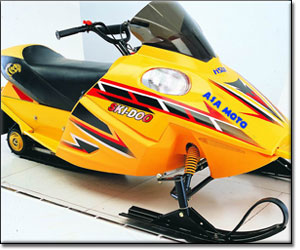
MORE ASIAN SNOWMOBILES

In the current issue of Supertrax there’s a photo of an 800cc snowmobile from China. The Scarab looks like a pretty serious effort but we’ve only been able to acquire scanty details about it.

One of our readers sent in a link to an interesting website for another Chinese manufacturer already making knock-off mini-sled copies of the BRP Mini-Z and the Polaris XC120.

You’ll also see photos of a revised and improved copy of the old Chrysler Sno-Runner and a 250cc weird looking thing.

Not sure how close to the originals these sleds are or whether they’re tied to the Scarab.

Visit smartmotorcycle.com.

Power Hungry Follow-Up Comments

0

Kent, Kent, Kent,

I normally respect your opinion on most everything. However as a GM Powertrain employee I am in complete disagreement with your recent “power hungry” titled discussion.

I quote “At the root of the problem is the two US behemoth’s difficulty innovating and delivering clean engines that product the king of power North American drivers require, and doing it with reasonable cost.” Come on, I expected something more intelligent from you than this.

Is 300+ horsepower not enough for you available in some of our cars and utilities, is 400+ horsepower not enough for you in some of our cars and utilities, is 500+ horsepower (ZO6 Corvette) not enough horsepower for you.

Do flex85 fuel and coming hybrids not represent innovation and clean? Enough of the Europeans perfecting variable valve train, variable intake risers, etc. The “big three” have had those for years albeit not as common as some foreign vehicles. You think it doesn’t cost billions of dollars to develop an engine program? Think again.

Of course it’s not as much to develop a small engine. That’s not rocket science. Give credit where credit is due. The so called clean engines you refer to by foreign competition are typically way less horsepower than domestics and those that are comparable in horsepower are not necessarily any cleaner or efficient. The media is really negatively biased towards domestics and it gets tiresome.

Regards

Jeff Williamson

Response:

Jeff:

Glad you took time to read the article and thanks for responding. My comments on the domestic auto industry were not a potshot at the automobile business as much as a praising of the snowmobile industry for its ability to innovate economically and rapidly.

As a domestic truck owner myself I am concerned about the dropping stats for Big Three automobile sales. I’m also aware that Detroit is working triple time to get back on track with faster, less expensive and cleaner cars. There’s never been any doubt about GM, Ford and Chrysler’s ability to build engines with big horsepower – NASCAR is ample proof of this and cars like the Viper and Z01 Corvette, although beyond the price range of most buyers, are convincing arguments.

If Detroit is going to get back into a world leadership position, in the price ranges most automobile buyers are shopping, it is going to have to behave like a leader by building cars that generate more base horsepower in each class while still delivering EPA cleaness and low cost and I ‘m not talking about big honking V-8’s.

Take a look at the base V-6 and 4-cylinder engines from Nissan, Toyota, and Honda in the Altima, Camry and Accord and compare them to the base engines in the once hugely popular Impala (4-cylinder not available), currently strong selling Ford Fusion and the new Sebring. Although I like these cars and would consider each of them for myself, I get a wallet cramp when I look at the horsepower I’m paying for compared to the Japanese stuff. Then there’s the end-of-lease residual value blues that come into the picture, too.

Don’t get me wrong, these aren’t hate comments. I just think the domestic auto industry has to get better at competing with the Asian market and needs to do it fast! The snowmobile biz is an excellent model of how to get there.

Kent Lester

Playing Favorites?

Question:

Many say you are “in bed” with SkiDoo and having a poll where there is only one Doo versus 2 Cats and 2 Yams only furthers this. With your Ski-Doo fan following and not having to split votes, the Renegade will win in a landslide.

Steve

Response:

Thanks for your email!

Over the 17 year history of this magazine we’ve been accused of being in bed with – at one time or another – all four OEM’s.

When one OEM delivers better product and shoots ahead in sales we comment editorially on the product – if it’s good – and it usually is if it causes a market shift – we evaluate the product and clarify the details. Invariably our report on a new better sled – regardless of who built it – is usually a reflection of just that – a new and better sled.

There was no collusion involved in Ski-Doo ending up with one sled in this on-line poll. I think your observation is correct, Ski-Doo will get all the votes from loyalists on one sled while the others will be split.

Anyway, we do lots of polls all year and you could conclude we’re biased (to any OE) from almost anything we write. It’s what this business is all about.

Your interpretation proves brand loyalty is still a huge influencer in purchase habits. I would suggest you read carefully our editorial on both the new F’s and the Yamaha’s – we have been criticized greatly for liking them from the other two OE’s.

Have great winter!

Motorhead Mark

Cleaning Polaris Exhaust Valves

Question:

Hi guys,

I’m looking for a long lost Supertrax issue that included a great article describing the correct method for cleaning Polaris exhaust valves (03 700 Pro-x).

It appears that my wife may have “Removed” my more heavily read stack of supertrax mags from their beloved storage area in the bathroom closet during fall clean-up.

Can you hook me up with the proper cleaning procedures?

Thanks to the best mag in the business!

Dwayne

Response:

Thanks for your email!

I’m pleased you liked our original story on exhaust valve cleaning.

I haven’t been able to locate it from our archives just yet but in the mean time I would suggest you contact Polaris through their website and download their instructions on valve cleaning. I’m sure we accessed their info when we put together the story.

Hope this helps!

Motorhead Mark

WPSA READIES FOR HISTORIC BRAINERD NATIONAL

Press Release –

The WPSA PowerSports Snowmobile Tour will make history next weekend when it brings Pro National Snocross racing to Brainerd International Raceway for the first time. The Polaris BIR Championship is scheduled for Friday through Sunday, Jan. 12-14, here.

The event, which will feature Pro Stock and Pro Open finals on both Saturday and Sunday, will also feature qualifying Friday, and a full Amateur and Pro-Am show during the weekend. Saturday’s race will be telecast on SPEED on Feb. 3 at 2 p.m. EST, and will re-air on Feb. 7 at 3 a.m. Sunday’s event will be telecast on Feb. 7 at noon EST, followed by the re-air Feb. 15 at 2 p.m.

“Brainerd International Raceway has hosted many notable national racing series during its nearly 40 years of operation, including World Sports Cars, Trans-Am, NHRA drag racing and many others,” said PowerSports Entertainment, Inc. CEO Rick Murphy. “We’re thrilled to add the PowerSports Snowmobile Tour’s National Snocross moniker to that list. We’ve run many successful and exciting regional races here, and we’re looking forward to bringing our brand of National Snocross racing to Brainerd.”

“Brainerd has long been a vacation destination for snowmobile enthusiasts from all over Minnesota and the surrounding states,” said Scott O’Malley, president of PowerSports Entertainment, Inc. “Our snowmaking crews are working double time to get the track prepared and we’re looking forward to an exciting and competitive race weekend.”

The Polaris BIR Championship kicks off Friday, Jan. 12 at 9 a.m. CST with qualifying. Racing gets underway Saturday, with both Pro finals running at 10:30 a.m. and noon. Sunday will feature the Pro finals at 9 a.m. and 3 p.m. A full race weekend schedule can be downloaded in PDF format at PowerSportsTour.com.

MORE WET WEIGHTS FOR 2007 SLEDS

0

We weighed some of the new sleds and reported on it last month. Since then we’ve added a few more to the list and have come up with some interesting observations.

The first sled we weighed was the Arctic Cat Twin spar F6 and we got a wet weight reading of 591.5 lbs. The second sled weighed was the Polaris IQ 600 CFI. Wet weight registered a feather-like 566.5 lbs. The Ski-Doo REV MXZ 600 SDI came in at a very reasonable 576.5 lbs, wet.

The 600 IQ Polaris continues to impress with its killer power and lightest wet weight. This combo makes it the sled to beat in the 600 class this year.

What Are The Advantages To ACT?

Question:

I’m looking to upgrade my current sled. I have found two carryover F6 Firecats from 2006. The green one has a traditional gear box plus reverse and the orange one has the new ACT drive.

I’m wondering if there would be any noticeable difference in the two drive systems. I know there’s about a 10 pound weight difference, but are there any other advantages to the ACT?

Bill

Reply:

Thanks for the email!

Either Firecat is a great choice and you pretty much said it all when you noted the 10 pound weight difference. Frankly, we haven’t noticed much difference in the way the planetary drive system works versus the older jackshaft system. It depends what you want on your sled.

If reverse is a big consideration, the older drive system can be pretty easily converted to reverse. If you don’t care about backing up and want the ultimate in low weight, go with the ACT model.

Of course the best scenario would be if you could convert the ACT drive to ACT w/reverse (I don’t know if this is a possibility yet). We’ve sampled the 2007 Cat reverse system (planetary) and it’s the best in the industry, bar none.

Kent Lester

Which Reed Valve System Offers Highest Performance

Question:

Hey guys, I love your site and mag. I always try to look at your articles on here every couple of days and try to get a magazine every month to keep updated with what’s going on in the biz (most accurate info in the biz today)! I’d go for a subscription but school keeps me pinching pennies but anywho I have a couple of questions for you guys.

I wanted to know which reed valve system would be the best one in regards of overall performance increase: The Boyesen reed valve system or the V Force 3 reed valve system. What advantage does one have over the other?

Also, I was wondering what the advantages were to gutting an airbox and if there are any dissadvantages to doing this.

Oh and one more thing, when school is finished I plan on buying a well used (8600 miles) 1999 RMK 700 (and a subscription from your mag I might add) with new rings, pistons, seals, bearings, and lots of other new parts replaced in 2005, from a friend and was wondering which not so expensive mods would give me some well needed HP (I think its rated hp for that year was something like 115).

It has some clutch work and gearing work to give it more down low snap as well as Carbon Tech reed petals and a boost bottle, and a custom made can too (actually sounds mean). Please give me some input.

From one of your favourite fans,

Chad

Reply:

Thanks for your question(s)!

First, the reed valve replacement issue. Both systems you speak of are good performance improvers and the difference between them – if there is in fact any – would be unquantifiable for even a hard core tuner – unless you used a dyno.

These reed valve systems increase the motor’s ability to “scavenge” – or pump air. That’s the deal in a 2 stroke – move more air, mix fuel in with the air and you make more HP.

This requires more than just reeds to take it to its upper most level and will be the answer to what you could do to the used RMK 700 you are looking at.

If you run big reed cages you are allowing the motor to take in more air. Next step, processing the air internally requires porting. Hog out the transfers, raise and open up the exhaust port. Finally, get rid of the air – install a honking big set of tuned (twin pipes).

This will net you a motor which, in my humble opinion, will drive you nuts. It will be pipey, lose torque (bottom end) and will scream like a wild banshee with a shift RPM increase of more than 1000 revs. How’s that sound?

Personally, I wouldn’t do this to an enemies sled. Install the reeds. They’ll improve low end response. Maybe a fatty single pipe that enhances torque and do the proper jetting to make it work and live. Do stuff that’ll make usable power – not peak power. Tighten up the squish with a shaved stock or aftermarket head.

Or, better yet – here’s a suggestion. Take the extra cha-ching you would spend on copious speed equipment and buy a newer, bigger displacement sled in better condition, with less miles.

At the end of the day, that 700 will only make so much usable HP. Sure, you can twang the thing until it screeches RPM but you’ll end up with a clutching and jetting sensitive annoyance that you’ll hate.

Good luck!

Motorhead Mark

What Does Extra Oil Do For A New Motor?

Question:

How long should extra oil be added to a motor for break-In? Does extra oil actually displace some of the gas and create a lean condition? Lastly, what does the additional oil do for a new motor?

Thank You

Mike

Reply:

Thanks for your email!

Good question! I’m noticing the OEM’s are talking less about the necessity for “break-in” oil added to the fuel on new 2 strokes these days. No doubt this is at least partially due to the new EPA certification process which monitors actual sleds in the field – from time-to-time.

The concept of adding extra oil is to reduce the piston/cylinder/ring friction created in a “tight” new engine. Essentially the extra oil provides a safety margin as it establishes what is referred to as a wear pattern or as some refer to this as the “seating” of the piston rings.

In any case, a new engine needs to “free-up” a bit by actually scratching (I use this word very carefully) microscopically – the cylinder and the rings. These small scratches are actually good and contribute to a tight seal between the piston and the cylinder.

It usually only takes a short time for this to occur but the most important thing for you to remember is not to squeeze the loud handle for long periods until you’ve got a couple hundred clicks on the odometer. Heat will build up in the rings and cylinder and can create a less than ideal “seal” during break-in.

In today’s electronically controlled world most new 2 strokes have a “built-in” ignition retarding program (Ski-Doo was the first to do this a few years ago) which actually “holds back” the motor from developing full jam – even when you whack it – until a predetermined number of hours has been clocked – usually about 5 hours.

No, the oil will not lean-out your mixture appreciably. Keep in mind – oil flattens gas – it actually reduces octane. Less oil is good. More oil is not so good.

Hope this helps!

Motorhead Mark

