Home Blog Page 368

CCSO Encourages Responsible Riding

Press Release –

With winter conditions well established in many parts of Canada the CCSO in partnership with the provincial organizations reminds snowmobilers across the country that February is Snowmobiling Environment Month.

Snowmobiling offers a wonderful opportunity to get out, get active and enjoy the beauty of Canada’s natural wonders during the winter months.

The Canadian Council of Snowmobile Organizations (CCS0) reminds snowmobilers that it is every snowmobiler’s responsibility to know and follow the Snowmobilers Code of Ethics and to ensure that our trails and forests continue to flourish.

The following recommendations can help to ensure that each and every trip onto the trail networks is done in an environmentally favorable manner.

Leave Tracks, Not Trash

If you had space to bring it in, then respect nature by carrying it out.

Protect Wildlife

Animals are more vulnerable in the winter, so keep your distance and leave them alone.

Stay On The Trail

Wherever organized trails exist, reduce your environmental impact by riding on them.

Snowmobilers have historically paid their own way for the development and maintenance of the snowmobile trail systems. In many areas trails developed by snowmobile clubs directly benefit many other outdoor enthusiasts.

During the non-winter months, many of these trails are used for hiking, horseback riding, bicycling and other trail based activities.

Share the message during the month of February that “Snowmobilers are Environmentalists”. We care about the environment and work closely with businesses and the governments to properly plan the trails systems.

Well designed, signed and maintained trails and riding areas will provide future generations with many enjoyable recreational snowmobiling experiences.
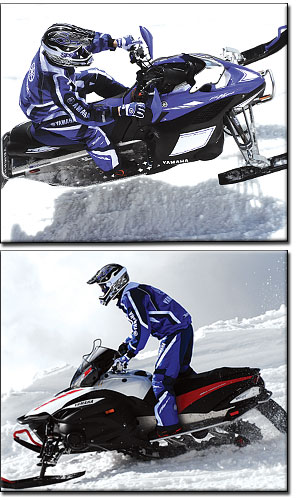
BEST IN CLASS AWARDS: Best 4-Stroke Snowmobile

0

Winner: Yamaha FX Nytro

Yamaha drew a line in the sand in 2003 and has been true to its self-imposed edict: To deliver credible 4-stroke power to the mainstream snowmobile market.

This unswerving commitment has led to the largest investment in new product from Yamaha in two decades.

The FX Nytro is proof positive Yamaha has arrived as not only the 4-stroke snowmobile company, but as the world leader in building 4-stroke sleds.

The new Nytro levels the last nagging objection to 4-stroke power: Weight. While not as light as the new Ski-Doo XP platform, it is lighter than many 2-strokes with similar power.

This, combined with a revamped A-frame IFS with improved geometry and an engine producing reliable 135hp-level power without more pistons, cubic inches or a turbocharger, makes the Nytro a superb trail weapon by any standard.

Runner-Up: Yamaha RS Vector

You read it right. Not only does Yamaha win Best in Class, it takes Runner- Up honors with the all-new and radically improved Vector.

Until the arrival of the Nytro, the Vector had been our favorite 4-stroke sled among all the trail hardware we evaluate every season.

Now, with the original carbureted Vector 120hp triple inserted in the rider-forward and slick handling Apex chassis using the easy-adjust single shock wonder-skid out back, Yamaha made it tough for us to decide which of its two all-new 4-strokes deserved to be called Best.

Eikura Wins Second of Season

Press Release –

At the start of the first heat, it was Yamaha rider Masafumi Terasaki who grabbed the holeshot. He was followed into the first turn by Shinji Tozawa, Tomonori Matsuda (A) and Nobuaki Eikura. But in that first turn, Tozawa and Matsuda bumped into each other and took a fall.

Besides that, Terasaki developed machine trouble in the first lap that forced him to retire from the race. That left Eikura to take over the lead and run on alone well ahead of the pack.

Entering the middle stages of the race, Eikura continued to race at a steady, high pace, but he was being chased all the time by Masaki Sasaki (S).

On lap seven Sasaki had closed in on Eikura’s tail, and on lap nine he slipped past Eikura into the lead. Shortly after that, however, Sasaki took a fall that put Eikura back in the lead and he ran on that way to win the heat.

Meanwhile, Yamaha rider Kiyotaka Kawagoe, who had come through the first lap in 4th position, lost two places after that to finish the heat 6th. Tozawa recovered quickly from his fall and managed to finish 10th, while Daishi Takamura finished 11th after a slow start.

In heat two, Matsuda took the holeshot, followed closely by Eikura and Tozawa. After that, however, the two Yamaha riders were unable to match Matsuda’s pace, and by lap four he had built up a roughly 10-second lead. Eikura and Tozawa continued to run in 2nd and 3rd positions respectively. Matsuda continued on that way to the checkered.

In the battle for 2nd, Eikura was able to run away from Tozawa and go on to finish 2nd. With his pace slowing somewhat in the latter stages of the race, Tozawa was passed by Sasaki on lap 11, but he was able to hang on to a 4th-place finish. After starting the race in 4th position, Kawagoe eventually dropped two places to finish 6th.

Takamura got off to a slow start and was unable to make up much ground during the race, eventually finishing 12th. Still feeling the effects of the injury he received at the last round in Nagano, Terasaki slowed during the early stages of the race and finally crossed the finish in 15th.

With this day’s results, Eikura got his second overall win of the season, following his victory in the opening round at Yuzawa in Niigata. The day’s 2nd-place winner was Matsuda and 3rd went to Sasaki.

OFSC Says Stay On Open & Staked Ice Trails

Press Release –

Recent Tragedies Highlight Risks of Random Ice Travel

After several off-trail drowning tragedies last weekend, the Ontario Federation of Snowmobile Clubs (OFSC) questions what else can possibly be said or done to prevent more such incidents from occurring.

Since the first snow in November, the OFSC has continually issued strong cautions that ice conditions are poor and unpredictable this winter. The federation has also issued many warnings for everyone to stay off Ontario’s waterways, unless and until a trail is open and staked by the local snowmobile club.

“We have been especially diligent in making continuously updated information available on our website and working locally through our clubs and volunteers, with police agencies, and with the media, to get the ice safety message out,” said OFSC Manager of Safety and Public Education, Bill Harrison. “Unfortunately some people still persist in making the personal choice to put their lives at risk by riding off of open and staked OFSC trails.”

Ice safety at the OFSC starts with operating land-based trails to avoid water crossings wherever possible. OFSC clubs have built thousands of bridges to make water crossings safer. Where a land trail or bridge is not possible, clubs choose the best possible crossing route; water trails are not opened until sufficient ice has formed and the proper thickness confirmed.

In many areas, mild weather plus heavy snow have combined with the absence of deep freeze temperatures to prevent good ice from forming this winter. Thus, many traditional water crossings remain closed as of last week.

OFSC clubs report trail conditions a minimum of twice a week, including ice crossings, and these updates are always available to the public at www.ofsc.on.ca. Recent statements on the website about ice include: “Ice is never safe! Stay off All Bodies of water until the local clubs have staked the water crossings!” and “Unstaked Lake Trails Remain Closed And Are Unsafe!”

“The bottom line is that no ice is 100% safe,” says Harrison, “but your crossing risk can be greatly reduced by using only open and staked OFSC trails, by riding in good visibility conditions, and by avoiding excessive speed and alcohol consumption.”

For many years, the OFSC has recommended that anyone traveling on ice should wear a buoyant suit and carry self-rescue ice picks. By following these few simple precautions, most ice tragedies are preventable. So once again, the OFSC urges snowmobilers to STAY OFF ICE AND WATERWAYS unless riding on an open and staked OFSC trail.

Questions About Ski-Doo XP 800R Renegade

Question:

Dear Motorhead,

When I tested the 121″ prototype XP 800R I considered the vibration in my hands AND feet to be unacceptable.

I was hoping you could tell me what you think of the production version? Does the ring gear and rubber steering mount solve the vibration problem? I’m interested in buying a 2009 XP 800R Renegade but I need the vibration fixed.

Also, I’ve seen some pictures on the internet of cracked/broken drive shafts (mostly on mountain sleds) where the splined ends are pressed into the hollow drive shaft. Do you know if BRP has a fix in the works for this and do you think it will be fixed for 09?

I’m assuming the other issues like handle bar warmers, suspension calibrations and breaking idler wheels are small enough not to worry about for 09 since these should be easy to fix.

Any info you can pass on would be appreciated.

Thanks,

Kerry

Response:

Thanks for your email!

Your questions are valid. The engine vibes in the bars are gone this year. The de-coupling system BRP used here is highly effective. The jackshaft issue has not been a problem on flatland XP’s however I’m confident BRP would address this if it was a serious issue.

Yes, the rear tires are improved and BRP claims they have suspension calibration in the works (again) which should soften up the 137 Renny (and all other XP variants).

The hot grip issue was solved in December and our Renny 8 has almost 2000 miles on it without any trouble. Some have complained of belt issues but we have seen none on four XP units we’ve been running.

I think some consumers do not “break-in” new drive belts and just hold it wide open creating belt issues later on. Three gentle, easy miles when new is all it takes.

Thanks,

Motorhead Mark

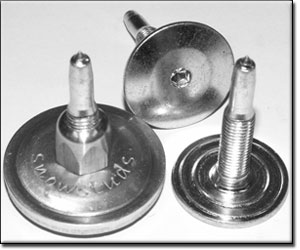
BIG SHOT STUDS

0

This new designed from Snowstuds by Accord features exclusive track gripping rings to prevent tear out, plus a lower shoulder and tapered head to mount flush in the track, which will eliminate idler wheel damage and reduce vibration.

These studs are specially designed for both the NEW Ski-Doo Rev XP and Camoplast single ply tracks.

Call 1-888-234-9822 and visit www.snowstuds.com.

Free-Riding Is Not A Crime

0

Read an excerpt below of AJ Lester’s BOONTALKIN’ column taken right from the pages of Supertrax!

Does the title of this editorial remind you of something you’ve read before? Think back to the beginning of this decade and you’d find groups of skinny kids wearing pants six sizes too big annoying retailers during the summer months.

These “criminals” hung around towns and the inner city using their skateboards to grind mom’s favorite autumn bouquet scented candle wax into cement parking curbs and freshly painted handrails.

Yes, skateboarders. Strangely enough there may be something to learn from this group of much maligned miscreants. The ever popular “Skateboarding is Not a Crime” slogan was a high profile segway allowing this group of athletes to be accepted by society through non-violent initiatives in North American cities and towns.

The majority of society had grown tired of the noise, vandalism and loitering skateboarders had become known for. Over the past seven or eight years politicians and community leaders have wisely chosen to give skateboarders a place to practice their skills without annoying the rest of the population. These places are widely known as “Skate Parks” and many are located away from the public eye.

Looking back, the journey to accommodating this activity and its participants wasn’t that hard of a nut to crack. The ultimate result has seen the extreme sports generation putting money back into the businesses that once were annoyed at their very presence.

The same story is true of snowboarders who now enjoy half pipes and fun parks as a result of revitalizing the dwindling downhill ski business.

Snowboarding and skiing now coexist and are thriving across North America. These examples have one thing in common: An open-minded response to the need for recreational space.

Fact: The next generation of snowmobilers may not be as pumped about squeezing off 200 miles on freshly groomed trails as you are.

Although many younger riders enjoy the occasional trail ride or family day there’s an increasing number begging for a place to call their own.

With trail permit sales and club membership under pressure we have to be on the lookout for ways to sustain the sport we all love. However, this new road may not immediately be understood or accepted by today’s entrenched participants.

Read more in Supertrax Volume 19, #3.

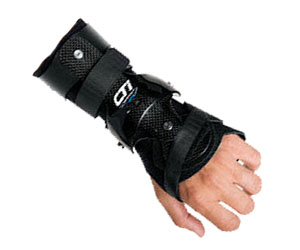
CTi Wrist Brace – Brace Yourself

0

If you’ve ever suffered an injury you know that a custom brace can be extremely pricey.

The off-the-shelf CTI wrist brace delivers affordable quality and maximum protection for your wrist and lower forearm.

The high-strength and lightweight shell offers superior protection and the soft and cushy liner doesn’t irritate your skin. Velcro keeps the hand strap firmly in place.

Visit DennisKirk.com and call 1-800-970-2309 toll free.

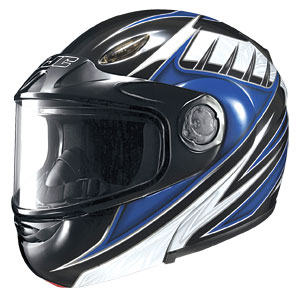
HJC’s Primo Modular

0

HJC has done it again with the CL-Max Modular helmet, made from injection-molded thermoplastic and DOT certified.

The one touch button allows you to easily open and close the helmet shield and chin bar.

The Vacuum Ventilation airflow system features an adjustable forehead and chin bar vents that direct the airflow to the top rear exhaust vents.

Visit DennisKirk.com and call 1-800-970-2309 toll free.

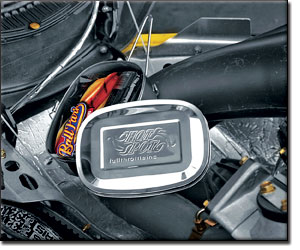
HOT POT: Better Than Granola

0

The Full Throttle HOT POT warmer is made from high-quality stainless steel with an aluminum mounting base for optimal heat transfer.

Easily installs on most snowmobiles within minutes and includes all mounting hardware.

Designed with a built-in handle. Recipes and menus are also included.

Visit DennisKirk.com and call 1-800-970-2309 toll free.