Home Blog Page 326

Removing Coupler Blocks

Question:

Can the rear coupling blocks on my 2009 Dragon 800 SP be removed from the rear suspension without doing any damage? I am assuming you would have to remove the cross shaft that they are mounted on. 

I removed the coupling blocks on my 2006 Crossfire and liked it…made the sled more fun to drive. I’m considering trying this on the D8, but I want to make sure I don’t damage anything as the suspension cycles through its travel.

Reply:

Thanks for your email!

As you know, this suspension is in it’s first year of production on Polaris IQ’s so I cannot answer your question with confidence that you will not do damage to the rear swingarm.

I am confident in recommending you not completely remove the coupler as I suspect the sled will stand up mid turn and “wheelie” uncontrollably under acceleration.

However, I have included Mike Bedard from Polaris who is a Senior Project Engineer and will be able to add his comments on your question.

Thanks,

Motorhead Mark

ISHOF moves to Eagle River

Press Release –

The International Snowmobile Hall of Fame (ISHOF) is now located in the World Snowmobile Headquarters (WSHQ) in Eagle River, Wisconsin. Elmer Cone and his family, who founded the program and kept it going for 20 years, have decided to “retire” from the administration of ISHOF and pass the duties over to the World Snowmobile Headquarters.

All phases and administration of ISHOF will now be handled from the Eagle River facility including induction ceremonies.

“We are excited about the move to Eagle River and pledge to continue to promote and give credit to the people and machines that have created and maintain the great sport of snowmobiling,” states Scott Eilertson, newly elected president of ISHOF and a 2005 Inductee.

“It is extremely impressive to see the photo plaques of the 74 very important and dedicated people that have done so much to create and develop our sport. They deserve a great place of honor and the new location showcases their induction into the very prestigious International Snowmobile Hall of Fame,” Eilertson adds.

Newly elected ISHOF officers (and their induction dates) are: Scott Eilertson (2005), president; Tom Anderson (2002), vice-president and secretary; Dave Carmichael (2005), treasurer. Directors are: Jerry Bassett (1996), Russ Davis, Dave Guenther, Dave Johnson, Larry Koch (1999), Les Ollilia, DeLyle Pankratz, Steve Pierce, Bill Schumann (1997) and Joann Smith.

ISHOF was founded in 1984 by Elmer Cone to honor the people who were instrumental in the development of the recreational side of snowmobiling and has been located in Bovey, MN. Health issues and the desire to bring more exposure to ISHOF is the reason for the move to Eagle River. Elmer was inducted into the Hall in 2007. Special recognition is given to him for his insight and dedication in the creation, development and operation of the program. He now serves as Director Emeritus of International Snowmobile Hall of Fame in their new location in Eagle River.

Opened three years ago, the World Snowmobile Headquarters is already home to several other snowmobile organizations.

“Right from the start of the “HQ” project, we learned of other groups interested in exposure in the facility. Now, seven more groups or organizations are showcased. They are: World Championship Snowmobile Derby Walls of Fame, Antique and Vintage Snowmobile Clubs, International Groomer Operator of the Year, Iron Dog Brigade, Women on Snow, Kitty Cat Racers and Thirsty Dogs. We finished off the project with a large snowmobile oriented gift shop and video viewing room,” states Tom Anderson, World Snowmobile Headquarters president.

“The concept of having several groups under one roof gives snowmobilers more to see and learn as they wander about our multi-faceted facility,” Anderson explains.

On display in the museum rooms are over 85 antique and vintage sleds, all under the watchful eyes of the 74 inductees into the International Snowmobile Hall of Fame. Over 250 photos from past Derby races are also on display.

Visitors can explore the 6,250 square feet of displays that provide a look back into the history of snowmobiling and the pioneers of the sport. The gift shop offers scores of snowmobile related items ranging from books, magazines, clothing, videos and other novelty items. All this with free admission.

The International Snowmobile Hall of Fame and World Snowmobile Headquarters are located at 1521 N. Railroad Street (Hwy 45 North just 200 feet north of the Derby Track) and open six days a week from 10 am-4 pm (closed Sundays). Telephone: 715-479-2186 or check out the website at: www.worldsnowmobilehq.com

2010 Polaris Product Update

Press Release –

All MY10 600 Cleanfire models will use 4-injector fuel injection systems.  This includes all IQ and Rush models.

A Service Bulletin was released on August 27, 2009 relating to MY08 and MY09 800cc Polaris engines to improve durability and drivability issues experienced by some customers under certain conditions.
 
The bulletin includes hardware and software updates using MY10 components:

* RMK – New head, 2-ring piston, revised fuel injection software
* IQ and Switchback – New head, 2-ring piston, silencer, revised fuel injection software
* Parts are shipping to dealers now.

All updated units will receive an extension of our limited engine warranty to June 1, 2010.

For more visit www.polarisindustries.com

Monster Signs As Primary Snocross Team Sponsor

Press Release –

Monster Energy signs on as primary snocross team sponsor

Andre Laurin, founder/president of Vaughan, Ontario based OTSFF Sports Marketing Group, is pleased to announce that he and his staff of motorsport specialists will continue to run Yamaha Factory Racing’s four-stroke pro snocross program for another season.

“We’re quite excited with the renewal of our association with Yamaha Factory Racing and are especially excited to announce the signing of Monster Canada as the team’s primary sponsor. Monster Energy® is known worldwide for their sports sponsorships and we’re proud to be representing their colours on the snocross circuit,” said Laurin. “If I may borrow from the Monster slogan, we’re ready to ‘unleash the beast’ and pick up where we left off last season with the prototype four-stroke FX Nytro® snocross development program.”

The team, which will campaign both the 2009-2010 ISOC and CSRA Snocross Championship series under the moniker Yamaha OTSFF Monster, will feature three-time CSRA Pro Open Champion Iain Hayden. This will be the second season for Espanola, ON’s Hayden with the factory racing team.

“I’m happy to be part of the team again for another season. The OTSFF crew is great to work with. They are really dedicated and committed to snocross racing,” said Hayden. “And the four-stroke FX Nytro® is an awesome sled. We made a lot of headway with it last year and I’m convinced we’ll take it to another level this season.”

Although the American ISOC Tour will remain paramount to the team’s schedule, the winning of the Canadian CSRA Championship will be the main focus. Adam “Stu” Robinson, one of the most reputable technicians in the Canadian snowmobile and motorcycle racing world, will serve the team as Crew Chief and Head of Development. Robinson has been part of the OTSFF technical staff for the past three years.

“We have worked with OTSFF Sports Marketing owner Andre Laurin for years and we are confident in his, and his staff’s, ability to put together a national calibre race program and field a consistently competitive team,” said Wade West, Yamaha Snowmobile Marketing Manager. “We look forward to cheering the OTSFF/Monster Yamaha FX Nytro® race sled to continue the Four-Stroke Challenge at major snocross races throughout North America.”

While negotiations are still in progress with a number of support sponsors GYTR® and Yamalube® have signed on for season.

Snowmobilers Mourn Hillclimb Legend

Press Release –

The Polaris family and the snowmobile world is coming to grips with the death of Rick Ward, perhaps the greatest hillclimber in history and one of the best gentlemen on the Western racing circuit.

The longtime Polaris hillclimber, cross-country racer and manager of the company’s Western racing program, died Tuesday, September 1, in a motor vehicle accident near his Sugar City home. He was 47.

Ward’s name had become synonymous with the term “King of the Hill.” During his long hillclimbing career he won 18 world championships, countless class titles and numerous King of the Hill honors at events throughout the West. He was not only a successful racer but a mentor and inspiration to many younger racers who admired the way he prepared his sleds, the way he rode and the way he graciously accepted the outcome.

Win or lose – and it was most often “win” – he was a sportsman. He celebrated victory with dignity and was always ready to congratulate competitors.

“This is a tragic loss of a great friend and an amazingly talented snowmobile racer,” said Polaris Racing Manager Tom Rager, Sr. “He was a tremendous asset to our racing program and he set an outstanding example, particularly for Western racers.”

Scott Swenson, Vice President of the Polaris Snowmobile and PG&A Division, said the entire Polaris family of employees, dealers and snowmobilers is saddened by Ward’s death. “Rick was a tremendous hillclimber and a great leader for our Western program,” Swenson said. “Our thoughts and prayers go out to his wife Michelle, their three children and his entire family.”

Ward, who made his living as a farmer, was a multi-time winner at the Jackson Hole World Championship Hillclimb and was a fixture in the Rocky Mountain Snowmobile Hillclimb Association. He raced exclusively on Polaris snowmobiles, and in recent years served as the manager of the company’s Western racing program, with a focus on hillclimbs.

As recently as 2007, Ward was still winning titles at Jackson Hole. That year he added to his legendary Jackson Hole resume, winning three classes and leading the Polaris racers as they won a dominating 45% of all classes at the event.

In 2006, Ward won Stock King of the Hill honors at Jackson Hole after winning the Pro Masters Stock and Pro 600 Stock classes.

Following that 2006 victory, Polaris Racing Manager Tom Rager, Sr., said, “Our strong showing was the result of a total team effort that was led by Rick Ward, one of the best-organized and most-successful competitors in hillclimb history. Out West, Rick is in charge of our hillclimb program, and this World Championship success is testimony to his leadership skills.”

Ward was extremely talented at building hillclimb sleds, and he had extraordinary riding skills that helped him optimize the sled’s performance regardless of the conditions on race day. When Polaris racers traveled west for events such as the Winter X Games or snocross racing at West Yellowstone, Montana, Ward helped them tune their engines to perform at high altitude.

Each year when new Polaris Deep Snow sleds were developed, Ward dissected them to learn how they could best be set up for hillclimbs, and he shared that information with Western Polaris racers.

Survivors include his wife Michelle, two daughters and a son. Funeral services will be held at 3 p.m. Saturday, Sept. 5, at the Sugar City LDS Stake Center. Visitation is Friday, Sept. 4, from 6-8 p.m. at the Flamm Funeral Home in Rexburg, and Saturday at the Stake Center from 1:30-2:30 p.m. Additional details are available, and online condolences may be sent to the Ward family, at www.flammfh.com

Al’s Snowmobile Celebrates 25 Years in Business

Press Release –

Al’s Snowmobile Parts Warehouse of Newport, Vermont was started in 1984 by Al Briere.

Al’s is the world’s largest supplier of used snowmobile parts, also specializing in discounted new parts for all years, makes, and models of snowmobiles and ATVs. The Vermont business is family owned and operated by Al and his 2 children Scott and Denise.

Al’s will celebrate this milestone October 16-18th at their 25th Anniversary Open House Celebration at their warehouse at 3868 Pine Hill Rd. Newport, VT 05855.

For info go to www.AlsSnowmobile.com or call 802-487-1000.

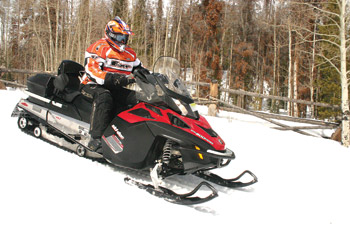
2010 Ski-Doo Expedition

0

Staff Report

Ski-Doo’s XP chassis has gotten pretty much all the BRP press the last three years but many don’t realize the company introduced a workhorse chassis at the same time.

The XU (the ‘U’ is for utility) platform incorporated all the weight saving chassis design of the XP but focused on extreme durability plus load bearing, towing and deep-snow traction. The big issue is weight and, like almost every Ski-doo model the last couple of years, this one delivers top-of-class lightness.

The 2010 version of the Expedition is available with choices of 2-stroke and 4-stroke power. Tick the 1200cc 4-TEC 4-stroke option box and you get a single throttle body 4-stroke triple with 130 honest stallions.

Go for the 600 SDI 2-stroke and you’ll get about 115. Here’s where things get interesting. The 4-stroke tips the scales at 690 lbs. – very good weight for a 4-stroke utility sled, but the 600 weighs in at a featherweight (for this class) 630 lbs.

These weights are stunning considering the Expedition has a full 156 x 20 x 1.25-incher under it and is supposed to be targeted at pure utility applications. We’re not arguing about its utility designation here, believe us.

The 2-stroke version rides and handles so much like a good touring sled, we can’t help but boost it into the touring category. To further mess up the minds of its competition, the Expedition comes equipped with a sub-tranny, too.

Yes, you’re reading correctly: A sub-transmission with hi-lo, neutral and reverse, electric start and a mega-track underneath plus bunches of touring amenities. The touring goodies include passenger handwarmers, a modular seat with underseat storage, a slick rear rack – even handlebars with a mountain strap, 8-inch riser and j-hooks. Snocross, anyone?

We’re not sure why Ski-Doo opted to use the old SDI semi-direct injected mill instead of the newer tech 600E-TEC engine that is top-of-mind with the powersports world because of its mileage and efficiency.

Frankly, we were long term advocates of the SDI engine and if the E-TEC hadn’t been so good were ready to beg for its return. In this application, it runs strong and delivers ample power to make the riding experience a good one. We kinda like the 4-TEC here a bit more, but it depends on what you want – almost like Ski-Doo already thought of that.

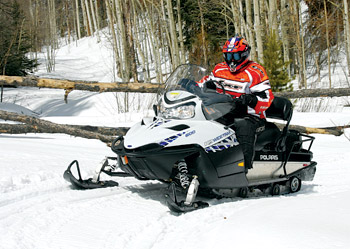
2010 Polaris 600 WideTrak

0

Staff Report

You could argue Polaris has lagged a bit in delivering Utility-Touring models that actually quicken the pulse. Last year the utility-targeted WideTrak took a giant leap ahead when the perennial workhorse was completely redesigned and fitted with a stretched and widened IQ chassis. Power was supplied by the 80 horsepower, non-turbocharged Weber 4-stroke twin used in some Polaris touring models. Way better, but not heart-pumping… yet.

This year, Polaris added one of its most exciting engines to the mix. The new 600 WideTrak, featuring the company’s venerable 600 Cleanfire 2-stroke twin, demonstrates the full potential of this category with a lighter, more powerful engine encased in a purpose built but very competent chassis.

Yeah, it may not be the logger’s choice for hauling timber out of the bush. Truth is, this sled leans very heavily toward being the ultimate touring sled much more than being a worker bee. It even looks like a touring sled with its cool graphics and paint and svelte cowl design.

Looking further underneath you’ll see the 600 WideTrak features the obligatory 156 x 20 x 1.25 inch track but, in this case, the slide rails do not offer the articulating feature seen on the Yamaha and Arctic Cat.

Instead, Polaris has gone the less complicated, lighter route and simply has tipped the rails at the rear so less track is on the snow in hard packed conditions. This makes steering a bit easier and still allows 100 percent traction in powder. Weight is further shaved off by using a conventional 2-shock skidframe.

It seems like the designers have prioritized weight in this sled’s design and it delivers a comfortable touring mass of 697 lbs., dry. This weight puts it right in the hunt with a lot of 4-stroke pure tourers not equipped with a sub transmission or the extra pounds of a wider track and skidframe. The end result is a nimble handling utility-tourer that really sells the whole concept of taking these sleds out on the trails and using them as 2-uppers.

When we rode the 600 WideTrak we were impressed with its nimble handling and premium ride. With about 80-lbs. less weight over the skis than a 4-stroke, it really carves corners and there was nowhere we could find any compromises with the way it turns.

Because Polaris has decided to simplify the design, the whole weight thing is enhanced and then, there’s the engine. This sweet, fuelie 2-stroke twin delivers a solid 125 ponies and its clutches spool the power down to the snow so nicely it feels like velvet. We’ve always said a strong, responsive engine makes a sled feel like it’s lighter. This is absolutely the case here.

Although you’re perched higher than when seated on a touring sled and the wider stance is felt between your knees, this is a roomy, comfortable sled for both passengers and the windshield affords good visibility and plenty of warmth.

One fault we noticed was absent rear passenger hand heaters. It’s about the only touring amenity left off the list and, by the time it hits the showrooms, Polaris may have already added it.

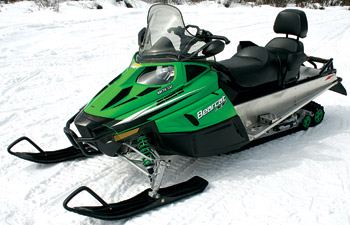
2010 Arctic Cat Bearcat Z1 XT

0

Staff Report

If you compare the specifications for this 4-stroke utility Cat, you can’t help but notice its dimensional similarities to Yamaha’s Viking. Stand back and squint, though, and you’ll see it’s a completely different animal.

With the rider in position, the Bearcat XT pretty much looks like any good red-blooded touring sled. It’s a real tribute to Cat’s stylists that only on closer inspection do you begin to notice its extra length, height and wider tunnel.

Power is provided by the Z1’s naturally aspirated (EFI) 4-stroke twin but the Bearcat doesn’t use a sub transmission for the clutches to drive through. The engineers are relying on the big 1056cc twin’s ample torque output for heavy duty towing chores. For trail riders, the real bonus is the weight reduction when you lop off the heavy, cast gearbox required for low range.

Underneath, the Bearcat uses a time proven skidframe with some tricks you won’t find anywhere else. The 156-inch skid has fiberglass helper springs and a torque sensing link – both very helpful when the rider is applying power in deep snow with a load on.

The slide rails articulate at the rear for better bite going both forward and backwards in deep snow – a useful feature if you’re mired. If you don’t want the articulating feature, for instance, when purely trail riding, you can tighten the rear spring adjusters to eliminate the flip-up feature so you get straight rail suspension.

The rear seat and backrest setup on the Bearcat is very much a touring design. Its roomy, sculpted contours are downright posh and the amenities for a rear passenger are as good as any luxo-tourer on the market.

The big bonus is you can remove the passenger part of the seat, go solo and end up with a huge flat-bed cargo area for hauling your mother-in-law’s sofa or just stowing your whole group’s touring bags. The front part of the seat flips up to reveal even more space for secret goodies.

The Bearcat is built on a wider version of Cat’s rigid Twin Spar chassis and it integrates the double A-arm front end design with a big aluminum cage surrounding the engine and reaching up to the steering head.

The design isn’t a lot different than Cat’s F-series sleds and thus, the handling of this behemoth is very good. Believe us, you can trail ride this sled all day and never feel cheated in the corners.

The engine is a strong 123hp performer with good EFI throttle response and the Bearcat’s lower gearing enables it to be surprisingly spry in the midrange. We’ve gone on trail rides with a mixture of sport and touring sleds and found the Bearcat keeps up fine and its accurate handling and stellar ride soon endears it to even the most critical riders.

See, there’s another level of fun here. You can ride it… or spend all day impressing your friends winching and towing less capable sleds around. Weird, but entertaining.

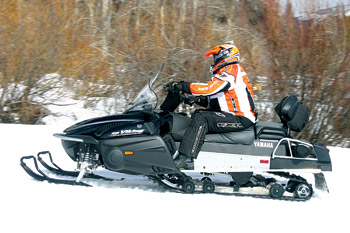
2010 Yamaha Viking Professional

0

Staff Report

Although its name qualifies it as a purely utilitarian snowmobile, until you’ve ridden it, you can’t appreciate how good the Viking performs as a snowmobile. It’s the grand-daddy of this new breed of Utility-Tourers and Yamaha deserves credit for being the first to deliver a utility sled with all the goods.

When we first rode the Viking Professional we couldn’t believe how fast it was and how well it handled. One of our staff riders recalls a dinner conversation with the engineer who was originally in charge of the project and he voiced his last minute doubts about “maybe making the sled too fast”. He was considering taking some of the power out of the prototype’s 1000cc 4-stroke and we violently disagreed.

We had just spent the afternoon riding some pretty hot 4-stroke Yamahas and we couldn’t help singling out the Viking. We loved it. Fortunately, when it came time to roll the assembly lines, Yamaha didn’t change it.

The 2009 version is pretty much a ditto of former models but, since the beginning, it really hasn’t needed much of a change. Its carbureted 4-stroke triple was pirated from the original RS Vector and provides the absolute best blend of torque and power for touring.

It uses a typical Yamaha CVT clutch setup but adds a sub-transmission with high, low, neutral and reverse. You may think low range is unnecessary… until it’s time to pull your buddy’s pickup out of the ditch or when you have to tow an injured sled for 20 miles. This is a feature most snowmobilers have had little experience using but believe us, it can be really, really handy sometimes.

Everything drives through a 156-inch long track and that track is 20-inches wide! Not only is this a huge shoe but it has 1.25-inch lugs – enough to surprise you with its bite. With this much track under it, you’d expect the Vike to be hard to steer, especially at low speeds. It actually gets down the trail incredibly well, even on hard packed surfaces.

Once underway, it takes a set and hunkers down like only a truly heavy snow vehicle can. There’s no such thing as twitchiness or darting; it tracks as firmly as an anvil on a foam mattress.

In deep snow the Vike floats up on top like a mountain sled and, as long as you keep the power going, its gi-normous track will dig you out and keep clawing to the surface. In bottomless stuff, it will get bogged down if you scrub off too much speed, but you’d be surprised how it can get through conditions some smaller sleds can’t.

Amazingly, there’s 11.5-inches of travel back there and its flip-up, articulating slide rail design guarantees plenty of track will always be on the snow, especially when you switch to reverse.

With huge underseat storage capacity, a jumbo cargo rack and room at the back of the seat for extra bags, you can load up big-time and carry an extra passenger, too. The Viking won’t even notice the extra weight.