Home Blog Page 302

POLARIS INTRODUCES 2011 RUSH PRO-R EARLY

With the success of the new-last-year RUSH still written bold in the headlines, Polaris has raised the stakes and released information on its newest performance sled, the 2011 RUSH Pro-R.

With dozens of upgrades, the 2011 RUSH continues to evolve and the biggest news is the addition of the much anticipated Cleanfire 800 engine to the platform this year. RUSH 800 models feature a 7lb lighter exhaust canister and a 2-injector system rather than the common 4-injector layout.

First, here’s some of the technical details on the new RUSH Pro-R chassis. The engineers have pared 2.5 lbs. of rotating mass out of jackshaft and drive area. A new cooler has been added at the rear to augment the unique front cooler on all RUSH models. This improvement facilitates better cooling for the demands of the physically larger 800 engine but it’s used on both the 600 and 800 Pro-R.

Walker Evans Needle shocks with 16-position compression clickers and remote reservoirs are used on the Pro-R and a 15×120-inch track with 1.25-inch lugs is specific to this new model.

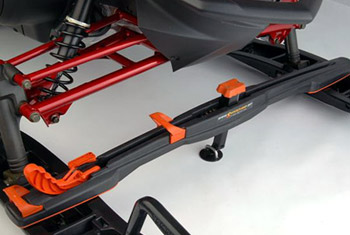
There’s a new rail profile on the RUSH for 2011 to increase top speed and the skid’s front torque arm has been modified to allow more stud clearance. A quick glance at the back of the sled reveals significant differences to the RUSH’s rear geometry and body trim.

The Rush combines its unique structural bonding process to marry chassis components to its cast bulkhead and the result is a lighter, stiffer chassis (actually 300 percent stiffer than other Polaris models).

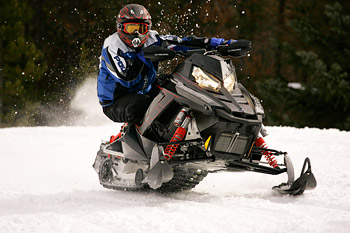
Supertrax has found the RUSH to be a flatter cornering sled than the IQ with an extremely lightweight persona. Handling is precise and predictable and there’s very little ski-lift or darting as you ply trails with it.

EARLY RELEASE OF POLARIS PRO-RMK 155

In 2011 Polaris is sending a powerful message it intends to be the dominant force in the vertical market with lighter, stronger deep snow platforms and class leading power-to-weight.

The introduction of an all-new 2011 RMK based on the RUSH Blackjack front clip married to a conventional track system at the rear makes a strong case for the company’s determination.

The 800 Pro-RMK 155 uses the super-strong chemically bonded construction process pioneered on the Rush to eliminate welds and rivets and nets an incredibly rigid chassis with significant weight savings.

Further weight has been dropped with reductions to the jackshaft, disc brake rotor, bumpers, tunnel, snowflap (now perforated), seat support and exhaust silencer.

The most obvious departure on the Pro-RMK compared to the Rush is the use of a shock-in-tunnel skidframe featuring a Camoplast 15×155 track with enormous 2.4-inch lugs.

Power is supplied by a 2-injector Cleanfire 800 2-stroke – the first application of this engine in this chassis.

Polaris claims a 40-lb weight reduction compared to last year’s IQ-based RMK and even more important, a 10-lb reduction in weight compared to its lightest competitor.

On closer inspection you can see how the product planners and engineers have rationalized every component on this sled to reach the lightness goal line.

You’ll get more details and some great photos on the complete RMK line-up in the March edition of the Supertrax online magazine. Stay tuned!

Polaris Introduces 2011 RUSH Pro-R Early

0

Staff Report –

With the success of the new-last-year RUSH still written bold in the headlines, Polaris has raised the stakes and released information on its newest performance sled, the 2011 RUSH Pro-R.

With dozens of upgrades, the 2011 RUSH continues to evolve and the biggest news is the addition of the much anticipated Cleanfire 800 engine to the platform this year. RUSH 800 models feature a 7lb lighter exhaust canister and a 2-injector system rather than the common 4-injector layout.

First, here’s some of the technical details on the new RUSH Pro-R chassis. The engineers have pared 2.5 lbs. of rotating mass out of jackshaft and drive area. A new cooler has been added at the rear to augment the unique front cooler on all RUSH models. This improvement facilitates better cooling for the demands of the physically larger 800 engine but it’s used on both the 600 and 800 Pro-R.

Walker Evans Needle shocks with 16-position compression clickers and remote reservoirs are used on the Pro-R and a 15×120-inch track with 1.25-inch lugs is specific to this new model.

There’s a new rail profile on the RUSH for 2011 to increase top speed and the skid’s front torque arm has been modified to allow more stud clearance. A quick glance at the back of the sled reveals significant differences to the RUSH’s rear geometry and body trim.

The Rush combines its unique structural bonding process to marry chassis components to its cast bulkhead and the result is a lighter, stiffer chassis (actually 300 percent stiffer than other Polaris models).

Supertrax has found the RUSH to be a flatter cornering sled than the IQ with an extremely lightweight persona. Handling is precise and predictable and there’s very little ski-lift or darting as you ply trails with it.

Darting Fix Fro My Nytro

Question:

Dear Motorhead:

I really like SnowTrax this season and find it very interesting & helpful.

My ride is a 2006 Yamaha Nytro. I like this machine, but the darting really bothers me.

I have tried just about everything I can think of and nothing seems to work, but after seeing your show on the weekend I’m going to give the Slim Jim SY4-6580 a try and hope maybe this will fix my problem.

Keep up the good work and remember snowmobilers everywhere are watching you.

Thanks for all the great information.

Andrew H

Response:

Thanks for your email!

You are not alone. Virtually all Yamaha 4-strokes come with the same outdated, dart prone ski. This trait is amplified by the reality of a heavy motor mounted high in the chassis – essentially a too-high centre of gravity.

You can mask the inside ski-lift and darting problem quite effectively with a set of Slim Jims – these things work exceptionally well and settle the front end of Yamaha’s immediately.

Steering effort will increase slightly but you will welcome it as the sled will respond in a more linear way to your inputs. This will allow you to keep the inside ski planted in turns.

A bonus with Slim Jims is their extra long life – they are super durable and will outlast regular carbides by a wide margin.

Good luck!

Motorhead Mark

What Sled Should I buy?!

Question:

Dear Motorhead:

First of all, I love SnowTrax. Awesome job this season!

My wife and I are looking into upgrading to newer sleds. We currently own two late 90 polaris sleds – one being a two up.

We are thinking 4-strokes, but wonder if the are really better than a 2-stroke for the price.

We are average riders and aren’t looking for speed and high performance, just easy handling, comfort and reliability.

Any help and advice you can give me on which to choose would be greatly appreciated.

Thank you,

B

Response:

Thanks for your email!

Okay, the first thing you should try to determine in your purchase selection is what brand has a dealer which you 1) Like and 2) is close enough to be convenient when you need support.

I know this sounds elementary but the relationship you have with the dealer will be the foundation of your purchase experience no matter what brand Snow Bullet you buy.

Second, what do you do most with a sled? Trail ride, tour overnight, ride lakes fast, two-up or powder ride.

Here’s the real deal. 4-strokes are good on gas and offer lots of power selections but they are virtually all heavy (er) . Does this concern you?
New SDI or DI 2 strokes are lighter, DI’s are MORE fuel efficient than 4 strokes and are often cheaper to buy and simpler to maintain.

However, resale on 4 strokes appears to be about 15% higher than 2 strokes – however initial cost is too.

The 600 class right now seems to meet many buyers needs head on. Look for a single rider, “cruiser” segment sled like a Polaris 600 LX, Yamaha Vector LTX, Arctic Cat Z-1 LX-R or a Ski-Doo GSX.

Most of these sleds offer longer tracks for bridging moguls and an improved ride as well as common sense features like higher windshields and heated everything – some have heated seats as well. Some come in both 2 and 4 stroke power variants.

These sleds will be covered in an upcoming Snowtrax segment this season and are currently covered in detail in SUPERTRAX Magazine – our international snowmobile title.

I would suggest these are good places to start.

Motorhead Mark

LX vs. LX-R

Question:

Dear Motorhead:

After reading your glowing report on the 2010 Polaris LX IQ 600 I purchased one a few weeks back. My first trail ride was awful. I have never ridden such a rough riding sled over bumps and it was darting everywhere on smooth trails. I have to wonder if your test riders ride these sleds on actual trails conditions.

After 179 miles I traded it in for a 2010 Arctic Cat 500 LXR – another of you favorite sleds. This one is right on the mark. I rode it 300 miles in two days and could have gone double that. Costly way to find that out however.

Paul A

Response:

Thanks for your email!

Just taking a wild guess here, but maybe you were a little impatient?

The Polaris LX 136 skid is setup a bit firm – and we covered that in our comparo in the last issue. However, it can be adjusted and made to ride softer. If you are under 150 lbs optional torsion springs would be the way to do it.

The darting is an issue on some trail surfaces which is easily and effectively cured with Woody’s Slim Jims, Duallies or Deuce bars.

The AC LX-R’s we have here have been fitted with them (as has the Polaris) as a result of the same issue – darting. In fact the Pilot 5.0’s on Ski-Doo’s here have them added as well to stop darting.

My point is this – darting is not a Polaris problem exclusively.

I’m sorry you had such a bad experience with the Polaris. Seems like an earlier email to us and we might have been able to help out.

FYI – our Polaris 600 LX has almost 1000 miles on it. We do ride – A lot.

Motorhead Mark

A Grand Traverse Snowmobiling Experience

0

By: Matt Lester

It’s been a few years since we last rode trails in the great state of Michigan. Every year our team confers about the significance of the Michigan snowmobile market, one of the largest in North America – perhaps in the world.

We’re very familiar with the remarkable trail system, jaw-dropping scenery and infectious enthusiasm for the sport throughout the snow-filled regions of Michigan and we’ve been anxious to get back. So when we received an invitation to stay at the beautiful Grand Traverse Resort & Spa in Traverse City, we jumped at the chance to re-visit this snowmobiling Mecca and immerse ourselves in this sledder’s paradise.

You really have to experience snowmobiling in Traverse City, Michigan for yourself to fully comprehend what the sport means to this community once the snow flies. Some might call it snowmobiling brotherhood, but the people of Traverse City, Michigan sure know how to show visitors a good time. We took this opportunity to introduce a couple of newbie riders to snowmobiling and brought along two old buddies from our past for this adventure. Darryl Waugh and Derek Moreau are friends we had grown up with. These guys are about as fresh to the sport of snowmobiling as you can get and we felt this was the perfect chance to see how new riders, with no prior notions, truly felt about snowmobiling life in Traverse City.

Our journey began when Derek, my brother Mike and I picked up Darryl in Troy, Michigan with sleds securely loaded in our Triton enclosed trailer. We jumped on I75 North and four hours later we were checking into the Grand Traverse Resort & Spa. Do yourself a favor when visiting the Traverse City area and contact the Grand Traverse Resort www.GrandTraverseResort.com. This is your one-stop shop for luxury accommodations, delicious dining choices and people who share a common passion for snowmobiling.

One of the most passionate and interesting snowmobile enthusiasts we’ve ever met is co-owner of Blue Sky Rentals www.bluesky-tvc.com, Jamie Bush. Jamie, along with business partners, Mike Manning and Ed Griffin, are not only diehard snowmobile nuts but are solid people who will guide you along the endless GTASC trail system, regardless of your riding skill level. These educated and experienced sledders know the area well and can take you to spots you might not otherwise see when you’re riding solo.

At the very least, it’s worth hanging out with the Blue Sky team for the pure entertainment. You will not be disappointed. Also joining us on our adventure were new riders Steve Timmer, the resort’s Director of Marketing and J. Mike DeAgostino, the man who helped put this all together. J. Mike is the Public Relations Manager at Grand Traverse Resort & Spa and he is extremely proud and passionate about this superb destination.

After a great meal at the Grand Traverse Resort and a solid night’s rest we awoke to ideal conditions with a light dusting of snow on an already substantial base. A quick jaunt over to the trailhead was where we were met by the rest of our riding group and is where Blue Sky Rentals is located. We easily purchased our trail passes at the trail head’s popular snowmobile restaurant, Peegeo’s, for $35 (cash) each and were ready to roll.

Having Blue Sky Rentals guide us was definitely the way to go as we had the chance to sit back, relax and just enjoy the ride. Obviously, with half of our pack being new riders we plugged along at an easy pace, but it was a nice change from the velocity we’re used to riding with the more experienced Supertrax crew.

Our newbie riders did extremely well on the freshly groomed trails and had ear-to-ear grins at every stop. One of those stops included a visit to the Kalkaska warming station http://www.youtube.com/user/mattlester2376#p/u/1/ByF03gixZY4 where we took some photos, answered Mother Nature’s call and warmed our paws. From here we headed south to Fife Lake for lunch at another popular snowmobile destination, the Fife Lake Inn. With bellies full we rode trail #5 north, back to where we started.

Important Places to Visit:

Grand Traverse Resort & Spa
1-800-748-0303

Aerie Restaurant (16th Floor, Grand Traverse Resort)
231-534-6800

Turtle Creek Casino & Hotel

Traverse City Visitors Bureau
1-800-727-5482

Blue Sky Rentals
231-645-2628

Grand Traverse Area Snowmobile Council

Peegeo’s Restaurant
231-941-0313

Fife Lake Inn
231-879-4441

TEST RIDE: 2010 Dragon 800 Switchback

0

Luke evaluates the 2010 Polaris Dragon 800 Switchback.

Subscribe to our YouTube Channel!

LATEST ISSUE OF SUPERTRAX

0

The latest issue of Supertrax is landing in mailboxes and on newsstands now.

This issue features our picks of the 10 best used sleds you should be looking for. We also compare the Apex LTX to Arctic Cat’s EXT Turbo and take a look at fan-cooled bargains like the 550 Shift and TNT 550F.

Also, get the inside scoop on breaking the 200 mph barrier on a sled and read about Arctic Cat’s 500 Sno Pro.

You’ll also find the great editorial columns you’re accustomed to like Inside Trax, Motorhead and Boontalkin’.

This issue is jam packed with good stuff so pick up your copy today! You can also get 3 seasons of Supertrax (12 issues) for only $22.99 by subscribing online!

Subscribe online safely and securely now!

New Yamaha Apex Features An Industry First

Press Release –

Yamaha Motor Company loves to lead. After two spectacular product launches last year, including the revolutionary 2010 YZ450F with its reversed, rearward slanted engine, and the VMAX SHO high-performance outboard, the first ever four-stroke capable of outclassing two-strokes in every category, the company is now offering snow-goers a radical change. For 2011, the New Apex features Electric Power Steering (EPS)—a first for production snowmobiles.

“We’ve been developing the New Apex for over three years,” says Yamaha Motor Canada’s National Manager of Product Planning and Research, Chris Reid. “After surveying customers to find out what they wanted from a trail sled, we went to work. What most asked for was a lighter feeling sled, and we’ve accomplished that by adding EPS. It makes the sled feel 100 lbs. lighter and delivers more confident, effortless steering. You have to ride it to truly appreciate it.”

But that’s not all. Yamaha’s next goal was to give riders more power where they need it: out of the hole and corner-to-corner. That led them to the addition of Yamaha’s Exhaust Ultimate Power Valve (EXUP).

“The EXUP is a variable valve positioned at the end of the chamber, where the four exhaust pipes come together. It functions to prevent exhaust blow-back and remove the peaks and valleys found in power and torque curves,” explains Reid. “What that means for the rider, is they will experience maximum engine performance in the more practical RPM range, from low to mid. It also creates a smoother, linear throttle response.”

Even though the New Apex is released today, it’s been igniting forum chatter for the last month. “We launched the 2011 Apex in a very non-traditional manner this year, releasing information, sneak peeks and rider impressions before the official launch. We knew we had an amazing new sled, but we also know consumers can be skeptical of traditional marketing claims. So we let them ride it! We wanted more genuine, authentic testimonial from real world riders.”