Home Blog Page 293

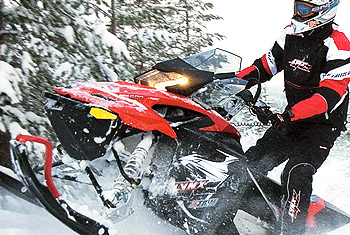
Five Polaris Teams in Iron Dog Top 10

Polaris Terrain Domination Includes Victories in Snocross, Hillclimb and the Grueling Iron Dog Cross-Country Race Across Alaska

Polaris Terrain Domination extends from the snocross tracks to the hillclimbs to the world’s most grueling cross-country snowmobile race, the Iron Dog, which was won this year by Polaris racers Chris Olds and Tyler Huntington.

The duo won the 1,971-mile race across Alaska by more than two hours, and that’s after coasting to victory because they built up such a significant advantage on their Polaris 600 IQ Shift snowmobiles.

The Iron Dog victory added to the Terrain Domination achieved by Polaris racers throughout the winter all across the snowbelt.

Along with the Iron Dog victory, Polaris racers won three Pro-class points titles on the ISOC race circuit, won multiple class championships on the U.S. Cross Country circuit, and reconfirmed the brand’s deep snow prowess with multiple titles at the Jackson Hole World Championship Snowmobile Hillclimb.

Undoubtedly, the most demanding single event is the Iron Dog, which sends teams of racers across Alaska, from Big Lake to Nome and back across the state to Fairbanks.

Man and machine are subjected to a wide variety of Alaskan terrain, from rough mountain passes through the Alaska Range to high-speed running on the frozen Yukon River.

In every situation – even a nearly snowless stretch across the “Farewell Burn” – the winners’ Polaris snowmobiles performed above all expectations.

“I feel awesome,” Huntington said after winning. “It’s been something I’ve been dreaming about my whole life, and I finally got it. I can’t explain it.”

Polaris Dominates Iron Dog Pro Class

The 2010 Iron Dog was so demanding that only 12 of 29 Pro teams finished. Of the top 10 Pro teams to finish, five of them were on Polaris snowmobiles.

Along with the winning team, the other Polaris Pro teams in the top 10 were: James Sweetsir and Mark Tope, both of Anchorage, in fifth place; Ryan Sottosanti of Wasilla and Jeremy Neeser of Anchorage in sixth; Louis Miller III and Louis Miller IV, both of Anchorage, in seventh; and Kenny Johnson of Wasilla and Andy Lachinski of Palmer in tenth.

Polaris teams have won 12 times in the race’s 26-year history, including 2009, when Todd Minnick and Nick Olstad posted the fastest winning time ever while winning a tight race. Prior to winning this year, Huntington’s best finish had been third place in 2008, while Olds, 38, had one fourth-place finish in his previous eight tries.

Olds said the winning team encountered “a little bit of everything” in terms of terrain during the race. “It was a little bit warmer than typical on the first half from Big Lake to Nome, and across the Farewell Burn there was probably a 50 to 60 mile stretch where there was no snow at all. We were pretty lucky because our machines have actual temperature gauges on them, so when we saw the temperature get to around 215-220 degrees; we stopped and tried to find snow to pack on the coolers to get them cooled down.”

“The burn area was really hard,” said the 24-year-old Huntington. “You’ve got to force yourself to stop.”

Cruising to Victory

They also found it challenging to hold back as they approached the end of the race. They knew they had a substantial lead, and didn’t want to ride too hard or make a costly mistake.

“We felt pretty comfortable at the end of the first day when there were only three teams in front of us,” Olds said. “I think probably a big advantage we had was we didn’t let our machines overheat. Some teams either lost coolant or they overheated their machines so it caused problems later on in the race.”

Olds and Huntington moved into second place on day two, and in Kaltag in the early morning of day three, they passed the lead team, which was repairing a faulty electrical component on a sled.

Once in the lead, Olds said, “we didn’t do anything too crazy. We just tried to watch ourselves… You’re thinking all the time of what little things could happen. Physically, we were fine and our machines were solid, but in your head, being up front, it was our race to lose this year, so we were really worried about something little happening.”

All that happened was they rode steadily on their Polaris snowmobiles and received a heroes’ welcome as they crossed the finish line in Fairbanks. Olds, who is from Eagle River, Alaska, said he and Huntington, who lives in Fairbanks, plan to defend their title in next year’s race. “Absolutely,” Olds said. “I could see myself doing it another 10 years for sure. I feel pretty good right now.”

TEN WORLD CHAMPIONSHIP TITLES FOR TEAM ARCTIC

World Domination in Snocross and Hillclimb

If there was any doubt about which snowmobile was the world’s best, Team Arctic snocross and hillclimb racers answered by winning a combined 10 World Championship titles and taking 29 podium positions.

At the FIM Snocross World Championship in Mala, Sweden, Team Arctic’s Tucker Hibbert won his first-ever World title in convincing fashion, going 1-1-2 in the round-robin format finals.

Just as impressive was the history-making Team Arctic podium sweep, with Sweden’s Johan Lidman taking second and Alaska’s Cory Davis taking third.

On this side of the pond, Team Arctic hillclimbers applied their skill with the incredible climbing ability of the M Series snowmobiles to win nine classes at the Jackson Hole (Wyoming) World Championships, including two King of the Mountain titles.

Highlighting Arctic Cat’s strength in all engine categories, Team Arctic racers scored wins in the 600, 700, 800 and Open classes to once again confirm that M Series Mountain sleds are best-in-class.

“Winning 10 World Championship titles in a single weekend is a huge accomplishment for Team Arctic,” said Mike Kloety, race manager. “Sweeping the podium in Sweden put an exclamation mark on another winning season of snocross. Taking nine hillclimb World Championship titles across the full spectrum of classes confirms the strength of our racers and crews, the hard work of Al Shimpa our hillclimb coordinator, and the performance of our machines.”

About Arctic Cat – Arctic Cat Inc., based in Thief River Falls, Minn., designs, engineers, manufactures and markets all-terrain vehicles (ATVs) and snowmobiles under the Arctic Cat brand name, as well as related parts, garments and accessories. Its common stock is traded on the NASDAQ National Market under the ticker symbol “ACAT.” More information about Arctic Cat and its products is available on the Internet at www.arcticcat.com.

Clock Ticking For Yamaha Spring Voucher

Time is running out for the 2011 Yamaha Advantage Spring Voucher FREE registration!

Time is running out! You need to register online or at your local Yamaha Snowmobile dealer before April 15, 2010 to get your Yamaha Advantage Spring Voucher.

It’s the only way you’ll be able to get either a FREE 4-year warranty or $700 in Genuine Yamaha Apparel and Accessories when you make a qualifying 2011 Yamaha Snowmobile purchase before November 30!

There is no cost to the voucher and there is no obligation to buy. You simply go to Yamaha-advantage.com or stop by your friendly Yamaha Snowmobile dealer and get registered.

You don’t even need to make a decision on which offer you will choose in the fall. Voucher holders will be able to decide which great deal they want at the time of purchase – either the FREE 4-year warranty or the $700 in Genuine Yamaha Apparel and Accessories.

As an added incentive for all-new 2011 Apex with EPS buyers to come in to visit your participating local Yamaha Snowmobile dealer, you will receive a FREE Apex cover if you put a deposit down and make a qualifying purchase of any 2011 Apex model in the fall!

The clock is ticking. You need to register with your local Yamaha Snowmobile Dealer or Yamaha-advantage.com before April 16, 2010!

2011 YAMAHA APEX: More Changes and Upgrades

The EPS system used on the Apex is an active power steering system. This means it is fully operational all the time and is not reactive.

Some electronic PS systems actually utilize sensors to respond in milliseconds to trail inputs. However, Yamaha’s EPS is a variable system that regulates the amount of assist as demand is increased.

Simply stated, there’s more assist at low speeds and much less at higher speeds so the rider doesn’t lose any “feel” up through the bars. A bypass system eliminates the possibility of overloading the EPS when the sled is static or not moving.

Keep in mind, as power steering setups go, EPS is a pretty light one. There’s no fluid, no pumps and it has a benefit that is really a breakthrough.

It helps eliminate negative feedback coming up from the skis into the handlebars. This is a particularly good thing for any snowmobile and it’s the reason we found the Apex was not only a better handler but, without the feedback as we rode over trail junk, the sled was much more settled and predictable.

We think this is the primary reason all snowmobiles are candidates for this great technology in the future.

A couple of other items we left off the list was the 2011 Apex’s use of a longer track and the fact it utilizes ‘extrovert’ drivers in the tunnel to eliminate track ratcheting.

The standard track length has been increased to 128-inches from 121 and along with a 1.25-inch lug depth, the net result is a big improvement in traction – something Apex customers have been wanting for a long time.

The base model Apex is equipped with the tunnel adjustable Monoshock skid while the upscale SE comes with Fox Float Air suspension front and rear.

The air combo significantly reduces weight by eliminating all coil springs in the suspension. This is a good feature if you’re concerned about weight because the addition of the longer track, the EXUP valve and the EPS has added some additional poundage – something the 4-cylinder 4-stroke could ill afford to compromise.

The net result, however, is really positive. As groomed trail sleds go, the new Apex is a fabulous ride. There’s a difference here that goes far beyond appearance or just one dramatic feature like power steering.

The whole package works great and we’d recommend this sled in a heartbeat.

Candidate for Craziest Sled of the Year

An interesting surprise and one that leaves us scratching our heads is the intro of a completely new concept snowmobile called the Tundra Extreme. Wait, don’t log off yet!

This is a crazy sled and just may hit the nail on the head with a new segment. Frankly, we just don’t know.

Okay, here it is: Take the featherweight Tundra chassis with front struts and delivering a crazy tight turning radius, add in a ridiculous 16x154x2.25-inch track and then power it up with a 600 E-TEC.

Yes, you read it correctly, a 600 E-TEC! Still listening? Add in a tall riser, a super-narrow 32-inch ski-stance and the new non-ported Summit track and you’ve got one of the most extreme hill climbing sleds ever built.

We’re not sure how much this sled under-weighs a conventional Summit but we’re betting it’s considerably lighter.

Honestly, for freeriders this sled may be the ultimate combination of horsepower-to-weight-to powder-handling-to-traction.

We think this is a sick piece of equipment and just may be the sleeper sled of the year. We can’t wait to get a ride on one.

The Tundra Extreme is definitely not a utility sled and may turn out to be a flat-out excellent play sled – especially if you love riding in powder or riding freestyle. We can’t think of anywhere this sled can’t go.

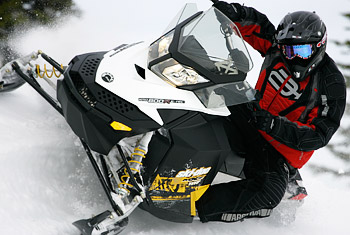
We don’t know who thought this one up at Ski-Doo but they may need some professional counseling. They may even be nuts enough to qualify to work here at Supertrax.

ARCTIC CAT: Other Items for Discussion

The 2-ton elephant in the room for 2011 is Arctic Cat’s resistance to widen the scope of the Sno-Pro 500 race chassis introduced last year.

We had been speculating the last twelve months that Cat would offer more engine variations in this slick, lightweight chassis that comes with a proven racetrack pedigree – just what the Cat faithful have been wanting.

Alas, there is no further commitment to this platform, at least in 2011. No, there’s no new EPA compliant 600 and no 800 either, at least for another year.

On the upside, the Sno Pro 500 has enjoyed a spectacular season winning cross country races everywhere across the snowbelt and has verified its position as one of the best low-cost race sleds you can buy.

Its tightly wound 500 has been more than adequate in this environment and the sled is proving to be both durable and consistently competitive.

The sliver of the market that wants a race-bred snowmobile for competition purposes is grinning ear-to ear. If Arctic Cat’s intention was to build credibility with this segment, it has succeeded in a big way. But, what about the panting masses?

On the flip side it makes some sense to hold off for another year on this platform. Why? Well, 2012 is a big year for snowmobile engines.

There’s another hurdle to be gapped with EPA compliance and it looks like most 2-strokes will need to be built with Direct Injection technology to meet requirements. For all we know, there may be some other way to get a 2-stroke to comply but, so far, it looks like there’s a very strong possibility both Polaris and Arctic Cat will be coming with some new 2-strokes next year.

It’s a practical corporate decision to hold off for a year and then bring out fully tested and debugged engines at the same time a less known but fully evolved chassis is introduced to more segments. We’re betting that’s the idea behind this strategy – and so are several thousand Arctic Cat customers.

Hayden Grabs Second Place In Kitchener

After a two week absence from the snowcross circuit due to a shoulder injury, Team Monster Energy-Yamaha-OTSFF’s Iain Hayden returned to action at a regional CSRA event in Kitchener, Ontario this past weekend.

Although temperatures were well above freezing and snow was hard to find in southern Ontario, organizers of the event managed to produce enough white stuff so the races could proceed as planned.

In addition to a good spectator turnout, most of the CSRA heavyweights attended the penultimate race of the season to get ready for the final National Championship round on April 10th at Horseshoe Valley in Barrie.

Despite riding conservatively and not taking any chances that might jeopardize his still vulnerable shoulder, Hayden rose to the occasion and finished the weekend with a noteworthy second place finish in the Pro Open class. His onetime teammate Steve Taylor was the only rider in the field to keep Hayden from climbing the top level of the box.

The weekend started off on a positive note on Saturday, when Hayden cruised to a second place finish in his qualifier. In his two qualifying heats on Sunday, he piloted his explosive four-stroke Yamaha FX Nytro to victory at the checkered flag, which gave him first gate pick for the 20-lap final.

Hayden took optimum advantage of his lucrative starting position top peg the holeshot. Taylor, who was in the mix from the get-go along with defending champ Lee Butler, snuck inside of Hayden to take the lead before the end of the first lap. They quickly distanced themselves from the pursuit group and it looked like the race was going to be decided amongst the power trio.

About three laps into the race, however, Butler seemed to be experiencing some kind of mechanical issues and he was unable to keep up the blistering pace. This left Hayden battling Taylor way but challenges for the lead went unrewarded with Hayden settling for second at the finish line.

“It was a good weekend. I hadn’t quite expected to do that well. I was just hoping for a top three finish. All I really had in mind was to get in some seat time and give the team mechanics a final chance to work on the sled under racing conditions before the last round of the championship in two weeks. As usual the guys did a great job and our Nytro ran like a charm. We’re all pumped for Horseshoe Valley. It should be one heck of a race,” said Hayden.

Hayden will be looking to nail down his fourth CSRA National Championship title at the closing round. To do that he will have to beat archrival Butler, with whom he shares 412 points.

RIDE IMPRESSIONS: 2010 Arctic Cat F8 Sno Pro

0

Arctic Cat’s F-Series platform is truly the heart of its product offering in 2010.

Ergonomics are superb but the addition of the new 800HO mill cleans up what was a more-or-less gas sucking, inconsistent 800 used the last couple years.

This new mill has a crispy power delivery, is more efficient and works in perfect concert with the F-chassis.

Even with Fox Floats up front and ditch banger Fox gassers in the rear, the F8 is a pleasure on trails.

There’s much goodness in the floating front arm, TSL skidframe used here and it shows up when the bumps get gnarly.

We like the moveable seat and bars and have to admit this is one of our favorite and most comfortable places to do business from.

Instruments are easy to read and toggle nicely but we would like to see a handlebar switch for them so you can make adjustments without having to take away concentration.

Standard hookers and tight footrests generate rider confidence from your first pull, especially if you’ve adjusted the seat and bars to your personal liking.

The 800 spools quickly and provides an urgent surge of power when the flipper is caressed.

Final thought: that can’t be a windshield. Really, why bother?

* Click here for specs and details

RIDE IMPRESSIONS: 2010 Polaris IQ LX 600

0

We just have to say that we really like IQs. This one gets high marks for extra accouterments targeted at big-mile trail riders.

This year’s LX gets a 136-inch, one inch lugged Camo-sneaker wrapped around a double coupled skid that is just a tiny bit over-sprung. We think it could be a tad softer for this target audience.

The rear storage bag is sumptuous and truly functional while the high windshield and weird but efficient mirrors round out the trail touring identity of the LX.

This 600 Cleanfire, still of the 4-injector variety, is a solid performer laying sweet, broad trail-power down to the snow.

The 125-horse Liberty pulls off idle with a smooth engagement and transitions seamlessly to full whack on lakes.

The real deal with any IQ is its variable castor IFS geometry used to control bumps and precisely steer the chassis.

Comparing brands head-to-head, there’s really nothing like the IQ for precise and linear turn-in at any speed.

The chassis corners flat, begs to be thrown deeper toward the apex on twisty trails and allows riders to input steering angles to their heart’s content without ski-lift or understeer.

Ergos are exceptional, allowing effortless sitting-to-standing transitions. Our only gripe is the lack of rear tires in the skid — it just looks cheap.

* Click here for specs and details
* TEST RIDE: 2010 POLARIS 600 IQ LX (VIDEO)

The Big RUSH Finally Hits!

Next year the RUSH chassis goes mainstream in the Polaris line-up and the basic RUSH platform will come in two power flavors: The current 4-injector Cleanfire 600 twin and a much awaited 800 Liberty Cleanfire, using for the first time, just two injectors. These engines are available in the RUSH chassis in a couple of very appealing variants.

For MY11, the basic RUSH package comes with non-reservoir coilover Fox HPG shocks up front and in the skid. A base RUSH can be fitted with electric start at the dealer.

This RUSH trim level nets a top speed enhancing 15x120x1-inch track. Interesting updates to the Pro-Ride suspension and its associated packaging have a profound effect on how the sled looks.

The big news is the addition of a tail cooler mounted under the new rear suspension garnish. This rear cooler was necessary for the 800 engine but will be standard on all RUSH 600 variants as well.

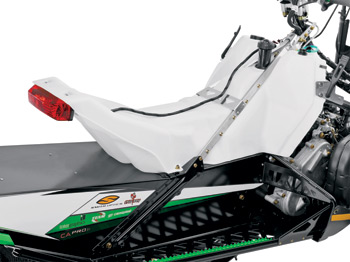
Notice how the new rear trim and the revised Pro-Ride system makes the RUSH look longer and the seat less isolated and less like a bar stool. Overall, the visual effect of the RUSH is exponentially improved across the board. The 600 comes in black only and the 800 looks sweet in red.

Big news comes in the form of a new rail bend and a modified front arm. Both these changes have added what some insiders have suggested is a 5-mph increase in top speed down the lake.

The other advantage is better stud clearance. The Pro Ride rear cantilever arm has been completely redesigned along with the garnishes covering the articulating rear suspension structure.

This change nets a substantial improvement in the visual persona of the sled and we like the overall improvement. So dramatic are the changes to Pro Ride this year we compared them to the updates Ski-Doo landed after the original 2003 beaver-tail REV underwent major rethinking when the 2004 flat-tail arrived.

Click for more RUSH details & the New Pro-R