Home Blog Page 251

Winning Riders Supports Snowmobile Associations

0

Polaris Supports Grassroots Groups with Sales-Based Contributions

For the seventh consecutive year, state and provincial snowmobile organizations across North America are receiving contributions from the Polaris “Winning Riders” program, which generates support for the groups based on sales of new Polaris snowmobiles.

From Newfoundland to Washington and Alaska to Quebec, snowmobile associations are receiving “Winning Riders” funds proportionate to the number of new Polaris snowmobiles sold within each state and province. Polaris is making contributions to snowmobile associations in 12 Canadian provinces and territories and 25 states in the United States.

Polaris also announced it is extending the Winning Riders program through the 2012 sales season, meaning contributions will be made next year based on retail sales of new Polaris snowmobiles between April 1, 2011, and March 31, 2012.

“The passion for snowmobiling is running strong across the North American snowbelt,” said Mike Jonikas, VP of the Polaris Snowmobiles, Sales and Corporate Marketing. “We see real benefits in supporting the associations that coordinate activities of snowmobile clubs and help develop great riding opportunities.”

Polaris makes the “Winning Riders” contributions with “no strings attached,” allowing each state or province to decide how to use the funds it receives. Projects funded by Winning Riders donations in recent years have included membership drives, trail and grooming programs, legislative efforts, tourism promotion and more.

About Polaris – With annual 2010 sales of $1.99 billion, Polaris designs, engineers, manufactures and markets innovative, high quality off-road vehicles (ORVs), including all-terrain vehicles (ATVs) and the Polaris RANGER® for recreational and utility use, snowmobiles, motorcycles and on-road electric powered vehicles.

Polaris is a recognized leader in the powersports industry, among the global sales leaders for both snowmobiles and ORVs. The Company has established a presence in the heavyweight cruiser and touring motorcycle market with Victory motorcycles and the acquisition of the Indian motorcycle brand. Additionally, Polaris continues to invest in the Global on-road low speed vehicle industry with internally developed vehicles and the acquisition of Global Electric Motorcars (GEM). Polaris enhances the riding experience with a complete line of Pure Polaris apparel, accessories and parts, available at Polaris dealerships.

Polaris Industries Inc. trades on the New York Stock Exchange under the symbol “PII”, and the Company is included in the S&P Mid-Cap 400 stock price index.

Information about the complete line of Polaris products, apparel and vehicles accessories are available from authorized Polaris dealers or anytime at www.polarisindustries.com.

2012 Yamaha RS Vector

0

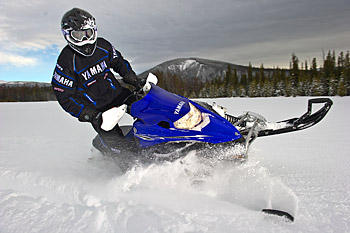
The Vector is very good at meeting the expectations of riders who want a sled that offers optimum comfort and very good performance on trails.

First, it’s 4-valve EFI triple is a precision work of art and its rear exiting exhaust makes some of the best noises money can buy in any powersports medium.

This 1049cc, 130-horse powerplant is powerful and despite the extra weight the Vector carries, it is completely in the hunt with comparable sleds in acceleration and top speed.

One feature we like is Yamaha’s Engine Braking Reduction system. This valve system lets a small amount of air pass through the throttle body area on deceleration and allows the rider to ply the throttle much more smoothly when the throttle is off.

The inherent tendency of a 4-stroke is to jerk the sled down in speed on entry into corners when the rider is off-throttle. As with the Arctic Cat 1100, this anti-engine braking feature on the Vector allows it to behave much more like a 2-stroke.

Surplus weight is a continuing discussion and really makes the Yamaha see taillights when the trails are rough or the ditches are moguled up.

Its monoshock skid hasn’t been affected negatively by the shock “downgrades” this year but the ultra-light and nimble XP and RUSH – even the 4-stroke Procross Cat, like this environment much better and produce synonymous results.

Get over it. There’s nothing wrong with the way the Veck works. If it had been designed with about sixty less pounds and Yamaha was bragging it as a ditch-banger, then we’d be critical.

As it is, this sled offers years of plush trail riding, plenty of mid-range performance, time proven reliability and great trail handling.

You can ride the Vector in the bumps and it will produce decent results but go to the max and it’s simply out of its element.

2012 Polaris 600 RUSH PRO-R

0

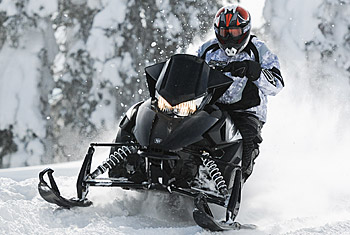
Everything about the RUSH seems unconventional until you take a seat behind the controls. It’s here the sled displays its ability to become one with its rider.

We’ve already discussed the new front end handling improvements but the 125-hp Cleanfire twin the platform originally started with is an incredible motor. This 4-injector SDI Liberty is surprisingly close in its emissions to a 600 E-TEC and its fuel economy isn’t far off, either.

The good news is Polaris has an even better new-generation EPA certified 2-injector 600 already in the marketplace in its 2012 mountain sleds.

We’ve found very little to complain about with this mill and despite some nearly indiscernible midrange throttle lag issues a couple of years ago, it’s been a plowhorse of reliable power and function.

We’ve been learning the ropes setting up the RUSH’s Pro-Ride rear suspension and have continued to be amazed how well it can work on roughed-up trails.

There’s just enough transfer in the rear end to keep the skis light and when you’re engaging deep whoops, the biggest challenge is adjusting your mind to keeping the throttle pinned and trusting the suspension’s ability to make you look like a pro snocrosser.

From the cockpit the RUSH feels a bit tall and it really lends itself well to stand-up riding. The truth is, the back end handles big bumps so well, you don’t have to stand up much.

If you’ve got the rear exposed shock spring preload right, there’s no fear of bottoming and even on the fastest, most gnarled- up approaches, the sled launches straight.

The RUSH is so good in extreme trail junk you could almost overlook its performance in light chatter and stutters.

Unless you’ve dialed this suspension properly you can end up frustrated with the way it handles this kind of terrain at low and medium speeds. Get it right and it’s pure heaven.

Our recommendation is that you do not simply accept the factory delivered settings as being perfect for your personal weight and riding style.

You need to ride this sled, make adjustments and then ride it again. Certainly, there’s plenty of potential for tailoring this ride exclusively, but you need to work at it until you’ve figured it out.

10 SKI-DOO MODELS BAT CERTIFIED FOR NATIONAL PARKS

0

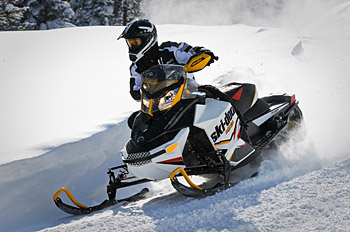
BRP has ten 2012 Ski-Doo snowmobile models certified for use in Yellowstone and Grand Teton National Parks where some of the toughest emission standards are enforced.

These BRP products stand alone as the only 2012 models to be certified with no modifications or kits.

Snowmobiles must be certified as Best Available Technology (BAT) by the National Park Service to enter Yellowstone and Grand Teton National Parks.

BAT certification is one of the most stringent standards for air and noise emissions in the world, requiring hydrocarbon emissions of less than 15 g/kW-hr, carbon monoxide emissions of less than 120 g/kW-hr, and sound level limited to 73 decibels.

These ten Ski-Doo snowmobiles are all equipped with four-stroke engines, either the ultra-quiet and efficient Rotax ACE 600 engine or the more powerful Rotax 4-TEC 1200 powertrain. The certified Ski-Doo snowmobiles require no modifications or throttle limiters to meet the BAT standards.

“BRP is committed to providing responsible recreational products that meet or exceed our customer’s needs while being as environmentally friendly as possible,” said Robert Lumley, vice-president, Sales and Marketing, Ski-Doo and Sea-Doo. “Unlike our competition, these ten machines require no modifications. All customers using these models across North America are getting this same kind of fuel economy and efficiency, not just sleds limited to Yellowstone or Grand Teton national parks.”

BRP’s Rotax ACE 600 engine was designed for efficiency, with every aspect focused on maximizing output, minimizing fuel consumption, reducing maintenance and extending longevity. Fuel economy on some models is an industry-leading 8 L/100 km (29 mpg).

The Rotax 4-TEC 1200 engine is designed more for performance. This engine meets the demands of experienced riders across the world by delivering a lightweight and powerful four-stroke package that translates to easy handling and quick acceleration in the REV-X chassis.

BRP’s unmatched leadership in advanced technology powertrains, including the ACE 600 and 4-TEC 1200 engines, has contributed significantly in powering Ski-Doo snowmobiles to the number one sales position in the industry.

Ski-Doo models certified for BAT are offered in one-rider and two-rider configurations, including: the Grand Touring SE, Grand Touring LE with the Rotax 4-TEC 1200 engine, and the Grand Touring Sport, MX Z Sport, MX Z TNT, Renegade, Tundra LT, Tundra Sport, Expedition Sport, and Skandic WT, all equipped with the Rotax ACE 600 engine.

2012 SKI-DOO AMBASSADOR PROGRAM EXPANDS VISION

0

BRP’s Ski-Doo Freeride Ambassadors program enters its second year and brings a new perspective with the addition of two women riders, Ashley Chaffin and Stephanie Schwartz.

This group of talented riders will once again be sharing their ride experiences, thoughts and opinions on everything for the deep powder market of western North America.

For those unfamiliar, the Summit Freeriders are this year comprised of seven mountain snowmobilers with a wide range of riding styles, riding interests and unique talents.

A couple of them are seen in some of the extreme back country videos, one has an impressive collection of X-Games medals, one is a former racer and another is an adventure athlete who has competed in almost every kind of human powered race there is.

It’s a wide range of people who can offer something for all riders. But they all share a passion for mountain riding.

Last year the Summit Freeriders gave you some great insight on what they’re up all winter long – how they prepare before the season starts, the gear they use, sled set-up and some great riding tips – that will continue this year and you’ll get the added benefit of a women’s perspective. Be warned, the ladies can ride.

Watch for an announcement on what Carl Kuster is up to very soon. He’s not leaving the Ski-Doo fold and has a really exciting new venture that will bring some real value to Ski-Doo mountain riders.

The Freeriders will appear at the western snowmobile shows this fall and watch the Ski-Doo Mountain blog Elevation or Ski-Doo Mountain Face Book Page for updates on where they might appear at select dealer events and demo rides.

2012 ARCTIC CAT F1100 LXR

0

The 1100 4-stroke LXR fully embodies what we look for in a trail-happy sled. The Suzuki-built 4-valve EFI twin under the hood is a solid, dependable power source with hundreds of thousands of reliable miles behind it.

Its durability is further endorsed by the fact it can be taken from 123 ponies up into the stratosphere by adding a turbocharger to it. Cat’s turbos also have zillions of miles of consumer use on them.

None of this is intended to mask the fact a liter-plus 4-stroke has a weight disadvantage compared to a 600cc 2-stroke. What’s amazing about this sled is the way it handles the extra mass.

We’re not exaggerating when we tell you the F1100 gives away nothing in handling and ride to a 2-stroke. You can ride this sled a hundred miles and, except for its flatulent exhaust note, never be aware it’s a 4-stroke.

What you get as a bonus is that nice, 4-stroke low end torque and, although power up top may not match an E-TEC or a Cleanfire 600, we’ve seen triple digits on the speedo, which we’re pretty happy about.

Cat has developed a fairly revolutionary setup called a Torque Control Link that amounts to a one-piece, extruded aluminum brace that connects the engine and the jackshaft and adds incredible support between the primary and secondary clutches.

The result is near-perfect belt deflection and alignment. Certainly, this means the belt will live longer but better yet is what it does to the power delivery of any of the Cat engines in this new chassis.

Spool-up from low RPM right to the top is smooth, linear and velvety. There’s a sense this sled is getting all of its power to the snow – and this is in fact, true.

We’ve made the statement this sled represents the peak of 4-stroke snowmobile development. We think the competition has some catching up to do.

Indeed, Cat has rewritten the book on 4-strokes and if you aren’t a believer, you will be after riding this one.

LOWER-HP EVINRUDE OUTBOARDS WITH TOHATSU

0

BRP has signed an agreement with Tohatsu Corporation to supply a range of Evinrude outboard engines from 3.5 to 15 HP.

The new engines will be available at BRP dealerships in early 2012, adding to BRP’s existing line-up of Evinrude E-TEC outboard engines of 15 H.O. to 300 HP (Available for international from 25 to 300 hp).

“We believe Tohatsu Corporation, who builds quality and market-proven engines, to be the right supplier to complete the Evinrude line-up,” said José Boisjoli, president and CEO. “BRP’s focus remains on the development and manufacturing of high-value and higher horsepower engines, using the E-TEC technology that we will continue to enhance with industry-leading features and benefits over the years to come.”

BRP invested considerably in the Evinrude brand and E-TEC technology, including a $15-million investment in its state-of-the-art facility in Sturtevant, Wisconsin, U.S. This agreement further supports its commitment to the Evinrude brand.

Bombardier Recreational Products Inc. (BRP), a privately-held company, is a world leader in the design, development, manufacturing, distribution and marketing of motorised recreational vehicles. Its portfolio of brands and products includes: Ski-Doo and Lynx snowmobiles, Sea-Doo watercraft and boats, Evinrude and Johnson outboard engines, Can-Am all-terrain and side-by-side vehicles and roadsters, as well as Rotax engines. BRP products are distributed in more than 100 countries. www.brp.com

Snowcross Racer Killed In Construction Accident

0

The Canadian Snowcross Racing Association (CSRA) sent a press release to the snowmobiling community announcing the tragic death of young Snowcross Racer Kyle Knox #505.

As reported on the Toronto Star’s website, Knox – an apprenticing crane operator with Anchor Shoring & Caissons Ltd. was crushed to death on Tuesday, October 11th when a massive drilling rig fell over onto the loader he was in.

CSRA representatives stated in the release, “Kyle was one of our up and coming Snowcross stars, and will be sadly missed at our events this winter.”

Kyle Knox was 24.

Click here for the full story

2012 SKI-DOO MXZ X 600 HO RIDE REPORT

0

It’s tough to argue with Ski-Doo’s engine development strategy. Ski-Doo has virtually guaranteed the longevity of 2-stroke power in our industry.

E-TEC Direct Injection is such revolutionary technology it’s changing the way the public perceives 2-stroke engines.

We’ve had exposure to E-TEC for almost five years now and we continue to marvel at how good these engines start, idle and how little petroleum they use. The fact they are squeaky-emissions clean doesn’t even enter into it, as Ski-Doo says itself: The proof is in the riding.

Although XPs are very sharp handling, flat cornering sleds, compared to both the Cat and the Polaris, there’s an almost robotic numbness the driver is fed back through the bars. The sled handles with razor sharp accuracy until it gets to its limit and then can offer up some unpredictable ski-lift.

It’s not bad, it’s not uncontrollable in the least, but it’s there. Lift the throttle and it goes away. So the worst we’d have to say is the XP chassis requires some precise throttle control and some body-english to reach its maximum.

When you bolt in rMotion and start riding deep whoops and gnarl, the back end actually, noticeably outperforms the front end on the X.

Even with upgraded reservoir clickers up front the deep cycling the rMotion skid is capable of can cause the front end to “pack up”. This may be a bigger comment on the rising rate skid’s capabilities than the front end’s shortcomings though.

Throttle tip-in is as crisp as an Oreo and the MX-Z’s clutches spool up with smooth power delivery every time you squeeze the throttle.

Calibration is perfect. Much of this smoothness is due to the XP’s very light, rigid bulkhead design and it maintains very good clutch alignment, much like the Cat, by using chassis support to keep everything from twisting.

Overall, the smooth power delivery of the 600 and the prowess of the XP platform marry together to produce impressive acceleration and strong top end performance.

Snowmobile Clubs Need Volunteers

Snowmobile clubs in communities from coast to coast are joining in a national call to all snowmobilers from the Canadian Council of Snowmobile Organizations (CCSO) for volunteers to help clubs prepare for the upcoming winter.

Canada’s 673 snowmobile clubs operate 103,843 kilometres of snowmobile trails for 648,174 registered snowmobiles used by over a million riders.

Organized snowmobiling in Ontario is provided by 230 member clubs of the Ontario Federation of Snowmobile Club (OFSC) and its website is a good first contact point for those wishing to volunteer this fall.

Throughout the autumn, volunteers from hometown clubs prepare trails, groomers, signage, bridges, staging areas and shelters for the benefit of snowmobilers.

Frequently, their task becomes more challenging thanks to storm damage, flooding and other natural events that occurred during the off-season.

Clubs also need a hand in the office, with websites, social media, accounting and other administration.

“Organized snowmobiling depends on volunteers and we invite every snowmobiler to lend a hand, even for a couple of hours. We understand that everyone is very busy in their own personal lives, but even one day each fall would make a huge difference,” said Kevin Sweetland, volunteer CCSO President.

Besides helping to ensure that everything is ready when the snow comes, volunteering for your local snowmobile club provides many other benefits.

Among them is the camaraderie and fun of connecting with other snowmobilers to make new friends, share experiences and meet more riding companions.

For many volunteers, the personal satisfaction of making a contribution to the activity they love is also important. Others simply like to get outdoors to enjoy the fall.

“Most folks say that volunteering for their local club makes them feel more apart of snowmobiling and appreciative of all that goes on behind the scenes. Besides, volunteering for your club in the fall is absolutely the best way to take the edge off your eager anticipation for the coming winter!” said Eric Saunter, OFSC manager, Safety and Volunteer Development. “Now is the time to call and volunteer!”

The Canadian Council of Snowmobile Organizations (CCSO/CCOM) is dedicated to providing leadership and support to organized snowmobiling in Canada.

Visit www.ofsc.on.ca and then click on the ‘Volunteering’ button.

The Ontario Federation of Snowmobile Clubs is a volunteer led not-for-profit association, which through strong leadership, provides a wide range of quality programs and services to, and on behalf of, its member organizations. Our provincial network of organized snowmobile trails connects Ontario communities, providing responsible riding experiences that are safe, enjoyable, and environmentally sustainable.