Home Blog Page 246

Bunke Racing Wins Soo I-500 Enduro Race

0

The Bunke Racing team of Gabe Bunke, Aaron Christensen and Bobby Menne IV used Polaris Terrain Domination to outrun the field and win the grueling International 500 on the famous Soo I-500 track in Sault Ste. Marine, Michigan, on Feb. 4.

Unseasonably warm weather led to severe deterioration of the ice oval, but Polaris performance and reliability put five Polaris race teams in the top 10, and 10 Polaris teams finished among the top 22.

Polaris racers Corey Davidson and Travis Hjelle (XLT Engineering/Stud Boy), who have won the I-500 twice, including in 2011, finished third.

The Bunke Racing drivers drove hard and consistently, using their IQ Race Sled’s Polaris Liberty power to pull away from the competition repeatedly in the final 100 laps, when several yellow flags erased the team’s leads.

The Polaris sleds displayed exceptional durability as the ice melted and wore away in the corners, allowing dirt and mud to show through by the end of the 500-lap race.

Bunke Racing completed the 500-mile race in 9 hours, 24 minutes and 36 seconds, and they won by 16.475 seconds, a margin that would have been much larger if not for the numerous late caution flags.

Bunke and Christensen finished fourth in the I-500 in 2011. Bunke won at the Soo in 2005 as the lead driver and in 2002 as a teammate with Mike Gentz, Jr. Bunke, Christensen and Menne are all top drivers on the United States Cross Country circuit, so they usually race on rough terrain but were completely at home on the flat Soo oval.

“I think this one is the sweetest,” Bunke, age 35, told the Sault Star newspaper after the race. “We worked so hard for this… These might have been the toughest conditions I’ve raced in. You just had to try to drive safely and stay out of trouble.”

“This makes up for letting a lead get away last year,” said Christensen, age 30. “This feels really good.”

Davidson and Hjelle completed 498 laps and finished third one year after winning the race. They also won the I-500 as teammates in 2006, and Davidson, now age 41, also won in 2008 (driving solo), 2005, 2004, and three straight years – 1998, ’99 and 2000 – while teamed with Steve Olson.

Davidson isn’t through pursuing his ninth victory at the Soo. “I’ll get it. I’ll be back here,” he said after the race.

Other Polaris race teams that finished in the top 10 were: a second Bunke Racing comprised of Ryan Faust, Scott Macaig and Travis Faust, who finished seventh with 483 laps; the R&R Racing team of Tyler Nickles, Rodney Bell and Josh Ware, who were eighth (481 laps); and the Wuppet Race Team of John Bosek, Cameron Rittenour and Ryan Flynn, who were ninth (481).

Polaris race teams that also finished in the top 22 spots were:

– Hoos Racing, John Hoos, Matt Hoos, Dave Nelson and Brad McConnell, 13th place (476).
– Millennium Motorsports, Grant Vermeesch, Cam Vermeesch and Andrew Terrill, 14th (475).
– Bryan Kovar Racing, Steve Edwards, Richie Autterson and Jim Erickson, 19th (441).
– Beard Motorsports, Mike Haynes and Joe Burch, 21st (404).
– Millennium Motorsports, Andrew Shoemaker and Eric Gausen, 22nd (387).
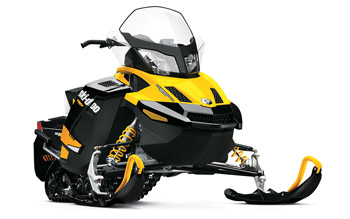
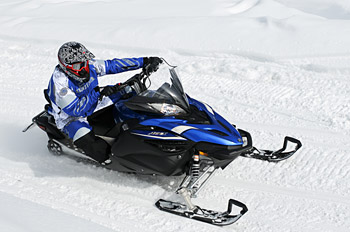
2012 SKI-DOO MXZ TNT 4-TEC

0

Certainly, at 130-horses, the TNT 1200 4-TEC appears to be at a disadvantage when compared to some other sleds.

Look closer and you’ll see this MXZ weighs in almost a hundred pounds lighter (dry) than an Apex and is actually 50 pounds lighter than its next nearest competitor.

The argument persists that if you take any engine and put it in an ultra-light chassis, you’ll get way better performance results than expected.

This is the case with this 4-stroke TNT and we’ve listened to many comments from people we’ve ridden with who readily classify it as a hypersled.

There’s no question this strong running 1170cc triple will push this lightweight XR beyond the C-note and will get you there with plenty of hustle.

Its claimed 130 horsepower output feels like a lot more and off-idle squeeze up through to midrange is especially robust.

There is noticeable throttle lag at initial engagement that can take some getting used to, but once you’re aware of it and compensate by being a bit more aggressive with the throttle, it’s not a big deal.

First-time riders of this particular sled will be conscious of it and need to exercise care when moving the sled in tight quarters as the throttle “jerkiness” can be unnerving.

The TNT’s SC-5 rear suspension is magnificent but the extra weight of a 4-stroke engine takes away a smidge of the handling precision you’ll find in a 2-stroke equipped MXZ.

Nonetheless, this is still a very taut, flat-cornering sled that will reach its limit a hair before its lighter siblings. Compared to the other 4-strokes in this article, however, it’s right in the hunt.

Ski-Doo’s TNT package is a winner no matter what engine you choose. High quality gas shocks, a 1.25-inch deep RipSaw track and, of course, the mandatory electric start and reverse, all add up to a sled you’ll want to keep a while.

Polaris Introduces New leadership for PG&A

0

Polaris Industries Inc. (NYSE: PII) today announced the hiring of Steve Eastman, former president of Target.com, to lead its Parts, Garments, and Accessories (PG&A) business.

This appointment allows Scott Swenson, who previously ran both PG&A and the Company’s Small Vehicles business, to focus his attention on establishing a strong Polaris presence in the $4 billion small electric vehicle market. After a record year in 2011, Polaris expects these businesses to strongly contribute to its future success.

“Our Small Vehicles and Parts, Garments and Accessories businesses are vital to the company’s success and we are committed to pursuing growth in these markets,” said Scott Wine, Polaris CEO. “In order to achieve these aggressive goals, we need talented leaders dedicated to each business. Hiring Steve to lead PG&A, thereby allowing Scott to devote his efforts to Small Vehicles, puts two strong executives in position to drive outstanding results.”

Polaris anticipates rapid growth in its PG&A business during 2012. Eastman will lead this work as vice president of Parts, Garments and Accessories.

Eastman is an innovative leader with more than 30 years of business experience. In his most recent position, as president of Target.com, he was responsible for growing and managing a $1.3 billion business and leading a team of more than 1,000 global employees.

While at Target, he managed strategy development and execution, merchandising, operations, distribution channel management, marketing, and e-commerce, experience that will be directly relevant to his new position with Polaris.

Scott Swenson was promoted to vice president of Small Vehicles in 2011, while retaining his existing role as vice president of Parts, Garments & Accessories.

Eastman’s hiring transitions Swenson out of PG&A, allowing him to focus on building the Small Vehicles business, a critical component of Polaris’ long-term strategy.

Swenson began his Polaris career as Assistant Treasurer in 1998 and his leadership has been instrumental in the success of the Company’s snowmobile and PG&A businesses. He will continue to lead Polaris’ retail financial services group.

Polaris is a recognized leader in the powersports industry with annual 2011 sales of $2.7 billion. Polaris designs, engineers, manufactures and markets innovative, high quality off-road vehicles (ORVs), including all-terrain vehicles (ATVs) and the Polaris RANGER side-by-side vehicles, snowmobiles, motorcycles and on-road electric/hybrid powered vehicles.

Polaris is among the global sales leaders for both snowmobiles and off-road vehicles and has established a presence in the heavyweight cruiser and touring motorcycle market with the Victory and Indian motorcycle brands. Additionally, Polaris continues to invest in the global on-road small electric/hybrid vehicle industry with Global Electric Motorcars (GEM) and Goupil Industrie SA, and internally developed vehicles. Polaris enhances the riding experience with a complete line of Pure Polaris apparel, accessories and parts, available at Polaris dealerships.

Polaris Industries Inc. trades on the New York Stock Exchange under the symbol “PII”, and the Company is included in the S&P Mid-Cap 400 stock price index.

Information about the complete line of Polaris products, apparel and vehicles accessories are available from authorized Polaris dealers or anytime at www.polarisindustries.com.

YAMAHA WINS 7 FOR 7 IN MERCER

0

Yamaha FX Nytro snowmobiles won a perfect seven out of seven Sport, Semi-Pro and Pro events they entered in a great day of cross-country racing in Mercer, Wis. on Saturday, Feb. 4.

Proving the FX Nytro trail machine’s versatile performance in the rugged conditions were Yamaha snowmobile R&D engineer Andy Storbeck, who won the Sprint and Distance races in the amateur Sport category, Ben Lindbom, who swept the same events in Semi Pro, and Nathan Titus, who likewise topped both events in the Pro category.

Making the day even better, Titus later teamed up with semi-pro racer Jake Jorgenson to win the team race, wrapping up Yamaha’s most successful cross-country weekend in years.

Thanks to varying weather and ground conditions, the long 7.5-mile course at Trude Lake proved an especially tricky one, giving the adaptable four-stroke FX Nytro a key advantage as the day progressed.

While the course was run almost entirely on the lake surface, it featured speeds from just above idle to over 100 mph in some places – along with plenty of obstacles and challenges.

For instance, the lake surface had packed snow atop thick ice, which sprouted whoops and berms as daytime temperatures climbed and an impressive 117 sleds tackled the course.

At the lakeside, frozen marshland warmed up during the day to expose devious stumps and jumps. In some places, standing water atop the ice made the sleds look more like WaveRunners as they planed across it.

And whenever the course reached a wooded peninsula, it went up and over, launching sleds high into the winter sky. In short, it was snowmobile terrain racing at its most demanding.

Racing started at 10 AM, with Sprint races scheduled for three to four laps apiece and Distance races slated for seven to eight laps each. Timing was old-school, with two sets of double horseshoe turns carved into the course so scorers could slow down and then record each sled as it passed.

One by one, Storbeck, Lindbom and Titus started racking up Yamaha victories, ultimately amassing an impressive tally of six class wins, while freestyler Matt “Tinger” Tingstad added a Pro podium of his own on a borrowed FX Nytro after his rival two-stroke sled broke.

The team race added a final dose of excitement as each driver, upon finishing their laps, parked their sled ran 15 yards through the staging area to tag the next driver.

Titus drew the Yamaha team’s first leg, putting his FX Nytro into the lead over two laps and then making the sprint to tag Jorgenson.

With daylight fleeting at that point, Jorgenson only got a single lap in before officials wisely waved the checkers. But that was enough to give Yamaha its lucky seventh win on a memorable day of cross-country snowmobile racing.

“This was the first full terrain race of the year, and everyone on the team was really excited to finally get on some snow to see how we stack up against the competition,” said Yamaha’s Eric Josephsen. “Sweeping every class we entered, including our engineer Andy Storbeck taking a pair of wins, validates all of the hard work and determination the team has put into this challenging season. It’s the most successful any manufacturer has been in a single weekend in recent years, and it proves that the performance accessories we’ve developed for the FX Nytro really work.”

2012 YAMAHA APEX

0

Yamaha made some revolutionary changes to the Apex last year and transformed it from a quirky handler into a groomed trail wonder.

Most obvious was the introduction of electrically assisted power steering (EPS) to the snowmobile marketplace.

However, there was more to the Apex than just one mind-bending new techno-trick. Geometry changes up front and new, reduced darting skis made a big difference, too, and might have had more influence on handling than EPS.

Along with the handling improvement came a shift to a 128-inch track – a feature that could have increased steering and darting problems on the original Apex. But the longer track and additional traction married to the front end tweaks made the Apex a completely new snowmobile. The engineers weren’t done yet, though.

Someone at Yamaha knew there was more power to be wrung from that 998cc 4-cylinder 4-stroke under the hood and the addition of an exhaust control device called EXUP boosted the power over 160 ponies and added even more bottom end torque.

Not only was the upgrade noticeable, combined with the suspension and chassis improvements added in 2011, it breathed new life into the Apex brand.

The question may be, is the Apex still a viable hyper performance choice? Depending on where and how you ride it, we would say absolutely, yes.

Without question, the Apex is a heavier sled than it was in 2010. However, its ride results and overall agility are perfect for riding groomed trails – especially on long trips.

You can undertake globe-trotting distances with this sled, and even if the trails are less than ideal, be assured you’ll be comfortable and pain-free at the end of the day.

Along the way, you’ll dip into the Apex’s considerable power and be impressed with the smoothness and lightning-quick response from that amazing mill you’re throttling.

It plays a soundtrack like no other sled can. Four cylinders screaming through those rear-exiting pipes is one of the sweetest sounds a gearhead can experience and it only gets better as the RPMs increase.

Perhaps the Apex’s biggest asset is something you can’t touch or feel in the showroom. This snowmobile has an unbelievable record for durability and trouble-free mechanicals.

If rudimentary maintenance is followed, this sled has a history of lasting for years and then delivering near-ridiculous resale when it’s time to move on.

Epic Last 2 Days in Whistler

0

Here’s some beautiful footage captured by Jorli Ricker while riding in Whistler BC.

Jorli is the brilliant mind behind the insane cult snowmobile flick Fourcast, which if you haven’t seen should be at the top of your list for your next iTunes downloads.

Visit snowrideadventures.com and click here for more info about Fourcast.

LATEST ISSUE OF SUPERTRAX NOW AVAILABLE!

0

The latest issue of SUPERTRAX is landing in mailboxes and you can download it from Zinio right now!

This issue features a comparo between five big pony crossovers on the market: Ski-Doo’s Renegade 800 E-Tec, Polaris’ 800 Switchback, Arctic Cat’s XF 800 and XF 1100 Turbo and Yamaha’s Apex XTX.

You’ll also take a look back at the 10 most amazing technologies of the last decade that have been instrumental in shaping snowmobiling.

You’ll also find a great article about the 2011 Vintage I-500 Race written from the saddle of a ’79 El Tigre Cross Country!

If you caught the feature earlier this season on SnowTrax Television about our vintage escapades riding Sno Travelers in Maine, you’ll love the article in this issue featuring great photos of the event.

Get all this and more in the latest issue of SUPERTRAX!

+ Click here to subscribe online to the print edition!

+ Click here to get your digital edition from Zinio!

2012 ARCTIC CAT PROCROSS F1100 TURBO

0

We may as well state at the outset, this is the maximum the market offers in a 4-stroke for 2012.

This all-new chassis envelops an incredibly powerful 1056cc turbocharged twin, independently dynoed at 177-horsepower.

Is this more power than the average red-blooded snowmobiler needs? Absolutely! Is it an incredible blast to ride it? You betcha!

The absurd power output of this sled may completely overshadow the fact Arctic Cat has done a fabulous job in designing its new Procross chassis.

The new Cat platform is every bit capable of handling the power this 4-stroke makes and it does it with precise handling, excellent weight distribution and top-of-the-segment suspension compliance.

A big challenge in the sled’s design was literally harnessing the gargantuan power of a 175-plus-horse engine as it spools up its power under acceleration.

Former Cat Turbos have been notorious for belt-wear issues simply because the engine moved so much on its mounts as the rider applied maximum thumb pressure. This problem has been cured with a device called the “Torque Control Link”.

The idea behind it is to create an integrated link between the engine, the secondary clutch and the jackshaft so that under acceleration, everything moves uniformly.

Long ago, chassis designers gave up on trying to stop the engine from moving on its mounts. Lashing the motor down so securely it couldn’t move created incredible vibration problems and even premature wear of bulkhead and chassis components to the point of popping rivets and breaking welds.

With TSL, the motor can move around and not put stress on the chassis or the drivebelt. In the case of this giant-killer Turbo, it completely changes the way the sled feels and makes it downright pleasant to operate.

Furthermore, since no power is lost to excess belt deflection, you can be sure all the power is getting down to the snow, all the time. Hey, you may as well get everything you’re paying for, right?

You can read more about this chassis in Supertrax, but dare we say, its ride quality and especially, its handling are unprecedented in the 4-stroke world thus far.

We would go as far as to say you really can have it all with this snowmobile. Although it does weigh more than a mega-performance 2-stroke, its balance and agility are unlike any other 4-stroke we’ve ridden – extremely close to a 2-stroke.

The 4-stroke mass is slightly more obvious with this sled than its non-turbocharged sibling, particularly on tight trails, but without any reservations we’d accept the claim this engine and chassis combo nails the definition of what a 4-stroke hypersled should be.

Yamaha Racing Show

0

Follow Pro racer Ross Erdman and Semi-Pro Ben Lindbom at the Beach Bar 200 race in The Yamaha Racing Show, Episode 3.

Authentic Quebec – Act 3

0

Authentic Quebec is an extraordinary place. It’s so easy to get lost in the absolute joy of the riding experience here that, believe it or not, sometimes the nuts and bolts get overlooked…even by seasoned veterans like us.

Our 2012 Ski-Doo Renegades were amazing the whole trip and literally sipped fuel and oil. Keep in mind they do require both in order to run.

After our mishap with the saddlebag we knew we had to cover some serious distance to get back on schedule and everything seemed to be going according to plan. We knew time was going to be tight but we were re-energized after conquering a fairly big obstacle and coming out relatively unscathed.

So when we reached Saint-Zenon – home of the legendary Auberge Le Cabanon www.aubergelecabanon.com, the wise decision would have been to fill up the sleds while we had the opportunity (For the record, this was suggested by one of our crew).

Looking at my watch and realizing the distance we still had to cover that day I foolishly made the decision to press ahead believing (without any proof or justification whatsoever) there would be another gas station in the not too far distance.

The amenities in Authentic Quebec are copious, however fuel stops along the section of trail from Cabanon towards Matawin on trail 360 are limited. So make note that if you make it to Cabanon… fill up!

Pressing ahead, it didn’t take long to realize my assumption of unlimited numbers of gas stations along the way was way off the mark. As I watched the gas gauge shrink, I began checking signage to see just how long my riding partners would be making me walk to the nearest town for gas when we undoubtedly ran out.

By now the sun was gone and we were literally in the middle of nowhere. We arrived at a junction that said “Matawin 45km” which is about 27 miles. My gas gauge had one bar and Vern’s gas light was already blinking. It wasn’t looking good. Its interesting to see how panicked three grown men can get when faced with being stranded in unknown territory in the middle of the night in the middle of winter.

Pressing on was the only thing we could do now and getting as close to the next town as possible to limit our walking distance was all we cared about. Counting down the miles was a little stressful. Every hill we went over was one less we’d have to walk back up with a can of gasoline and before we knew it, we had made it to the end of trail 360 in Mattawin.

Vern had literally sputtered into the rest stop on fumes and Mike and I weren’t fairing much better. We turned off our sleds, high fived each other and then realized we still had about another kilometer to go along a road in order to reach the gas station.

Vern started his sled, went about ten feet and that was it. We towed him into the tiny town’s ESSO station and filled up right to the brim and decided to call it a day.

There was one hotel in town which was completely full with snowmobilers, not even one room available. The next closest place was about 35 miles away so we had a late dinner in Mattawin and headed for Auberge Beau-Lieu in Saint-Joseph-de-Mekanic www.aubergebeaulieu.com, which turned out to be one of the best nights of the trip.