Home Blog Page 235

Polaris-Sponsored Iron Dog Ambassadors

0

Polaris Terrain Domination will be showcased by several teams competing in the grueling Iron Dog race across Alaska, and by the Iron Dog Ambassadors, a Polaris-sponsored group of four riders who will run the racecourse to promote the event and thank volunteers in remote towns and villages.

The Iron Dog Ambassadors will start the race with Trail-class teams in Big Lake, Alaska, on Friday, Feb. 17. Pro teams will start in Big Lake two days later.

The Ambassadors will run the racecourse on Polaris PRO-RIDE performance models ahead of the Pro teams to promote the event and spread goodwill across Alaska.

They will visit schools and civic groups and thank residents in remote towns and villages for volunteering with the race.

The 2012 Iron Dog Ambassadors are:

– Mike Bedard, Polaris Snowmobile Engineering Manager, Trail Performance and Race
– Lt. Col. Joseph Lawendowski of the Alaska National Guard, the race’s main sponsor
– Evan Booth, who won the Iron Dog in 1992 and 1994 aboard Polaris Indy snowmobiles
– Dan Zipay, a five-time winner of the Iron Dog – all on Polaris Indy models – who is a member of the Iron Dog Hall of Fame.

Bedard, 43, is a long-time Polaris rider, a former snowmobile racer and a veteran of the U.S. Army and Army National Guard. He joined the Polaris snowmobile engineering team in 1991 as a development technician operating engine dynos. He has played a significant role in the development of numerous Polaris snowmobiles, including the snocross race sleds of recent years and the 600 Switchback Adventure models that the Ambassadors helped introduce last year.

Bedard was an Iron Dog Ambassador in 2011, the first year of the outreach program, as was Lt. Col. Lawendowski. Booth and Zipay are first-time Ambassadors but both are familiar with racing in and winning the Iron Dog. Booth and Zipay won the race as teammates in 1992 and 1994, and Zipay won it with John Faeo as his teammate in 1986, 1987 and 1988.

“It was an honor to take part in the race last winter, and we look forward to spreading goodwill and appreciation to volunteers as Iron Dog Ambassadors in 2012,” said Bedard. “The race runs through some extremely remote areas, and the residents of those towns and villages are vital to the racers’ survival and the race’s success.”

The Ambassadors won’t officially compete for the Trail-class victory, but will maintain a competitive pace. Their plan is to arrive in Nome on Feb. 21, service their sleds and leave the next day to run the second half of the racecourse ahead of the Pros, spreading goodwill all the way to the finish line in Fairbanks.

In 2011, the Ambassador team left Nome headed for Fairbanks but a fierce winter storm near the coast forced them back to Nome, which they reached only after a harrowing overnight battle through sea ice and ocean overflow.

Sixteen of 31 Pro teams and nine of 17 Trail teams will race on Polaris snowmobiles – including Trail Team 51, the Iron Dog Ambassadors.

The Polaris Pro teams include Team 6, which has two-time defending race winner Tyler Huntington paired with Tre West. Team 10 has two-time defending race winner Chris Olds paired with Mike Morgan.

Last year, four of the top seven Pro teams to finish were on Polaris snowmobiles. This year’s Pro teams includes Team 2, comprised of Polaris racers Ryan Sottosanti and Andrea Zwink, who finished sixth in the 2011. Polaris racer Arnold Marks, Jr., who was on the team that finished seventh last year, is teamed with Archie Agnes on Team 40.

The Pro teams will start in Big Lake on Sunday, Feb. 19, race to Nome, the traditional half-way point for Pro teams, then restart in Nome and race to the Feb. 25 finish in downtown Fairbanks. The race course covers slightly more than 2,000 miles.

It’s easy for Polaris dealers and their customers to follow Iron Dog teams online as they race across Alaska. Every race team – including the Ambassadors, Team 51 – has GPS units on their sleds so they can be tracked and, if necessary, located by search teams.

Polaris in Iron Dog History

The first Iron Dog race was run in 1984, and was won by the Polaris team of John Faeo and Rod Frank. Faeo has been part of six winning Polaris teams.

The Iron Dog has been run 26 times (it was cancelled in 2003), and Polaris teams have won it 13 times, the most of any brand. Those wins include the past three races, as Polaris racers Chris Olds and Tyler Huntington won in 2010 and 2011, and Todd Minnick and Nick Olstad won in 2009.

Teams that have won the Iron Dog on Polaris sleds are:

2011: Chris Olds & Tyler Huntington
2010: Chris Olds & Tyler Huntington
2009: Todd Minnick & Nick Olstad
2001: Tracey Brassard & Ken Lee
1996: John Faeo & Bob Gilman
1995: Todd Palin & Dwayne Drake
1994: Dan Zipay & Evan Booth
1992: Dan Zipay & Evan Booth
1991: John Faeo & Bob Gilman
1988: John Faeo & Dan Zipay
1987: John Faeo & Dan Zipay
1986: John Faeo & Dan Zipay
1984: John Faeo & Rod Frank

INNOVATIONS AND NEW LOOK FOR 2013 SKI-DOO MODELS

0

BRP introduces the 2013 Ski-Doo snowmobile line-up to its dealers from North America, Russia and Japan, featuring two new chassis, tMotion rear suspension, Flex Edge tracks and more.

The new line-up will appeal to consumers with features to improve their experience and raise the bar for the snowmobile industry once again.

“BRP’s continued focus on innovating to improve our customers’ experience is what defines the 2013 Ski-Doo line-up,” stated Yves Leduc, vice-president and general manager for the North America division. “The new ideas and fresh thinking that we applied to both trail and mountain snowmobiles continue to separate BRP from competitors and keep our core customers engaged while attracting newcomers to the sport.”

NEW REV-XS and REV-XM chassis

Leading the way at this year’s annual dealer meeting is the all new REV-XM platform for the mountains and the new REV-XS body style for cross-country and cross-over applications.

The REV-XM platform delivers new ergonomics, function and styling to the mountain market and will establish a new benchmark in rear suspension and handling with innovative features like the tMotion rear suspension and Flex Edge track design.

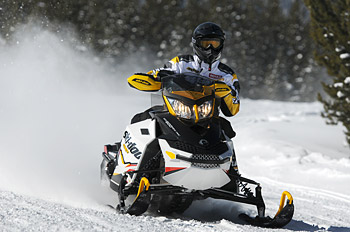
The REV-XS platform, for trail use, takes the look to a new level with layered floating edge design and intricate details including a jewel inspired headlight, side panels that significantly improve both function and appeal, a new tail light, snow flap and unique storage area.

“We start the second decade of the REV chassis design with the attributes of rigid pyramidal frame construction, driver and mass centered design, by giving it a whole new look and feel,” declared Chris Dawson, vice-president and general manager for the International division. “BRP is bringing specialized products to markets around the world that allow our dealers and distributors to enrich the consumer experience and keep BRP products at the forefront.”

tMotion Rear Suspension

Creative thinking has lead to a new design that enables the rear suspension rails to twist two degrees in each direction – allowing the rider to more easily initiate mountain type carving turns. The suspension also incorporates a rising-rate rear shock motion ratio to deliver a comfortable ride in small bumps while maintaining the capacity for larger bumps.

Flex Edge Track

Thinking outside the box once again has led to another innovation from BRP. The 16 inch (41 cm) wide Flex Edge track features centered reinforcing rods that are 12 inches (31 cm) long rather than traditional designs running full width. This allows the outside two inches (5 cm) of track to actually bend and flex when a rider initiates a mountain type carving turn, again requiring less effort.

rMotion Rear Suspension Expands

The widely acclaimed rMotion rear suspension expands into the Renegade model as engineers reworked it to fit the 137-inch (392-cm) track length for a segment that continues to see increased consumer interest. Plus, the industry-leading suspension will be offered to more consumers as the Ski-Doo MX Z TNT models will gain its benefits of comfort, capability, and adjustability.

Integrated Accessories – Plus LinQ System

The trend of customizing to meet specific needs continues to grow. BRP therefore introduces a complete line of accessories for the new REV-XM and REV-XS platforms also.

Innovative items like auxiliary light and GPS kits integrate perfectly and are prewired for plug and play installation, or new 1 + 1 seats that provide flexibility to comfortably fit a passenger quickly and easily.

Also new is the LinQ quick-attach system that allows fast and easy installation of modular accessories like a fuel caddy and tunnel bag.

To see all of BRP’s 2013 Ski-Doo sleds, suspension and engine technologies, new accessories and special spring programs, visit www.ski-doo.com.

2013 SKI-DOO: What the Heck Is t-Motion?

0

We’ve just gotten used to rMotion and now Ski-doo is offering t-Motion!

Don’t worry, there’s no cross-technology between the two names and, in fact, tMotion is targeted 100-percent at the mountain crowd.

What’s behind it? It’s a pretty revolutionary idea, really. Here goes: The idea is to allow the skidframe to have side-to-side lateral movement, as well as cycling up-and down.

Sounds weird but by allowing the skid to tilt laterally 2-degrees in either direction, the rider gets much quicker response when feeding in direction changes during side-hilling or cross-hilling maneuvers.

It’s especially nimble when performing powder hooks or when trying to initiate a direction change against the grade.

There’s a ball joint at the fulcrum of the rear arm and drop link, and the front arm is actually split into two separate pieces. Cool!

Besides t-Motion, the new REV-XM gets the latest 2013 XS-style bodywork and the additional bonus of better rider movement around the footwell area.

Now, the rider’s feet are further forward when standing with both feet on one running board for better leverage.

New 16-wide tracks have been developed with shorter reinforcing rods (only 12-inches long) running laterally so the outside 2-inches of the track flexes more.

Once again, this aids in maneuverability when turning uphill against the grade and further enhances the tMotion concept.

Because XM Summits are based on the new XS design, you’ll be getting the nifty heated storage compartment up top, the new LED taillight, better seat storage and a cool new “hinged” snowflap.

The new tMotion skidframe will be available on all early order Summit X models and 800 E-TEC equipped Summit SP models.

600 E-TEC SPs and all Summit Sport series will use the more conventional but upgraded for 2013, SC-5M2 16-inch wide skidframe.

Better check out what your dealer has for you!

2013 SKI-DOO: XS is the New XP!

0

For 2013, Ski-Doo has extended its “X” platform nomenclature with a new series called “REV-XS”.

The new body design addresses several issues the XP lacked such as improved wind protection, easier ergonomic movement fore and aft and left and right for the driver and limited onboard storage capability.

The smoother, more rounded body panels look great and give the new XS a distinctly modern look while maintaining extremely light overall weight.

From the driver’s seat there’s a heightened impression of quality because of more use of high gloss panel inserts.

There’s a new headlight design and the sled’s nose has been reshaped and some body air vents are hidden under individual layers of the panels where they overlap. The overall look is cleaner and fresher but undoubtedly, Ski-Doo.

Get this: There’s now a heated “glove box” storage compartment above the gauges between the windshield, heated by ambient heat circulated from the engine compartment.

Other XS features are an LED taillight, a new snow flap and the running boards have a much stiffer extruded aluminum edge than before. There are no front end geometry or suspension changes compared to the former XP.

Engine packages remain the same for 2013 with available 600 and 800 E-TECs, 4-TEC and ACE 4-strokes plus the 550 fan and limited availability of the 600 carbed 2-stroke.

We’re a bit disappointed there are no upgrades in power for any of these engines, especially the rising-in-popularity 130-hp 4-TEC triple.

The 2013 Renegade gets Ski-Doo’s rising rate rMotion suspension as does nearly every MX-Z model with the exception of baseline Sport MX-Zs and Renegades.

Spring Early Order programs guarantee depositors will get the new X-Series XS platform with shock upgrades and those who early-order select TNT models will get the XS bodywork and rMotion. The racer-based X-RS will still use XP bodywork in 2013.

4-TEC powered MX-Z and Renegade models will continue in 2013 with the original XR bodywork but rMotion is pretty much available with any of the big-inch 4-stroke MX-Zs and 137-inch Rennies.

More to follow about Ski-Doo’s attack on the Mountain segment with an all-new “XM” equipped with “t-Motion” suspension!

How To Adjust The Rear Suspension On An Adventure

Dear Motorhead:

I’m wondering if help me with a suspension question. I just purchased a new Switchback Adventure and when I go over bigger bumps it seems to be sort of bucking me off. I have the shock set up to my weight, so what can I do to relieve this problem?

I also have about 200km on it and the oil tank is only gone down about an inch. Is this normal? My only machine before it was an 340 touring and that drank oil like it did gas so I don’t really have anything to compare it to.

Thanks!

Byron

Byron!

Thanks for your email!

You need to measure through the rear most hole in the running boards to the snow with the sled pulled up to full extension. Then sit on the sled with all your gear and adjust the rear spring preload to allow for no more than 3 inches of sag when loaded. This is the right way to adjust the rear end and you will get a great ride this way.

Your oil mileage is fine, however if you’re still worried have your dealer check it for you.

Hope this helps.

Motorhead Mark

Is Weight Still The Issue?

0

Another thing we’ve been hearing from our readers and viewers concerns the issue of weight.

Again, some manufacturers have indicated weight is no longer a major consideration when consumers are shopping for new iron.

Granted, it’s usually those OEMs that have been struggling with weight issues that make these claims, but Supertrax does put credence in what we hear from active snowmobilers in the marketplace.

Here’s what we’ve been hearing: Weight is still an incredible consideration when potential buyers are walking showrooms!

Buyers of snowmobiles in the 100-plus horsepower categories are especially aware of issues like power-to-weight and overall mass.

Although not every snowmobiler’s riding habits can realistically take full advantage of the extreme lightness offered by some models, when it comes to signing the check, they want to know their new snowmobile is the lightest it can be.

Indeed, if you’ve had occasion to ride an extremely lightweight sled, you can tell the difference immediately. Handling is better, ride tends to be better, rider fatigue is reduced and you can get the most out of every pony an engine can produce. Even gas mileage can be affected, although less so than performance.

Truthfully, there;s no need to defend the focus on lightness in this decade. It’s a no-brainer that buyers still want sleds to be as light as possible.

We believe the next five years will see even more weight-shaving taking place as consumers continue voting with dollar bills and making choices in the direction of lightness.

2-stroke Versus 4-stroke Argument Still Hot!

0

We’ve been listening to our readers’ and viewers’ comments this winter and despite the fact some sled-makers contend the 4-stroke market is not getting bigger, we’re seeing a growing trend toward new buyers seriously considering 4-strokes when making their next buying decision.

Considering the high level of 2-stroke technology available today, this is an interesting event. It seems the biggest complaint with buyers is the long term reliability of 2-stroke engines.

As buyers pay more for the upscale tech on 2-stroke sleds, they expect them to live longer, be trouble free and return high resale when the miles have accumulated. Sounds a bit idealistic, but why shouldn’t owners demand this kind of longevity when prices for new sleds are high?

Apparently, the biggest roadblock is not the first or second year of ownership of a 2-stroke, it’s when the sled has been on the snow a few years and may need an engine “freshening” or may be more susceptible to a total engine rebuild or replacement.

These are not cheap repairs anymore and usually are not the kinds of fixes the average owner can perform in his own garage.

Granted, a catastrophic failure with a 4-stroke engine is a scary proposition, too, but history is showing this kind of problem is a lot less likely to rear its ugly head with a 4-stroke.

We’re thinking some of the renewed interest in 4-strokes is coming from the release of relatively light, nimble handling sleds like Cat’s Procross 1100s and Ski-Doo’s XR models with 4-stroke power.

Many owners are finding these sleds deliver acceptable handling and performance commensurate with some of the best 2-strokes.

Yamaha’s incredible history with reliable 4-strokes is another factor. Some of the Big Y’s 4-stroke sleds have been on the snow for 10 years now and it’s extremely rare to ever hear of engine problems with them.

Frankly, we’re a bit surprised at some of the opinions on 4-strokes we’ve gotten from the most hardcore snowmobilers we’ve talked to this year.

There’s a respect there we haven’t seen before and we can’t help but think the 4-stroke market may be on the increase over the next couple of years.

Hibbert to Race FIM as Planned

0

Monster Energy/Arctic Cat’s Tucker Hibbert will indeed travel to Russia to compete in the FIM Snowcross World Championship as originally planned.

The ISOC AMSOIL Championship Snocross Series recently rescheduled New York’s Eastern National for February 24-25, which is the same weekend as the World Championship in Russia.

Hibbert, who is the defending ISOC ACSS National Pro Open Champion, had plans to race the full eight-stop ISOC ACSS tour along with the World Championship in Russia and Sweden’s Clash of Nations the end of March.

To follow Hibbert’s racing this season, visit www.tucker-hibbert.com.

Tucker Hibbert – Monster Energy/Arctic Cat

“It’s unfortunate that the New York event and the World Championship will now happen the same weekend. For the amount of time and resources, myself, sponsors and crew have invested in this season we have to move forward with our schedule as planned, which includes racing the World Championship in Russia.”

Tucker Hibbert’s Remaining 2012 Snocross Events

Feb 24-25: FIM Snowcross World Championship – Ivanovo Region, Russia
March 2-3: ISOC ACSS Fargo National – Glyndon, Minn.
March 9-10: ISOC ACSS ERX National – Elk River, Minn.
March 16-17: ISOC ACSS Grand Finale – Lake Geneva, Wisc.
March 23-24: Clash of Nations – Falun, Sweden

Third Appearance at FIM Snowcross World Championship

2011 – Tuuri, Finland: 3rd Race 1: 1st / Race 2: 16th / Race 3: 1st
2010 – Mala, Sweden: 1st Race 1: 1st / Race 2: 1st / Race 3: 2nd

TEST RIDE: 2012 Ski-Doo GSX SE 800 E-TEC

0

SnowTrax Television Co-Host AJ Lester evaluates Ski-Doo’s 2012 GSX SE 800 E-TEC.

Watch full episodes of SnowTrax Television online! Visit snowtraxtv.com to watch!

2012 BEST IN CLASS AWARDS: BEST BIG MILER

0

Determining winners in the annual Supertrax Best In Class selections requires the combined brainpower of seasoned Supertrax editors and opinionated test riders. Co-Publishers and brothers Kent and Mark Lester present their arguments for each winner and runner-up.

WINNER: ARCTIC CAT PROCROSS 1100LXR

KENT’S TAKE:

I know this is a completely new sled this year and, under your unrelenting criteria, “hasn’t had enough consumer testing yet” to officially rate a win (I’m being sarcastic here).

The fact is, however, before the first snowflake hit the ground this season, I had personally put almost three hundred miles on this chassis and particularly, a lot of miles on the non-turbocharged Procross 1100. Come to think of it, at that point in the season, I may have ridden this sled more than any other non-Arctic Cat employed consumer or media person in the world.

Last February, on one pre-production adventure, I rode this sled from Montana into Idaho and back and I’ve gotta admit, it was probably the best day’s riding of my winter.

I was impressed with the 1100 LXR’s great handling and doubly impressed with its great ride. However, what really sent me reeling was the integration of this all-new platform with its 4-stroke twin.

This sled feels as light as a 2-stroke and its power delivery is a close match to one, too. Frankly, this is the first 4-stroke snowmobile I’ve ridden that didn’t feel compromised in some way.

Big Mile competence usually boils down to ergonomics and this sled is so comfortable and so confidence inspiring, whether you’re sitting or standing it just feels perfect. Its seating position, footrests, instruments, switchgear, controls, even the brake lever are a pleasure to ply and seem to be tremendously well thought-out.

This snowmobile will leave owners with a drooling desire to get on the seat and dial miles of long distance. Absolutely, the best in this class by more than a country mile.

RUNNER UP: SKI-DOO GSX SE 1200 4 TEC

MARK SAYS:

Let’s get this straight; the Big Miler segment has been owned by the Ski-Doo GSX SE since it first landed.

You might ask yourself why this is the case and why a brand new ride isn’t able to dethrone it in one short year? The answer is obvious to everyone but Kenny.

Let’s talk air ride, on-the-fly adjustable suspension that’s so plush you can fall asleep at the controls on this thing. Ski-Doo’s SC-5 using an onboard compressor to make incremental or wide-swing adjustments to the rear shock’s air pressure is without equal. It even out-rides Ski-Doo’s brand new rMotion in deep, gnarly bumps.

Yes, I am at a slight disadvantage here as a result of the 4-TEC’s throttle lag issues. However, if this engine produces only 130-hp how come it literally blows away sleds with as much as 20 more ponies. The GSX can regularly haul over 110 mph on hard pack.

Finally, check out the standard accouterments on this exceptional ride. There’s heated everything including the seat, adjustable handlebars, mirrors, a digital display that makes everything else in the biz look like a kid’s cell phone and a mogul-bridging 136-inch shoe.

Kent, dunno how you can sleep at night after missing this one! Clearly, the GSX SE rules.