Home Blog Page 163

WHY DO YOU TRADE IN YOUR SLED?

0

Eventually, everyone comes to the place where the old blister is too old and too much of a blister. We’re talking sleds here, not feet.

Here’s our question of the day for you: What motivates you to sell your old sled and get a new one?

Our polls have shown us there are two factors at the top of the list. First is the desire for more power.

When you begin to feel your old sled is just not fast enough and your friends are all riding sleds you cannot keep pace with, it means you’re more likely to look for an upgrade.

By the way, upgrade is almost always associated with power output. You don’t upgrade to a sled with better electronics or suspension and downgrade to a lesser-powered engine. Uh-uh, never happens.

Second is suspension compliance. When your riding time is uncomfortable or your shocks and springs are just plain worn out, you’re probably inches away from visiting your local dealer.

Replacement parts are pretty expensive, too and that means you’re suddenly looking for a replacement for the whole sled rather than fixing up one that needs a ton of investment to only end up with what you already had.

A third reason – and the one we thought would be uppermost on every trade-in customer’s list, is reliability. It looks like many riders would rather put up with a sled that needs more and more maintenance rather than get rid of it and replace it with something new.

This indicator may be more about the type of person who rides a sled that is likely to break down and their financial situation or ability to afford a new sled rather than their desire to have a new, reliable one.

Back to the power thing: No wonder the OEMs keep coming out with faster, more powerful sleds in almost every category. In snowmobiling, power is a very strong motivator.

SNOCROSS MOBILE MEDICAL TEAM

0

The newly formed Snocross Mobile Medical Team is excited to announce its title sponsor with FXR Racing Inc.

This three year sponsorship brings together a company full of passionate enthusiasts who have been supporting and investing in our sport for years and a brand new medical team for our athletes.

Snocross Mobile Medical Team:

Formed in the fall of 2016 and initially brought to the attention of the industry at Haydays, the Snocross Mobile Medical Team (SMMT) was created with the purpose of providing world-class on track medical care (emergency, trauma, 1st responder) for the snocross athletes at every round of the AMSOIL Championship Snocross Tour.

Former AMSOIL Championship Snocross assistant race director, Jake Vanada, was prompted to start this organization after seeing first-hand how the Alpinestar Mobile Medical (formerly known as Asterisk Mobile Medical) works within the professional Supercross and Motocross industry. In his new role as the MX and SX Chaplain, Vanada consulted the Alpinestars Mobile Medical director, Tom Carson, and it became clear the sport of snocross could greatly benefit from a similar program.

To make this program a reality for snocross, Vanada formed a board of like-minded industry leaders to launch a 501c3 non-profit. Sara Schultz (trained as medical nurse, Wife of “Monster” Mike Schultz) , Trace Leighton (team owner of Leighton Motorsports), Levi Lavallee (X Games Gold Medalist, distance jump world record holder, team owner), and Jesse Strege (20 year veteran snocross racer, assistant race director with ISOC) have all stepped up to serve alongside Vanada to help launch this medical team for the industry. On why he said yes to being involved, Levi stated, “Because it is great for the sport of Snocross! We all love this sport and the riders that are on the track so being able to bring a service like the SMMT, elevates Snocross and aids in the riders safety. It is a honor to be a part of such a great cause and hats off to Jake for bringing it to life! ”

SMMT is a non-profit organization which exists thanks to the generosity of teams, team owners, families, and businesses in our sport. All donations are fully tax-deductible.

FXR Racing Inc. has agreed to an inaugural three-year sponsorship of our medical team. The SMMT will be naming the new medical team FXR Mobile Medical. FXR Racing Inc. is just the kind of company the SMMT had in mind to be a sponsor. Doug Rust (FXR Snocross Marketing Director and Brand Manager), Milt Reimer (Founder and President of FXR Racing Inc.) and their whole team over at FXR Racing are amazing people with a passion for not only our industry, but for the health, safety, and wellness of our athletes. FXR is passionate about the sport, all of the riders, and the safety and development of the riders and the sport, which is what makes this sponsorship very unique and very special.

Triton Trailers has come alongside FXR Mobile Medical to provide a brand new custom trailer which will be the “mobile medical rig” used at each round. Jeff Goodwin (Triton Trailers Director of Sales) and the team at Triton Trailers are some amazing and passionate people in the industry and their heart for the care of our athletes has been front and center through this whole process. Inside this premium all aluminum sled hauling trailer, the FXR Mobile Medical team will be building out a state of the art medical trauma center which will sit track-side at all 17 rounds of the snocross series for our athletes.

Polaris Industries has sponsored the team with a brand new Polaris Ranger XP with tracks to serve as the medical rapid response rig at the races. The team at Polaris, lead by Polaris Race Team Manager Tom (Junior) Rager., came on board immediately, offering their full
support. Tom Jr. has expressed his strong support and excitement about bringing this much needed part of our racing series into a reality.

In addition, Action Graphics and RedPlateMedia of Baxter, MN has agreed to sponsor the team with the complete FXR Mobile Medical graphics kit. “Gary Walton and his team were on board from the start,” says Vanada. “He approached me right away at Haydays offering his full support.”
Finally, the FXR Moblie Medical rig will be harnessed to a brand new RAM 2500 through a new sponsorship with Cornerstone Auto Group of Elk River, MN. The Cornerstone Auto Group is just the kind of passionate, enthusiastic company and staff that SMMT is proud to partner with.
The SMMT is incredibly grateful for Cornerstone’s owner Scott Powell, Rob Powell (Vice President), and Cornerstone Auto’s Ram manager Roy Quade.

The Doctor:

Dr. Odom from Odom Health and Wellness will be FXR Mobile Medical’s lead Doctor and Medical Director. FXR Mobile Medical will have an ER Doctor, Athletic Trainer and a medical coordinator (volunteer) at each race. Dr. Odom is a board-certified medical doctor who specializes in sports medicine, and continues to practice emergency medicine in Minnesota. When he is not providing care in the ER Trauma rooms, he is treating athletes of all

levels and all disciplines in an effort help them get back to peak performance. He has years of experience providing medical coverage at the USA Olympic Training Center, US Ski and Snowboard Team, Dew Tour, USA Triathlon, Chicago Marathon, and multiple high school and college level sports teams.

NEW LONG ARM TECHNOLOGY

0

You may not have even noticed it! This would be especially true if you haven’t had a chance to ride a new AXYS-based Switchback 144, a 141-inch XF Arctic Cat or any Ski-Doo with an rMotion skidframe.

The big difference is in the way these sleds handle bumps. There’s never been any question about Ski-Doo’s coupled rMotion having incredibly good ride quality but who would have ever thought you could get such a good ride out of a non-coupled suspension like the Switchback or the XF Cat has?

The key element is the length of the skidframe’s front arm. Ski-Doo did it first with rMotion and was quickly followed by Polaris with the RUSH AXYS. By moving the lower mounting position of the front arm back anywhere from four to six inches (depending on the length of the skid) and increasing the length of the arm, it made a dramatic difference in how the back end responded to trail junk.

Arctic Cat reworked the rear arm geometry on its uncoupled and torsion spring-less Float back end used in the XF series and its mountain sleds, two model years ago (2016 models). No one noticed and Cat’s marketing team didn’t make too big a deal of it.

Consumers noticed, however, and those sleds have become much bigger sellers because of the ride change. We tested both the 141 and the 153-inch versions last winter and walked away amazed. Simply no comparison to the past.

We had the same response when we rode the new Switchback Assault. Fantastic ride – and not even coupled.

You’ll get the same results from Yamaha’s XT-X and BT-X series sleds. Apparently Cat and Yamaha engineers worked together on those suspension projects and calibrations are very close to identical.

HOW WILL THE E-TEC 850 HOLD UP?

Dear Motorhead:

Very interested to hear your opinion on SkiDoo’s claim that the new E-TEC 850 offers 4-stroke reliability. Can you elaborate on some of the testing that has been done to backup this claim?

You’ve done a great job covering the technology, but I’d like to hear more about the validation process from Ski-Doo about that claim.

I currently own a 4-stroke and I’m really excited about this new motor and chassis and see this as a way I can have the best of both worlds (reliability and light weight).

I personally see reliability as one of the final fronteirs for snowmobiles.

We have come so far in the last 10 years in terms of handling, fuel economy, emissions and weight reduction, but I still feel a sled with over 10,000 miles is pretty tired. Is this something manufacturers should be focusing on in the future?

Just think if you bought a $17,000 motorcycle or car that was pretty much worn out with 10,000 miles. I feel sleds are very pricey relative to the worry free mileage they get. Your thoughts?

Thanks for your time!

Tyler

Tyler:

Thanks for your email! Ski-Doo has made a number of claims about the durability of the new 850 E-TEC. They haven’t – so far – given boiler plate numbers like hours at WOT on a chassis dyno etc.

I think the stuff they’ve done to enhance 2-stroke reliability speaks for itself. The stuff they’ve done to improve their own reliability record like using a forged two piece crank instead of a built-up crank will prove beneficial.

At the end of the day it’’s going to be about what happens in the real world of consumer “testing”. We’ll all be able to comment with accuracy after this inaugural season with the new G-4 850.

Sorry I can’t be more specific. We too are anxious to log some serious clicks on a G-4 and see how the engine holds up.

Thanks,

Motorhead Mark

2016 Ski-Doo MXZ Blizzard 800R

0

SnowTrax Television Co-Host AJ Lester evaluates Ski-Doo’s 2016 MXZ Blizzard boasting a 129-inch Ice-Gripper pre-studded track, Pilot TS tuneable skis and a Rotax 800R engine.

Subscribe to our YouTube Channel!

SKI-DOO PARTNERS WITH SHE SHREDS

0

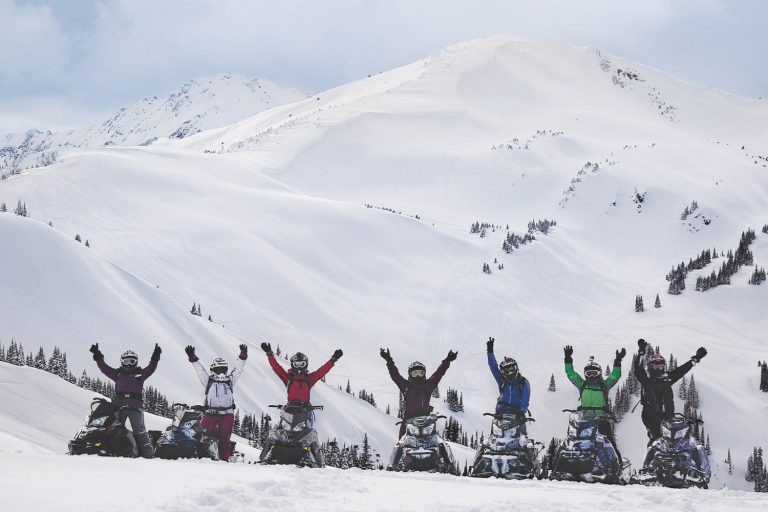
BRP’s Ski-Doo snowmobiles has partnered with She Shreds Mountain Adventures this season to offer riding clinics across North America that specialize instruction for the growing segment of women deep snow riders.

The clinics are held primarily in British Columbia, but also travel to Quebec and the US from December through April.

She Shreds was founded by Julie-Ann Chapman in 2010 when she recognized a growing need for clinics where women felt more welcome and could form a special camaraderie away from the male dominated clinics offered elsewhere.

“BRP is proud to partner with She Shreds Mountain Adventures and Julie-Ann Chapman to bring mountain and deep snow riding instruction to an increasingly important group of riders” stated Marc Lacroix director of Global Marketing Ski-Doo Snowmobiles. “The interest is clear as we see more and more demand for women only specific clinics and we’re happy to be in a leadership position with She Shreds.”

“It’s great to officially partner with the snowmobile brand I’ve been on since the beginning of my business and I really look forward to helping elevate women’s stature and growth in mountain riding”, said Julie-Ann Chapman.

She Shreds Mountain Adventures clinics include instruction in riding, outdoor survival and proper rescue gear seminars, along with avalanche avoidance and safety training in multiple or single day segments.

For more information visit sheshreds.ca

NEW BRP TRAINING INSTITUTE IN WISCONSIN

0

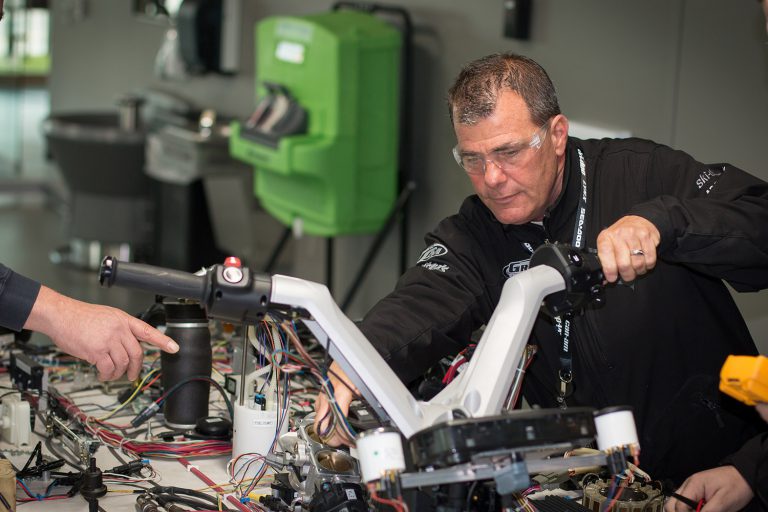
BRP (TSX:DOO) today marked the opening of its state-of-the-art technician training institute within its Sturtevant, Wisconsin manufacturing facility. This new institute will train dealers and their employees to maintain and repair all BRP vehicles, engines and accessories.

Alain Villemure, vice president and general manager of BRP’s Marine Propulsion Systems division and Martin Soucy, vice president of its global after-sales function, participated in the ribbon-cutting ceremony before employees, media and the general public.

“BRP’s seven product lines are sold in over 100 countries through 4,200 dealers,” said Soucy. “We continue to implement a series of initiatives that allow BRP to remain a reference in the powersports industry worldwide. This training institute, one of five that cover our regions across five continents, is a focused investment to better equip our U.S. network to deliver an excellent customer service.”

“We are grateful to the Village of Sturtevant and the Racine County Economic Development Corporation for their support in the creation of this world-class training institute that has allowed us to create and secure over 20 full-time positions. The new institute will bring around 500 visitors a year to the region,” said Villemure. “The Evinrude brand has a storied relationship with South Eastern Wisconsin and BRP is excited to open up this new chapter.”

Technicians from dealerships all over North and South America will be fully trained and certified on all Ski-Doo, Sea-Doo, Rotax and Can-Am products in this new institute, alongside the existing Evinrude training center.

BRP (TSX:DOO) is a global leader in the design, development, manufacturing, distribution and marketing of powersports vehicles and propulsion systems. Its portfolio includes Ski-Doo and Lynx snowmobiles, Sea-Doo watercraft, Can-Am all-terrain and side-by-side vehicles, Can-Am Spyder roadsters, Evinrude and Rotax marine propulsion systems as well as Rotax engines for karts, motorcycles and recreational aircraft. BRP supports its line of products with a dedicated parts, accessories and clothing business. With annual sales of over CA$3.8 billion from over 100 countries, the Company employs approximately 7,900 people worldwide.

brp.com

SKI-DOO’S TURBOCHARGED ACE 900

0

BRP’s off-road division, Can-Am, recently introduced a new Side x Side vehicle called the X3.

This thing is totally radical and for all-the-world looks like a cross between a desert racer and a trophy truck.

Here’s what’s interesting to snowmobilers: The X3 uses a version of Ski-Doo’s 900 ACE 4-stroke triple boosted with a turbocharger. Bottom line? It makes 154-hp and runs as smooth as silk.

When our test riders (from our off-road televison show, Dirt Trax) rode the X3, they came back raving about its engine. Apparently it makes big-time torque down low, has almost no turbo lag and cranks power like an engine double its displacement.

The 900 ACE has been consumer proven for a number of years in snowmobiles and in Sea-Doo personal watercraft and has shown itself to be durable when operating in the 90-hp range.

Knowing Ski-Doo’s penchant for building 4-strokes that last, we think the company was actually being conservative pegging the turbocharged version’s output at 154-ponies.

Based on what we’ve seen with other turbocharged 4-strokes in the snowmobile biz, big displacement isn’t always necessary to get big power. Remember Cat’s original 660cc triple? It made about 115-hp and was fairly conservatively boosted. Polaris came with a 750 Weber with a turbo and that engine made 140-hp with a boost cycle that could give you over 160 stallions for a short interval when you tipped-in the throttle.

Yes, we think Ski-Doo is working on a 900 ACE with a turbo and it will make over 165-hp, giving buyers the opportunity to go 4-stroke in the same range as the Gen 4 850.

3 REASONS POLARIS WON’T BUILD A 4-STROKE SLED

0

You’re asking us why Polaris doesn’t build 4-stroke sleds. Here are some reasons:

1. Tried it and it didn’t work.

Polaris offered a couple of 4-strokes from the early 2000’s up until a couple of years ago and they just didn’t knock the socks off the market in the sales department.

You’ll recall the company started with a very low-key economy sled making about 60-hp in the Indy platform in the early and mid-2000s and then graduated to an IQ Turbo 2-cylinder later on. We loved that sled and it was bullet-fast. Unfortunately it didn’t sell very well.

2. The AXYS may not be hospitable to the type of 4-stroke Polaris should build.

Ever since we first saw it and rode it, we’ve felt the AXYS would make a fantastic foundation for the company’s dreamy 1000cc 4-stroke twin currently used in its off-road program.

This versatile engine platform can produce anything from 90 to 160-hp (when turbocharged) and would fill the gaps in Polaris’ model selection beautifully.

The problem is: Will consumers respond to a twin when the hottest thing is a 4-stroke triple? Also. Will a triple fit into the AXYS without spoiling its strong points?

3. Polaris is doing just fine building 2-strokes.

The company currently holds a firm grip on second place market share with nary a single 4-stroke in its sales brochures. It’s tough to argue with success and Polaris AXYS sleds are the lightest in the industry with incredibly good handling.

Why compromise it when the percentage points of 4-stroke sales are about 25-30-percent of the total market?

3 REASONS YAMAHA WON’T BUILD A 2-STROKE SLED

0

It’s been over a decade since Yamaha made the commitment to build only 4-stroke snowmobiles.

Thus, it’s been more than ten years since the company introduced a new 2-stroke engine.

Sure, there are some reasons we think Yamaha should consider building a deep-powder-market 2-stroke. However, here are some reasons it won’t happen:

1. Yamaha firmly believes the 4-stroke engine is the future of snowmobiling.

If you look into the crystal ball and think about what sleds will be like 10 to 15 years from now, Yamaha honestly believes, based on future emissions standards and overall durability/customer satisfaction, the 4-stroke is what snowmobilers will be riding.

Why invest in technology the company sees as obsolete?

2. The mountain market is only a portion of the total snowmobile business.

Yes, Yamaha owns excellent direct injection patents for 2-stroke engines and Its DI system has been consumer-proven on outboards for a number of years.

That being said, why tool up an all-new 2-stroke engine platform when your target market (deep snow) is probably only 25-percent of the total market? The fact is Yamaha is doing a decent job with 4-stroke mountain sleds, albeit they are not the answer for all mountain riders.

3. It’s hard to reverse the cycle when you’ve invested years in convincing everyone you’re on a different path.

The fact is Yamaha hasn’t done badly selling only 4-strokes. The 1049 triple is a very popular engine and operates very much like a 2-stroke in its Arctic Cat ProCross chassis. Furthermore, Yamaha-philes love 4-strokes and aren’t pleading for a 2-stroke.

The 4-stroke sell is complete and although Yamaha won’t convert huge masses of hardcore 2-stroke users over to its side, they are grabbing a decent share of the market.