Home Blog Page 113

2019 ARCTIC CAT MOUNTAIN CAT ALPHA ONE

0

It seems like Arctic Cat has always been playing catch-up in the mountain marketplace and has stood firmly planted in the shadow of Polaris and Ski-Doo. This trend could be shifting quickly.

Arctic Cat mountain team leader, Andy Beavis, and his engineering group have been burning the midnight oil to meet and exceed those competitors and have given mountaineers something truly different that works.

Some of the issues the team has addressed are 1. Weight 2. Panelling-out on side-hills 3. Ease of Side-hilling and 4. Crisp, immediate throttle tip-in.

Cat successfully dealt with throttle response last year when it brought out its new DSI 800. This slot-injected 155-hp twin is exactly what the vert crowd needed and delivers the kind of braap-braap throttle response you require when you’re performing powder maneuvers. That alone makes a huge difference.

Cat’s recent mountain bodywork is actually inches narrower than previous designs and allows the rider to weight the sled and run sidehills so the lower bodywork prevents the uphill ski coming unattached from the snow.

Good uphill ski bite is the key to sticking on sidehills as you’re standing on the inside running board. Also, those boards are about an inch narrower and sculpted so the riders feet are more forward for better balance.

All of these changes, combined with lighter, skinnier spindles up front allow less drag and better agility in deep powder.

Without a doubt he biggest change this year is a new mountain specific skidframe design called “Alpha One”. This is where things get super-interesting: Basically Cat took all the old deep snow skidframes and track design concepts and threw them out the window.

Alpha One is what is referred to as a “single beam”. The skid is extremely narrow and is situated dead in the middle of the track – there is one slide rail – not two!

Not only does this reduce the number of parts but it’s much lighter – and the weight reduction is of the unsprung variety to make everything more efficient.

Snow build-up inside the track is remarkably reduced and the best part is yet to come: Alpha One allows the rider to lay the sled over on the outside edges of the track so easily, it’s like riding a bicycle. Actually, it’s more like riding a Snow Bike.

The single beam skid’s center rail is hollowed-out for better rigidity and lightness and uses magnesium at its attachment points.

The 3-inch lugged track is a special design, intended to flex and twist from its center fulcrum so the rider can pivot the sled in powder and run sidehills with maximum grip.

Pulling powder hooks with this sled is so easy, you don’t even have to think about it. There are large windows in the center of the track only.

Not having to think about anything is a big part of Alpha One’s appeal. Our test riders told us, after getting over the shock of how the Alpha skid looked, in the mountains they didn’t even think about what it was doing differently.

The whole thing was transparent and except for the improvement in the way the sled side-hilled and turned up hill, it was down to basics – just ride the thing and enjoy its agility.

Since this skid relies on its twisting, flexing track on sidehills, there’s a grip factor you don’t experience with other mountain sleds that tend to grab the sidehill with the “edge” of a less flexible track.

In side-hill situations our testers felt the sled taking a slightly different stance than they were used to – almost pointing slightly uphill with the track churning – yet continuing to run 100-percent lateral to the incline as power was applied.

There may be changes in how the Alpha attacks sidehills and powder, but an attack it will be!

FIRST RIDE: SKI-DOO’S 2019 ACE 900 TURBO

0

There were a lot of shocked gasps when it was revealed Ski-Doo was replacing many models for MY 19 originally powered by the much-beloved 4-TEC 1170 4-stroke with an all-new ACE 900 Turbo in the 137-inch Renegade chassis for MY2019.

The first shock was Ski-Doo’s move away from an engine (the 4-TEC) that has placed the company squarely in the lead in the 4-stroke realm.

This venerable big-incher has proven to be fast, fuel efficient and dead reliable. It truly established Ski-Doo as a viable leader in the 4-stroke engine class and those who have owned them have been more than satisfied with them. It is still available in a few 2019 models – but only a few.

The second shock is what Ski-Doo has chosen as a replacement. The 900 ACE engine has had its bottom end, rods and pistons beefed up and now accommodates a Rotax-built and developed turbocharger.

Where the former 4-TEC made about 130-hp, this new one claims 150. The new turbo-engine, with all its plumbing displays little – if any – weight disparity with the big-block 4-TEC.

Keep in mind the new 900 turbo is only used in the new G-4 wide body chassis – a place the old 1200 simply would not fit into.

Power Differential

Our test riders had ample opportunity to ride the new G4-based sled in Montana and were impressed with its handling and solid performance.

Get this straight: This engine claims 150 ponies, not 180 like Yamaha and Cat’s turbos. Thirty stallions is a lot to give up but, to a man, everyone felt this engine is an overachiever and delivered performance (at least at elevation) particularly at lower RPM – relatively close to the Yamaha turbo.

Although the dyno will undoubtedly show a big difference, the end result, acceleration up to about 80-mph, is competitive.

We think much of this is due to the Ski-Doo’s pDrive clutch and the fact the Doo offers a 1.6-inch track. We’ve said it before and we’ll say it again, the high torque output of a turbocharged 4-stroke requires traction. Cat and Yamaha have figured this out and offer up to 1.6 inch lugs.

Conversely, Yamaha and Arctic Cat introduced the new SRX and Thundercat with a top end biased one-inch track this year to enhance top end speed. Hmm.

Get On it

Ride and handling with the new Turbo-Gade is very G4-ish. We felt the cornering performance of the wide body G-4 models was actually better than the 2 stroke G-4s – depending on the ski choice.

The G-4 widebody is obviously warmer because of the wider bodywork. Ergonomics are as all G-4s, far-forward and comfortable according to the G4 formula.

Our testers weren’t in love with the turbo’s throttle response but felt it was due to the DBW throttle setup and not to turbo-lag.

In fact, the opinion was that there was no discernible throttle lag from the turbocharger and at mid-throttle settings the sled tipped-in and accelerated voraciously without hesitation.

Do we think this sled will replace the sales volume of the 4-TEC? There’s a pretty significant uptick in price here but a lot of 4-TEC owners have been begging for a turbo the last couple of years.

By upping the power of the 2019 900 ACE EFI from 90 to 95 ponies this year, those 4-TEC buyers who don’t want a turbo may be satisfied. Dunno – I know we wouldn’t be.

As for the new Turbo-Gade; aside from the weird throttle, we approve and are pretty sure the Ski-Doo faithful will love it too.

2019 Arctic Cat Snowmobile Sneak Peek

0

Luke gets to experience Arctic Cat’s revolutionary all-new suspension technology as he rides the 2019 ZR 8000 equipped with the iACT system and the 2019 M 8000 Mountain Cat Alpha One armed with single-beam rear suspension.

Subscribe to our YouTube Channel!

BEST 2018 FREESTYLE SLED

0

WINNER: SKI-DOO FREERIDE X 850 146

Mark Says:

Here’s an example of how Ski-Doo refuses to let any buyer fall through the cracks.

This sled represents careful targeting at the almost mountain specific market while still allowing for spirited and pleasurable trail riding.

The 850 Freeride can get you to the snow and the vertical rides better than any pure mountain rooster. With fully adjustable KYB’s out front and a custom calibrated t-Motion skid, the Freeride comes as close to anything you might call dual purpose in MY 2018.

Before Kent loses his mind (it may be too late for that), let me qualify my last statement. If you were heavily into trail carving and into riding off-trail frequently, the new Renegade Backcountry X 850 with a 146 would be the right choice. However, there’s a ton of riders who spend significant time on trails or hard pack just to get to the big snow.

This 146 x 2.25 PowderMax-equipped Freeride is the perfect balance of track and suspension to make both genres enjoyable.

There’s more here making my intuitive anointing of the Freeride as the BIC winner. Think about a 165-hp E-TEC with lightweight SHOT batteryless starting, mass centralization, tunable KYB dampers, RAS 3 IFS, t-Motion rear suspension and the list goes on.

The Freeride is, quite frankly, one of the best-equipped vert sleds in Ski-Doo’s line-up, yet it still displays competent trail riding versatility.

Hard to beat, Kent.

RUNNER UP: POLARIS SKS 800 HO 1460

Kent Says:

The truth is, the SKS, just like the Freeride, is a pure mountain sled with a shorter track and a chaincase.

The 146, as opposed to a 163 or a 155, makes the sled easier to pivot and more fun to play with in powder, thus its freestyle designation.

Polaris got it right with the SKS because it’s lighter, totally flickable and has incredible deep-snow manners.

But honestly, Mark, what are you thinking, talking about how these sleds are so great because you can ride them in powder – and on trails?

Gimme a break, they’ve both got 2.25-deep tracks. Tracks that deep dig trenches in trails and eat up sliders in two miles!

They’re not intended for, nor are they any good on trails and it means you have to rate them as powder sleds only.

If you look at it that way, the Polaris is it. Period!

50 Years of Yamaha Snowmobiles

0

Motorhead Mark looks back at Yamaha’s impact in the snowmobile industry as the company celebrates their 50th anniversary in 2018.

Subscribe to our YouTube Channel!

BRP’S SKI-DOO BRAND BRINGS INNOVATION, SPEED AND EASE TO ADJUSTABLE SKI STANCE

BRP’s Ski-Doo division is introducing the new Rapid Adjust Ski Stance, an innovative bolt on design, to the feature of adjustable ski stance making it more practical and easier to use.

Many snowmobiles are equipped with adjustable ski stance, but it’s a feature that’s under utilized because of the time and tools required to make changes. The new Rapid Adjust Ski Stance changes that and exemplifies simple and elegant design with real world use, by allowing snowmobilers to change ski stance in seconds rather than minutes, without any tools needed. Riders lift the spacer by pulling up on the extended lever next to the spindle, slide the ski over and then push the spacer back down into place on the other side of the spindle.

The new Rapid Adjust Ski Stance kit is easy and fast to use. Retail pricing is $49.99 USD/$64.99 CAD

Now owners of Summit, Freeride and Backcountry models can make easier, faster use of the different ski stance offered on their snowmobiles. Adjusts two inches (50.8mm) fits all Pilot DS-1, DS-2 and DS-3 skis.

In-Depth Look: 2019 Polaris INDY EVO

0

Polaris looks to tackle a new aspect of the snowmobile market by focusing on new-rider accessibility as we go in-depth with the 2019 INDY EVO.

Subscribe to our YouTube Channel!

Kimpex Arrow II Snowmobile Ski

0

Possibly the oldest debate in snowmobiling revolves around the ski you choose for your sled can either make or break it from a handling perspective. Whether you’re replacing the stock old school steel skis of a classic sled or dialling in the performance of something new, making the right ski choice is incredibly important.

Kimpex is not new to the ski game, they have been producing high quality replacement skis for years and offer the broadest range of designs we’ve seen. They bring high quality design elements with durability and performance benefits to suit a wide variety of riding styles and help you tune your sleds performance to your riding preferences. Add to this exceptional value as well as offering mounting kits for nearly every sled made as well as a huge selection of color choices for both ski and handle and you can literally custom tune your skis performance and style.

Three of their most popular styles which cater across the spectrum of needs are the single carbide – center keel Rush Ski, the trail performance dual-keel Arrow II ski and finally the off-trail natured 7 inch wide Stealth ski.

Dubbed as the “Best Replacement Ski on the market”, the Arrow II is targeted towards those looking to step up your game and increase your front-end bite.

With 6 unique colors available for the updated handle design you can make the Arrow II compliment your sled, but it’s the dual keel design that has made the ski so popular. When we match up 4 single side effect 90 degree carbides you’ve got a 5.5 inch wide ski that’s going where you point it and eliminate any darting along the way. The biggest benefit is that it manages to do with a minimal increase to steering effort. Tested on a G4 Ski Doo the Arrow II delivered serious drivability and increased confidence as the ski does not wander or deviate from the path you put it on. In hard crusty snow it is planted and confident and in lighter fluff it finds solid grip where other skis will push. The raised rear tail of the ski helps with backing up, keeping the aft section from dropping under the snows crust, and rather riding on top.

One of the other cool features to the Arrow II ski is what Kimpex refers to as Integrated Fixation. In layman terms, it’s built in mounting saddles that eliminates the mounting kits which also contributes to the skis reduced weight at just 4.1 pounds per ski features which in the end amps up the precision this ski delivers.

For more information on the full line of replacement skis from Kimpex visit www.kimpex.com.

Full REVIEW: 2018 Yamaha SRViper L-TX 50th Edition

0

To celebrate a landmark fifty years in the business, Luke is ripping around the trail aboard the 2018 Yamaha SRViper L-TX LE 50th.

Subscribe to our YouTube Channel!

Hibbert Puts Stronghold on Championship with Dominant Performance in Iowa

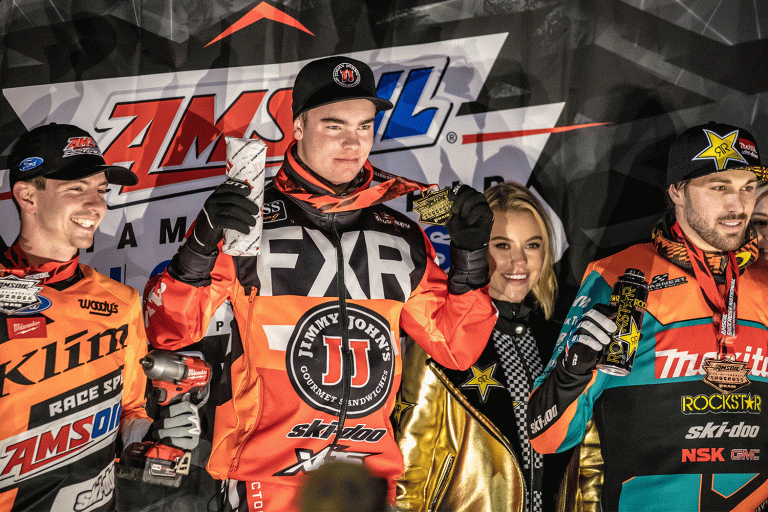
March 12, 2018 – Tucker Hibbert put a stronghold on the 2018 ISOC National Snocross points championship with back-to-back dominant performances in Dubuque, Iowa. Winning both finals and three of the four qualifiers, Hibbert gained 39 points over second place throughout the weekend to extend his points lead to a whopping 100.

In its second year hosting the Iowa National, Sundown Mountain Resort featured a completely different style track than last year with a technical course stretched across the top of the ski hill. The 35-second track utilized sections of two downhill runs, giving the course elevation changes with big jumps, sweeping turns and off-camber corners.

Friday and Saturday night played out similar for Hibbert. Capitalizing on solid starts in the 18-lap, 15-rider finals, he took the early lead both nights. Masterful with his line choices, he moved all over the course looking for the fastest and smoothest lines. His strategy worked as he rode unchallenged to finish 11 seconds over second place both nights.

With 177 points on the line at the three-day season finale in Lake Geneva, Wisc. this weekend, Hibbert has the opportunity to clinch his 11th Pro National title Friday night.
For more information on Hibbert and his racing, visit tucker-hibbert.com.

Tucker Hibbert – #68 Monster Energy / Arctic Cat / Ram Truck
Friday night recap:

“Friday night was a great race for me. I won both my qualifying races so I was number one qualifier heading into the final. My pick put me way on the outside of the startline which was a good place to be as long as you got a good launch. It lined you up really nice for the first turn and up the hill. I got a really good jump off the line, my sled pulled hard and put me out front of the guys next to me and into second position. I charged hard on the first lap and was able to capitalize on a small mistake by Montana Jess and make the pass for the lead in the last turn on the first lap. I put the hammer down, focused on riding fast laps right away and ran my own race.”

Saturday night recap:

“In the final on Saturday, I was able to take an inside starting position that was left open by the other riders. I was really happy about that. It was a different place to be but it was good. I got a good jump off the line and went into the first turn side-by-side with Logan Christian. I was able to carry a little more momentum than Logan over the first couple jumps and took the lead just before the first downhill section. Saturday’s track was a lot rougher than Friday and more challenging, which was good for racing. I was glad to be out front early and find the lines I wanted to slowly pull away a build up a good lead. The track was really technical. I had to be careful not to make mistakes. It was fun to pick my lines and charge around the track.”

Thoughts going into final event of the season:

“I’m really excited about my weekend in Iowa to win both races and extend my points lead by a good amount. Getting ready for Lake Geneva, I’m motivated to finish the season strong. We’re in a really good position with the points championship. I’m confident in my riding and my sled. The goal is keep winning races and clinch the championship.”

Tucker Hibbert – Iowa National Results
Friday, March 9 – Pro Round 13
Round 1 Qualifying: 1st
Round 2 Qualifying: 1st
FINAL: 1st
Saturday, March 10 – Pro Round 14
Round 1 Qualifying: 1st
Round 2 Qualifying: 2nd
FINAL: 1st
CBS Sports Network Broadcast 
Iowa Snocross National Day 1: Sunday, March 25 – 11:00 am ET
Iowa Snocross National Day 2: Sunday, April 1 – 11:00 am ET

About Tucker Hibbert
Tucker Hibbert, 33, entered his first race at the age of eight and today stands as the most decorated snowmobile snocross racer in history. He’s a two-time FIM World Snowcross champion, 14-time X Games medalist and 10-time national snocross champion. Now in his 18th professional season, he holds 137 Pro National victories. For more information on Hibbert, visit tucker-hibbert.com.