Home Blog Page 111

2018 Real World Sled of the Year

0

The final snowmobile showdown of the 2018 Season commences as Luke and Mark host this year’s coveted Real World Sled of the Year evaluation. After tens of thousands of accumulated miles across a full spectrum of test riders, they breakdown the top contenders from Arctic Cat, Polaris, Ski-Doo and Yamaha. Make sure you tune in to find out which sled scored the highest and provided the SnowTrax team with the best overall rider experience.

Subscribe to our YouTube Channel!

SLED OF THE YEAR AND RAD AWARDS SELECTED!

Supertrax Media, producers of SnowTrax Television, North America’s most watched, longest running, snowmobile television series, is pleased to announce the winners of the show’s annual Real World Sled of the Year and Revolutionary Advanced Design awards for Model Year 2018.

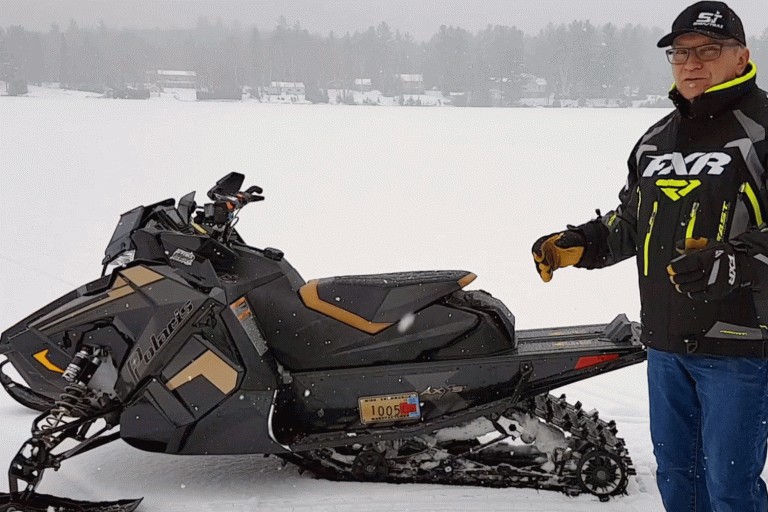
REAL WORLD SLED OF THE YEAR AWARD: Polaris Switchback XCR 800 HO

The battle for the annual SnowTrax Real World Sled of the Year laurels continues to intensify with the last two seasons witnessing almost dead-even heats between the two finalists.

Once again it was the hardcore staff at Supertrax Media and SnowTrax Television scoring the sleds across 18 categories of evaluation for the snowmobile industry’s ultimate award.

The nominees were impressive: The Yamaha Viper LTX 137, Arctic Cat’s ZR 8000 137, the Polaris 800 XCR Switchback 800 HO and the G4 Ski-Doo Renegade 850 XRS.

Interestingly, this year’s nominees were all, without exception, 137-inch models, indicating just how quickly the industry is moving to longer track lengths in top performance sleds.

Voting was exceptionally tight, requiring staff voters to spend extra time weighing the strengths and weaknesses of each of the nominees.

When push came to shove it was the Polaris XCR Switchback 800 HO carding the winning votes sending it to the top of the Supertrax Media podium for the 2018 Real World Sled of the Year Award.

It cannot go unsaid this year’s result was again as close as we have seen with the Ski-Doo G4 Renegade 850 XRS literally neck and neck in the voting with the Polaris Switchback XCR.

In the end, the XCR prevailed largely due to its inimitable handling prowess and high-speed ditch-banging demeanor.

The XCR is marketed as a hardcore sled for discerning riders and this cannot be overstated: The XCR rules terrain with its sophisticated, fully adjustable Walker Evans shocks and the continued supremacy of the AXYS platform’s variable castor, double A-arm IFS.

While the G4 is unquestionably the technological leader in the industry, the inherent goodness of a design delivering legendary handling performance at the limit, prevailed.

Polaris’ Pro XC external shock rear suspension received solid praise from the test team for it’s excellent control in deep bumps and square edged hits.

While the G4’s rMotion skidframe takes plush to new levels, the Polaris Pro XC delivers amazing control and stability when the sled is pushed to its limits.

Brake performance was also universally praised by the Supertrax Media staff. The Polaris jackshaft-mounted caliper and Hayes master cylinder provided what some testers called the best feel and depth of modulation among all OEM braking systems.

Congratulations to Polaris for winning the Real World Sled of the Year competition in model year 2018.

REVOLUTIONARY ADVANCED DESIGN AWARD: Ski-Doo SHOT Starter System

Ski-Doo set the snowmobile industry on end when it pulled the sheets off the SHOT starter system. The SHOT system uses the 850 and 600R’s stators as an electric starter motor powered by an ultra-lightweight capacitor.

The capacitor will hold a sufficient one hour charge to restart the engines. The beauty of the SHOT system is its inherent lightness. Tipping the scales at barely 11 pounds, it beats current electric start systems by more than 20 pounds.

So far, the SHOT system has only been used on Ski-Doo’s Summit line-up. Mountain riders are the most weight-influenced snowmobilers in the sport and they are also the most prolific re-starters of their sleds, often in awkward, off-kilter positions.

SHOT means after using recoil start at the beginning of their ride-day owners can use the push-button SHOT the rest of the day without the weight penalty of a conventional electric start system.

The SHOT capacitor is recharged in as little as 90 seconds and ready for another “shot” after each use.

There’s only one thing left to say about SHOT: In the future will the capacitor be increased to supply power at any time replacing batteries and starter motors on both mountain sleds and trail snowmobiles? Only Ski-Doo knows the answer to this question. However, Ski-Doo engineering continues to push the boundaries of snowmobile technology to new and ever-higher heights.

Congratulations to Ski-Doo for winning Supertrax Media’s RAD (Revolutionary Advanced Design) award for 2018.

For more information contact (705) 286-2135

THE NEXT BIG THING IN SUSPENSION

0

Seems there’s almost always something lurking on the horizon that’s supposed to be the next big thing.

Sometimes the “thing” actually makes it to our sport but turns out to be not-so-big. Think about Electronic Power Steering.

I believe we’re on the cusp of a “thing” which will turn out to be “big”. My rationale goes like this. Most of the pieces of the next big thing are openly displayed and available on 2019 sleds from both Arctic Cat and Yamaha.

They only lack a few more pieces to become paradigm shifting. Furthermore, off-road SxS OEM, Polaris, has the next big thing done and available on certain 2019 RZRs.

WHAT IS IT?

Active suspension. Polaris raised more than a few eyebrows when it introduced the RZR Turbo Dynamix a few months ago. Dynamix is Polaris-speak for “active” suspension.

Active suspension means your sled’s shocks will be in a state of continual damping adjustment as sensors read and process the shocks movements.

The sled’s ECU will process data from the sensors and make millions of split second adjustments to the shocks to better respond to the terrain you’re covering.

The new iACT system on Yamaha Sidewinders and many Arctic Cat models already use similar shocks suitable for fully active control, complete with stepper motors on the reservoirs, controlled by the rider.

To be “active” these shocks only need speed sensors and a chassis-mounted yaw sensor to feed inputs into the sled’s expanded ECU. This hardware is available right now and Fox is the predominant supplier of this technology for off-road vehicles. I’ll go out on a limb and assume they’ll have the full system available soon for snowmobiles.

WHY IS IT IMPORTANT?

Whiz-bang tech can be good or it can be a gimmick. In the case of the RZR with Dynamix active suspension, it’s the real deal.

Luke had the privilege of wringing out one of the first RZRs with Dynamix and came away thoroughly impressed. He felt the ability to attack crazy terrain at speed was almost limitless.

The shocks reacted to speed and yaw inputs so quickly the RZR actually felt as if it was floating over jinormous bumps and jumps. Dynamix also responds to turning G-forces and body roll, keeping the RZR laser level in turns.

When it comes to rough terrain, snowmobiles appear to be a great place to apply this active suspension technology. For the record, we suspect the OEMs agree with this assertion because it is no coincidence we’re seeing oh-so-close to active suspension on these 2019 models.

Snowmobiles cover incredibly rough terrain at speed and the implementation of iACT on some 2019s from Cat and Yamaha proves the point: When your suspension can be adjusted on the fly you can ride faster and in more comfort.

Take this rationale to the next level – having the suspension automatically adjust – and ride quality over just about any kind of surface will improve exponentially.

WHO’LL HAVE IT FIRST?

An informed guess would be both Arctic Cat and Yamaha, however, Polaris has the complete Dynamix system de-bugged and ready-to-go on SxS vehicles today.

We think Polaris could actually beat Cat and Yamaha to the draw because of their experience with the Dynamix system. On a related note, we have to wonder if the call has gone out from Valcourt to KYB in Japan commisioning development of an active system for Ski-Doo.

ENDURO SUSPENSION CONFUSION

0

Dear Motorhead:

I’d like some help understanding my Ski-Doo Enduro’s rear suspension. I weigh 220-lbs before gear and can’t seem to find a comfortable setting.

I am currently running the ski springs at 2, Center shock in position 2, torsion spring cam block at 3, transfer block in position 1 or 2, limiter strap tightened up one hole, air suspension set at 1 or 2.

My complaint is that I still need to stand up to absorb big dips in the trail when running at 50 to 60 mph, or else I bottom out. I also find my self having to hold my self off the seat to prevent being bucked off.

I really do not feel the suspension working in a compliant manner. If I go softer setting on the rear torsion spring, like position 1, my mud flap is almost touching the ground. The air spring seems to control rear ride height, should I set rear sag with sled running and air suspension set at 1 or 2 or should I be setting the rear sag with the sled off, this will greatly increase the amount of sag because the air spring won’t be assisting to hold the sled or the rider up.

Just an FYI the rear shock has a sport and performance hole position. It is set in the stock position, performance.

My goal is to find a plush ride. I do like to ride fast, and occasionally aggressive when the trails get whooped up. I have played with the suspension for hundreds of miles and can’t seem to dial in the comfort of the rear skid.

One Ski-Doo sales guy recommended stiffer rear torsion springs, but I know I don’t want a stiffer ride. I rode a friend’s Polaris Switchback Rush yesterday and I could actually feel the rear suspension working in a compliant manner. It was almost like slow motion, I could feel it comfortably compress and gently rebound the sled back.

I was actually forcing my self to stay seated and feel the comfort instead of standing up or squatting on my sled to let the sled do its thing before sitting back down to prevent bottoming out or getting bucked up after full compression.

On my sled I did suck in the limiter strap one hole for two reasons, better cornering but more importantly to make sure the skid was contacting the ground at the front and rear at the same time.

I read online that if the front or the rear of the skid is not parallel to the ground as you lower from a raised off the ground position then your suspension won’t be working at its full potential.

Sometimes I feel that the seat is too soft and Im actually bouncing on the seat foam. Any thoughts? Also, what is the proper way to set the sag with an air suspension if it too contributes to ride height?

Thanks for your help,

Michael

Michael!

Whew! You are in the classic position of over-adjusting your rear suspension. The fact you tweaked the limiter was just one clue you are in way over your head.

Whoever told you about the angle of the rail thing requires a limiter adjustment was just plain wrong. You have the very best snowmobile rear suspension under your butt and you are not abnormally heavy. So here’s my recommendation. Limiter strap adjustments are mysterious and have far reaching implications all the way down the rail – put it back to stock!

Put everything except the air suspension back to dead stock – including the front IFS shock preload settings the centre shock and the coupler block.

Think about what you did when you dialled in more snail cam preload on the front IFS and then pulled the limiter up! You did two contradictory things at once.

When you get everything back to stock take the sled for a spin – (probably next winter now!) Adjust nothing – zip, nada except the air spring until you get the ride you want in the terrain you ride most.

Setting one or two is not going to be enough air for your weight – you’re going to be at three or four for sure. Completely forget about static ride height – this is an air suspension which only uses the torsion springs minimally – get them back to stock as well!

The whole idea of the air suspension on the Enduro is max on-the-fly adjustability – not fiddle until you’re confused sno-X racer set-up.
If you want a sled you can mess around with suspension settings you would be much better off with an MX-ZX or XRS.

The Enduro’s air ride is the among the very best suspensions we’ve ever ridden – for general trail duty. If you’re trying to ditch bang and clear doubles it’s not the right suspension for that behaviour.

My advice for most suspension tweaks is to use oil (shock damping)- not steel (springs) to control your rear suspension. In the case of the air ride suspension on the r-Motion I would say use air – and nothing else.

Hope this helps!

Motorhead Mark

TEAM ARCTIC SETS HISTORIC WIN PERCENTAGES DURING 2018 SNOWMOBILE RACE SEASON

St. Cloud, Minn. (March. 29, 2018) – The season is over, the numbers are in and the record books are written in Green! In national snocross and cross-country competition, Team Arctic racers and teams delivered a historic performance, capturing more than 60 percent of all class wins, more than 50 percent of all the podium positions and more than 75 percent of the high point championship titles.

“Our racers and the ZR 6000R race sleds completely dominated from the top on down, and across all classes,” said Mike Kloety, Team Arctic Race Manager. “I’ve wittnessed many great race seasons over the past couple decades, but nothing that compares to 2018.”

How well did Team Green crush everyone in the yellow, red and blue camps?

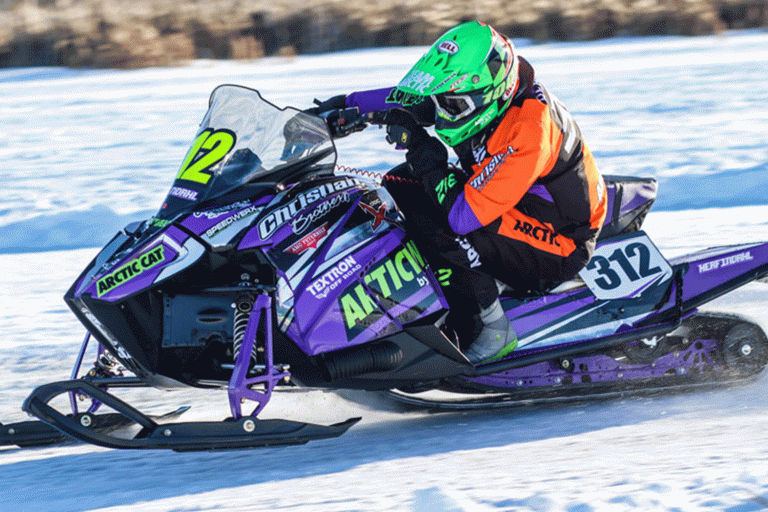
In ISOC National Snocross, Team Arctic won 95 out of 161 class finals throughout the 16-race season. That’s 59 percent of the total wins! Equally impressive, Team Green captured 264 out of 483 podium positions (54 percent) and 12 of the 14 class high point championship titles. From the season opener in Duluth, Minn., to the final in Lake Geneva, Wis., it was an all-out blitz aboard the indomitable Arctic Cat ZR 6000R SX snowmobile featuring the ProCross chassis and C-TEC2 6000 EFI engine.

The results were equally dominant in USXC cross-country, where Team Arctic captured 88 out of 140 possible class wins (62 percent), 213 out of 414 podium positions (51 percent) and 16 of 21 class high point titles (76 percent). Team Arctic racers crushed the competition aboard the same snowmobile and technology available to all Arctic Cat enthusiasts: the ZR 6000R XC in the ProCross chassis that features the C-TEC2 DSI engine plus the ARS front and SLIDE-ACTION rear suspension combo.

“For one brand to win 60 percent of all the terrain races is a testament to Arctic Cat engineers, and even more, our outstanding racers and their incredibly supportive teams,” said Kloety. “We congratulate every Team Arctic racer and crew member for being part of the most successful race program’s in snowmobiling competition.”

Team Arctic High Point Class Champions in ISOC National Snocross

Tucker Hibbert – Pro
Daniel Benham – Pro Lite
Matt Pichner – Pro AM Plus 30
Trent Wittwer – Sport
Anson Scheele – Junior 14-15 and Junior 16-17
Sophia Hulsey – Junior Girls 9-13
Drew Freeland – Transition 8-13, Transition 9-13 and Junior 10-13
Landon Giese – Stock 200
Brady Freeland – 120 Champ

Team Arctic High Point Class Champions in USXC Cross-Country

Wes Selby – Pro Open
David Brown – Semi Pro 600
Savannah Landrus – Women’s
Brian Brodehl – Masters 40 Plus and I-500 Open
Hannah Diesen – Junior Girls 14-17
Braden Sillerud – Expert 600 Limited
Annie Olson – Junior Girls 10-13
Caleb Nymann – Junior Boys 10-13
Morgan Nyquist – Expert 600 Improved
Nicholas Nyquist – Sport 600 Limited and Junior 14-17
Morgan Nyquist – Trail
Brian Brown – Classic IFS 50 Plus
Bill Young – Vintage
Gary Tintes – Vintage 50 Plus

About Arctic Cat


The Arctic Cat snowmobile brand is among the most widely recognized and respected in the industry. The company designs, engineers, manufactures and markets snowmobiles, in addition to related parts, garments and accessories under the Arctic Cat® and Motorfist® brand names. For more information, visit: www.arcticcat.com.

About Textron Inc.

Textron Inc. is a multi-industry company that leverages its global network of aircraft, defense, industrial and finance businesses to provide customers with innovative solutions and services. Textron is known around the world for its powerful brands such as Bell Helicopter, Cessna, Beechcraft, Hawker, Jacobsen, Kautex, Lycoming, E-Z-GO, Greenlee, Textron Off Road, Arctic Cat, Textron Systems, and TRU Simulation + Training. For more information, visit: www.textron.com

TWO 2019 ARCTIC CAT 7000 IMPROVEMENTS

0

Last year Arctic Cat went pretty much across-the-board with its new easy-remove and restyled ProCross-ProClimb bodywork.

The exception was the 7000-series of 4-stroke sleds that retained their original plastic.

Cosmetic Surgery

This year, the 7000 series gets the more modern plastic used on the 2-strokes and it constitutes the first major change to Cat’s 1049cc 4-stroke line in four years.

The upside to this change is the ease with which body panels can be removed and replaced. This was less of a problem with Cat’s 4-strokes than it was with its 2-strokes which require side panel access to fill the oil tank.

This was a pain in the neck and usually resulted in spilled oil and a sloppy mess every time you tried to add oil. The panel change fixed that problem and also added a more aero look to the sleds and a tighter fit at the seams.

As for the rest of the sled, it;s pretty much business as usual. Cat has continued with the same Yamaha triple (still no DBW throttle setup) and the same combo of TEAM clutches (roller secondary) that have worked extremely well with this awesome, bulletproof, and might we add, sweet-sounding engine.

iACT Adjustability

The 2019 137-inch 7000 Limited version offers Cat’s new iACT adjustment for the front IFS and rear track shock. The same feature is available on all Cat’s liquid-cooled 2-stroke sleds.

iACT is operated from a new left handlebar control and has three settings for the rear track shock: Soft, Medium and Firm.

The rider just taps a button on the brand new left side switchgear cluster and a large readout on the electronic dash gauge indicates which setting (soft, medium, hard) the shocks have adjusted to. The on-the-fly damping changes happen instantly and are immediately noticeable.

iACT uses Fox’s gas shock QS3 technology and although we love the manual ease of adjustability of the compression damping on these 3-position shocks on any model, Cat’s QS iACT version takes suspension on-the-fly control to a new level.

There’s always the “is this option really worth the extra bucks” question and we will say without hesitation, iACT adds such an impressive dimension of comfort and confidence to the riding experience, you begin to wonder how you ever rode manual systems before.

You can run trails set on “Soft” and if you spy some rough trail ahead, just spool up the hand control to Medium a few breaths before you hit the roughage and Bob’s your uncle.

Likewise, ditch bangers can run with settings on Hard and then turn the controls over to another rider (wife) who may not require such an aggressive setting.

The best part is, you always know exactly where the suspension is set and can change it in an instant to your exact liking.

Woody’s Traction Snowmobile Stud Comparison

0

AJ gets some help from Woody’s as he reveals some eye-opening results on the advantages of proper traction control in a real world test between a pair of 2018 Polaris XCR’s.

Subscribe to our YouTube Channel!

MBRP’s Arctic Cat 800 C-TEC2 Trail & Race Exhaust Review

0

AJ reviews MBRP’s latest Trail and Race performance exhausts which are designed specifically for Arctic Cat’s 800 C-TEC2 mill.

Subscribe to our YouTube Channel!

Full REVIEW: 2018 Ski-Doo Grand Touring 600 H.O. E-TEC

0

Mark saddles up for some 2-Up touring in his Test Ride review of the 2018 Ski-Doo Grand Touring and proves why the 600 H.O. E-TEC engine is a perfect choice.

Subscribe to our YouTube Channel!

WOODY’S TWIST SCREWS

0

Get a grip! And we mean that literary with Woody’s Twist Screws.

Whether the dead of winter or during the spring melt – icy conditions still exist and traction beyond the studs on your sled can be paramount for not only performance but safety as well.

Woody’s Twist screws are marketed to provide traction to waders, heavy equipment and everything in between. What’s especially great about Woody’s Twist screws is the ease of application. Simply pick from the four profile lengths, twist the screws in with the supplied installation tool and then walk, ride, drive over any slippery or uneven terrain.

You’ll have full confidence the carbide tip is penetrating the terrain giving you the utmost in traction and control. Once installed, the head of the Twist screws are encompassed by the lugs/tread and moves with them.

This prolongs the life of the screw and gives superior traction. After the snow and ice melts away, simply remove the Twist screws and place them aside for next season – your soles, treads and lugs remain fully functional and with hardly a trace. Similar to the Woody’s top quality studs, Twist screws are made from high carbon steel and are zinc plated to keep them rust free.

Twist Screws are application specific depending the overall length, size of carbide and hex head. The following guide breaks down the wide variety of applications:

For more information on the full line of traction products including Twist screws visit woodystraction.com.