Home Blog Page 104

POLARIS PATRIOT 850

0

With the top performance marketplace demonstrating fluid movement toward whatever is biggest and fastest, Polaris could not effectively continue its mission to gain share on Ski-Doo without an 850.

Polaris needed a badder, more powerful engine with some incomparable performance numbers. This would require more than a simple bore and stroke of the current 800 Liberty: A new engine from the motor mounts up was required.

Polaris is quick to point out it was in full development of the Patriot 850 engine at the time Ski-Doo dropped the 850 Rotax two seasons ago. Even though Polaris was working on the new Patriot before the Rotax arrived, we have to think the Polaris engineering department was one of the first buyers to get mitts on an 850 Rotax to ensure the Patriot exceeded Ski-Doo’s benchmark.

Is it better? Without a doubt, this will be the most-asked question this season. Let me fine-tune the question a bit: “Is the 850 Polaris faster than the 850 Ski-Doo?” Clearly, this is an important question given these top performance sleds sell early and command the largest MSRP’s among all other displacement models.

Here’s what we can tell you right now – and we promise to update this info as soon as the snow is down and the ice is thick enough for a head-to-head dig on Kevlar Lake.

The new Polaris feels less edgy and more mellow from idle through engagement to about 6000 RPM compared to the Rotax 850. There is an immediate sense of refinement emanating from the Patriot as a result of its noticeably smoother idle and vibration-free engagement.

Polaris aced this issue – one that most 850 Ski-Doo owners identify as less-than-pleasing. An all-new vibration-isolating motor mounting system gets the credit here. Of particular interest is the removal of the ubiquitous “torque-stop”, used for years to stabilize center-to-center variance.

The torque stop is notorious for transferring engine vibes directly into the chassis, circumventing the engine’s vibration-isolating rubber mounts. This new smoothness naturally gives off a less edgy feel at trail speeds and could nearly be misinterpreted as less powerful feedback.

Frankly, we can’t say conclusively the Ski-Doo is quicker down low. Here’s what we can say: We appreciate the more refined and low vibration feel of the Polaris, hands down, over the Ski-Doo.

SKI-DOO RACERS CONTINUE TO DOMINATE AT JACKSON HOLE SNOCROSS

The Ski-Doo X-Team snocross racers have started the season with a stranglehold on the podium and dominant performances on the track. Lincoln Lemieux (Scheuring Speed Sports) and Elias Ishoel (BOSS Racing) claimed wins in Rounds 3 & 4 of the top Pro class over the weekend, and each time they were backed up by Adam Renheim and Tim Tremblay (both from Warnert Racing) to sweep the podium. Adding to the dominance was the Pro Lite podium sweep by Patenaude brothers Leo (Ingles Performance), Hunter (Scheuring Speed Sports) and Francis Pelletier (Warnert Racing) on Friday. Of the Pro podium positions through four rounds of racing, Ski-Doo racers have taken an amazing 11 of 12 and all four wins.

Pro Domination
The new Ski-Doo MXZx 600 RS E-TEC race sled has proven to be fast, durable and easy to handle as shown by both run away wins and tough rides through the pack. Friday Lemieux started the final with a strong holeshot and after the first lap established a lead that wouldn’t be challenged, but the Warnert duo of Renheim and Tremblay had to work their way through traffic from mid pack starts to earn their podium spots – and they were followed across the line by BOSS teammates Ishoel and Aki Pihlaja to make it a top five sweep! Saturday’s race had a very familiar feel as Ishoel and Pihlaja shot out ahead of the pack with Lemieux close behind in fifth while Renheim and Tremblay were mid pack. Ishoel staked claim to the top spot and slowly began building a lead that went unchallenged, while Lemieux and Pihlaja both had challenges as Lemieux came off in front of Pihlaja and he couldn’t avoid hitting the sled virtually ending Aki’s night while Lemieux was able to remount and finish eighth. Renheim and Tremblay were in full attack mode as they came through the pack yet again and with a couple laps left cemented their podium positions and the Ski-Doo sweep. Elias Ishoel’s fast qualifying and stellar final results helped him increase his championship points lead as the series breaks for the holidays.

Pro Lite
Pro Lite racing on Friday added a sibling rivalry as brothers Leo and Hunter Patenaude battled it out for the win. Leo was able to pull a slight advantage at the end and by backing up his Duluth wire to wire win, shown he’s the real deal. Francis Pelletier had the red plate coming into the Jackson Hole event and by virtue of his strong and steady third place finishes both nights will leave with it as he retains the championship points lead.

Brodeur and a blast from the past
Ski-Doo Women’s Pro-Am racer Megan Brodeur claimed her third straight win on Friday and proved she’s still the one to beat. While Saturday was a little tougher because of a first lap tangle, she showed the drive that’s necessary to be a champion and worked her way back to a close second place finish. She also will retain the red plate and championship points lead.

In a blast from the past, former Pro Champion Steve Martin – with huge help from Anderson Racing – came to Jackson Hole and raced in the Pro-Am +30 class where he managed a second place finish! Congrats as it’s great to see some guys reacting to Kurt Bauerly’s challenge to come out and have some fun, and certainly great to see Martin hit the podium.

ROTAX 900 ACE TURBO

This season Rotax pulled the sheets off a completely new ACE 900 equipped with a Rotax-built intercooled turbocharger producing 150-horsepower. Clearly this new engine is what a legion of 1200 Rotax diehards have been waiting for.

Ski-Doo has made it clear the ACE Turbo is not in competition with Yamaha’s turbo. It is the next step in performance for the 1200 Rotax buyer. To this end, we would agree, the 150-hp ACE Turbo is a perfect fit. However, inevitable comparisons will multiply this winter.

To get to the 150-horsepower level from an engine producing arguably 95-hp without a hair dryer stuck in its throat, requires more than subtle tweaking. The Turbo gets bigger, stronger rods, stronger pistons and different valve timing from its twin overhead cams.

The turbocharger itself is mounted close – we mean really close – to the exhaust ports. In fact, the turbo unit is actually an integral part of the exhaust manifold. This design trick is targeted at reducing lag and keeps a highly pressurized charge in the intake runner that enters the intercooler then encircles the engine connecting to the intake plenum on its back side.

Here are some interesting stats for you to digest ands don’t take these numbers as boilerplate. Honestly, we wish we could give you (like we did in the early 2000s) the actual wet weight of each model but apparently we are not able to handle such revelations.

Here’s what we’ve discerned by deductive reasoning and common sense calculations: An 1170cc 4-TEC triple weighs about 20 pounds more than the 900 ACE with no turbo. We think a 900 Turbo is about 26 pounds heavier than an ACE 900 and about 44 pounds heavier than a 600R E-TEC.

If you’re comparing the new Turbo to its most likely rival in the Ski-Doo brochure, the 850 E-TEC, it would appear to be 37 pounds heavier. If you go one step further and do some rudimentary power-to-weight calculations, an 850 E-TEC is hands down, running away king-of-the-castle in terms of real world power and acceleration down the lake.

If you’re a loyal 1200 4-TEC owner looking for the next step, get on down to your Ski-Doo store; you won’t be disappointed. The Turbo 900 delivers a healthy blast of acceleration and a formidable run past the C-note on Kevlar Lake. The spread of power is wide and trailable.

As with most 4-stroke sleds, the Turbo stays shifted out when accelerated hard. This desirable trait has to do with the inherent torque 4-strokes – in particular turbocharged ones – produce. Also, there is simply no undervaluing the effect of the low-friction pDrive roller primary in play here.

The Turbo ACE has but one foible: The electronic drive by wire (DBW) throttle carried over from later model 4-TECs. This multi-mode throttle is not up to the performance standards we’ve come to expect from the number one selling snowmobile OEM. It is laggy, not at all intuitive and feels less than connected to the engine.

We’re satisfied the engine does not produce any turbo lag, however there is “throttle lag” in the DBW system. Trust us, select “Sport Mode” every time you ride the Turbo. Come to think of it, why would anyone buy a 150-hp snowmobile and want to ride it in “Eco Mode”? Can you acclimatize to this less-than-perfect throttle? Sure. The question is this: Should you have to?

Comparisons to the Yamaha turbo are, as we said, inevitable. The reality is this: 150-hp isn’t 180 and don’t expect it to be. Having said that, keep in mind this engine, in almost identical form, is tucked in the Can-Am Maverick X3 SxS producing a claimed 173-hp. We find it hard to believe savvy BRP snowmobile dealers haven’t figured out a way to tweak the ECU, wastegate and/or both on the new Turbo to deliver more power.

We have to conclude, if the 900 Turbo can reliably deliver another 25 horsepower in a side-x-side then it won’t be long until the snowmobile version gets a tune up.

2019 YAMAHA SIDEWINDER SRX

0

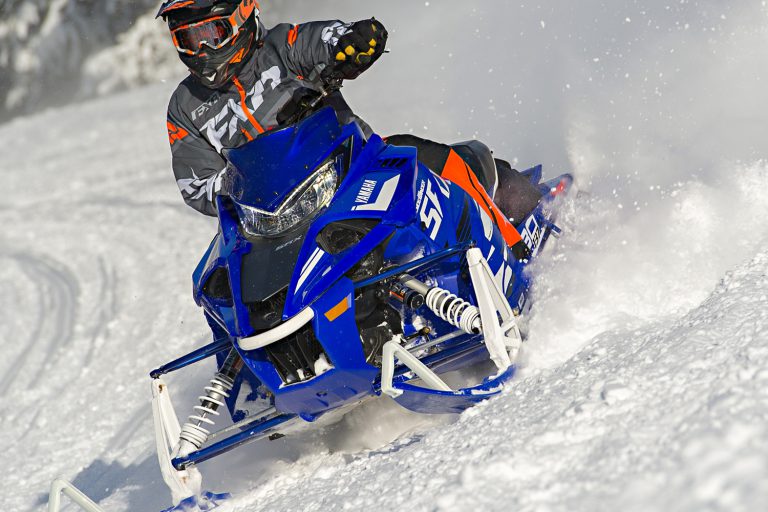
The SRX has a few distinguishing features that carve it out from the mainstream. In a move many questioned at its announcement, Yamaha has lowered the SRX’s ride height a total of an inch. In today’s world of long travel suspension and deep stroking shocks, this seems like a step backwards. Yamaha figured out a way to keep the SRX’s center of gravity low, low and still deliver good ride results. Yes, the answer is technical and… expensive.

Up front, the engineers chose dual rate springs to deal with the increased sag built-in and then added “low preload” rear shocks. Check the specs and you’ll find the SRX actually has the same amount of suspension travel as other SideWinders but when you’re sitting on it, the suspension sag drops your butt an inch deeper into its travel.

The end result is that the sled feels like it’s sitting lower – and in fact, is – but you still have the same amount of suspension movement when the sled is static. Why do this? Like we said, a lower sled has a lower CG so its mass is closer to the ground. But more than that, this SRX rails corners and keeps the skis planted without a lot of ski-lift as its suspension unloads right to left and back again.

In technical sections of trail the lower CG also tends to counter the feeling of top-heaviness often attributed to heavier 4-strokes especially with turbocharger plumbing.

Yamaha conspired with Fox to develop the IQS (Intelligent Quick Shift) shock, which allows the rider to toggle three different suspension settings from the handlebars that can upgrade or reduce compression dampening within a second. Although this is fully a rider negotiated system, meaning the rider has to make the adjustment and judge whatever setting is needed depending on the terrain, it’s very quick-acting and effective. The on-the-fly adjustments are immediately noticeable and the ride change is significant.

Just so you know, Yamaha has dealt with the engine performance issue not by increasing boost from the turbo but by adding a new helix to the secondary clutch. The steeper helix accelerates the SRX harder and backshifts more aggressively to assist with power transitions – like when you’re too hot going into a corner, brake hard and then want to get back into the power quickly to hit the apex of the corner.

The Apex, with its non-roller primary, struggled with this issue and often had a “rubber band” feel when you wanted the clutches to hook up right now! It’s no surprise aggressive secondary clutching would offer more performance given the enormous torque the turbo 998 can generate.

So we know the person who wants an SRX wants the max Yamaha offers. Based on its dealer invoice, that owner shouldn’t have to and won’t tolerate compromise – and won’t have to – thanks to IQS. There will be a performance improvement, based on the revised clutching but there is one caveat that seems contrary to all of this.

Yamaha has chosen to use a one-inch track on this model. We’re absolutely positive this has to do with bragging rights about being the fastest snowmobile ever. Obviously, the one-inch track was a compromise made to gain top speed. Sure, it won’t hook up as well as a deeper track but it is definitely faster on hardpack. One focus, one purpose , total compromise to everything but top speed.

A low-ply one-incher generates way less friction than a heavier 1.6 (the minimum depth track we feel is required here) and will accelerate harder and maintain blistering top end.

We honestly have to question whether or not this sled will hook up on any surface without about 100 traction studs. This adds both weight and friction and pretty much negates the benefits of the shallower track. Our experience with all SideWinders and Turbo Cats tells us the biggest issue with these sleds is traction. There’s so much power on tap here you’re simply dreaming if you think you can get full performance potential without studs – and lots of ’em.

Problem is, Yamaha has had a longstanding policy about track warranties where studding is involved. As of this writing, the company’s stance is the same – no dice. Here’s what owners may wish to do: Forget about warranties and stud the track anyway. Just don’t complain if you peel the track off the sled in 5,000 miles.

Sure, it’s a compromise, but there’s always a price attached to being the fastest.

Congratulations… You’ve Chosen Québec!

0

Great news, you’ve decided to visit Québec this winter! Get ready to be impressed; there’s much, much more to snowmobiling in Québec than most riders expect or dream of – and it’s all good!

As soon as snowmobilers cross the border and head north, east or west, within a surprisingly short distance they begin to see the difference in snow accumulation. We like to tell first-time travelers: “Just watch the fence posts beside the road.” You’ll see the fallen snow levels climbing higher on those posts at times of the year other regions are struggling just trying to get their trails open.

Dreamland

That thick, rich snow blanket is the stuff of dreams for hardcore snowmobilers and is the foundation for building the best snowmobile trails on earth! Everywhere you look you’ll see laser-smooth trails groomed over gorgeous meadows and through pristine forest glades in close proximity to the sea. Great as it is, it’s only part of the Québec snowmobiling adventure.

Québec offers a unique cultural experience. The province’s focus on comfort and cuisine provides incredible dining and accommodation, along with an environment that welcomes visitors with a level of warmth and service unsurpassed by any other area, anywhere. You and your travelling crew will be surprised at the variety of quaint, clean, fully equipped inns and hotels available on-trail and the quality of dining you’ll experience.

Get iMotoneige Now!

How do you find the best places? It’s easy. This year Québec has revisited its interactive map for snowmobilers and increased the featured services on it from 200 to 600, including gas stations, accommodations, restaurants, snowmobile dealers and tourist attractions. You can reach them all by snowmobile and all you need to do is download the app, iMotoneige, onto your smartphone.

With iMotoneige along with you, you’ll know exactly where you are at any point within the vast Québec trail system. Not only do you have the comforting assurance of not getting lost, but downloading iMotoneige lets you plan your itinerary and track your position, find restaurants and hotels – all without a data plan or cell signal. The information is already inside your phone!

Get it on Google Play | Download on the App Store

Start Planning

If you’d like to have a paper map with you on your trip or when you’re making your trip plans, you can order it at snowmobileinquebec.com/snowmobilers-guide.

Trail Permits Are A Must!

It’s important you buy your annual Québec trail permits online.

**This is the best way to purchase your annual permits and you should make sure you’ve received them in advance of leaving home!

If you’re planning on riding in Québec for only a few days, you can choose from a one-day trail pass, 3-days, 7-days or a full-season permit.

Upon arrival in Québec, it is possible to purchase 1, 3 & 7-day permits from the local snowmobile club in the area where you’re starting your journey.

Abitibi-Temiscamingue is the only destination selling daily trail passes online.

Fees for each permit type are available at snowmobileinquebec.com

Your Equipment Will Be Safe!

There are many overnight destinations easily reached by trail, offering secure storage compounds and facilities (some, even indoor) for your snowmobile. You can securely park your sled for the night, knowing it’s in a locked, supervised location while you enjoy a delicious dinner and a warm, cozy overnight stay.

At the outset of your journey it’s easy to find inns and resorts that allow you to leave your truck and trailer parked on their premises while you’re exploring the countryside on your snowmobile.

This information is quickly and conveniently available on iMotoneige. Just another reason you should make the iMotoneige app part of your planning regimen!

Photo Credits:

©Studio du Ruisseau/Le Québec Maritime
©Fabrice Tremblay/Tourisme Saguenay–Lac-Saint-Jean
©Hugo Lacroix/Tourisme Abitibi-Témiscamingue
© Montagne du Diable/Tourisme Laurentides

2019 Polaris 600 INDY XC 129 Walk Around & First Impressions

0

Motorhead Mark is here to give you all you want to know about the 2019 Polaris 600 INDY XC 129 following a solid weekend of riding.

All-new season of SnowTrax Television begins the week of December 31 on OLN and WILD TV in Canada, Outdoor Channel in the United States and the week of January 6 on YouTube!

Subscribe to our YouTube Channel!

SUSPENSION SET-UP MADE EASY!

0

Here’s a basic tips on setting up your suspension for maximum ride results. The idea here is to provide an understanding of where to start from when adjusting things.

Consider this: There are two elements of your suspension that you may or may not have control over: First is spring tension, second is shock damping.

SPRING TENSION

Your sled usually has either snail cam adjusters on each coilover shock or “progressive wind” threaded adjusters that can increase spring tension.

Torsion springs have a cam adjuster usually with no more than four settings. Winding up these adjusters has more to do with adjusting spring preload than changing the whole rate of the spring as it travels from full extension to full compression.

Preload is really only affected in the first couple of inches of travel and sets the static height of the snowmobile when it’s not moving but has its rider and cargo in place.

Generally, cranking up the preload will not make your sled ride stiffer. Those spring rates are set at the factory and they are what they are.
If you want a stiffer or softer ride as it pertains to springs, you’ll need to go to either the OEM or a spring expert and purchase springs with a different rate. Frankly, this is rarely necessary as factory spring rates are almost always within the ballpark.

When we set up a suspension on a stock sled, we like to start our adjustments with the preload backed off completely. In this way, we know we can add more preload when we get our shock damping adjusted properly.

SHOCK DAMPING

Shock damping is the most critical element of suspension tuning – provided you have springs that match rider and cargo weight. Many snowmobiles have no damping adjusters on their shocks and that sucks if you need ride improvement.

For the ones that do have adjusters (and definitely more sleds have damping adjustable shocks these days), you need to start by setting your damping adjusters to the softest setting.

Take the sled for a ride with the payload (including an extra rider if it’s a 2-up sled) you’d normally be carrying and determine where and when the suspension is bottoming-out.

Determine if you’re bottoming out at low speed – if you are, you’ll need to start adding more compression damping. Now speed up. If your low speed damping is good but you bottom out when you’re going faster, move the compression damping adjusters up one notch and test ride again.

Work on both front and rear of the machine at the same time and keep moving the damping adjusters at single increments until you’re satisfied. Do not go crazy and move your damping adjusters a bunch of notches at a time. This will only confuse things.

After you’ve got the compression damping set close to what you want, determine if you need to adjust front versus rear. If this is the case, only move the front or rear adjusters one notch at a time separately and then retest.

We’ve only talked about compression damping and have avoided rebound dampening adjustments – simply because fewer stock sleds offer both adjustments.

Yes, the testing process can be tedious and time consuming, but it’s definitely worth the work!

QUALIFIED SNOWMOBILERS NEEDED

We’re on the lookout for snowmobilers to participate in a new snowmobile evaluation!

If you or anyone you know uses their snowmobile for more than just recreational riding, we invite you to click the link below and complete the participant questionnaire.

Aside from recreational riding, you would be eligible to participate if you use your snowmobile for a combination of any of the following uses…

* Ice fishing
* Trapping (Hunting)
* General utility work including towing a sleigh
* Deep snow accessibility
* Remote cottages / Cabin accessibility
* Snowmobile trail maintenance
* Commercial use (Forestry / Construction / Hydro, etc.)

COMPLETE QUESTIONNAIRE

MORE POWER ACROSS THE BOARD

0

The all-new Ski-Doo 900 Turbo powerplant is rumored to be under intense aftermarket scrutiny.

Inasmuch as Ski-Doo is likely not thrilled with the impending propagation of turbo controllers and ECU chips, we think this development is very interesting in the face of a downturn in snowmobile aftermarket engine modifications the past decade.

It looks like we’re poised to enter the realm of aftermarket go-fast accessories for what will surely be a large (sales) volume model this year and even larger going forward.

The arrival of the Yama-turbo generated a similar response from the aftermarket but there’s no way you can compare the unit sales volume of the new Rotax turbo to the Yamaha, even considering Arctic Cat’s use of the same engine. Ski-Doo’s market share is ji-normous in comparison.

At the other end of the spectrum comes Arctic Cat and its relatively new (two years ago) dual stage injection 800 2-stroke.

With Ski-Doo and Polaris battling for ultimate supremacy with their monster 850cc 2-strokes, there has to be serious concern at Arctic Cat over the perceived and/or real power deficit in the face of the new 850s.

Interestingly, we’ve heard rumblings Arctic Cat’s 800 DSI can be stretched to 850-cubes with little effort. If this is true then we think it’s prudent for the green team to do just that. Soon.

iACT DELIVERS THE GOODS

0

The idea behind iACT is to allow the rider to custom adjust the sled’s suspension to the terrain you’re riding by toggling increased or less compression damping from the drivers seat to the shocks.

Each shock has three settings, SOFT, MEDIUM and FIRM, and the rider can glance at the big digit display on the dash and select which setting is most comfortable. Response is near-instantaneous. Fox, the manufacturer, claims settings change within a second.

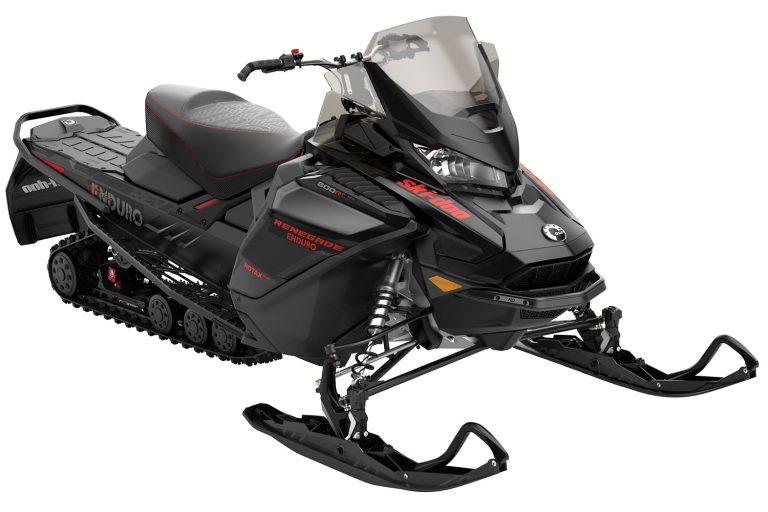
We think Cat’s rapid selection of only three possible compression settings and the fine-tuned damping results you get instantaneously from iACT trump Ski-Doo’s air adjustable setup available on the Enduro and we actually prefer only having three settings – especially since you can really feel the differences and besides, it eliminates a lot of driver error in the process.

Another biggy is the fact iACT adjusts both front and rear damping at once, not just the skidframe’s rear arm as Ski-Doo’s system does.

The iACT shocks are located left and right up front and on the rear arm. Changing dampening at both ends of the sled makes a huge difference in how the chassis handles rough terrain. Although you can’t toggle front and rear damping separately, it gives you everything you’d hope for from an on-the-fly-adjustable suspension.

If you have occasion to jump your Cat, say when you’re in the ditches running approaches in Minnesota or Wisconsin – as you ramp up to the drop-off, just toggle FIRM and the sled will deliver maximum damping for your landing. You can quickly toggle back to SOFT or MEDIUM after the landing.

Sightlines to the dashboard iACT indicator are incredible. The big digits clearly displayed on the dash are readable at a mere glance and the toggle is set up so you don’t compromise your grip on the bars when you’re making changes.