Home Blog Page 59

AIR RIDE OR REMOTE DAMPING?

0

When it comes to remote, from-the-handlebars, suspension adjustment you basically have two choices.

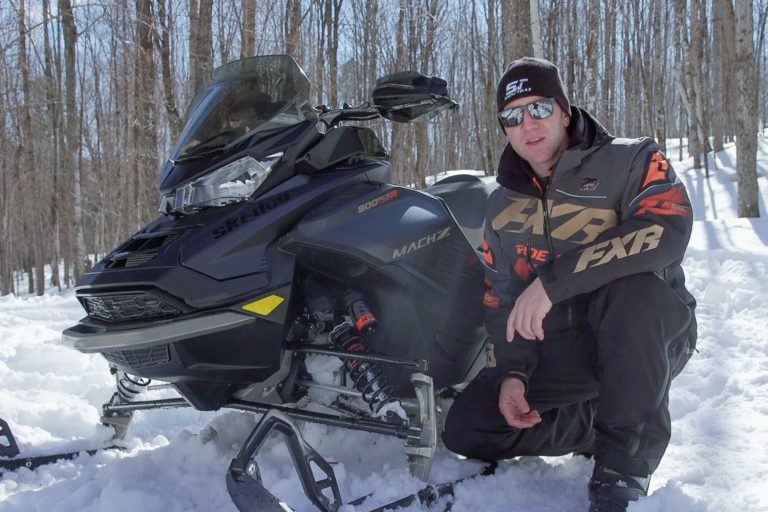
Over a decade ago Ski-Doo came with a mass-produced remote adjustment feature called Air Ride. This system has always used an onboard mini-compressor to alter the air pressure in a bladder inside the rear track shock. The rider adjusts a toggle switch on the left hand side of the handlebars to determine how much pressure is to be built up or released as required.

As pressure is increased, the air suspension becomes more resistant to collapsing. The effect is equivalent to having multiple springs available to soften or firm up the back end of your sled. However, there are no coilover springs surrounding the shock but there are torsion springs at play. Likewise, the air shock can be softened for one rider or less luggage by using the same handlebar toggle control to bleed pressure.

Air Ride is especially effective on touring sleds where an extra passenger may be onboard or significantly heavy luggage or gear is added to the back of the sled. Air Ride does not make a detectable difference to either compression or rebound dampening but it does tend to limit the bounciness of the back end of the sled with dampening features built into the rear shock. The response time with Air Ride is very quick and it is infinitely variable within the parameters the system allows.

Air Ride can be effective on a medium performance trail sled like the Renegade Enduro but is actually more commonly used on 2-up models like the Grand Touring or Expedition.

Remote adjustable shock damping systems like you’d find on the Yamaha SideWinder (iQS) or Arctic Cat Thundercat (ATAC) are a completely different animal compared to Air Ride.

With either the Yamaha or the Arctic Cat systems, the rider can adjust the damping from a control switch on the left side of the handlebars. Since these two remote systems are paired with Fox QS3 shocks, there are three damping settings: Soft, Medium and Firm and the ride difference between those settings is significant.

Not only is the remote feature easy to use but the time response from when the rider presses the toggle to when the damping change actually occurs is a millisecond. The rider can set up for a gnarly corner and – at the last instant – and at any speed, get the rear shock to adjust to a firmer setting, fast.

With iQS and ATAC there is no change to the spring rate of the skidframe’s rear shock (conventional torsion springs are in place). Yes, it can be used to make an extra passenger more comfortable or when adding cargo weight by increasing the damping setting but neither iQS nor ATAC is available on a 2-up sled… yet.

To label one system better than the other is kinda missing the point. The real point, although these two remote-adjust features are fun and functional, is that it all depends on how you want to ride – and what kind of sled you prefer.

If it is damping adjustment you want, it’s ATAC and iQs. If it’s 2-up comfort and hauling, you want Air Ride!

RIDING SKI-DOO’S 2021 MX-Z SPORT 600 EFI

0

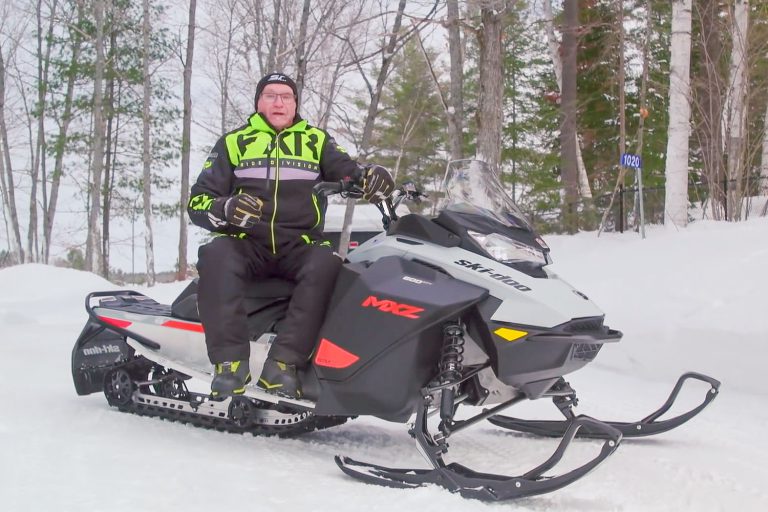
Some performance riders may be inclined to look down their noses at a 600 2-stroke sled that produces 85-hp; but after riding the MX-Z Sport some miles this winter it wouldn’t be us.

Sure, we’ve gotten used to 600 cube sleds that generate 110 or more ponies these days but competition-exceeding power wasn’t Ski-Doo’s intended purpose with this one.

What the engineering department was challenged to do was build a fully equipped snowmobile that could be delivered at an industry-low price. Oh, and one more thing: It had to avoid being boring. That means it needed to have good handling, a decent ride and enough power to hold the rider’s attention.

Did they get it right?

Based on our experience riding it this year, we have to say the 600 EFI Sport package is a homerun!

We honestly had to keep reminding ourselves this sled sells for thousands less than pretty much any other similarly equipped 600. Keep in mind, the Sport is a surprisingly well featured snowmobile. Built on Ski-Doo’s most up-to-date platform, the G4, and loaded with electric start, reverse, EFI, a nice digital display and a 129-inch track with 1.25-inch lugs, this sled pretty much has everything you could ask for.

Sure, we could tell you this is a snowmobile your wife or teenage offspring will love – and they will – but we can’t help but think the hardcore riders with keys to the garage will be sneaking a few rides on this sled this winter, too.

Why? Because this sled is all-out entertaining to ride – especially on trails. Frankly, 85 horsepower is enough to deliver trail satisfaction – even if you’re riding with more powerful sleds.

We were shocked at how snappy this EFI engine was. There are no exhaust valves and it’s really a pretty simple 2-stroke but its throttle response is excellent and it gets out of the hole quick and continues with surprisingly good mid-range power.

Yes, power drops off pretty significantly at about 80-per but you’ll rarely go that fast on any trail (or shouldn’t be) and even on the lakes it won’t lose sight of your riding buddies.

Frankly, we weren’t expecting this much engine performance, but Ski-Doo has fine-tuned this engine and clutched it so it always feels like it’s right in the meat of its power band. The EFI mapping delivers very crisp power, easy starting and… the 600 makes so little smoke we had to keep checking to make sure there was oil in the injector tank.

Yes, we’re raving about it but we also know you’re asking if there’s anything we’d change about the Sport. We’re digging deep here and probably going contrary to Ski-Doo’s conceptualization of what this sled is intended to be but… the SC-5 skidframe would be so much better if it was coupled.

We remember how well this skid worked before the days of rMotion and it was truly at the top of the heap back then. rMotion was an improvement on something that worked more than just adequately in the last couple of years the SC-5 was used in MX-Zs and Rennies.

Maybe there’s a way buyers looking for more plush can raid the parts department and buy coupler blocks for the Sport. Dunno – but it’s about the only thing we can think of to improve what Ski-Doo is delivering at a rock-bottom price.

As it sits, this is an incredible value snowmobile – maybe the best in decades – and we would guarantee those who have been able to find one this year are super smiley-faced.

Snowmobiling in New York: Hamilton County / Adirondacks

0

Matt Lester and his daughter Madeline take an epic father/daughter adventure to Hamilton County in New York State’s beautiful Adirondacks region and highlight all the best spots to visit.

Subscribe to our YouTube Channel!

Marlon Xplore Pro II Truck Deck for Hauling Snowmobiles

0

AJ takes a closer look at the Marlon Xplore Pro II – 7 foot deck with 24-inch clip-on extension on our 2021 GMC Sierra 1500 with EasyLift Air bags.

Subscribe to our YouTube Channel!

2021 Yamaha Mountain Max LE 154 Review

0

AJ climbs to elevation to find some powder so he can showcase Yamaha’s 2021 Mountain Max 154 featuring a mountain single beam suspension, a 154-inch PowerClaw Track, a Fox Zero QS3 shock package and a 794cc 2-stroke engine.

Subscribe to our YouTube Channel!

JetBlue Ice Melter by Tillsonbrands

0

Everybody uses some form of ice melter to deal with the winter climate pretty much anywhere temperatures drop below freezing.

Salt is certainly the most common product for these situations, however there are obvious downfalls to salt including inferior functionality in super low temps, environmental damage and of course, the messy staining to name a few.

We’ve discovered a product that does it all. It’s called JetBlue, manufactured by a company called Tillsonbrands.

JetBlue consists of a coating that’s a blend of polyols, organic salts and bio additives coating non-organic chloride pellets. It tackles ice fast and when sprinkled down, it actually gets started melting faster in temperatures as low as -32 Celsius.

If it’s really icy where you parked you can sprinkle some JetBlue in front of your truck’s tires so you can get a good launch in 4×4 to get your truck and trailer moving once you’re loaded with equipment.

Due to its super-melting properties, you use much less of it and when used properly you don’t damage the surfaces you’re spreading it on.

Sprinkle some in front of your trailer, loading ramp or just about anywhere around the outside of your home to reduce slips and falls.

Keep a convenient shaker in your truck and by the door to your house and you’ll never have to worry.

Visit tillsonbrands.com to find out where you can get yourself some of this superb product.

Why Snowmobilers Need JetBlue Ice Melter

0

AJ explains the benefits of JetBlue Ice Melter; a premium product every snowmobiler needs to have onboard when towing and trailering this winter.

Subscribe to our YouTube Channel!

MIDRANGE TRAIL SLEDS: 2021 POLARIS INDY XCR

0

The big question is this: How much power do you really need?

Sure, a lot of snowmobile shoppers would argue, “If you’re in for a penny, you’re in for a pound”; meaning if you’ve got your wallet out, why go for a 95-130 horsepower sled if you can spend a few more bucks and get a 160-200-hp one?

The hard truth is this – and it’s challenging to get power-hungry buyers to fully understand what we’re proposing here – not everyone wants or most certainly, needs more than the 130-hp ceiling this line-up offers.

Here’s a look at some of the most popular (and largest selling) trail sleds that fall splat into the middle of the power wars.

2021 POLARIS INDY XCR: Two Ways Get It Right!

When it comes to wannabe race sleds for actual trail riders, Polaris approaches the market in two distinctly different ways.

Both of the Polaris XCR models are targeted at the same market, but the company has chosen to offer the longer tracked Switchback XCR in the 137-inch Pro-Ride chassis using external shock technology and the 129-inch version of the XC in the Indy AXYS platform using conventional shock-in-tunnel tech.

We’re not sure why Polaris went this direction in MY 2021, but we tend to think it may have something to do with the intro of the new MATRYX platform this year.

Since either XCR is very, very close to being a competitive ditch warrior suitable for racing, we believe there just wasn’t enough time to get a new MATRYX calibrated to fit the bill of a very exclusive market.

Why continue with the Pro-Ride version in a 137-inch chassis? We think it has a lot to do with the past performance of this sled.

Frankly, The Switchback XCR is a fabulous example of the fine-tuning of an AXYS PRO-RIDE chassis and has proven its performance without any doubt in the past.

I guess the best answer is to ask another question: “Why mess with something that works so doggone good when it’s so likely there will be a completely clean sheet of paper in the next year or two?”

This brings up another interesting observation: If you want to know what the XCR future looks and performs like, borrow a ride on the 2021 Indy XCR 129.

This sled combines a jumbo set of Walker Evans WER compression and rebound adjustable piggybacks with a “race-inspired” Pro-CC coupled skid with rail doublers. There’s also a high performance brake with an external air scoop for cooling the brake pads when you’re running hard in tight areas.

We don’t even need to mention handling. Suffice to say, these two XCRs are at the top of the heap for knifing under your buddies in corners. Flat, predictable and accurate!

Both versions of the XCR use the SDI Liberty 600 Cleanfire and although this engine hasn’t been modified beyond subtle tweaks to the ECU and the clutching, it’s still the same efficient and reliable 2-stroke twin.

We can only guess if Polaris will go all-out in the future and make all XCRs Patriot 650s. We know what we’d do but that doesn’t mean Polaris will risk eliminating itself from some classes of competition. Hmm, I wonder what a 600cc Patriot would perform like?

As it is, Polaris will sell – or already has sold – every XCR it can roll off the assembly lines in Roseau this year. Good on them – and good on the riders who bought one. These two sleds are amazing!

MIDRANGE TRAIL SLEDS: 2021 ARCTIC CAT 6000 LIMITED

0

The big question is this: How much power do you really need?

Sure, a lot of snowmobile shoppers would argue, “If you’re in for a penny, you’re in for a pound”; meaning if you’ve got your wallet out, why go for a 95-130 horsepower sled if you can spend a few more bucks and get a 160-200-hp one?

The hard truth is this – and it’s challenging to get power-hungry buyers to fully understand what we’re proposing here – not everyone wants or most certainly, needs more than the 130-hp ceiling this line-up offers.

Here’s a look at some of the most popular (and largest selling) trail sleds that fall splat into the middle of the power wars.

2021 ARCTIC CAT 6000 LIMITED: Incredible Adjustability!

Cat hasn’t been spending a lot of time or money promoting its snowmobile products these days and the most common question we’re asked is how the company is doing rather than what do we think about this or that model?

This is a shame because Cat has been working hard on its model line-up and has been trimming its selection and keeping prices down across the board.

One of our fave models this year is the 6000 Limited. This sled competes strongly in this midrange class and offers one feature you simply cannot get anywhere else in a 600 – ATAC.

ATAC is Arctic Cat’s acronym for a remote suspension adjustment system that allows you to fine-tune the sled’s shock dampening from the handlebars. This will be its third year in production and it’s an option worth every penny!

Even if you don’t spend extra for ATAC, the Limited still uses QS3 3-position adjustable compression damping shocks – and that’s always a good deal.

As far as the 6000’s 599cc Dual Stage or “slot” injected engine goes, it’s hard to find a better 600-class engine in the marketplace. Remember, this is the engine everyone else had to match a few years ago, and it still runs as strong as any other 600 out there.

Using a roller secondary and excellent clutch calibration, with 600ccs you’re pretty much guaranteed good belt life and solid shifting.

The 6000’s wide-spaced A-arm front end is also a strong point with this model. Cat has been tuning and tweaking this front end in harmony with skid-frame mods the last few years and the result is a very good handling sled that will not disappoint.

Probably the biggest area of improvement could be ergonomics. There have been complaints about the shape of the seat and the grade of foam being used, especially when the rider is seated far forward.

It might also be time to consider a more fully equipped digital gauge package on a high-end sled like the Limited.

Over all, the 6000 Limited is great value, and although its chassis is a bit long-in-the-tooth, Cat has been on a march to steadily improve the ProCross platform and this particular sled is still very competitive in this category.

Trails & Grooming Operations Allowed During Provincial Shutdown

0

Earlier today the Government of Ontario, on the advice of the Chief Medical Officer of Health, advised all Ontarians to stay home as much as possible with trips outside the home limited to necessities such as food, medication, medical appointments, or supporting vulnerable community members. Employers in all industries should make every effort to allow employees to work
from home.

“The number of daily cases continue to rise putting our hospitals and long-term care homes at risk,” said Premier Ford. “We need to stop the spread of this deadly virus. That’s why, on the advice of Dr. Williams and other health experts, we are taking the difficult but necessary decision to shutdown the province and ask people to stay home. Nothing is more important right now than the health and safety of all Ontarians.” (Government of Ontario News Release, December 21, 2020)

Given that physical activity is an important part of staying healthy, today’s announcement by the Government of Ontario stated that “trails servicing snowmobiles will be allowed to remain open.” This means that OFSC trails can open in accordance with all public health guidelines.

Being allowed to remain open allows the OFSC to proceed with trail and grooming operations, however snowmobilers are strongly encouraged to stay home and if they do ride, they need to be mindful of several other important factors related to the pandemic.

* Today’s announcement reinforced “that Ontarians should stay at home as much as possible to minimize transmission of the virus and prevent hospitals from becoming overwhelmed.” This means that during the shutdown, and when trails are in the Orange, Red or Grey Zones, trail riding will be local in keeping with public health restrictions. To facilitate this, the OFSC will implement Flex Trail options for local riding as and where appropriate. Check the Interactive Trail Guide before riding. Flex Trail options include trails within a public health region being available only for local residents.

* As the announcement also said: “Many businesses throughout the province will be faced with restrictions throughout the shutdown, including restaurants and bars, which will once again be limited to only take-out and delivery operations.” This means that snowmobilers may not have normal access to food services along the trails and should plan accordingly, although hotels and motels are permitted to operate.

* It is likely that all unattended buildings and washrooms (including outhouses and warm up shelters) on the trails will be closed with no access to riders. This is because public health measures demand that such structures “are subject to rigorous cleaning and sanitization protocols” which simply cannot be achieved frequently enough by volunteers, and thereby increase the risk of exposure and will likely close.

* OFSC trails connecting to another province (Quebec, Manitoba) or state (Michigan, Minnesota) will remain closed until further notice.

* The OFSC strongly encourages all snowmobilers follow current public health measures and practice our Ride Smart 2021 common sense approach to trail riding, including: Plan Ahead. Be Aware. Mask Up. Clean Often. Spread Out.

Even under these conditions, none of us can let our guard down. Only by continuing to demonstrate our willingness to be responsible riders and volunteers, and to cooperate with public health measures, can we protect each other and communities across Ontario.

The OFSC will continue to monitor the situation and communicate changes and status updates to permit holders regularly through our website, Interactive Trail Guide, Facebook page, weekly newsletter and Go Snowmobiling App alerts.

The Ontario Federation of Snowmobile Clubs (OFSC) is a volunteer led, not for profit association that provides the voice for organized snowmobiling in Ontario. OFSC snowmobile trails managed by 200 community based, member clubs generate up to $3.3 billion in economic activity in the province each year.

For questions or to schedule a media interview with the OFSC, please contact us at marketing@ofsc.on.ca or by phone at 705-739-7669