Home Blog Page 435

Race Ready: Yamaha

The sheets are off the 2006 limited build snocross iron.

It’s no secret Yamaha built and raced a Vector 1000 in Open sno-x across the pond last year. The sled actually showed up on display, not raced – at some end-of-season events in the US and Canada.

There won’t be any Vectors in stock sno-x…yet. However, word has it Yamaha will campaign a Vector in some limited Midwest X-C (remember cross country racing?) events and possibly foray into Semi-Pro Open this season.

ISR Rules are allowing the Vector’s 1000cc 4-stroke engine to compete in Open Class racing against 600cc 2-strokes.

For more info these race sleds pick up the latest issue of Supertrax available on newsstands now!

Race Ready: Arctic Cat

The sheets are off the 2006 limited build snocross iron.

Last season Arctic Cat shocked us with a return to a 13.5-inch wide race sled and, by golly, it’s not changing this year either.

After the breakthrough, floating front arm (Read/Valve last issue) and its miraculous improvement to the reluctant-to-turn Sno-Pro, the often maligned 13.5 wide concept received an injection of credibility in ‘05. Arctic continues to forge ahead with this five-year-old platform, presenting numerous updates for 2006.

The handlebar pole can now be moved through three positions to accommodate rider preferences. Arctic Cat’s inter-linked rear skid shocks are completely separated with the front featuring PSD (position sensitive damping) while the rear offers compression and rebound adjustability.

For more info on these race sleds pick up the latest issue of Supertrax!

United Trailers’ Hefty Hauler

0

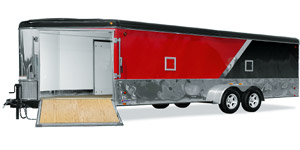
Load up United Trailers’ 27 footer and haul your sleds in style.

At 7 feet wide this hauler feautures tandem axle, side entrance door, standard interior height of 6 feet and vibrant aluminum 2-tone exterior detailing.

Load your sleds through the rear gate and drive out through the front access ramp.

Call United at 1-800-637-2592 for pricing on this unit and many others in their lineup and Visit their website at United-Trailers.com.

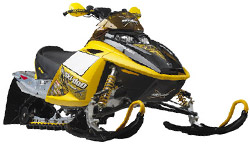
Race Ready: Ski-Doo

The sheets are off the 2006 limited build snocross iron!

When the original racing REV 440 hit the ground in 2003, Ski-Doo virtually wiped out the competition. Dominance was instantaneous, in a way the sport had not witnessed in the past.

Since 2003, Ski-Doo has continued to enjoy success but racers and tuners have been consistent in their concern over one key issue – the holeshot. It seems every year the REV has received improvements, it has incrementally lost its ability to gain the holeshot.

This year BRP’s race department is crowing very confidently they’ve got it nailed. Almost everything they’ve done to the 440 REV is aimed at the first 100 feet of race track. This year Ski-Doo will use a full 1.75 inch lug track instead of the 1.625/1.725 combo.

A nickel plated pipe will gather and maintain pipe heat – important for 440’s running on $10.00 per gallon race fuel. New electronically triggered Mikuni flatslide Power Jet carbs will take their signal from the engine MPEM (ECU).

Interesting news comes in the form of a pipe heat sensor. This is a breakthrough feature for BRP and will allow the MPEM to add and take away ignition timing in response to pipe temperature during a race. This will keep the pipe hot; something the Rotax 440 has struggled with.

For more info on each brands race sled buy the latest issue of Supertrax!

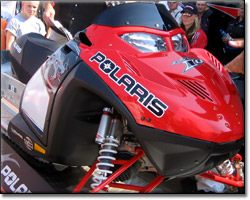
Race Ready: Polaris

The sheets are off the 2006 limited build snocross iron!

It’s no secret Polaris is getting somewhere with the IQ racer. Last year the Polaris racing department had real success in Sno-X competition and it’s largely due to taking a huge risk and introducing a completely new sled.

This year, the purpose-built race chassis and engine is improved even further. For 2006 the limited build IQ 440 will receive new Walker Evans shocks up front featuring piggyback reservoirs. These replace last season’s remote reservoir units.

The front arm track shock is now a Walker Evans air spring – indicative of what will become an industry-wide trend toward air-spring dampers over the next few years.

For more info on Polaris’ race sled get the latest issue of Supertrax on newsstands now!

POLL RESULTS

0

In the last issue of Supertrax, we asked our readers How much horsepower is TOO MUCH horsepower for a snowmobile.

We received a whopping 1,043 votes for this online poll and the results were as follows:

60.12% – No Limit! (627 votes)
21.00% – 175 hp (219 votes)
11.98% – 150 hp (125 votes)
03.84% – 125 hp (40 votes)
03.07% – 100 hp (32 votes)

To participate in our current poll, scroll down to the bottom of this page!

Rotax Powered E-Tec Ski-Doo

Rampant speculation coming from BRP relates to the use of Ski-Doo’s revolutionary E-Tec Direct Injection system currently in use on Evinrude 2-stroke outboards.

E-Tec was recently granted the EPA’s “Clean Air Excellence Award”, the first manufacturer to receive the award for a 2-stroke engine.

We strongly suspect the next generation of Rotax 2-stroke snowmobile engines might employ E-Tec rather than Ski-Doo’s 2006 EPA certified Semi-Direct Injection (SDI) system.

BRP can now rationalize its clean air 2-stroke technologies and standardize the systems used on both snowmobiles and outboard engines which BRP has proven can be cleaner, more efficient and lighter than competing 4-stroke outboards.

We don’t think it’ll be long before you’ll see a Rotax powered E-Tec Ski-Doo.

Snowmobiles Take NEGDS Season Championships

Press Release –

Yamaha came out a big winner in the Northeast Grass Drag Series (NEGDS) season-ending race weekend on October 22-23.

The action was limited to Saturday due to rainy weather on Sunday, but there was plenty of time for three Yamaha snowmobile pilots to post wins and claim class championships at the Gilford, NH event.

Greg Omasta finished on the podium in both Stock 500 and Stock 600 races, but more importantly the strong finishes secured him 2005 NEGDS championships in both classes – the Stock 500 title on his Vector and the Stock 600 title aboard his new Apex.

Making the day even better, Simon Bolduc from Quebec took the Stock 600 race win on another Apex, while Francis Byron earned an Improved Stock 600 series title aboard his SRX with Omasta second.

The purpose-built grass drag facility, operated by the Belknap Snowmobilers for many years, is right alongside the Laconia Municipal Airport and it just about took a runway to rein in Frank Jarocki, who won the Heavy Mod 1000 class on Saturday aboard his RX-1 Turbo.

He did it in impressive style too – setting the fastest trap speed that NEGDS has ever recorded in its 13 years of operation – some 120 mph at the end of the 500-foot track.

Details About Ski-Doo’s ’06 MX-Z 550x Fan

The 2006 Ski-Doo MX-Z 550X Fan will come stock, out of the box, with a host of trick, 440 limited build parts aimed at making the already potent race ready and race legal leaf blower more durable under competition use.

Here’s the goody list:
– Steel braided brake hose
– Internal/external drive sprockets
– Gun drilled jackshaft
– Heavy duty chain tensioner and a one inch
– Full block Camoplast Predator meat to deliver commanding holeshots

Cat’s Sno-Pro Skidframe

Arctic Cat’s unusual floating front arm on the 2005 Sno-Pro racer turned what was otherwise a very poor cornering sled into a very capable railer. Cat’s 128 x 13.5 wide track has had a reputation for being resistant to turning because of its extra length. This length generates excessive side grip, undermining the skis’ ability to lever the sled in turns.

Last season the the Cat crew introduced a radical yet simple piece of engineering allowing the front arm’s upper mounting pivots (inside the tunnel – just behind the drive sprockets) to “float” back and forth more than an inch. When this innovation was unveiled as a handling enhancer, its unique benefits were not fully explained to the press or even to racers.

To make the floating front arm work, the rear arm drop link had to be converted to a fully coupled (rear-to-front) unit using conventional coupling blocks like AC’s trail sleds use. The difference is in how early the coupling moment hits on the Sno-Pro set-up versus the trail sleds.

Here’s what happens. When you squeeze the loud handle on a conventional snow bullet, the sled is driven forward by the tracks rotational forces coming through the front arm and into the tunnel near the footrests. The sled is not driven forward by the rear arm. It’s drop link design compensates for the geometric arc of the front arm to maintain consistent track tension.

All snowmobiles, when turned by the front skis, are pivoting precisely at the front arm of the skidframe. In the case of AC’s longer 128 inch track, there’s a ton of sled that has to be pried around behind the driver.

With AC’s floating front arm, the track and skid actually drive forward in the chassis until the rear coupler blocks lock up at the rear arm before the floating front arm hits its forward limit. This causes the Sno-Pro to “think” it’s pivoting at the rear arm were the power is now entering the chassis (when the coupler blocks contact the drop link). This occurs a considerable distance back from the front arm and provides more leverage to swing the rear of the sled around in tight turns.

This may take more than just one read to understand but as far as we’re concerned, it’s engineering genius.

(Originally published in Supertrax – Volume 17, Number 1)