Home Blog Page 403

What Affects Snowmobile Acceleration

Question:

Hello I’m doing a project on what affects snowmobile acceleration and speed for a grade 10 physics class.

Please help it is due Monday…

Eric

Response:

Eric:

Here are a couple of things to consider – and you’re going to have to dig a bit on this stuff. After all, I don’t have enough time to do your whole project for you.
Acceleration is affected by:

1. Traction: If the sled is at a dead stop and has no motion, the number of lugs and lug depth in the rubber track determines how fast the track can hook up and overcome the (mass) of the static sled to get it moving (inertia).

2. Friction: A thicker track produces more friction, especially as the temperature drops. This type of friction is the extra inertia required to get a thick track to roll around the idler wheels. The colder it is the more the rubber resists bending.

Friction can also be measured in misalignment of the drive parts of the snowmobile. If the track isn’t rolling onto the drive lugs on the driveshaft straight, it will generate friction and that means you’ll need more power to turn the track. This goes for every part of the drive system.
Friction can also be measured by the resistance of the track running over the sliders to lubricate them. If there isn’t enough snow getting on the sliders, the track creates resistance and needs more power to turn it.

3. Power: Since you didn’t determine what type of snowmobile you’re describing, I’ll say this. In any displacement category, a well tuned, properly carbureted engine will produce better power than one that isn’t – a no-brainer.

4. Clutching: This is very complicated and you’re physics teacher probably won’t want to read it but, clutching on a snowmobile has everything to do with acceleration. The rate at which the clutches will shift up ( the primary closes and the secondary opens) will determine how fast the sled can gain speed. Worn parts, misalignment or dirt can cause clutch parts to slip, stick or under-perform. Maintenance and part replacement is always a big consideration here.
Hope this helps and let me know what mark you get.

Kent Lester

Polaris 800 Exhaust Valves Issue

Question:

I have a 2002 Polaris 800 and during my last trip of last season to Canada, my exhaust valves melted to the point that they would not slide out of the cylinder. My friend’s 2002 800 also had the same problem during this trip.

I was able to remove the exhaust Y pipe and bend the valve up enough to remove my valve however my friend’s engine had to be torn down to allow better access to the melted valves.

I just received the replacement valves, springs, diaphragm and gaskets from my local Polaris dealer and I noticed that the valves are notched out on one side.

Can you answer why the exhaust valves melted? Also, why is the replacement valves notched on one side? I would have to guess it is to help dissipate heat!

Thanks,

Greg
Ingleside, IL

Response:

Thanks for your email!

The power valves are not only notched but are now made from stainless steel. The original units were made of aluminum and you are correct – could not withstand heat in the 800 Liberty.

It is imperative you follow the replacement instructions for the installation of the new guillotine slides and in particular the fastening nuts on their stems.

Read and follow the instructions which come with the new valves paying particular attention to the torque spec and proper thread cement use on the stem nuts.

One more thing – and you’ve likely heard this one too many times but repetition is the law of emphasis so here goes – use good oil and clean your exhaust valves regularly. If when you clean the valves at regular intervals (max 2000 miles) you find them heavily gummed up and sluggish or stuck, CHANGE OIL BRANDS!

There are a thousand companies peddling oil promising to deliver clean valves. Some do, some don’t. Be careful.

Motorhead Mark

Supertrax Weighs The Truth

We pulled out our trusty Intercomp scales and hoisted a couple of sleds up just to see how we were doing for 2007.

As is our custom, we made sure these sleds were full of fluids.

The first sled was the Arctic Cat F6 weighing in at 591.5 lbs (wet).

The second sled was the Polaris IQ 600 CFI coming in at 573.5 lbs (wet & studded track). We then subtracted 3216 grams (7 pounds) for the studs in the IQ, giving a final weight of 566.5 lbs.

The result: The Polaris equivalent model for 2007 weighs 25 lbs less that the Cat!

HOLESHOT: CSRA Searchmont Report

0

By: AJ Lester

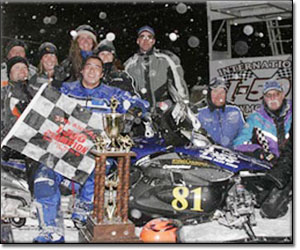
The 2006/07 CSRA Searchmont opener started the season off with great momentum. Almost 500 entries made the pits look full while the snow on the track was deeper than ever.

In Pro Open Mike Island rode his #98 Tim George tuned Polaris to victory showing that he still has what it takes to run up front with the top Canadian Pro drivers.

Following in hot pursuit was promising up and comer Peter Raymer riding his OTSFF sponsored Arctic Cat. Rounding out the top 3 was Joey Sagan aboard his Ski-Doo.

In the stock class it was Mike Vandolder bringing home the checkers on his Ski-Doo with Peter Raymer charging hard in Second.

Island was able to hold onto third place leaving both the Polaris and Arctic Cat trailers in good standing after the first National round.

Although spectator attendance was down, the event went smoothly. A bunch of Michigan riders coming to the Sault race for track time which made for great competition throughout all race classes.

AJ Lester is a full-time Editor and test rider for Supertrax International, North America’s #1 Snowmobile Enthusiast Publication. AJ began racing Sno-X when he was eleven. During his ten year career he amassed multiple National and Regional Championships, scoring a record 26 Semi-Pro National victories in the 2002/2003 season. AJ’s years of experience ensure his often humorous opinions on everything from racing rules to trail sled performance and handling tips are both credible and insightful.

Canadian Powersports Dealers Form United Front

Press Release –

A landmark event in the history of the Canadian Powersports industry took place Monday December 11th, as dealers, industry speakers and a host of association sponsors from across Canada as well as the Executive Director from the New York State Powersports Dealers’ Association met to develop an ambitious plan in support of Canada’s independent powersports dealers.

One of the highlights of the morning session was a presentation given by Tim Stover of the manufacturer backed Motorcycle and Moped Industry Council. Stover discussed various land use and lobbying efforts that the MMIC focuses on that help maintain a positive public image for the powersports industry and powersports dealers nationwide. This was the first time that the MMIC and CPSDA had worked together in such an effort which promises to help build manufacturer and dealer relations down the road.

Other key industry lobbyist speakers included Sandy Currie from the Canadian Marine Manufacturer’s Association (CMMA) who provided perspective on Manitoba Senator Mira Spivak’s controversial Bill S-209 which has been threatening the personal watercraft and Canadian boating industry since 1999.

Currie explained that due to recent health concerns, the Senator has withdrawn the bill from the legislature agenda. Currie also expressed a strong desire to work with the CPSDA membership to acquire data for a comprehensive marine industry study the CMMA is working on.

During the afternoon dealer-only closed door session, considerable discussion was focused on how dealers could solidify investment in their dealerships by working together with OEM suppliers to forge a set of provincial franchise laws.

“We firmly believe that our industry has regressed in recent months in terms of being able to offer the quality of buying experience consumers are coming to expect. Both the OEMs and the dealers agree that dealerships need to undergo a merchandising modernization process much like in the auto industry but to forge ahead we need a solid foundation first before millions of dollars get invested in new storefronts” expressed CEEDA President and CEO Bev Leavitt.

CPSDA attorney Mark McMackin further explained that recent versions of OEM dealer agreements have shown a trend toward an increasing imbalance in favour of the OEM.

“Until we can hammer out a set of guidelines that both OEM suppliers and dealers are comfortable operating within, dealer morale will continue to erode. Frankly, dealers of all brands are quite deflated by the dealer termination notices that have been issued by Honda Canada nationwide last July because it really means that the two thirds of all powersports business owners that are predicted to retire (according to a recent report from the Business Development Bank of Canada) within the next 10 years have had their hard earned goodwill swept out from under their feet” explained McMackin.

In a passionate presentation made by New York State Powersports Dealers’ Association Executive Director Bob Ski, it became evident that although it is critical that a province or state have a set of franchise laws in place to govern an industry, it is another thing to have rules respected and enforced.

Interesting comparisons between the Ontario and New York State powersports markets were also discussed which revealed that amongst the 18.95 million people in New York State there are only 238 authorized powersports dealers whereas in Ontario, 12.49 million people are service by 304 dealers. That’s a ratio of 1 powersports dealer for every 79,621 people in New York State compared to one dealer for every 41,085 people in Ontario” commented CPSDA President and CEEDA board member Stephen Bieda.

CPSDA and NYPSDA representatives also discussed the merits of incorporating a “code of ethics” into the membership criteria for all North America powersports dealerships which would prohibit powersports dealers’ association members from selling beyond State/Provincial or National boundaries to further enhance the existing clauses in many powersports OEM dealer agreements.

The primary purpose of the event was to rally dealers from across Canada in support of the effort to strengthen relations between dealers and OEM suppliers and to enhance communications amongst a fragmented network of Canadian powersports dealers.

Limited Build Predictions from Supertrax Staffers

Here’s what we think the sled makers might release before the end of this season:

Ski-Doo:

Look for a limited-build (one per dealer) REV II wearing Renegade clothes and powered by the new-last -year 800R PowerTek engine.

If this new Gen II REV is lighter than its predecessor, Ski-Doo could release an X-package 121 incher to more clearly make its point.

Polaris:

We think Polaris wants to shore up credibility and sales in the popular flat land, deep snow marketplace. This means they need a 136 inch IQ to compete with Ski-Doo’s Renegade chassis, Arctic’s CrossFire platform and the 4-stroke Rage and Attak from Yamaha.

If we were betting folks – and you know, we’re not – we think a 600 IQ CFI with a 136 inch IQ (not mountain) skid makes a lot of sense.

It would also be easier for Polaris to drop such a model as a limited build this season, as it doesn’t compete with other Polaris models now in showrooms, except for maybe the Switchback.

Arctic Cat:

While we think it’s unlikely AC will debut any consumer oriented limited builds this season we do expect Thief River falls will show off an F-based Open Mod sno-X racer before the end of the season.

This new “F- Sno-Pro” will foreshadow next year’s racing Sno Pro expected to be powered by a 600cc engine as the sport moves away from 440 stock engines in 2008.

Yamaha:

The highly sensitive Supertrax RADAR has picked up some unusual (for Yamaha) signals indicating something limited is in the works for this winter. Yamaha has not been in the habit of releasing early-builds so this info is potentially earth shattering.

While no details are available at this writing, January’s Sneak Peek event may see the intro of an SE variant of a popular Yamaha. How about a signature series Robbie Malinoski Nytro or Phazer?

Ski-Doo’s New EXO Series Lids

0

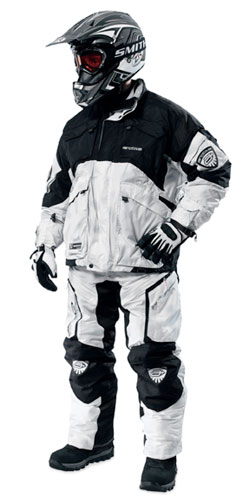
Ski-Doo’s hot, new, Snell M2005 and D.O.T. approved and wind tunnel tested EXO series helmets are a must-have this winter.

Optically corrected shield with anti-scratch, moisture wicking, breathable removable liner and cheek pad, adjustable vent system and rear spoiler combine to make this the ultimate brain bucket.

Visit your local Ski-Doo dealer and click the banner at the left side of this page for more information.

4-Stroke EFI Basics for Snowmobiles: Part 4

0

Regulating Fuel Flow

By: Kent Lester

It just makes sense that if you have thousands of computations taking place every second and mechanical “squirt guns” (injectors) to get the fuel into the cylinders, there could be a problem with fuel delivery.

This challenge is handled by using extremely high pressure in the fuel system and very sophisticated injector nozzles to open and close at the same rapid level the ECU is calculating.

For this reason, electronic fuel injection systems use a very powerful pump, usually located inside the gas tank, to get the pressure high enough in the fuel rail for the nozzle to respond as quickly as possible.

The fuel rail is merely a distribution reservoir for gasoline where the highly pressurized fuel can be ready for instantaneous delivery to the nozzles.

EFI throttle bodies are located the same place a carburetor would be situated and from the outside actually look pretty similar. There’s one massive difference between a carburetor and a throttle body. No fuel flows through an EFI throttle body – only air.

Air flow is regulated by a flapper style butterfly valve monitored by the throttle position sensor (TPS). Gasoline is introduced to the cylinders via the injectors only and, in port style injection systems, the most common type with snowmobiles, the injector nozzles are located between the throttle body and the engine, either on the intake manifold or the cylinder head.

The idea is to get the nozzles as close to the intake valves as possible.

SNOWPOD: Thanks for The Memories

0

A letter to CJ Ramstad:

I just wanted to take a quick minute to let you know how much I enjoy Snowpod.com – especially the past week. I was in the third grade (1967 model year) when my Dad, who was a John Deere dealer in Jerome, ID, picked up an AMF/Ski-Daddler franchise.

By the time the Ski-Daddlers faded from existence, we were hearing rumors of John Deere getting into the biz.Jerome Implement was also a Harley dealer, but we chose to not get involved in the AMF/Harley Davidson snowmobile product.

The ’72 model John Deere 400 & 500 were not very exciting and I continued to ride my 1971 Ski-Daddler Mark XX. It was an awesome little sled with an Arctic slide frame, a 15″ wide steel cleated track, and a strong running, high revving, Hirth 340, axial fan cooled engine.

The ’73 JDX8 was OK but the short plastic track did not go very well in our western snow. In ’74 I was a sophmore in high school and I got one of the 295/S’. I literally kicked butt that winter so my Dad backed me the next year on a Winnepeg to St. Paul entry on a ’75 340/S.

I do not recall the exact number of entries that year, but 376 is the number that comes to mind. Only 22 finished. I was one of the 300+ that did not finish, but it was a once in a life time expereince to be there.

The 340/S photos brought back a flood of memories. I know it is a very busy time of year for you. but I wondered if you could take a quick look at your archives and see if you have any phots of #21 in the ’75 Winnepeg to St. Paul race.

Sincerely,

Ron Bentzinger
Snowmobile Product Manager
Western Power Sports

Visit www.snowpod.com to find a new snowmobile photo every day from the archives of snowmobile legend CJ Ramstad

More Radical Intros On The Way From Yamaha?

With all four OEMs setting their dates for Sneak Peek previews of 2008 models, we suspect the sizzle factor will be strong in every camp.

Yamaha made it clear over a year ago it will stay on the cutting edge and we expect yet another radical intro.

It seems obvious that the popular Vector might be due for a massage; under its traditional sit-down ergonomics lies the original RX-1 platform.

The Apex, debuted in 2006, uses a variant of the RX-1 chassis to deliver superb rider forward ergos and huge improvements in both ride and handling.

We suspect the Vector will debut a more rider forward profile and add increased 4-stroke sophistication to its already bulletproof, super-efficient 1000cc triple.