Home Blog Page 315

No Ice is Safe…Despite What They May Say!

Press Release –

“They say the ice is safe.” That’s the mysterious rumour often circulated at this time of year among the outdoor fraternity; no one knows who “they” are or where their misinformation started. But in the early weeks of every winter, a few outdoor enthusiasts take it as gospel and have close calls or pay with their lives, as occurred this past weekend in central Ontario. Consequently, the Ontario Federation of Snowmobile Clubs (OFSC) reminds everyone yet again that no ice can be considered 100% safe for travel by any motorized recreational vehicles or trucks, especially at this time of year.

To avoid ice risks, the OFSC recommends that snowmobilers ride open, land-based, OFSC trails whenever possible. OFSC clubs provide many trails that avoid water crossings altogether and also provide many bridges and culverts to pass over known water safely.

If you do make the personal choice to travel on ice by snowmobile, wait until a marked stake line is in place and cross only when you can follow it from shore to shore, without stopping on the ice. While ice crossing is never a sure thing, snowmobilers can also reduce their risk by:

• Never travelling on ice because “they” say it is safe.
• Understanding that ice conditions may vary from day to day, from hour to hour and from place to place.
• Checking ice thickness before riding onto any frozen water. At least 15 centimetres (6 inches) of clear, hard ice is needed to support one snowmobile.
• Never travelling on ice alone, at night or after consuming alcohol.
• Avoiding slushy ice, untracked ice, or ice near moving water.
• Staying off ice early or late in the season or after any sudden and pronounced melt, thaw or rain.
• Wearing a buoyant snowmobile suit and carrying ice picks.

Remember, you always enter ice at your own risk; neither the OFSC nor its member clubs accept any responsibility or liability for ice crossings or variations in ice conditions.
Snowmobilers Invest $2.4 M into Winter Tourism

Press Release –

The Ontario Federation of Snowmobiling Clubs is making a $2.4 million winter tourism investment by strengthening its provincial grooming fleet. Through its Industrial Groomer Program, this OFSC investment from permit sales revenues is for 22 capital equipment projects. They will significantly improve the snowmobile trails that generate $1.2 billion in economic activity for the province each winter.

The placement of new or upgraded grooming equipment in many key areas of the province will enhance the capability of local snowmobile clubs to resurface their trails more consistently and effectively. The average cost of a new groomer unit runs from $190,000 to $225,000, depending on make and options.

“Our goal is to get as many of these units on the snow as possible this winter, while the rest will be available for the 2011 season,” commented Mike Farr, OFSC trails programs manager. “Snowmobilers should be pleased to see their permit dollars at work in this very tangible way.”

For the 2010 season, OFSC clubs are operating 339 pieces of heavy industrial equipment presently valued at over $22 million. Last winter, OFSC clubs groomed 102,394 hours and purchased 1.2 million litres of fuel for their grooming operations. The annual cost per kilometre to operate the OFSC’s almost 40,000 kilometres of snowmobile trails is estimated at $496 or about $20 million for the entire provincial system.

This recent $2.4 million OFSC groomer investment complements the previously announced $4.1 million funding made possible by Canada’s Economic Action Plan for trail infrastructure improvements that the OFSC and its clubs are currently utilizing to enhance winter tourism in Ontario.

The Ontario Federation of Snowmobile Clubs is non-profit organization dedicated to providing strong leadership and support to member clubs and volunteers, to establishing and maintaining quality snowmobile trails which are used in a safe and environmentally responsible manner, and to furthering the enjoyment of organized snowmobiling.

TEAM ARCTIC CRUSHES GRAFTON CROSS-COUNTRY

Press Release –

Cory Davis Sweeps Pro; Sno Pro 500 Undefeated in Debut

By the looks of it, 2010 will be a mighty fine year for Team Arctic. At the first USCC cross-country race of the season in Grafton, ND, Team Arctic delivered one of the most stunning performances of the past decade, winning 11 of 15 classes, including Cory Davis sweep of the Pro classes.

A winner at the USCC race in Munising, Mich., last season, Davis once again took advantage of a break in the National snocross season to focus on his family’s forte: cross-country. The result was the perfect blend of speed and conditioning, with Davis putting time into his rivals on each of the four laps of the Pro 600 class for a clear victory.

Davis’s Team Arctic/Christian Bros. Racing teammates Ryan Simons, D.J. Ekre and Brian Dick slotted into third, fourth and sixth. Add the strong rides by Chad Lian and Brian Carey, and Team Arctic notched six of the top-10.

“In 20 years of watching Team Arctic cross-country success, this ranks as one of the all-time great performances,” said Mike Kloety, Race Manager. “Better yet, Grafton was also the debut of our Sno Pro 500, which proved even better than we expected.”

How successful was the new Sno Pro 500 in its first cross-country? Bryce Buchanan led a Team Arctic sweep of the top-nine in Expert 85; Chris Klie led a top-14 sweep of Sport 85 and C.J. VandePutte led a top-8 sweep of Jr. 14-17, all aboard Sno Pro 500s. Just as impressive, Buchanan and second-place finisher Dave Dirkman clocked times aboard their Sno Pro 500s that would have won the Semi Pro 600 class!

“The Sno Pro 500 has transformed the 85-hp classes this year,” said Pat Mach, Race Director for USCC. “The sleds are easy to race for all abilities and are manageable, which brought new racers to the circuit and helped make our largest-ever event.”

“Even better, there were 10 guys in the Sport 85 class that finished within one minute of fourth place. The racing was so close and enjoyable that most of these guys laughed and shared stories with each other post-race. That’s what cross-country is all about.”

While Team Arctic cross-country racers were crushing the Grafton course, the snocross contingent delivered a nine-win weekend at the ISOC Regional race at ERX Motorpark in Elk River, Minn. Factory Arctic Cat racers Dan Ebert and Cody Thomsen won a Pro class each; Andrew Carlson took Semi Pro Open, Britt Anderson won Sport Women and Tyler Riewer won Sport Stock, putting Arctic Cat on top of all race categories.

IS THERE A NEW YAMAHA GENESIS?

0

After riding the “mystery Yamaha” last week, the Supertrax crew has been trying to guesstimate what’s under the hood. Our imaginations have been running wild and one thing we can’t overlook is the uncanny smoothness of what we think is a new 4-cylinder snowmobile engine in that particular sled.

Our guessing goes over to the GP road race Yamaha ridden by world champion Valentino Rossi. His GP bike uses a unique engine built by Yamaha called the “Cross-Plane”. Huh? Never heard of it? Kevin Ash of ashonbikes.com explains it this way:

“A conventional four-cylinder engine has its crankpins all in the same plane – a flat-plane crank – with the two inner ones 180 degrees from the two outer ones. The inner two pistons move up and down together, and so do the two outer ones, and it’s this particular configuration that generates inertial torque. This is independent of the main torque output generated by the combustion and cylinder pressure and happens entirely because of the crank layout.

On a flat-plane engine (like the Apex Genesis), the pistons are traveling at high speed when they’re half way along their cylinders, and at this point they have a lot of kinetic energy. Yet 90 degrees of crankshaft rotation later, all four pistons are stationary, two at the top, two at the bottom. Their kinetic energy has been transferred to the crankshaft, which was responsible for slowing the pistons down. Another 90 degrees on and the pistons are back up to maximum speed, accelerated by the crank which has returned some energy to them and in turn, it’s slowed down again.

On Yamaha’s cross-plane crankshaft, these fluctuations are all but eliminated. In this layout the crankpins are distributed at 90 degrees to each other around the crankshaft (in two planes which form a cross when viewed on end). So as one piston is slowing down and losing energy to the crank, another is speeding up and taking the same amount back. At no point do all the pistons stop together, as they do on a flat-plane crank. Instead the energy flow is evened out and the rotation of the crank is much smoother.”

First Impression: Something Very New From Yamaha

0

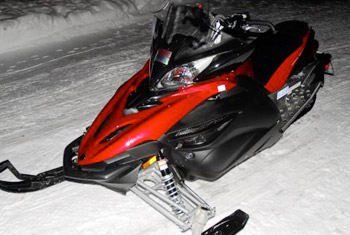
Here’s the deal. We’re sworn to secrecy… sort of. Actually, we can tell you we rode a completely new Yamaha over the Christmas break but as of this writing we cannot publish any pictures or disclose technical details… yeah right, if we had any.

The reason: We didn’t really see it – even though we rode it and the staff present for our 140 mile tour patently refused to answer any specific questions about it, beyond verifying it was painted red.

Of course those who follow Yamaha’s product carefully will no doubt be able to fill in some blanks, just as we did. While we came away impressed and have pretty solid hunches we know what’s going on here, nothing is etched in stone because the Yamaha brain-trust will simply deny this ever happened.

Our impressions are pretty significant after a minus 15C all-day pull to Whitney, Ontario on some of the sweetest, freshly groomed, table-top smooth trails we’ve seen in years.

The sled steers easier and offers more intuitive feedback through the handlebars than any snowmobile, particularly any Yamaha, we’ve ridden to date.

Inside ski-lift, something Yamahas have struggled with, is markedly decreased and we suspect what looked like a new ski profile combined with the aforementioned light and responsive steering feel are reducing this unwanted trait in a pretty dramatic way.

The sled lays down power in the typical Yamaha 4-stroke linear way but there’s something different here.

The engine is buttery… no, velvety smooth beyond any 4-stroke engine we’ve plied to date. How many holes does it have? Dunno for sure, but we think maybe four.

Rider ergonomics are much improved with a taller, more upright rider-forward seating perch that immediately improved comfort and control allowing the pilot to easily perform gymnastics in twisties or make sitting-to-standing transitions through trail junk.

Ride quality is consistent with what Yamaha has become legendary for – exceptional. That’s because the monoshock skid looks pretty much the same as what we’ve come to know and love here at Supertrax.

Trail trash, craters, and jigglers are erased completely with this set-up. We also felt traction – particularly when exiting turns or pulling away from rest was better than any previous 121-inch Yamaha. Hmm, wonder why?

We’ll have more on this new Yamaha later this month – including some pics we were allowed to take but had to surrender when the Yama-staffers demanded a body cavity search after the ride.

Thankfully, after they found them they didn’t want to keep them. We will put them up for your viewing pleasure soon.

Yes, most definitely, stay tuned.

CAT BLASTS BREW CITY WITH FOUR WINS

Press Release –

Victory in Three Classes at ISOC’s Milwaukee Mile National

Round two of the ISOC National Snocross season brought Team Arctic to the famed Milwaukee Mile and a crowd estimated at 15,000.

The team responded with historic wins of their own, taking Pro classes, Semi Pro Stock and Jr. 14-15, as well as top finishes in all classes.

“Team Arctic has a long and storied tradition at the Milwaukee Mile, going all the way back to Dave Thompson’s historic oval win in 1973,” said Mike Kloety, Team Arctic Race Manager. “To return here and win four classes was a highlight for our team and our fans.”

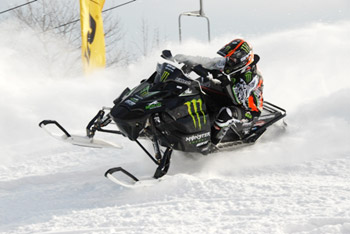
Team Arctic/Monster Energy phenom Tucker Hibbert continued his unbeaten march in the Pro classes, thrilling race fans with come-from-behind wins and his nearly flawless combination of speed and talent. The victories marked career wins #49 and #50 for Hibbert.

As was the case the week prior at Duluth, Team Arctic/Christian Bros. Racing stalwart Garth Kaufman shrugged off a poor start in the Pro Stock final, picked off racers on every lap and put himself into third place with the most exciting run of the weekend.

For the first time in his young career, Team Arctic/Christian Bros. Racing’s Logan Christian scored victory in the Semi Pro class, winning the Stock #2 final after a tough battle with Factory Team Arctic’s Cody Thomsen and Kyle Pallin.

Christian also took third in the Semi Pro Open which, combined with his finishes the week prior, put him and Thomsen on a path towards the season point championships. Likewise, Pallin’s second place in both Semi Pro Stock classes underscores his consistency, and the strong likelihood he’ll stand atop the podium yet this season.

“We’re two races into the season and already we’re in a great position for our championship hopes in Pro, Semi Pro and the Sport classes,” said Kloety. “Our Sno Pro 600 is practically bulletproof, our racers are on top and we head into the holiday break with no significant injuries.”

The next race in the ISOC National Snocross Series is Jan. 8-9 in Sandy, Utah. Go to www.isocracing.com for more information.

MBRP Header Gives the MXZ 1200 Real Blast

0

Press Release –

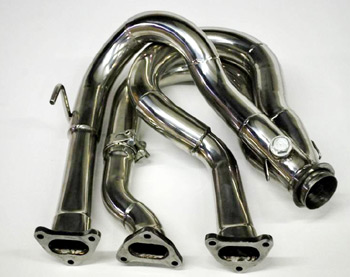
MBRP’s new premium headers for the MXZ 1200 4 Tech will put you to the head of the pack.

With heavy wall T-304 tubing you can count on greater durability as well as exceptional heat retention.

Mandrel bent tubing, a perfectly smooth transition via a 3 into 1 collector and a unique step-header configuration guarantees more power when you want it. There’s even a bung to accommodate a wide band air fuel ratio gauge.

These headers fit to the stock muffler to maintain stock decibel levels or team it up with an MBRP silencer for serious weight savings plus big power.

Find out more about MBRP’s performance exhaust products and off road accessories at www.mbrp.com or call toll free at (888) 636-7223.

HIGH FIVE FOR TEAM ARCTIC AT SPIRIT NATIONAL

Press Release –

Five Wins and a Clean Sweep of Season Opener

Despite postponing the Spirit National ISOC Snocross race two weeks, the inevitable happened: Team Arctic racers collected the most wins in the biggest classes, including both Pro finals and two-of-three in Semi Pro. In other words, it’s going to be another long and disappointing season for the competition.

“Of the 10 classes comprising Sport to Pro, Team Arctic won five,” said Mike Kloety, Race Team Manager. “I’d call that a dominating performance. And I’d credit the preparation and hard work of our teams coupled with the performance and durability of our Sno Pro 600 race sled.”

Tucker Hibbert’s reign over the Pro class continued as the Arctic Cat/Monster racer won every heat and final in both Stock and Open with his customary combination of speed, control and sled preparation.

Hibbert’s strongest challenge came from Team Arctic’s Dan Ebert, who took the holeshot and led the Pro Stock final for six of the 20 laps before settling for second ahead of Christian Bros. Racing’s (CBR) Garth Kaufman, also on an Arctic Cat.

Matching Hibbert’s outstanding performance was Factory Team Arctic racer and first-year Semi Pro, Cody Thomsen, who swept the Open and Stock #2 finals en route to an undefeated weekend (Note: ISOC allows Semi Pro racers to enter two of three classes: Open, Stock #1 or Stock #2).

Logan Christian of the CBR team showed strong speed and conditioning to move within striking distance of Thomsen in the Open final, setting up what will likely be a season-long battle between them.

Add to the mix Thomsen’s new teammate, Kyle Pallin, who took second in Stock #1 (and appeared one additional lap away from winning), and looks poised for a heavy haul of hardware.

As if winning four of the top-five classes weren’t enough, Team Arctic/Sportech racer Andrew Carlson’s victory in Sport Stock #2 and third in Stock #1 proved two things: He’s the guy to beat for the class championship; and the Sno Pro 600 is a winner in every class.

“This is our third year with the Sno Pro 600,” said Kloety. “We’ve optimized the power, handling and durability to the point that it’s a turn-key winner. Add to the mix the on-track clutching support of Speedwerx, plus the knowledge and dedication of our teams’ crews, and the result is a top-to-bottom sweep like we saw at Duluth.”

The next race in the ISOC National Snocross Series is Dec. 18-19 at the Milwaukee Mile in Milwaukee, Wis. Go to www.isocracing.com for more information.

Byers Motorsports Team Update From Searchmont

Press Release –

This past weekend the Supertrax / Steadymate / Byers Motorsports Team travelled to CSRA season opener in Sault Ste Marie, Ontario. The race was originally scheduled for Dec 4-6 but was rescheduled due to the lack of snow, which this weekend there was no lack of snow.

The team unveiled its Retro ’79 RXL decaled (by Creechers Design) IQ’s for Fridays practice although it did not start until 3pm due to a heavy snowfall creating little visibility on the track.

Kyle Byers #109 had a great weekend racing in the Sport 600 class consisting of 39 racers. Kyle knew that he needed strong consistent finishes in his motos to make the final.

He got pinched out off the start in moto 1 putting him near the back of the pack into the first corner but battled back to finish 4th. In moto 2, Kyle’s Polaris IQ race sled hooked up and put him to the front and he held his place for 2nd. “There are a lot of good riders in the class and the hole-shot is going to be key in the final to get up front” said Kyle before the final. He did exactly what he had planned on doing and got himself into the top 5. On lap 3, Kyle squared up in a corner and got T-Boned by another rider and finished 8th.

#219, Jamie Byers’ weekend started off with the mod sleds in Semi-Pro Open. The day started off rough, as, in moto 1 Jamie got tangled up with another rider while in 3rd place and finished 7th. Moto 2, Jamie finished 3rd.

Starting in the front row for the final, Jamie didn’t get the best initial start but pulled the sled to the inside of the track and found a good line up the hill. The sled gained traction and pulled him into the Top 5 coming out of the first corner.

Jamie rode hard and led for 2 laps before falling back and had a come-off in the rhythm section at the bottom of the hill with the white flag flying finishing up 12th.

Sunday was the stock class for Jamie and had 29 riders competing for the 15 position final. He had a bad start and had to battle his way from the back of the pack to finish up 2nd in moto 1. “I would have liked to get a better start but I had a lot of fun picking the good lines and working my way through the pack” said Jamie after the race.

In moto 2, Jamie blew a corner finished up 9th. Placing 9th in moto 2 put Jamie to a back-row start for the final. His Polaris IQ and Woody’s traction products hooked up and he dove to the inside of the track once again getting him to the front. He had a strong race and picked the right lines giving him a Top 5 finish for 5th.

The Teams next stop is this weekend in Gaylord, Michigan for the Can-Am Challenge.

LATEST ISSUE OF SUPERTRAX

0

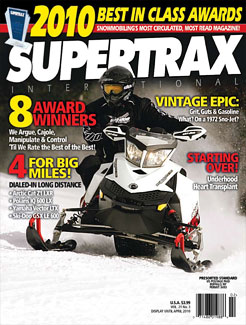
The latest issue of SUPERTRAX is landing on newsstands and in mailboxes nationwide!

Volume 21, Number 3 features the 2010 Supertrax Best In Class Awards. The Lester brothers are at it again, telling it like it is and holding nothing back. Read their opinions and whether you agree or not, you’ll be entertained by their arguments.

Plus, our resurrection project Indy 500 gets a new heart from the team at CVTech. Seriously, this engine is like brand new again!

Kent also regales us with a colorful account of Waconia from the saddle of a borrowed ’72 Sno-Jet.

We also compare 4 sleds that can tackle the biggest miles. Z1 LXR, IQ 600 LX, Vector LTX and GSX LE 600.

Now you can get 3 seasons of Supertrax (12 issues) for only $22.99!

Subscribe online safely and securely now!