Home Blog Page 139

2018 LYNX SNOWMOBILES

BRP (TSX:DOO) unveiled its 2018 Lynx lineup today in front of hundreds of its dealers and invited guests. The 2018 Lynx snowmobile lineup is the 50th model year created by Lynx and is introducing the new Radien platform, the next generation of Rotax 850 E-TEC engine and the ultra-lightweight E-TEC engine starting system, SHOT.

The new Lynx Radien platform will be introduced on the 2018 Lynx BoonDocker, Xtrim RE and Rave RE models. The new models are lighter, more agile and include new innovations, such as the short Radien DS tunnel system on the Lynx BoonDocker DS model.

“The new design is most prominent in the completely redesigned Lynx BoonDocker DS model. It looks radical, but most importantly it greatly combines power, stability and agility”, says Valto Ristimella, Commercial Director, BRP Scandinavia.

The models offered with the new Radien platform are powered by the Rotax 850 E-TEC 2- stroke engine. It unleashes 165 horsepower and riders will also appreciate its 30% quicker response, which instantly delivers the power. This new powerplant provides one of the best power-to-weight ratio in the industry. Still, snowmobiles maintain impressive fuel and oil economy equal to the Rotax 800R E-TEC engine.

“Once again, we challenged ourselves to re-think a snowmobile from a blank sheet of paper by designing it around the riders to give them the best experience on snow,” said Steve Pelletier, Vice-President and Regional General Manager, Europe, Middle East and Africa (EMEA). “The new Rotax 850 E-TEC engine is one of the most sophisticated 2-stroke in the world, delivering an impressive combination of power, responsiveness, fuel and oil economy, and this, with a lightweight, unique and durable package. With the handling characteristics, ergonomics and Lynx’s trademark robustness, I am confident that these new vehicles will provide a remarkable consumer experience.”

SHOT is an ultra-lightweight E-TEC engine starting system which introduces ultracapacitor technology to the industry. This system provides an electrical charge with no battery, starter motor or ring gear to start the engine.

The system will be most appreciated by deep snow riders who want to conserve energy by no longer pull-starting their sleds. It also saves weight, as SHOT adds only 900 grams.

“With SHOT, we are once again bringing to the market an industry- first invention created by our engineering teams. I’m convinced it will become a benchmark in the snowmobiling industry,” said Pelletier.

To celebrate the 50th anniversary, a special model, the Lynx Commander 5900 snowmobile, and a clothing collection have been specifically designed. “We are thankful to the many generations of loyal Lynx customers and invite them to celebrate this great milestone with us using the tag #lynx50. We will also tell the Lynx story in a special video series that will be revealed this year”, concludes Valto Ristimella.

BRP (TSX:DOO) is a global leader in the design, development, manufacturing, distribution and marketing of powersports vehicles and propulsion systems. Its portfolio includes Ski-Doo and Lynx snowmobiles, Sea-Doo watercraft, Can-Am all-terrain and side-by- side vehicles, Can-Am Spyder roadsters, Evinrude and Rotax marine propulsion systems as well as Rotax engines for karts, motorcycles and recreational aircraft. BRP supports its line of products with a dedicated parts, accessories and clothing business. With annual sales of over CA$3.8 billion from over 100 countries, the Company employs approximately 7,900 people worldwide.

brp.com

SnowTrax Television 2017 – Episode 13 Preview

0

Our pick for 2017’s Real World Sled of the Year will be unveiled in a final showdown between Polaris, Ski-Doo, Arctic Cat and Yamaha. Will Polaris reclaim the throne for a third straight year?

Then, AJ presents the winner of the 2017 Revolutionary Advanced Design Award to the technology that pushed the industry forward the most.

And in the final edition of Test Ride for the season, Mark Lester zooms over the frozen lake on a 2017 Yamaha Sidewinder R-TX SE.

All this and more in the final episode of the 2017 Season of SnowTrax Television!

2018 ARCTIC CAT NORSEMAN 6000

0

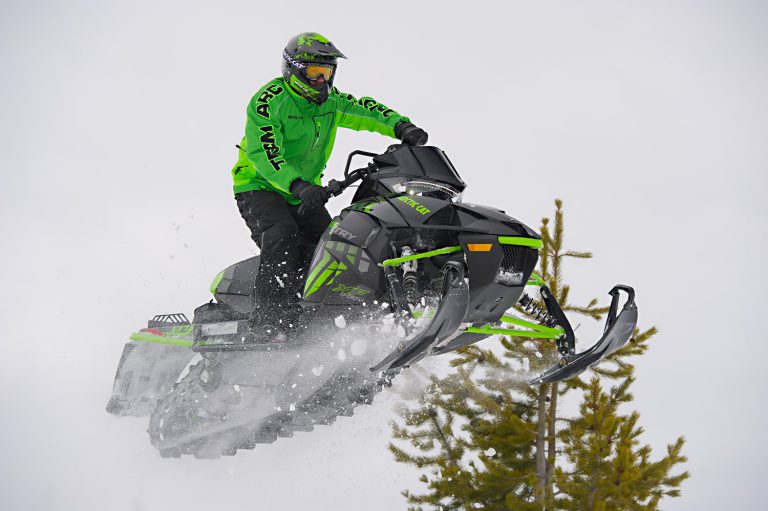
Arctic Cat has taken a different line of attack than the Polaris Titan and offers a new line of sleds, slightly smaller than the steadfast Bearcat, called Norseman.

The Norseman is intended to bridge the gap for riders who occasionally need utility function from their sled but also want to have fun off-trail on a regular basis.

Offered in two versions, the 3000 Norseman, powered by a Kymco EFI 4-stroke twin and the Norseman 6000, using Cat’s slot-injected 600 2-stroke twin with TEAM primary (600 only) and secondary clutches, are both built on the ProCross chassis with Cat’s latest and very svelte quick-remove bodywork.

The Norseman doesn’t use a dual range tranny – leaving that technology to the more utility-driven (and heavier) Bearcat.

The 6000 does, however have a fully articulated 154-inch Cobra track, 15-inches wide with 1.6-inch lugs. Considering the sled’s lightness this track length and track type provide incredible floatation in powder and serious bite when hauling or towing stuff.

We were impressed with the 600’s agile trail manners and its ability to go almost anywhere in powder. The CTEC2 600 is a great engine and really all you need but we fully expect Cat to respond with its new 800 DSI in the near future to compete for showroom props against the Polaris Titans and Ski-Doo’s Expedition Extreme.

As it is, this overachiever will give you everything you need both as a workhorse and a powder sled.

BRP REMOTE COUPLING BLOCK ADJUSTER

0

BRP introduces a new Remote Coupling Block Adjuster to give riders on the fly adjustment of their snowmobile’s handling.

The system allows Ski-Doo snowmobiles equipped with the rMotion rear suspension to be quickly and easily changed back and forth between uncoupled and coupled settings without getting off the machine – just twist the handlebar grip mounted switch – even while moving.

The benefits of being able to switch coupling of the rear suspension is the change in snowmobile handling: a coupled setting doesn’t allow as much rear weight transfer, which keeps the skis planted for more positive steering, while uncoupled allows more rearward weight transfer and gives lighter steering while letting riders lift their skis over bumps.

If a rider wants more ski pressure through a set of twisting turns, they can move the adjuster to the coupled position, but when the trail opens up and they want lighter steering or the ability to lift the skis easily they can move it to the completely uncoupled position.

On and off trail riders can also benefit, as the uncoupled position would work better in deep snow.

The system works via a cable running down from the handlebar mounted twist grip to the slide rail where the rubber cushions that couple front and rear arms would be, but these are replaced by a mechanism that lifts or lowers cushions to achieve the desired setting.

The kit is available for all rMotion suspensions from 2012 – 2018.

Pricing is $329.99 USD/$404.99 CAD

2018 POLARIS TITAN SERIES

0

There’s a new breed of sleds from Arctic Cat and Polaris this year.

To be fair, this genre wasn’t invented by either, rather it was begun by Ski-doo with its Expedition Extreme series.

What Cat and Polaris have come up with this year are two models that constitute a pretty good response.

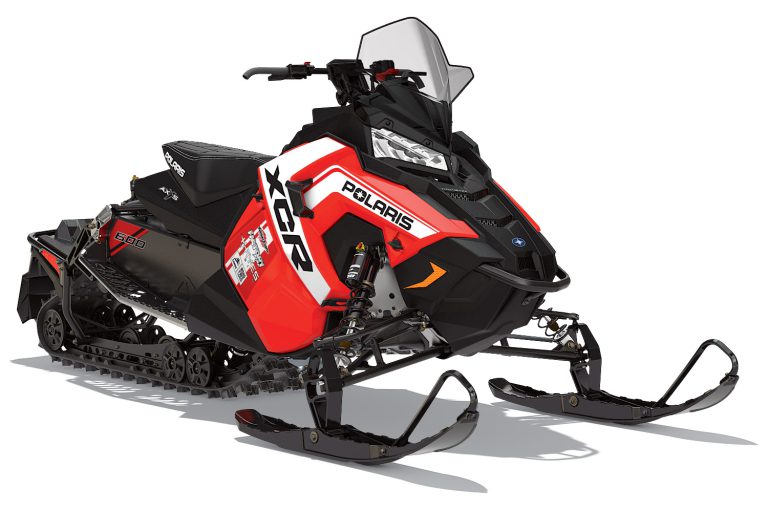
What are we talking about? First, Polaris has just introduced a 2018 line of sport-ute sleds called Titan.

There are three versions: The baseline SP 155, the cross-country focused XC 155 (Fox QS-3’s all around with the deepest track) and the Titan Adventure – a dual purpose utility and touring sled.

What makes these new Titans so attractive is the fact they are all powered by Polaris’ stellar 800HO 2-stroke Cleanfire twin with TEAM BOSS secondary clutches and dual range sub-trannies and are based on the AXYS front end design.

Traction is provided by a 20-inch-wide track with 1.8-inch lugs (XC), 1.375 (SP) and 1.5 (Adventure). The Adventure also uses trail calibrated QS-3’s front and rear while the SP uses IFP gassers all around.

The SP and XC models look for all-the-world like regular crossovers until you start to examine them closely.

It’s then you discover these are regular crossovers on steroids. They’re big sleds in the 600-lb range but because of their slick drivetrains, can really rip powder and are amazingly agile on trails – very similar to Ski-Doo’s 800 E-TEC powered Expedition Extreme.

All Titan models are extremely fun to ride and offer truly impressive and surprising performance with their quick handling, monster grunt and excellent ride quality.

WINTERIZED SPORTSMAN XP 1000

0

In this Trail Tech segment, AJ pulls out one of our DirtTrax rigs and winterizes a Polaris Sportsman 1000 XP for the final weeks of cold and snow.

Subscribe to our YouTube Channel!

Northwest Ontario Adventure

0

AJ Lester ventures on a journey to Northwest Ontario to take in the sights, soak in the culture and of course, do some snowmobile riding in the area of Atikokan and Thunder Bay.

Subscribe to our YouTube Channel!

THE SWITCHBACK REINVENTED

0

2017 Polaris Switchback Assault 144

We’re not gonna mix words here. The original Pro Ride-based Switchback Assault has not been among our fave rides. It used a 144-inch uncoupled skid without torsion springs and gave its rider an unrepentantly stiff ride. Some said it rode like a dump truck in moguls and handled like an overloaded A class motorhome in the twisties. Okay, maybe a C Class motorhome. The problem was the chassis was too much off-trail and too little on-trail to be a real dual-purpose snowmobile.

For 2017 Polaris moved the Switchback Assault into the AXYS front clip and developed a brand new skid. The changes Polaris made amount to a completely new sled and we mean more than just parts and power. We mean a new response in terms of ride and handling.

The 800 HO is a complete re-think of the original Cleanfire 800. It pushes out 160-odd-ponies using 3-stage exhaust valves and a 2.5 pound lighter crank. The engine cases and all associated hardware have been rationalized and designed for both efficiency and lightness. Case in point: The 800 CFI actually weighs one pound less than the 600! There’s an electronic oil pump for vastly improved oil efficiency and standard equipment V-Force reeds are used.

Interestingly, the lightened crank trick has been emulated in Ski-Doo’s new Rotax 850. It’s obviously a solid idea that delivers enormously improved throttle response, spool-up and corner-to-corner thrust. Keep in mind, we suspect it was this Polaris engine that motivated Ski-Doo to do an 850 instead of another 800.

The Assault’s rear suspension desperately needed rethinking. The all-new skidframe is not an RMK cast-off or clone – it’s a new generation of skidframe utilizing an ultra long front torque arm, torsion springs and an uncoupled rear arm, referred to in Polaris marketing hype as the IGX skid.

The new front torque arm, dimensionally identical to that used on the Pro-XC external shock skids (RUSH), produces over 40-percent more travel. This is not inconsequential. This travel improvement, in concert with a non-coupled rear drop link produces two important results: First, mogul absorption is remarkable, and we don’t mean when compared to the old torsion-less skid. We mean when compared to Pro-XC! Only under the worst conditions we could find was anyone able to conclusively say the Pro-XC was better than the IGX.

The second benefit of the uncoupled rear arm is deep snow mobility. The new Switchback climbs on top of untramped snow easily thanks to the increased front arm movement and the uncoupled rear drop link. Sounds like a win-win to us, but you’ll be the final judge.

You have the choice of the 1.35 Cobra or a Series 4, 2.0-inch deep lugger for traction. The 1.35 is the best choice if you’re riding on-trail more than off. The 2.0 wins if you’re riding mostly off-trail. The 2.0 is rumbly on hard pack as a result of a stiffer durometer rubber while the 1.35 is mostly transparent, not generating annoying vibes or rumble but still capable on and off-trail.

We have to commend Polaris engineers on this re-invention of the Switchback Assault. There’s a lot here that’s new to digest, all in one year. As always, we’d love to see a better stock windshield – this one’s pretty chilly. We also think a clip-on passenger seat would be a superb accessory for those who justify their purchases to a significant other.

TEST RIDE: 2017 Ski-Doo Renegade X 850

0

Mark Lester hosts this week’s Test Ride and takes out a 2017 Ski-Doo Renegade X 850 on the trail.

Subscribe to our YouTube Channel!

2017 YAMAHA SIDEWINDER B-TX

0

Big, Powerful, Innovative and Versatile. Is That Enough?

Despite its long track, the B-TX’s design target is certainly not to be a mountain sled. It’s really a deep snow sled you can take on a decent trail journey or, as it is now coined: A Crossover.

The bonus is that this sled floats powder like a 4-stroke mountain sled and its 1.75 lugs can handle some pretty decent climbs. If you go back a decade, there weren’t many pure mountain sleds with this much track – and certainly not this kind of power.

Power certainly is not an issue. The turbo allows this sled to perform consistently at very high altitudes and the steps Yamaha has taken to minimize turbo lag pay off in deep powder performance. Yes, it is heavier than a comparable 2-stroke but, for sure, there’s never any concern about a power shortage when you need to dip into the throttle when an imminent powder crisis rears its head.

One factor affecting performance is Yamaha’s choice to use a roller secondary clutch on all SideWinders. In deep snow, immediate backshifting and the quick load response of a roller will make a huge difference on the B-TX.

In heavy, damp snow with such a long track and 1.75-inch lugs, you need a clutch that can respond fast, especially when you’re carrying a lot of snow inside the sled’s suspension and track, when elevations are varying and the snow is harder to push through.

Is the BT-X the Crossover everyone will want? Probably not. After all, despite its strengths, it’s pretty expensive and the turbo market is a growing but fairly narrow sliver of the whole snowmobile market.

However, for those who want the ultimate in power, traction and versatility and can justify the cost of a very sophisticated ride, we strongly recommend this sled. It will impress you and surprise you with its abilities.